If the buyer is back with the same question within a few weeks, reopen the lost deal and write down that Lost was the mistake. If months have passed, or the need is different, create a new deal, link it to the old one and mark it as returning. Do it the other way round and two reports start lying at once: the sales cycle stretches to cover the silence, and the win rate quietly forgets a loss that really happened.
That is the whole rule. The rest of this piece is why, and how to set it up in Pipedrive with one optional field and a note.
He wrote again, and the deal is already in Lost
Clara runs a team of five. In February one of her reps, Finn, spent two weeks on a deal for a mid-size distributor: discovery call, a demo, a proposal, then a polite “we’re going with the other option.” Finn marked it Lost, picked “Chose competitor” from the list, and moved on. Nobody argued with that. It was a clean closed lost deal, and knowing when to close a deal as lost is half of what keeps a small pipeline honest.
In June the same contact emails Finn. The other vendor’s onboarding stalled, the budget is still there, can they talk again? Finn does what most reps would do. He finds the old deal, brings it back, and drags it to Proposal, because that is roughly where the conversation left off. It feels tidy. The history is in one place, the notes are there, and the deal is “back”.
Then it closes Won in August, and Clara pulls her quarterly numbers. The team’s average cycle is up. Finn’s win rate on competitor deals has gone up since March. The lost reason “Chose competitor” has one fewer entry, which is odd, because the competitor was chosen.
Nothing in the data is wrong, exactly. It just no longer describes what happened.
The figures in this story are illustrative, and the names are made up. The pattern is common, though, because reopening is the path of least resistance and nobody has written down when it is allowed.
What breaks when you reopen a lost deal
Three reports take the hit, each for a different reason.
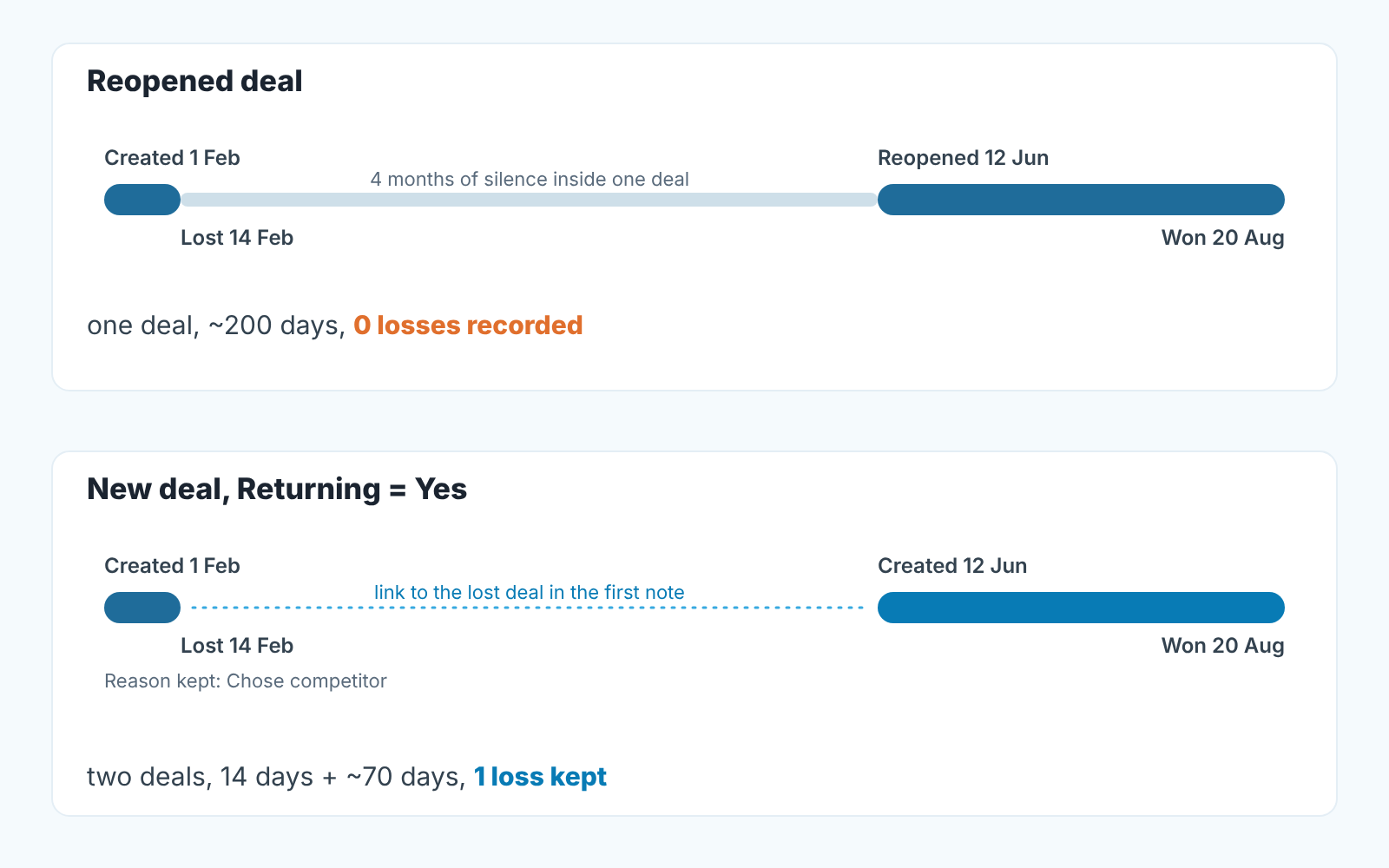
Sales cycle. If you measure cycle length from deal creation to won, as most teams and our own cycle-length guide do, the reopened deal carries four months of silence inside it. Finn’s deal was created in February, lost after 14 days, and won in August. Measured end to end, that is a cycle of roughly 200 days for a sale that took 14 days the first time and about two months the second. In a team of five, one deal like that moves the average by weeks. Pipedrive’s own deal duration report works differently: it measures the time deals spent in stages, divided by the number of deals, with won and lost deals in the default filter (Pipedrive: Insights deal duration). The help page doesn’t say how a stretch spent in Lost and then reopened into a stage is counted. Before you trust that report for reopened deals, open one of yours and look at what it shows.
Win rate. A reopened deal that later closes Won is one deal with one outcome, and the February loss drops out of the count. If you report win rate as won divided by closed, the way we set it up in the win-rate article, the denominator shrinks by one and the numerator grows by one. Two separate buying decisions, one of which went against you, become a single success. Pipedrive’s conversion report treats a won deal as having completed every stage, and a lost deal as one that stopped at a specific stage (Pipedrive: Insights deal conversion). So, once the deal is reopened and won, the report has no reason to show the February drop-off. Check one of yours.
Lost reasons. When a deal is marked lost, the reason sits in the details section of the deal’s detail view, and Insights lets you filter the deal performance report by lost reason (Pipedrive: lost reasons). That report is where the “we keep losing on price” conversation starts. Reopen the deal and win it, and the February loss stops being a data point about your competitor, whatever the field itself still shows. The reason list we covered in the lost-reasons piece is only as good as the losses it is allowed to keep.
This isn’t only a Pipedrive problem. The HubSpot community reached the same conclusion for their CRM: reopening skews lost-reason and cycle-time reporting, and a new deal with a “returning” marker is the cleaner record (HubSpot Community thread; search snippet, page not accessible). Pipedrive users say much the same in the Pipedrive Community thread “Reopen lost deal after 3 months”: don’t reopen unless it is truly the same opportunity, and if a lot of time has passed, create a new deal (also from the search snippet). We made the same call for churned customers in the win-back article.
Our position: Lost is a fact. You don’t erase a fact because the story got a sequel.
Reopen or new deal: two checks
Two checks cover nearly every case, and they go in this order.
- How long ago? Weeks: reopen. Months: new deal. Pick your own line and write it down. We’d suggest six weeks, because that is longer than a normal “let me check internally” pause and shorter than a budget cycle. A buyer who comes back inside that window never really left. A buyer who comes back after a quarter has run a new decision process, and your pipeline should show a new decision.
- Same thing? If the first check says “reopen”, ask whether they want what they were about to buy. Same product, same scope, roughly the same value: reopen, and record that the Lost was premature. Different scope, a different contact, a bigger or smaller order: new deal, even if it has only been three weeks. A different need is a different sale, the same logic we use for repeat orders.
Check one does most of the work. Check two exists for the the awkward middle, and for the rep who reads “weeks” generously.
How to mark a returning deal in Pipedrive
Honest answer first: Pipedrive has no built-in “returning” marker for deals that we could find, so this is a custom field and a habit. Custom fields are a cost in a small team, and we try hard not to add them. This one earns it’s place because without it the new deal looks exactly like a cold inbound, and the whole point is to see these deals separately.
The setup we suggest:
- One deal custom field: “Returning”, single option, Yes/No. Not required at creation. Most deals aren’t returning, and a required field that is “No” ninety times out of a hundred teaches reps to click through fields. The rep sets it to Yes on the new deal only.
- A link to the old deal in the first note. Open the lost deal through the Lost filter in the pipeline or deals list (Pipedrive: filtering for won, lost or deleted deals), copy its URL, and paste it into the first note of the new deal with one line: “Returned after Lost on 14 Feb, reason was Chose competitor. Their onboarding stalled.” The old deal keeps its lost reason in its details section, and the new deal explains why it exists. Thirty seconds of work.
- A title prefix, if you want it visible on the board. Some teams start the deal title with “R:” so returning deals stand out. We don’t, because titles get reused in reports and the prefix leaks everywhere. The field plus a filter does the job.
- For the “reopen” case, a note on the old deal. When the two checks say reopen, the rep finds the lost deal the same way, brings it back to open, and adds a note: “Reopened 3 Mar, Lost on 14 Feb was premature, buyer paused for sign-off.” Pipedrive’s help center documents reopening only for deleted deals (Pipedrive: restoring deleted deals). The pages we checked on lost deals describe closing a deal and finding it afterwards, but not how to bring it back or what that does to the lost reason and stage. So check what your own account records in the deal’s changelog, which lists changes to stage, value, label, contact, expected close date and custom fields (Pipedrive: deal detail view). Whatever it keeps, the note is your record.
Then the filter. Create a saved deals filter “Returning = Yes” and share it with the team. That is the view Clara opens once a month. It answers a question no standard report does: how many of our wins this quarter came from buyers who had already said no once?
Which reports to read with a caveat
Once you keep the loss and start the new deal the three reports from earlier go back to telling the truth. There is a price. Your win rate now includes a loss that, in hindsight, you recovered. Fine, that is what happened. If someone in leadership wants a “net” win rate with returns folded in, build it from the Returning filter and show it next to the honest number, not instead of it.
Two caveats to keep in writing, next to your metric definitions:
- Lost-reason reports for any period before you adopted the rule contain reopened deals you can no longer see. Don’t compare “Chose competitor” counts across that boundary without saying so.
- Sales cycle for returning deals is measured from the new deal’s creation, not from first contact. The relationship is older than the deal, and that’s fine: cycle length is about how long a decision takes, not how long you have known someone.
A returning deal also needs a different kind of attention than a fresh one. The buyer has already said no to you once, so a week of silence after the second proposal means more than it would on a new lead. We build SalesBond, a sales management layer on top of the CRM a team already uses; we started with Pipedrive. Its Deal Health checks flag deals with no next activity scheduled or no progress, and a manager who keeps the Returning filter open next to that list sees quickly which second chances are going quiet. If you want to know how many deals in your own pipeline are sitting without a next step right now, check your CRM with SalesBond.
When Lost was the mistake
Sometimes the honest answer is that the deal should never have been closed. The rep marked it Lost on day ten because the buyer said “not now” and the pipeline review was the next morning. Three weeks later the buyer calls back with a purchase order.
That is not a returning customer. That is a premature Lost, and the fix is to bring the deal back, add the note from step four, and talk about why “not now” got a Lost instead of a pushed close date. We wrote up the “not now” case separately in the lead-recycling article. Short version: a parked deal and a lost deal are different records, and only one of them belongs in the lost-reason report.
Clara’s team now has a line in the pipeline review for this. Any reopened deal from the last month gets thirty seconds: why was it closed, who brought it back, does the note exist. Most months it is one deal, sometimes none. The point is not to catch anyone. It is to keep “Lost” meaning lost, so that when the report says you lose on price, you can believe it.