When a buyer sends a price match request, do not answer it with a number. Lay both quotes out on the same set of lines, mark what is in theirs and what is missing, send the gaps back to the buyer as written questions, and talk about price only on the lines that actually match. A total hides the composition. Until the composition is on the table, any discount you offer is a negotiation against yourself.
They sent a PDF with a smaller number on it
Ivo has been working a deal for six weeks. Demo done, proposal sent, the champion is on his side. Then on Tuesday the buyer’s procurement lead, Jana, forwards a competitor’s quote. The total is about 20% below his. Her email is two lines: “We prefer you, but we need you to come to this number. Can you match by Friday?” The figures are made up.
Ivo does what most reps do. He opens a spreadsheet, puts his total next to theirs, and starts working out what he could cut. By lunch he has a version that gets close if he drops onboarding to two weeks and swaps the named support contact for a shared inbox. He is about to send it when his manager asks a question he cannot answer: what did the other vendor quote for onboarding?
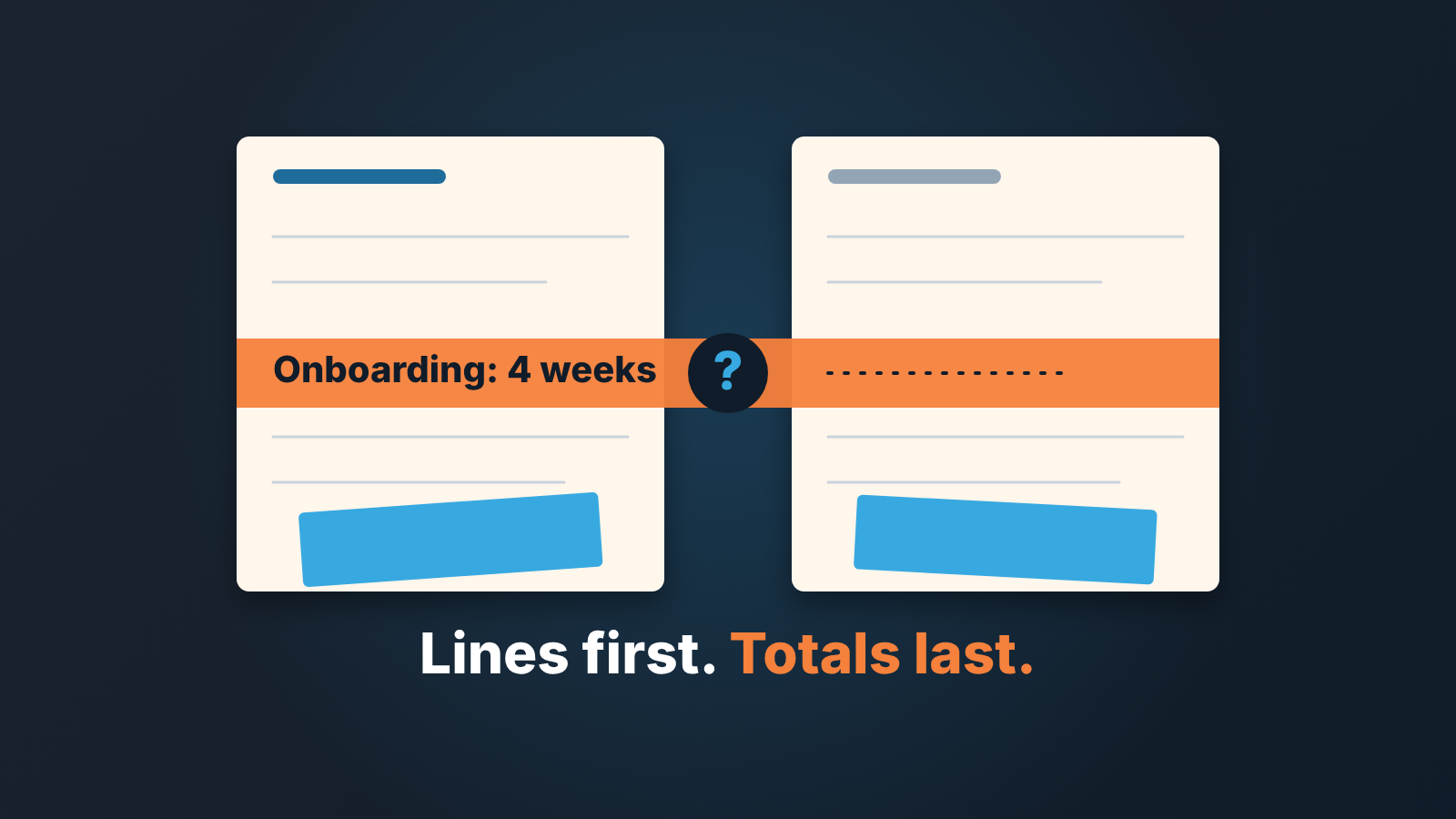
He does not know. He has read the competitor’s PDF three times and he does not know, because the PDF does not say. There is a line called “Implementation” with no duration and no scope. There is no line for support at all. Payment terms are there, net 60, which is kinder to the buyer than ours. The one thing the PDF is clear about is the total, and that is the one thing Ivo has been staring at.
We think this is the most common shape of a price match request in small B2B sales: a thinner offer for a smaller thing, with a total that only looks like a direct comparison. Jana is not hiding anything. It is on Ivo to show her what the document leaves out.
Why the total in a price match request tells you nothing
Two vendors who describe term, scope and support differently will land on different totals even if their list prices are identical. The buyer, reading two totals, has no way to see that.
So the first move is not a counter-offer. It is to refuse the comparison as given, politely and in writing: “Before we talk about the number, I want to make sure we’re comparing the same thing, because I can’t tell from their document what’s included.”
MTD’s advice on this request is the same at the top level: find out whether the service, the warranties and the support are actually comparable before you move on price (MTD Sales Training, “Should You Match Your Competitor’s Price?”). Where most advice stops is the word “comparable”. It stays a slogan: compare apples with apples. What follows is the fruit bowl.
If the buyer pushed on price on the first call, before any quote existed, that is a different conversation.
The lines we put both quotes on
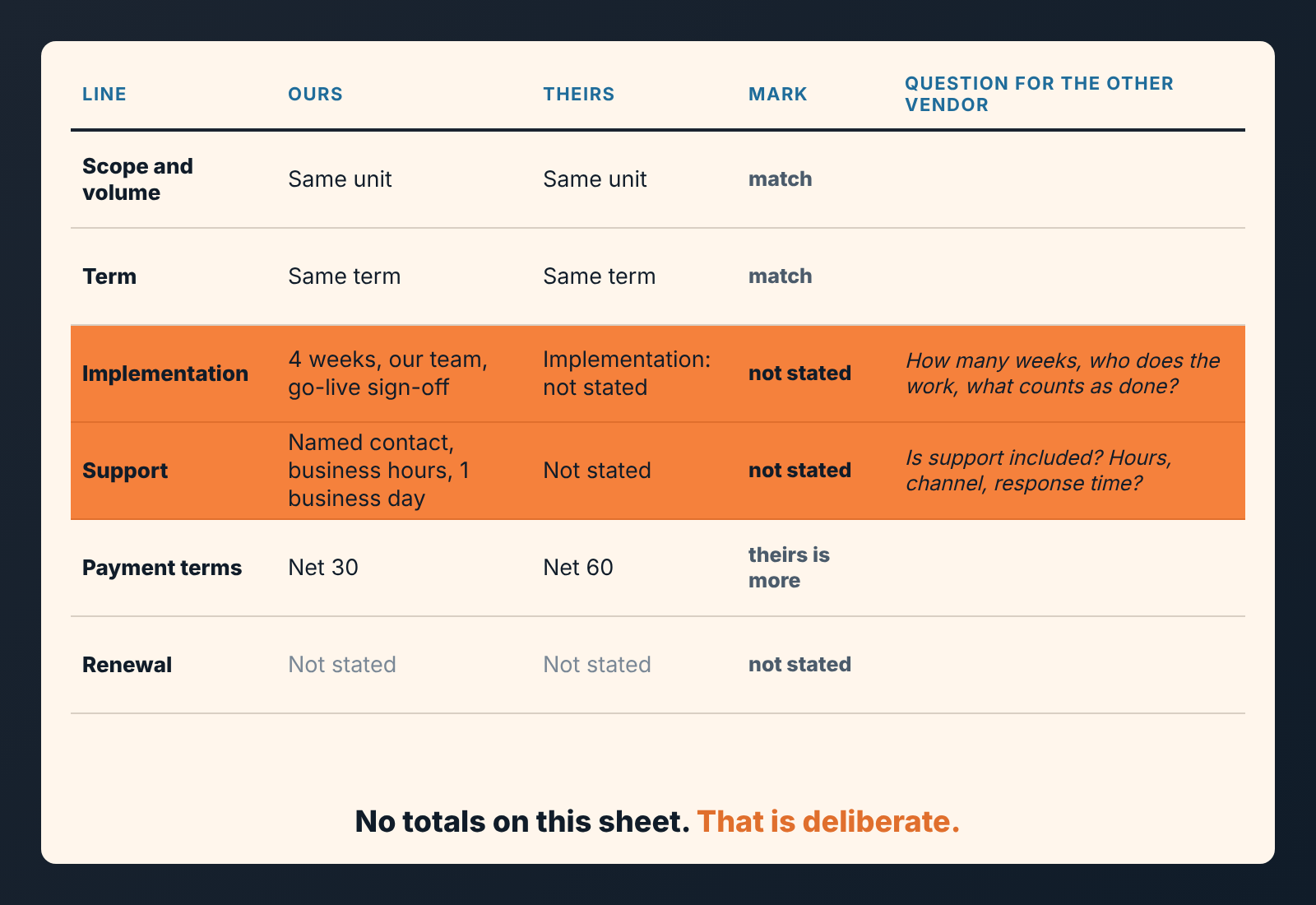
Take a blank sheet, two columns, one row per line below. Fill in ours from our quote. Fill in theirs from their PDF, and only from their PDF. If the PDF does not say, write “not stated”. Do not guess from what you know about the competitor, and do not fill it in from what Jana says on the phone. Written document, written lines.
- Scope and volume: seats, sites, records, whatever the unit is. Convert to the same unit before you compare.
- Term. A longer term with a lower monthly number is not a lower price.
- Implementation, meaning duration, who does the work and what “done” means. The row Ivo could not fill.
- Support: hours, channel, a named person or a queue, and response time if either quote commits to one.
- Payment terms. Cash timing is part of the price, and buyers who care about it will tell you.
- Renewal: price lock, cap, or silence.
Six rows is usually enough for a software or services deal in this size range. Add a row when a line in either quote has no home, and nowhere else.
What if there is no document? Sometimes the buyer only has a number from a call, or won’t share the PDF. Then the right-hand column stays empty, and you say so. Ask for the quote in writing or, failing that, for the buyer’s own list of what it includes. Until one of those arrives, the number is a rumour, and you do not discount against a rumour.
Then mark every row with one of four words: match, ours is more, theirs is more, not stated. No shading, no scoring. A manager who has not seen the deal should get the shape of the comparison in ten seconds, and so should the buyer when you send it.
The row that is not in their quote
This is the row that decides the deal, and the one most reps handle worst. The instinct is to treat “not stated” as “not included” and say so: “Their quote doesn’t even cover onboarding.” Sometimes that is true. Sometimes the competitor includes onboarding in the licence and just did not write a line for it, and now Ivo has told the buyer something false about a document she has in front of her. He loses credibility on the one row where he had the advantage.
The rule we use: a row marked “not stated” is a question, never a claim. It goes back to the buyer in writing, worded so she can forward it to the other vendor without editing. Ivo had two open rows. For implementation he asked how many weeks, who does the work and what counts as done; for support, whether it is included at all, and on what hours and response time. Payment terms needed no question: theirs were simply more generous, and he said so.
His cover note, more or less: “I’ve put both quotes on the same lines. Two rows I genuinely can’t read from their document, so I’ve written the questions rather than assume. Once we know those, I’ll come back on price, line by line.”
Now the price conversation is about rows, not a percentage. The competitor has to answer in writing, and whatever they answer either moves their total or confirms the gap. Jana hears it from them, not from you.
The buyer may not forward the questions. She may just say “assume it’s included.” Write that down as her assumption, mark the row “theirs is more (per buyer)”, and carry on. You are still not guessing. You are recording who said what.
Where this lives in Pipedrive
A sheet in Ivo’s inbox is worth nothing to his manager on Friday and nothing to whoever picks up the the renewal in a year. We keep two things on the deal, and only two.
First, one note on the deal with the comparison in it: the six rows, the four marks, and the questions sent. Date it. When the answers arrive, add a second note rather than editing the first, so the sequence stays readable. Keep it apart from the log of your own quote revisions: our quote versions are about what we changed, this note is about what they sent.
Second, one custom field on the deal: Competitor quote total, monetary. Pipedrive lets you add custom fields to deals, and adding them takes the right global permissions, so on a small team its usually the admin’s job (Pipedrive: custom fields). Put the rule where the team will see it, in the field description if you use them: “Total on the competitor’s written quote. Blank if we have not seen a document. Phone numbers don’t count.”
One field, not one per row. Rows change per deal, and a field that is empty half the time teaches reps to ignore fields. Add it as a column in the deals list (the gear icon, then “Choose columns”, per the same article) and a manager can scan every open deal with a competitor total on record next to our value. Close numbers and a stage that has not moved in two weeks: that is the Friday conversation. If you already keep an objection log, “competitor’s quote” goes there too, and this note is what sits behind it.
This is our own field and our own habit, not a Pipedrive feature.
A disclosure, since we are on the Friday question. We build SalesBond, a sales management layer on top of the CRM a team already uses; we started with Pipedrive. A deal stuck in a price comparison looks fine for a while, right up until nobody schedules the next step. Deal Health checks every deal against its rules, activity and progression among them, and shows the specific problem with what to do about it, so the price-match deal that has gone quiet surfaces before the quarter ends. Check your CRM with SalesBond.
When the sheet says they are right
Sometimes you do all of this and the rows come back as six matches with a lower total on their side. What it changes is what Ivo says next.
He does not say “we’ll match it.” Matching a total is a discount with no reason attached, and it teaches the buyer that the first PDF gets 20%. If he moves at all he moves on one named row and gets something back for it, which is its own topic: concessions and what to ask for in return.
And sometimes the sheet says they are the same product, cheaper, and the buyer wants that. Then the honest answer is that we lose this one on price, and we write the lost reason as “price, like for like, competitor quote on record” rather than “price”. The second version is useless in a quarterly review. The first tells you whether your list price is wrong or your composition is.
A buyer running a scored evaluation of several vendors is in a bake-off, not a price match.
So next time a rep comes to you with “they want 20% off, can I?”, answer with “which row?” If the rep cannot name the row, the discount is not ready to be approved, and neither of you knows yet what you would be paying for. Our discount approval policy gets there from the other side: anything above the limit is approved in a deal note, with a reason. Once the row is named, check what a discount does to margin before you counter.