A sales bake-off (buyers also call it a vendor bake-off) is a deal where the buyer tests you and two or three competitors side by side and picks from a scoring table. Decide whether to enter by asking three questions: are the criteria written down, how many vendors are in, and who makes the call. Ask to see the criteria and add one of your own. Then run the deal in Pipedrive with a competitors field, the decision date as the expected close date and every evaluator added as a participant, so that when it ends you have a recorded reason instead of a feeling.
Lusha defines the bake-off as “an evaluation process where your potential customer pits you head-to-head against other providers” and warns that it “can take a lot of time, energy, and resources” (Lusha: how to win a sales bake-off). The second half is why a small team needs a rule for entering before it needs a plan for winning.
There are three of us
Augustin runs an eight-person digital marketing agency (example, with invented numbers). On a Tuesday he gets an email from Jolanta, head of marketing at a regional retail chain. She is polite and organized. Attached is a spreadsheet with twelve criteria, each with a weight, and three vendor columns. The chain will run a two-week evaluation, every vendor gets the same brief and the same data, and the team will score.
Augustin reads the twelve rows twice. Paid social reporting, yes. Turnaround on creative, yes. Then: “native integration with our loyalty platform,” “dedicated account team of three or more,” “offices in two or more regions.” The agency has none of those and never claimed to. What it does have, a track record of cutting cost per store visit for chains exactly this size, is not in the table at all.
He has seen this table before, in a different font. One of the other two vendors wrote it, probably months ago, and Jolanta adopted it because it was the the only structured thing anyone handed her. Nobody is cheating. The criteria simply describe the vendor who wrote them.
That is the shape of most bake-offs we see in small-team pipelines. The relationship with Jolanta will not decide this deal. A table will, and the table arrived before you did.
Three questions before you say yes to a bake-off
If you have read our piece on bid or no-bid for RFPs in Pipedrive, you know we like a written gate. A bake-off is the informal cousin of an RFP: no document and no procurement deadline, so a full scoring gate is too heavy. Three questions do the job, and you can ask them in your first reply to the buyer.
- Are the evaluation criteria written down, and can we see them? If they exist, you learn what you are up against. If they do not, you have just been handed the chance to help write them.
- How many vendors are in the evaluation? A snippet from a Technoledge article in the search results suggests two vendors is the ideal shortlist and more than three is a reason to walk away. We could not open the page, so treat the numbers as one practitioner’s view. Our own line is simpler: the more columns in the table, the more the decision is about price and checkboxes, and the less it is about you.
- Who makes the final call, and will that person be in the room? A bake-off scored by five people and decided by a sixth who saw none of it is a different deal from one where the decider does the scoring.
The rule we use: no clear answer to two of the three, and you either stay out or enter with a condition. The condition is usually “we will take part if we can see the criteria before day one.” Write it in the Pipedrive note and say it out loud to the buyer. Sometimes the other contender is not a vendor at all: when the buyer says they will build it themselves, the questions are different.
Ask for the criteria, then add one of your own
The Revenue Architect, writing about bake-offs for AI software, says the way to handle one is to get into “consultative mode by helping set the rubric” (The Revenue Architect: how to handle a competitive bake-off; the rest is paywalled, so we work from the open part). The open part has four steps: use a rubric to set the evaluation criteria, position yourself against those criteria, make the evaluation process easier for the buyer, and keep the evaluators focused on the criteria. Or, as we’d put it, on the criteria and not on the demo theater.
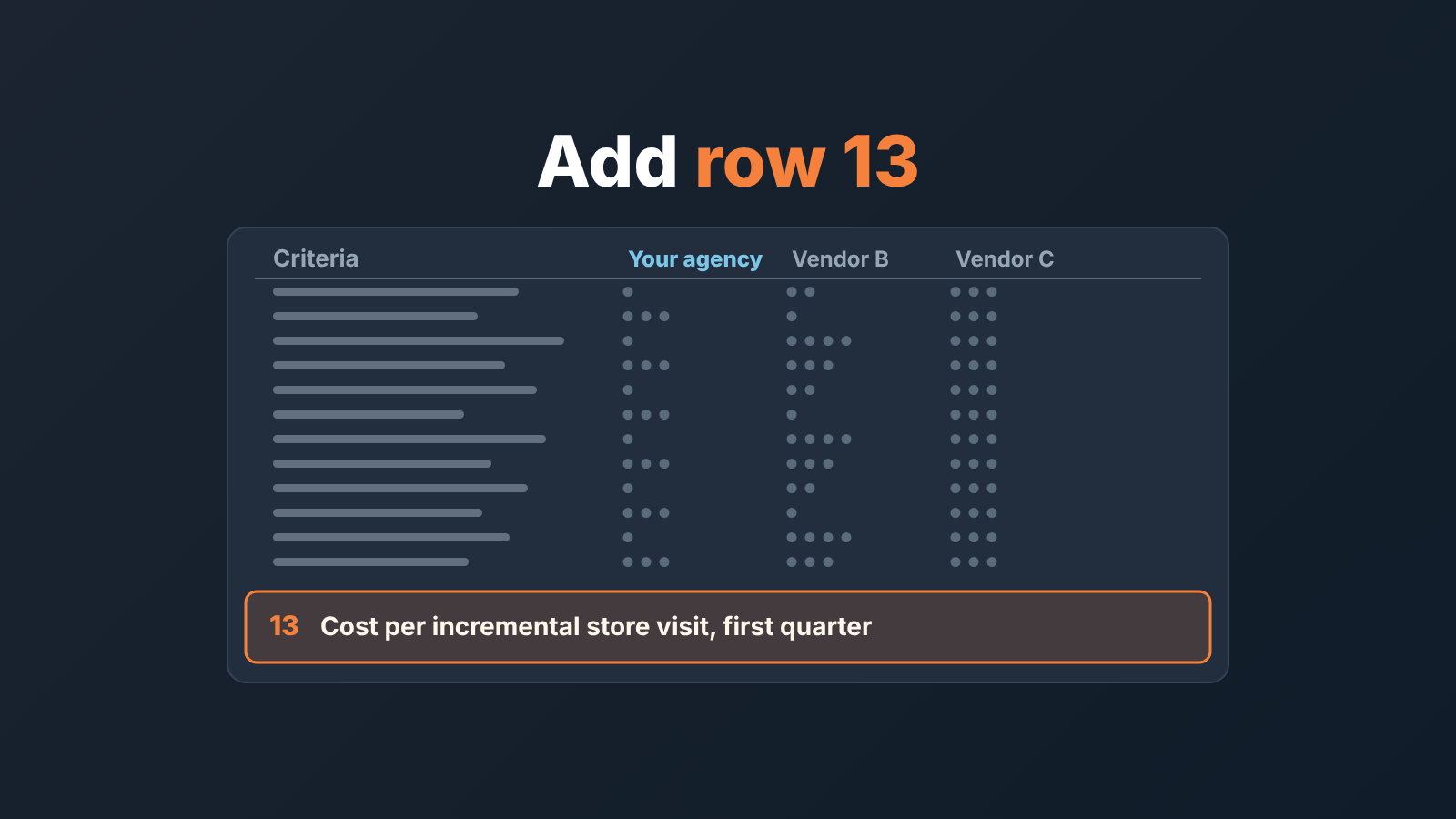
You will not get the loyalty-platform row removed. Asking for that looks like special pleading, and Jolanta will remember it. What you can do is add a row.
“We looked at the twelve criteria and they cover the service side well. One thing we’d suggest adding, because it is what you’ll be judged on internally: cost per incremental store visit over the first quarter. Happy to be scored on it alongside everyone else.”
That reply accepts the table, which earns trust, and slips in the criterion you win on. If the buyer says no you have learned how open the process is, and that goes into the deal note too.
Pick a criterion the buyer can measure in two weeks, or at least estimate from your past work. A row nobody can score during the test gets dropped on scoring day.
What this looks like in Pipedrive
A bake-off produces a debrief only if the deal was recorded like a bake-off while it was live. Here is the minimum we set up. The first time, it takes about ten minutes.
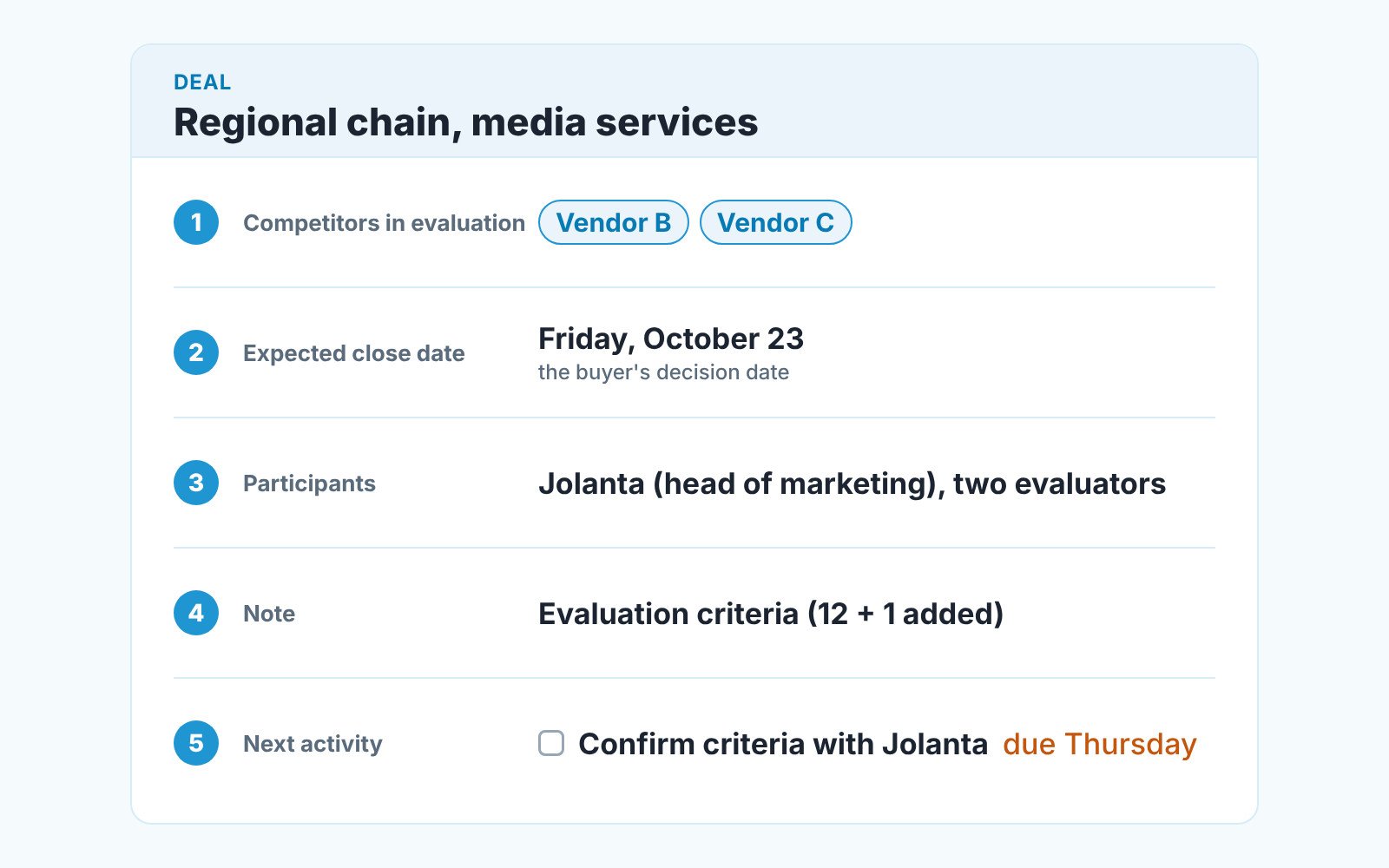
- A custom deal field, “Competitors in evaluation” (how to add one). If you already keep a Competitor field for sales battlecards, the two do different jobs: that one records who beat you, this one records everyone who was in the evaluation. Later you can filter on it: every deal where a given competitor was in the room, won or lost.
- Every evaluator as a participant. Pipedrive deal participants let you “add additional people to a deal without losing the one clear point of contact” (Pipedrive: participants). Jolanta is the linked person. The two people who will actually score the test go in as participants, with thier roles in the note. If one of them is quietly pushing for you, our piece on sales champions applies. If you only know Jolanta’s name on day one, that is a finding in itself, and our article on single-threaded deals says what to do about it.
- The buyer’s decision date as the expected close date. Not the end of the test, not your guess. Jolanta said “we decide the Friday after the test ends,” so that Friday is the date. If she didn’t give one, ask, and until she does, keep the date honest rather than hopeful.
- The criteria in a note: all twelve rows plus the one you added, with the weights if you got them. Paste the buyer’s wording, not your paraphrase: the debrief needs exactly what was promised to be scored.
- A next activity, “Confirm criteria with Jolanta,” due before the first test day. If it gets marked done with a “yes, agreed,” you are in a real evaluation. If it slides twice, the criteria are not agreed and your position in the table is weaker than it looks.
A field, a date, participants, a note, one activity. The payoff comes at the end.
The two weeks of the bake-off: what to do, what not to do
For most of a bake-off your deal is silent. The buyer’s team is testing, and your rep has nothing to log except “waiting.” Two things fill that silence badly and two fill it well.
Do not talk about the other columns. The Revenue Architect warns against “knocking the competition,” and we agree for a plain reason: Jolanta picked those vendors, so criticizing them is criticizing her shortlist. If an evaluator asks how you compare, answer on the criteria. “On criterion seven we do X; I’d rather you test it than take my word.”
Do not offer a discount first. Lusha’s advice is to sell on value rather than price and stay out of a discount war, and the Revenue Architect puts it sharper: “price is seldom the top criterion for buyers. You’re just negotiating against yourself.” Price is not one of the twelve rows until a vendor makes it one. If the buyer raises it, answer with the added criterion: what the incremental store visits are worth against the fee.
Do keep the evaluators on the criteria. One short midweek question to each participant, logged as an activity: which criteria have you been able to test so far? It also catches the case where the row you added is quietly not being tested.
Do watch the deal, because silence is where it dies. We build SalesBond, a sales management layer on top of the CRM a team already uses, we started with Pipedrive. Its Deal Health checks run more than 20 rules across activity, stage and data, and a bake-off deal with no recent activity and no next step is exactly what they flag. It does not know who is winning the table. It does know the deal has gone quiet, which in a bake-off is your cue to ask Jolanta what the evaluators have tested. Check your CRM with SalesBond if you keep that list by hand today.
Won, lost, or nobody: write down why before you feel anything
Decision Friday comes. Whatever the outcome, it gets the same ten minutes in Pipedrive before anyone on the team talks about it. If you won, ask Jolanta which rows decided it and write the answer in the deal before the celebratory message hits the team channel, because by Monday it will have become “we were just better.” If you lost, the lost reason names the competitor and the criterion, not “price” or “went with another vendor.” Our pieces on lost reasons in Pipedrive and win-loss analysis for small teams cover the list and the follow-up call, and the criterion the competitor won on goes onto their battlecard.
The third outcome is the one the “how to win” articles skip. The chain finishes the test, thanks everyone and buys nothing.
We suspect it is more common in bake-offs than in single-vendor deals, because a buyer who could not agree on criteria often cannot agree on a winner either. Its a real outcome and it gets a real lost reason: “no decision,” with a note on which of the three questions had no answer. Our article on no-decision deals has the re-engagement timeline. For a bake-off we set the re-check at the buyer’s next budget cycle.
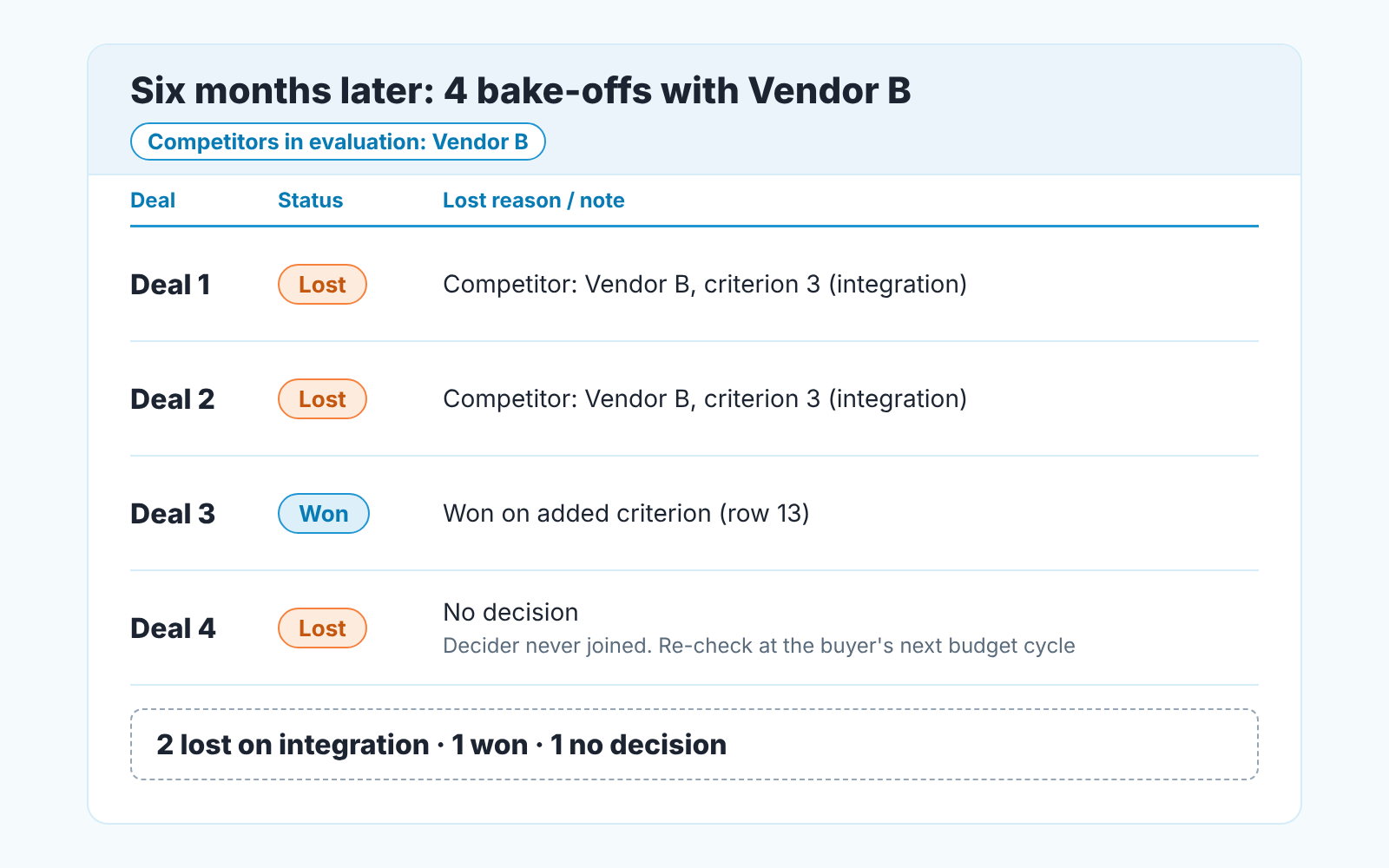
Here is where the field earns its keep. Six months and four bake-offs later, Augustin filters deals on the Competitors in evaluation field for Vendor B. Two losses, both on the integration row. One win, on the criterion he added each time. One no-decision, where the decider never showed up. That is a page in a battlecard, a reason to decline the next evaluation where Vendor B has written the table, and a very specific thing to say to the next Jolanta. None of it exists if the four deals were logged as “Proposal sent.”