A deal ends in “no decision” when the buyer picks neither you nor a competitor and stays with what they already have. Usually for one of two reasons: they never saw a cost to leaving things as they are, or they saw it and still could not bring themselves to choose. In an open Pipedrive deal that shows up long before the lost reason does: one contact on the deal, a next step with no date on it, a close date that keeps moving, and a decision process the rep assumed rather than confirmed. Check those before the deal reaches your proposal stage, because after it the fix gets expensive.
The deal that was “going well” until it wasn’t
Every pipeline has one. The deal moved through the stages on time, the demo landed, the champion said all the right things, the proposal went out, and then nothing. Not a no. The buyer answered the first follow-up, answered the second a week later, and the thread went quiet. Three months on you mark it lost and reach for a lost reason. “Competitor” feels wrong, because there was no competitor. “Price” feels wrong, because nobody argued about price. So it gets “Other”, or “Timing”, or it stays open with a close date pushed into next quarter and a rotting flag nobody looks at.
That deal did not die at the end. It was never going to close, and the evidence sat on the deal record the whole time. Why buyers freeze has been written about well elsewhere. What we care about here is what freezing looks like inside the CRM, while you can still do something.
One thing to settle first. “No decision” is an outcome, the way “lost” is an outcome, and behind it sit at least two causes that call for different moves from the rep.
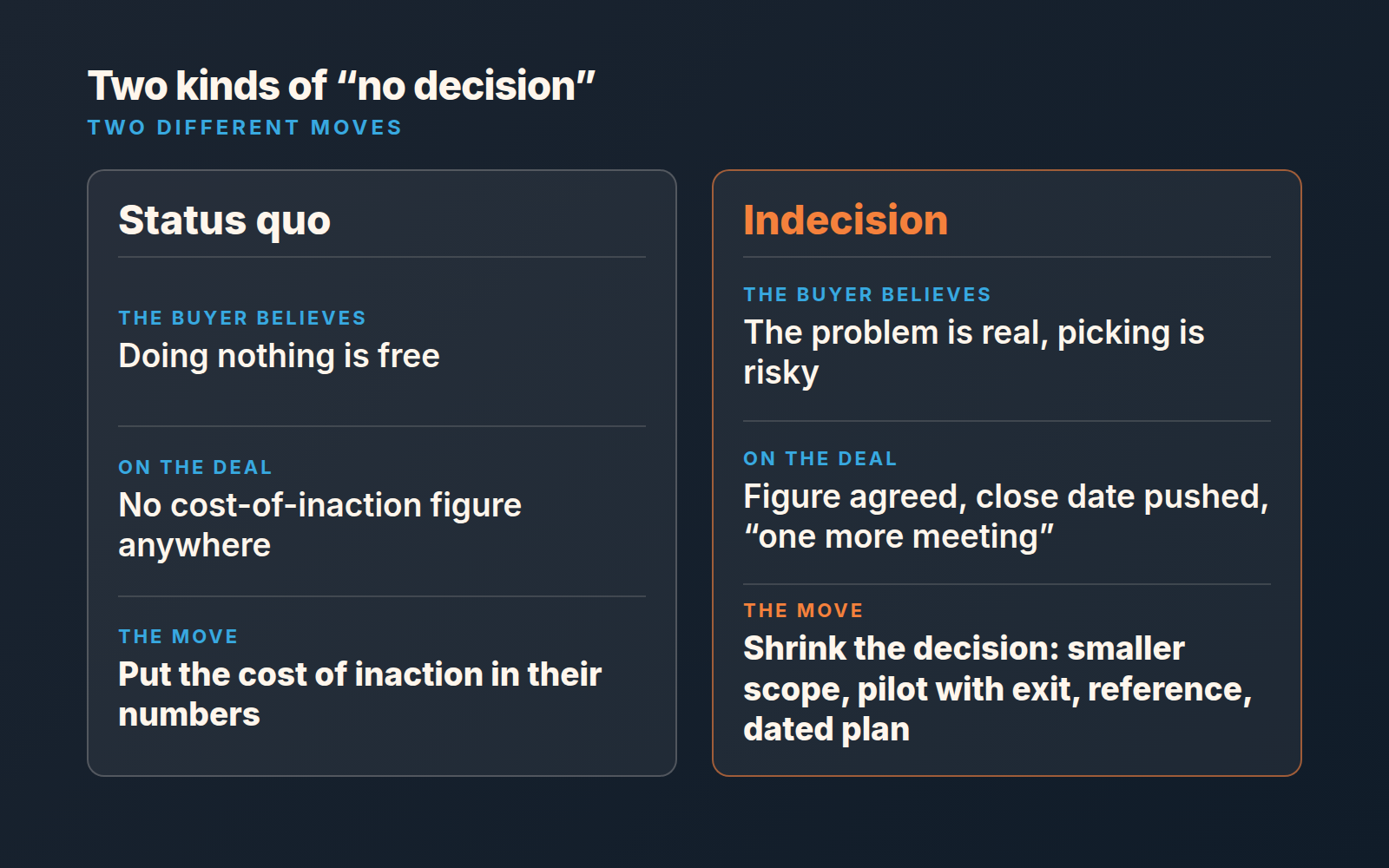
Two kinds of “no decision”, two different moves
The split we use comes from Matthew Dixon and Ted McKenna’s work on buyer indecision. As ecosystems.io cites it from their HBR article of June 2022, roughly 44% of no-decision losses are buyers who preferred the status quo and 56% are buyers who wanted to change and could not decide (ecosystems.io). We have not read the original HBR piece, so take the split as the authors’ estimate. The exact percentages matter less than the shape: the second group is at least as big as the first.
How big the whole problem is depends on who you ask. The same ecosystems.io post puts no-decision at 40 to 60% of lost deals, citing The Jolt Effect. Downtoat.co quotes a Gong analysis of executive sales cycles at 51% lost to the status quo against 17% lost to competitors (downtoat.co). Sources differ, so we would not put one number on a slide. Even the low end of that range is a big share of lost deals, and in the Gong figure the status quo beats competitors three to one. That is enough to act on.
The status quo buyer does not believe doing nothing costs anything. They may like your product. They just have a dozen other things that hurt more this quarter. The move is the one from Gap Selling: get the cost of inaction into the buyer’s own numbers, and get it on the deal in writing. We covered the fields for that in Gap Selling in Pipedrive, so one link and no repetition here. Some of these end not in silence but in an in-house build instead of a purchase.
The indecisive buyer is different and gets the wrong treatment most of the time. They have agreed the problem is real. They may have even agreed on the number. And they still ask for one more meeting, one more reference, one more version of the proposal. The standard advice is to strengthen the value story. We think that makes it worse. A bigger promise is a bigger decision, and a bigger decision is a bigger chance of being the person who got it wrong. What helps is making the decision smaller: a narrower first scope, a pilot with a written exit, a reference customer who looks like them, a plan with dates the buyer can point to when thier boss asks what they signed up for. Many of these deals begin as a friendly think-it-over stall at the end of a call, which is the cheapest place to catch it. In a trial, a second request to extend the trial usually shows the same thing: more time will not produce a decision the first extension did not.
You can usually tell which buyer is in front of you from the deal’s history. If nobody has ever written down what doing nothing costs this buyer, assume status quo. If that number is on the deal, the buyer agreed with it, and they still want another call, you are looking at indecision.
What an open Pipedrive deal already tells you
Open a deal that has reached the middle of your pipeline and check four things on the record: how many contacts are on it, whether the next activity has a date, how many times the expected close date has moved, and whether there is a note on how the decision gets made. Two minutes. Skip the email thread.
Start with the people on it. If the deal has one contact, that person is almost always the enthusiast who took the first call, and RAIN Group lists exactly that, one enthusiastic contact without access to the full buying group, as one of the early signals of a no-decision loss, alongside an economic buyer who was never in the conversation (RAIN Group). One name on a deal past the middle stage tells you who will decide, and the answer is nobody. We wrote about the mechanics of fixing that in single-threaded deals, so here it is just the check.
Then the next activity. Is there one, does it have a date, and what is it? RAIN’s list ends with “the next step was another meeting, not a commitment”, and that matches what we see. A “follow up” scheduled for Friday with no agenda is really a reminder to ask whether the buyer is still alive. The step that counts is the one the buyer takes: sends the usage data, gets you thirty minutes with finance, confirms the pilot dates. If every activity on the deal is something the rep does, the buyer has not moved since the demo. How we set up the field so it carries a real step is in next activity in Pipedrive.
Log what the buyer actually does as buying signals on the deal, and a stretch with none is the early warning, long before the close date moves.
Then the expected close date and how many times it has been pushed. One push with a note from the buyer is life. Three pushes with no note is a deal that has already ended and has not been told. What to do about the repeat pushers is in pushed close dates. The line between a slow deal and a dead one is drawn by the buyer’s behavior, and stalled vs dead deals is where we drew it in detail.
Last, look for a note about how the decision gets made. Who signs, what they need to see, by when. If that note exists and reads like the buyer said it, good. If it reads like the rep worked it out from the org chart, the process is assumed, which is another of RAIN’s signals, and so is impact discussed in general terms and never quantified. A one-page mutual action plan is the cheapest way to turn an assumed process into a confirmed one, and the buyer’s reaction to being asked for one is itself a signal.
A disclosure, since this part of the page is where a tool can help. We build SalesBond, a sales management layer on top of the CRM a team already uses; we started with Pipedrive. Three of the four checks above are mechanical. The decision-process note still needs a person to read it. Check your CRM with SalesBond.
A short pre-mortem for deals past the middle stage
A pre-mortem is a question you ask before the loss, not after: it is three months from now, this deal ended in no decision, and we are explaining why. Five questions do most of the work at a Monday deal review. The order matters less than the rep answering in specifics.
- What happens to this buyer if they do nothing for a year? If the answer comes back in adjectives, the deal is a status quo loss waiting to be dated.
- Who, besides our contact, has told us this is a priority? A name, not a title.
- What has the buyer committed to doing before our next meeting?
- Has anyone on their side described, in their words, how this decision gets made and who signs?
- If they said yes tomorrow, what is the smallest thing they would have to be right about? This is the indecision question. If the rep cannot answer it, the buyer cannot either, and that is why they keep asking for one more meeting.
The cleanest answer to question five is often a pilot with written success criteria, and pilot deals that skip the criteria are the ones most likely to end in no decision.
We keep the list short on purpose. A longer one turns deal review into an interrogation and reps stop bringing the deals that need it. The questions that cover the rest of the deal, forecast and buyer action included, are in deal review questions.
Counting them: a separate lost reason and what it does to win rate
You cannot reduce what you file under “Other”. Give “No decision” its own lost reason in Pipedrive and keep it apart from “Competitor” and “Price”, because the coaching for each is different and a mixed bucket hides which one your team has. How to structure the reasons list without letting it grow to thirty entries is in Pipedrive lost reasons; the one addition this article asks for is that single reason, used consistently.
The survey data shows how stubborn this is. In RAIN Group’s research on 2026 sales challenges, 28.2% of respondents say losing deals to no decision or the status quo is very challenging at the organization level, and 40.8% put reducing no-decision losses in their top three priorities. In 2023 only 15% said their no-decision losses had decreased; in 2026 that rose to 21% (RAIN Group). Our reading is simple: a team that has not separated the number cannot tell whether it is moving.
Once the reason exists, your win rate becomes two numbers, and both are useful. Take a hypothetical quarter with round figures: 50 deals closed and 15 won, a 30% win rate. Of the 35 lost, 20 went to no decision and 15 to a competitor, price or something else the buyer actually chose. Set the 20 no-decision deals aside and you have 30 closed deals with the same 15 wins, a 50% win rate.
The 30% is your pipeline’s conversion, the one you forecast with. The 50% is how you do when the buyer actually picks, the one you compare against competitors with. Both are true, and the whole distance between them comes from deals nobody chose. Your no-decision rate is no-decision losses divided by all closed deals: 20 of 50, or 40%, in this example. If that rate climbs from one quarter to the next while the 50% holds, the problem is in discovery, not in the demo or the proposal. How to pull both numbers from Pipedrive’s conversion report is in sales win rate in Pipedrive.
One more habit that pays for itself: when you mark a deal lost to no decision, leave it in the stage where the buyer stopped moving rather than dragging it to the last stage first. A no-decision report by stage tells you where in your process buyers go quiet. If yours go quiet right after the proposal, that is usually a polite way of saying the proposal went out before the decision process was confirmed.
When to stop chasing
There is no rule that makes this comfortable, so here is ours. If the buyer has not done anything on their side in thirty days, no new name has appeared on the deal in that time, and the close date has moved twice with no reason from the buyer, the deal is marked lost with “No decision” and a one-line note saying which kind it looked like. The rep did not fail. The deal is now data, and data about where buyers freeze is worth more to next quarter than a hopeful open deal is to this one. We covered the broader case for closing early in when to close a deal as lost.
Keeping it open “just in case” costs more than it looks. It sits in the forecast at a probability it has not earned, it sits in the rep’s head as a maybe, and it teaches the pipeline report to lie. Mark it lost, keep the the contact warm with something useful once a quarter, and reopen it the day something changes on their side: a new executive, a budget line, a failed project with the status quo. That is the version of “no decision” that comes back. The one that stays open and quiet never does. An acquisition mid-deal is a change of the same kind, but it calls for its own re-qualification before you reopen anything.