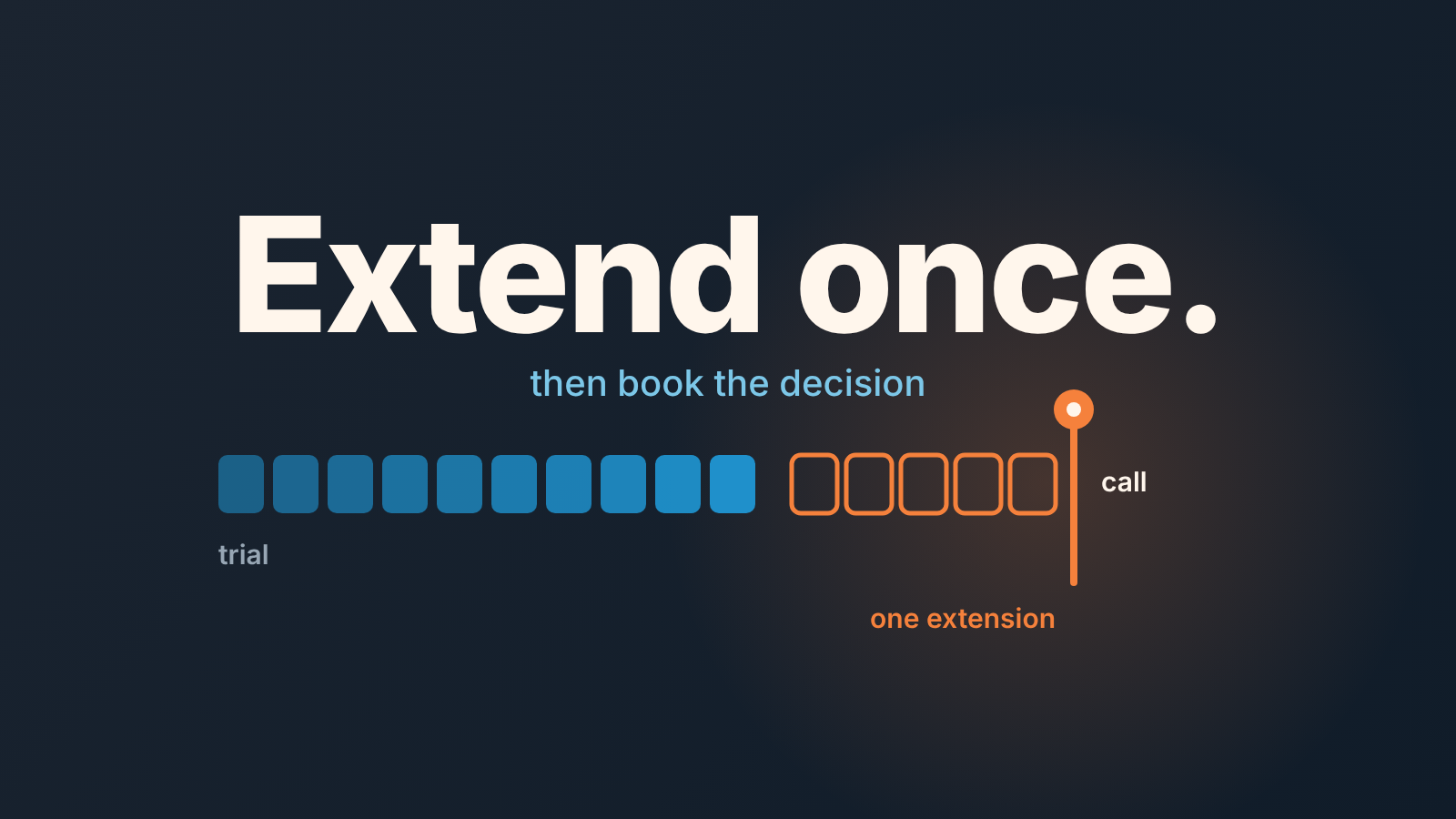
When a prospect asks to extend the trial, extend it once, for a fixed number of days, and only together with three things: the reason they ran out of time, what both sides will count as success by the new date, and a decision call already in the calendar. In Pipedrive, write the new end date and the reason into the deal, so the extension is visible to anyone reading the pipeline. A second request to extend is not a request to extend. It is a deal with no decision behind it, and it should be counted as one.
Week three, and the account is empty
Here is the version of this we see most often. Imran runs a five-person team selling a scheduling tool with a 14-day trial (an example; the numbers are made up). Paula, an operations lead at a logistics company, signed up on a Monday, had a good first call on the Wednesday, and said she would get her dispatchers into the account the following week. On day 13 she emails: “Could we get another two weeks? We haven’t had a chance to really test it yet.”
Imran opens the account. Paula logged in twice. Nobody else from her company has logged in at all. The integration she said she needed was never connected. There is nothing to test the second half of, because the first half never happened.
The reflex is to say yes. Saying yes is free, it is friendly, and it keeps the deal open. And that last part is exactly the problem. The deal stays in the pipeline at the same stage, with a fresh close date, and nothing about it has changed except the calendar. Two weeks later Imran gets the same email, slightly shorter.
We have stopped treating the request as a favor. An extension is a new deadline with a condition attached, and if the condition is not there, the extension is just a way of not saying no. For the bigger picture, see how SaaS sales works from trial to deal.
What is actually behind “another two weeks”
Lincoln Murphy wrote the piece most people find when they search this, and his position still holds: grant the extension, but treat the request as a symptom and find out what caused it. He lists five root causes, from the trial being designed badly to the prospect not being a fit at all, and argues for agreeing on what success looks like before the extra days start (Sixteen Ventures: SaaS free trial extensions). That article is written from the product side. The seller’s version is shorter, because by the time someone asks you personally, the trial design is not the thing you can change this week.
A trial extension request from a prospect who already talked to sales usually means one of four things.
They never started. The person who signed up was curious, got pulled into something else, and feels bad about wasting your time. More days will not fix that, because the obstacle was never time.
The right people were not in the room. Paula can evaluate the tool, but the dispatchers are the ones who would live in it, and nobody has asked them to. This is the one case where an extension is often worth it, on the condition that those people get access on a named day.
They hit a wall. An integration failed, a data import looked wrong, a feature they assumed existed does not. They want more time to find a workaround, or they are hoping you will build one. Ask which. The honest answer may be that the trial is over and the deal is lost on fit, which beats four more weeks of silence.
They want to buy and cannot say so yet. Budget opens next month, the manager is on leave, the procurement form takes ten days. More trial days change none of that. Turn the trial into a quote with a start date instead.
You cannot tell these apart from the email. You can in a ten-minute call, which is why the first condition below is a call.
The three things we ask for in return for an extension
Our rule has three parts, and we apply all three or we do not extend.
- A reason and a plan, in their words. “What got in the way, and what will be different in the next ten days?” If the answer is “we’ll have more time,” ask who specifically will log in and when. No names, no extension.
- One extension, with a fixed end date. We say the number of days out loud and we say “once.” Buyers respect it more than the open-ended yes, because it tells them we expect them to decide.
- A decision call on the new end date, booked before we hang up. Not “let’s touch base.” A 20-minute call whose purpose, stated in the invite, is to decide yes or no.
Notice what is not on the list: a discount, a longer trial as a sweetener or extra onboarding we would not give a paying customer. If the person asking cannot promise names and a date, the extension does not help them and it does not help us. We would rather close the deal as lost with a clear reason than carry it.
Paid pilots follow the same logic, except there the success criteria are written down before day one; that version is in proof-of-concept and pilot deals. A free trial rarely gets a written criteria list, so the decision call carries that weight instead.
What to record in Pipedrive: two fields and one activity
Pipedrive does not have a trial-extension field, and it does not need one. We add two custom fields on the deal and one activity. Creating custom fields requires global permissions on the account, and once a field exists it shows in the deal detail view, in list columns, in filters and in Insights reports (Pipedrive: custom fields). That visibility is the point: the extension stops being a line in an email thread and becomes something a manager can filter on.
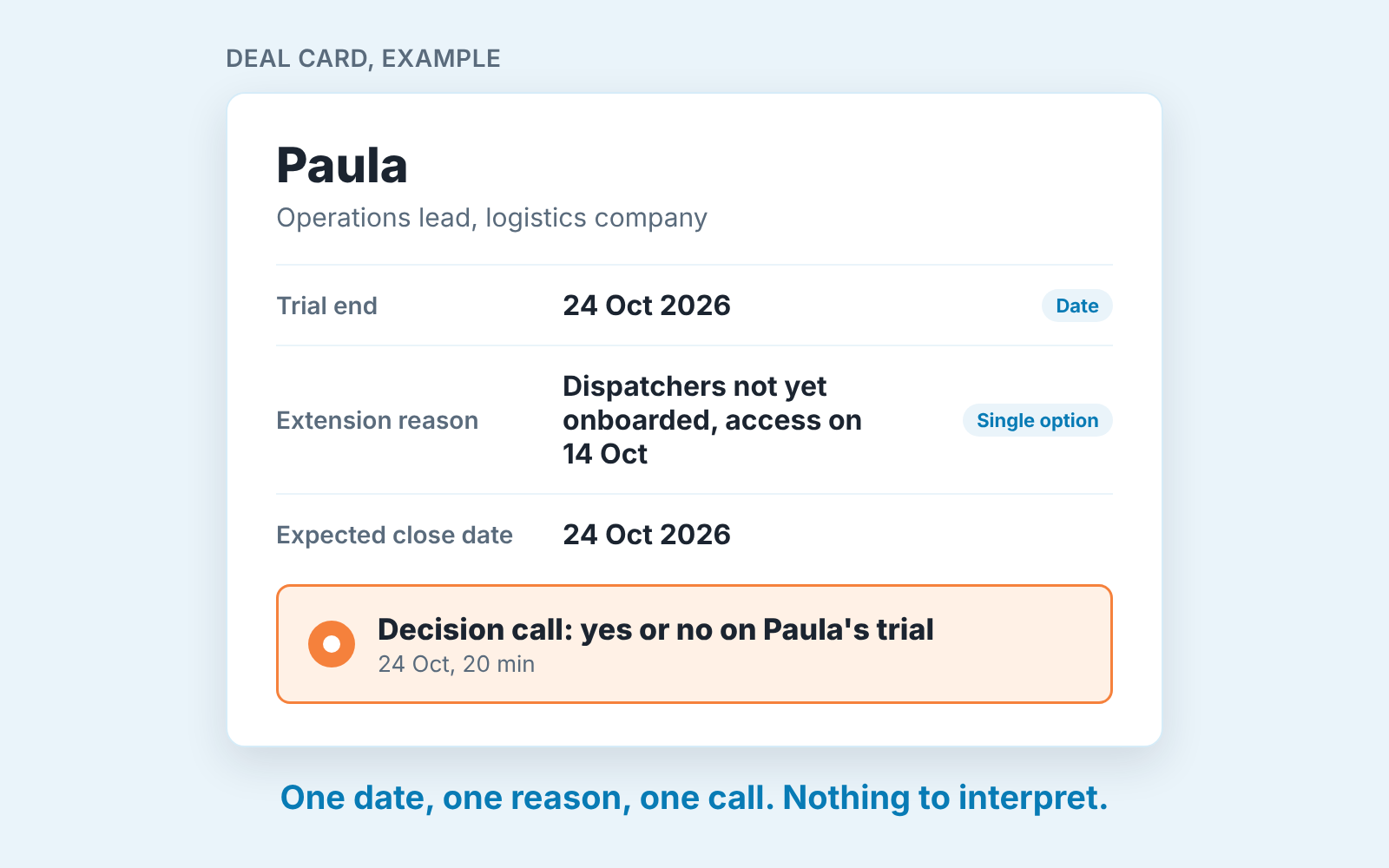
Trial end (a Date field). The date the access actually ends, updated when you extend. We put it on the deal rather than the organization, because one company can run two trials a year and the date belongs to the attempt, not the account. If your team already tracks trial signups as leads with usage facts, keep doing that; the call-or-no-call decision on day 8 to 12 is covered in free-trial signups in Pipedrive, and we are not repeating it here. This field is for the deals that reached a sales conversation.
Extension reason (a Single option field). A short list, not free text, so a manager can count it later. Ours: “Right people not onboarded”, “Never started”, “Blocked by issue”, “Waiting on budget / timing”, “Other”. The Paula deal gets “Right people not onboarded”. The deal where someone logged in twice and went quiet gets “Never started”, and a manager reading that line in a filter will ask the right question on Monday.
Decision call (activity). One call-type activity on the deal, due on the Trial end date, named so that nobody mistakes it for a check-in: “Decision call: yes or no on Paula’s trial”. When the call happens, the outcome goes into the activity, and if your team records outcomes in a field the way we described in activity outcome field, that is where “decided: no” lands. If the call gets moved, that is a signal too, and the same one as any prospect who keeps rescheduling.
One more field you already have: Expected close date. When you extend set it to the day of the Decision call. Pipedrive’s forecast view projects revenue by the expected close date (Pipedrive: forecast view), so this date decides which month the deal is counted in, and the decision call is the earliest day the deal can honestly close. What we see instead is a close date that slides by exactly 14 days with no reason recorded. Three months later the deal is still open, still “in trial”, and nobody remembers why.
The second time they ask
Say no. Politely, with a quote attached, but no.
A second request means the first extension did not produce the thing it was supposed to produce. Either the dispatchers were never onboarded, or they were and nobody liked it, or the budget did not open. None of those is solved by day 43. What the second request tells you is that the the person on the other end would rather keep the option alive than close it, and that is the shape of a no-decision deal, not of a late yes.
Here is roughly what we say: “I’d rather not extend again, because the last two weeks didn’t change much, and I don’t think another two will. If the team wants to go ahead, here is the quote and we can start you on a paid month and keep everything you set up. If it isn’t the right time, tell me, and I’ll close this on our side and check in when it is.”
Then act on the answer. A yes becomes a deal moving to proposal with a real close date. A “let me think about it” gets the treatment from that article: a reason and a date, or it is a no. Silence for a week after the decision call is a no, and the deal is closed as lost with the reason “Trial: no decision” so it can be counted. If your account uses predefined lost reasons rather than free text, someone with the Deals admin permission has to add that reason to the list first (Pipedrive: lost reasons); how we set up that list is in lost reasons in Pipedrive. Yes, every deal closed this way pulls your win rate down in Insights. That is correct. The deal was not alive, and the old win rate was counting it as if it might be.
We have had deals come back from that email, and when they do, they come back as a quote conversation, which is where they should have been anyway.
What extended trials do to the forecast
Extended trials sit in the forecast at the same stage as deals that are moving, and a manager who does not know which is which cannot read the pipeline. A trial that was extended once with a date and a reason is a legitimate open deal: there is a decision call on the calendar, and the forecast can carry it to that date. A trial that was extended twice is not an open deal in any useful sense. Nobody has had the conversation to close it, and if it stays in the pipeline at it’s original value, the number the team reports is wrong by exactly that amount.
This is why the fields matter more than the policy. A deal filter with three conditions, Status is open, Extension reason is not empty and Trial end is before today, gives you the trials that ended without a recorded decision. Leave out the status condition and the list fills up with deals you already won or lost, which makes it useless. On a five-person team that list should be short, and every deal on it should have a name next to it by Monday afternoon. A long list usually means the decision calls are being booked and not held, and the article on no-decision deals covers that pattern across the whole pipeline.
Deals like this go quiet rather than go lost, which makes them easy to miss in a weekly review. We build SalesBond, a sales management layer on top of the CRM a team already uses; we started with Pipedrive. Deal Health checks every deal against more than 20 rules a team can switch on and off, and shows which rule flagged a deal and why, so nobody has to scroll the pipeline looking for the quiet ones. If you want to see which of your open deals have stalled, check your CRM with SalesBond. The fields still have to exist first, and the rep still has to ask the question on the call.
Start with the fields. Add Trial end and Extension reason before the next “another two weeks” email arrives, and the next extension you grant will come with a date somebody has to keep.