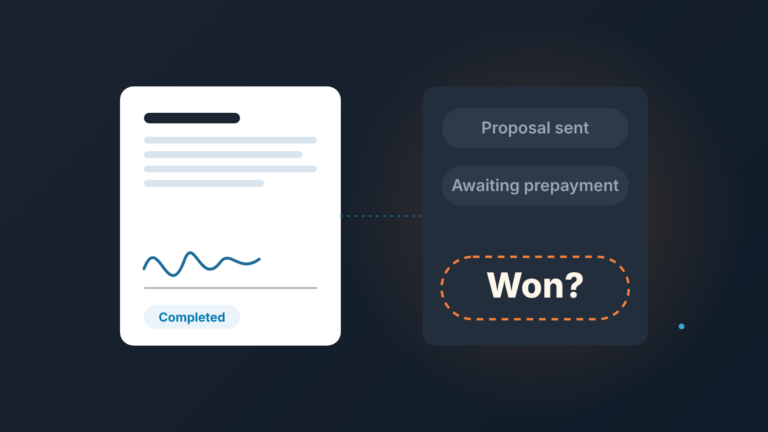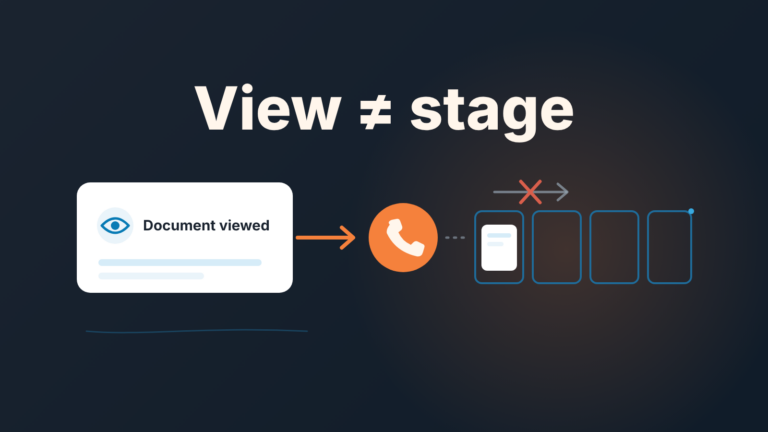

When a buyer says “let me think about it” at the end of a sales call, don’t agree in silence. Ask what exactly they will be thinking about, and agree on a date by which you will hear back. Then put both into the deal: the reason in one line and the decision date in a field. A “thinking about it” with no reason and no date looks like a live deal in the pipeline and behaves like a pause with no end.
The demo went well, right up to the last minute
A composite scene, the kind we see every month. Imke is forty minutes into a demo with Lorcan, who runs operations at a company with eleven field technicians. He asks good questions and pulls up his own spreadsheet to compare. Then, as the call winds down: “This looks good. Let me think about it and I’ll come back to you.”
Imke says what most of us say. “Of course, take your time.” She schedules a Follow up activity for next Tuesday and leaves the deal in Proposal with the close date at the end of the month. On Tuesday she writes “just checking in.” Nothing comes back. The deal sits there for weeks, looking honest, and nobody can say what it is waiting for.
HubSpot’s objection guide describes the pattern in one sentence: “All too often, salespeople simply agree to postpone the decision and check in later” (HubSpot: 8 ways to respond to “I want to think it over”). We would put it more bluntly. “Let me think about it” is not the outcome of the call. It is a question you did not ask yet.
What “I need to think about it” usually means
EVS7 lists four reasons behind the sentence: a soft no, missing information, the wrong person on the call, and price or budget (EVS7: what to say when a prospect needs to think about it). The list holds up. What matters is how differently each one behaves afterwards.
The soft no is a polite exit: the buyer has decided and does not want the conversation that follows “no.” Missing information is the opposite. He cannot decide because something was not shown, not priced or not understood, and he will not always tell you which (its close cousin, “send me some information”, usually hides the same gap). The wrong person means Lorcan liked it and Lorcan does not sign; someone else will hear a second-hand version of your demo. Price means the number landed harder than he let on.
From inside Pipedrive all four look identical. Same stage, same open activity, same close date. That is the real cost of writing nothing down: next week’s follow-up is written blind. The fix is small: one deal field that marks buyer indecision, filled in after the call.
One question instead of eight scripts
HubSpot offers eight responses; Sales Gravy, seven scripts. We don’t keep scripts in our heads, because on a live call a script sounds like one. One plain question does most of the work: “What is it you’ll be thinking about?” Then two more.
- Narrow it. “Is it the price, whether it fits the way you work, who else needs to see it, or the timing?” Four options are easier to answer than an open question.
- Find the room. “Who else will be in that conversation?” If a name comes up, you know if you are talking to the decision itself or only to its messenger.
- Set the date. HubSpot’s wording works well here: “Tell me, if I don’t hear back from you by [date], what should I do?” The same guide suggests a callback five to seven business days out (HubSpot). Whatever he answers is your plan for silence, agreed in advance.
“Take your time” costs nothing on the call. It costs the whole next week.
What goes into the deal before you hang up
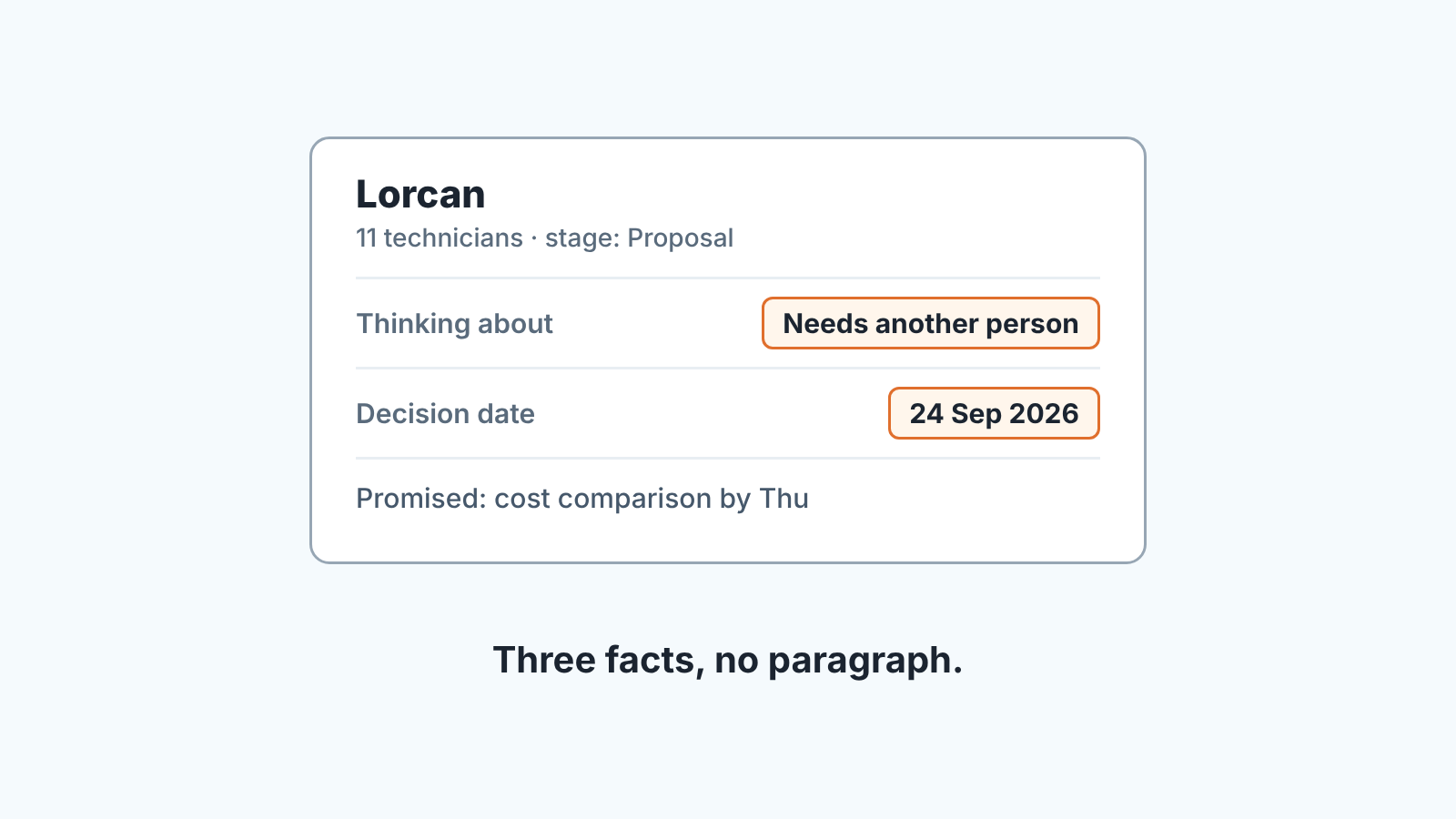
Three things, and the write-up takes under a minute: the reason in one line, the decision date, and what you promised to send. The next person to open this deal, including you in three weeks, should see those three facts without reading.
In Pipedrive we store the first two in custom fields rather than in a note, because a note cannot be filtered or sorted. Pipedrive offers sixteen custom field types; the two that matter here are Date, picked from a calendar, and Single option, a list of values you define up front. Pipedrive’s own help uses a deal-level single-option field to track whether a contract has been signed, which is the same idea (Pipedrive: what types of custom fields are there). One caution: a custom field’s type can’t be changed once it has been created (Pipedrive: custom fields), so settle the option list before you add it.
Our list for a field called “Thinking about”: Price, Needs another person, Timing, Comparing options, Unclear. Keep “Unclear.” It is honest, and when a manager sees it, she knows teh question was not asked, which is a coaching conversation rather than a pipeline one. If the deal form is already a drawer of half-used fields, clean up custom fields in Pipedrive before adding two more.
The record on Lorcan’s deal, as Imke should have left it:
Thinking about: Needs another person (Pernille, finance)
Decision date: 24 Sep 2026
Promised: one-page cost comparison, 5 users vs 12, sent by Thursday
If silent by the date: he said “chase me, I’ll have forgotten”
That last line is the the part most teams lose, because it lives in the rep’s memory and the rep has thirty other deals.
Logging objections in general is a bigger topic, covered in how to log objections in Pipedrive so a manager can coach from them. Here it’s one phrase and two fields.
The date passed and nobody wrote
Now it is 25 September, the field says 24 and Lorcan has not written. Resist “just checking in.” You have a reason on file, so ask about the reason, not about the deal:
“Lorcan, you were going to go through the numbers with Pernille this week. Did that conversation happen, and what came out of it?”
One email, one question, no attachment. It refers to his own words and leaves room for “we went another way.” Silence after a demo with no date agreed is a different situation; see when a prospect goes silent after the demo. The longer sequence after a formal quote is in follow-up after a proposal in Pipedrive.
How to read what happens next? If Lorcan said “chase me” and answers your one email, he meant it; update the date and the reason and carry on. If he said “assume we’re passing” and stays silent, he has already answered, and you agreed to accept it. If he said “chase me” and ignores a direct question about his own words, treat that as the soft no it is. Move the deal to Lost with a reason that names what he was thinking about, because “Needs another person” and “Price” are different lessons for the next deal (lost reasons in Pipedrive), and the right day to do it is usually earlier than you think (when to close a deal as lost). And if the answer is “we decided to keep things as they are,” that is a different kind of loss, covered in no-decision deals in Pipedrive.
We build SalesBond, a sales management layer on top of the CRM a team already uses; we started with Pipedrive. Its Deal Health checks every deal against the rules a team has switched on. But the field has to exist first, and the rep has to ask the question. No tool asks it for her.
Imke’s deal, with the two fields filled in, would have been one of three things by the end of September: moving, lost with a reason, or waiting for Pernille with a new date. Without them it was a deal nobody could describe. So on your next demo, when you hear “let me think about it,” ask what about before you say “take your time,” and create the two fields before that call, not after.