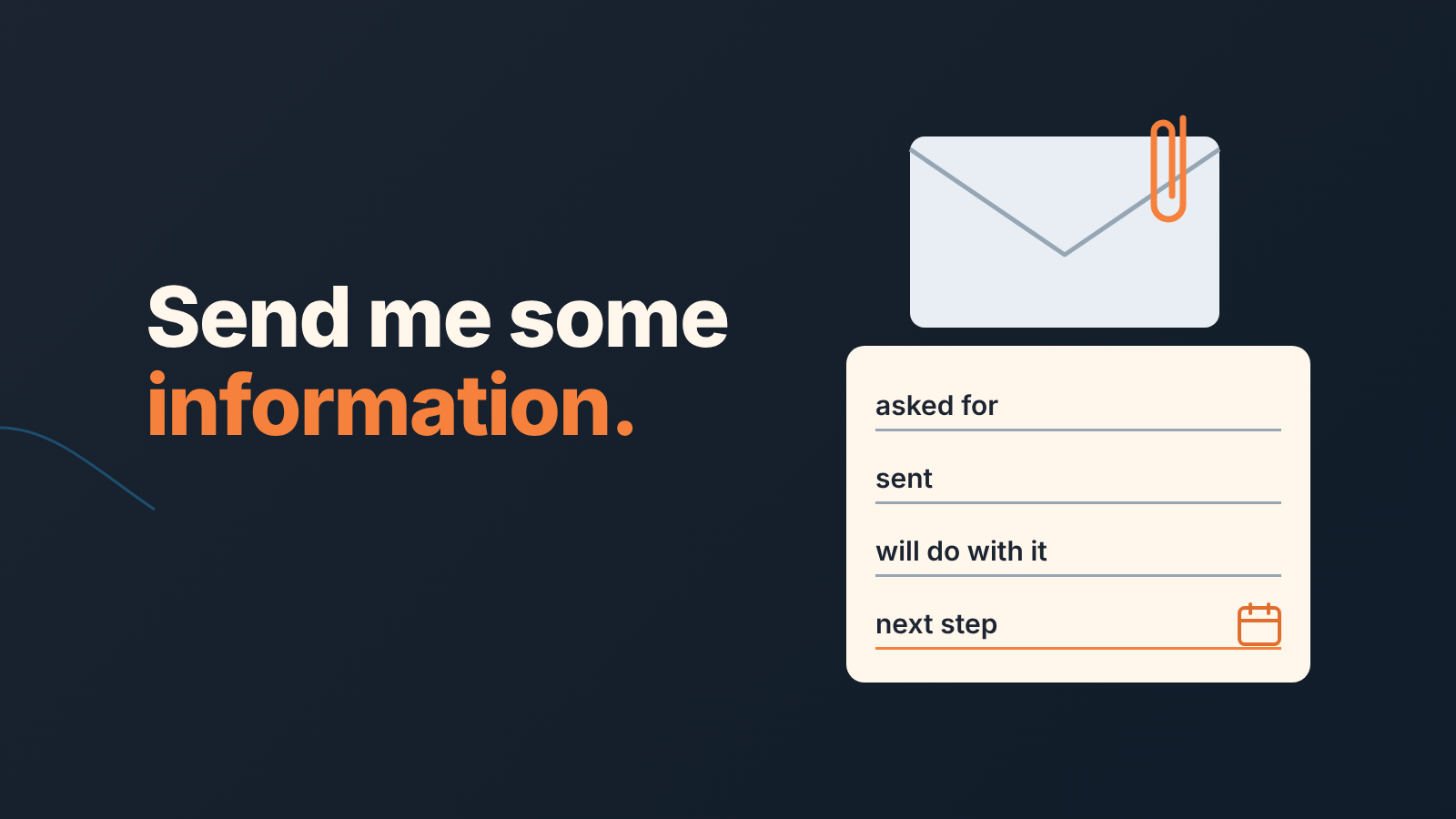
When a prospect says “send me more information”, say yes, then ask what the email has to contain and who will read it, send one attachment that matches the answer, and the same day write down in the deal what they asked for, what went out, and the date of the next step. Without that date the request is a dead end dressed as progress, and six weeks later nobody remembers whose turn it was.
What “send me more information” means, and why your ear can’t tell
Close treats the phrase as a polite way of saying “not interested”. PhoneBurner tells you to read the context first. In our experience the same five words come from three different people: the one who wants to hang up, the curious one with no time today, and the one who can’t decide alone and needs something to forward.
We stopped trying to tell them apart by tone. What happens after the email does that, if the rep wrote down what was agreed.
Send one thing, not the folder
Ilse runs a four-person team selling scheduling software to clinics. Her reps used to answer with the standard pack: deck, one-pager, case study, pricing sheet.
Now, before sending anything, the rep says something like: “Sure. So I send the right thing, what should it answer for you, and who else will read it?” The answers pick the attachment. If the clinic manager said no-shows are the pain, the email carries the one page on reminders and nothing else.
That email is already your recap email after the call. Don’t write two.
What the request adds to your call note
You probably already write a short note after every call: the problem, who else decides, a dated next step. The request adds a few lines to that note, because a week from now the whole question is whether the material did its job.
Ilse’s team adds this the same day:
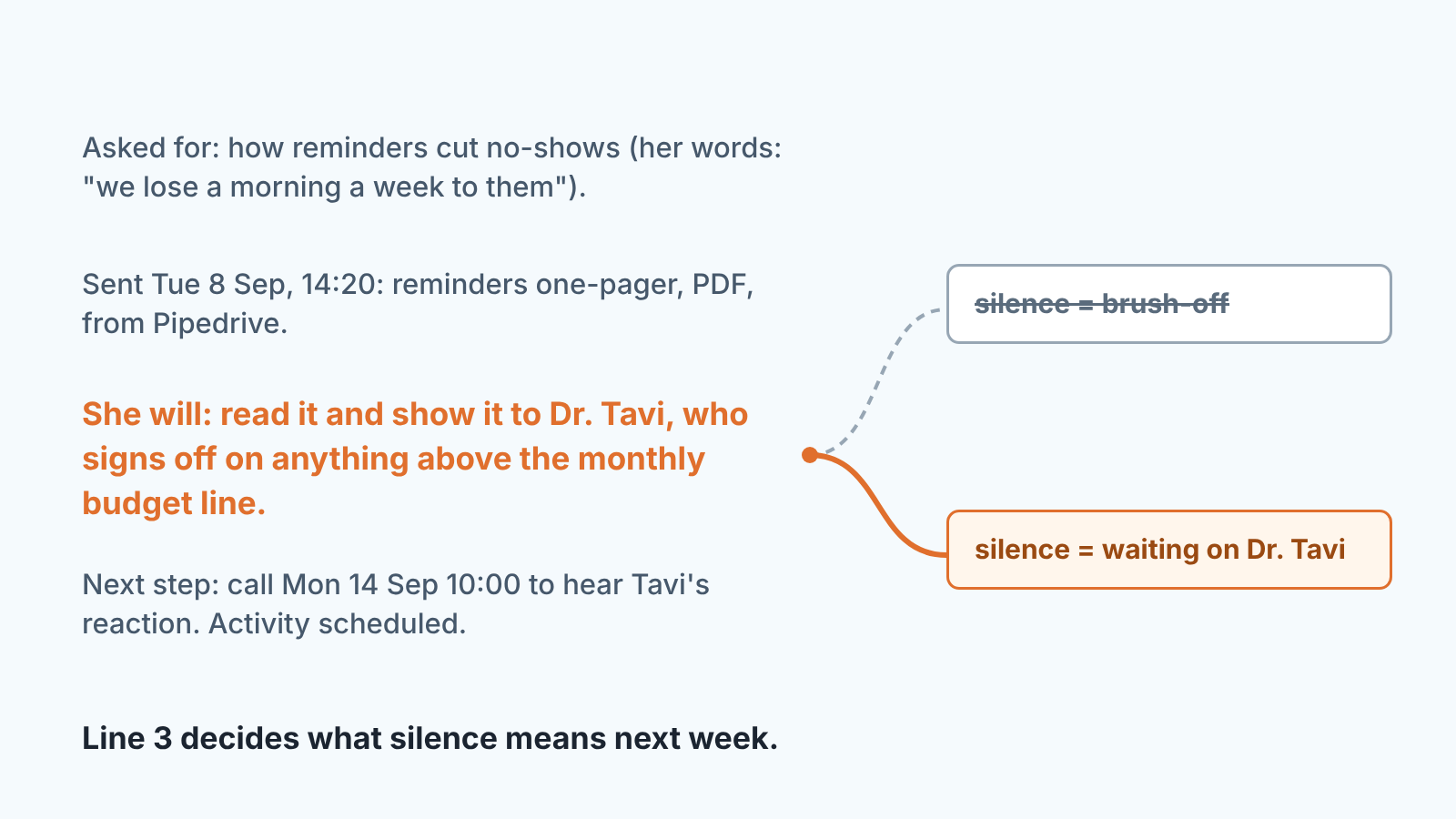
Asked for: how reminders cut no-shows (her words: “we lose a morning a week to them”).
Sent Tue 8 Sep, 14:20: reminders one-pager, PDF, from Pipedrive.
She will: read it and show it to Dr. Tavi, who signs off on anything above the monthly budget line.
Next step: call Mon 14 Sep 10:00 to hear Tavi’s reaction. Activity scheduled.
Why each line:
- What they asked for, in their words. That phrase becomes the subject line of your follow-up.
- What went out and when: document, format, channel. Pipedrive tracks only emails sent from Pipedrive, so if this one left from your phone’s mail app, say so.
- What they said they would do with it.
- The next step as a scheduled activity, because the next activity is what shows up on Monday.
The third line is the one most reps skip and the one we care about most. “She will show it to Dr. Tavi” means there are now two people in the deal, so add Tavi as a participant. When the call comes round you ask about his reaction instead of “did you get my email”. That’s not a rejection. It’s an introduction you haven’t been given yet. If you keep a log of objections in Pipedrive, add the request there too.
The date arrives. What counts as alive?
On the 14th the activity comes up and Brann, the rep, reads the deal before he dials. A reply with words in it is alive, whatever the words are; “not this quarter” is a live deal with a date problem. A question about the document is the best outcome of the the whole exercise. A forward is alive and shows who else is in the room; you hear about it from your contact, since tracking doesn’t record opens by whoever it was forwarded to.
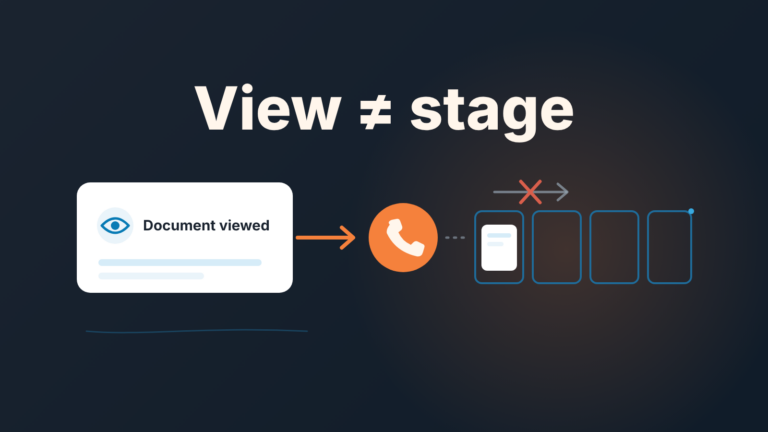
An open with no words proves very little. Pipedrive records an open when a hidden pixel loads, so it can fire when you reread your own copy in the Sent folder of an external mail client, and fail when the recipient blocks images. A tracked-link click doesn’t depend on images, so it’s the firmer signal (Pipedrive: email tracking; more in what an “opened” icon does and does not prove). A Smart Docs view counts only after the recipient accepts a cookie prompt, so zero views is missing data. Treat any of these as a reason to ask a question, never as the answer.
Brann’s rule on the date: reply, question or forward: pick up the phone and continue from what they said, as with any other buying signal. Open only, or nothing: one touch, and it’s a question. “Did the reminders page answer the no-show question, or was it the wrong page?” gives a busy person something to answer in one line.
Okay, so it was a polite no
A week after that one question, Brann has silence. Now the record does it’s second job: it shows the request was specific and the material matched, so silence after that is an answer.
What we don’t do is send the third, fourth and fifth email. The follow-up sequence after a proposal is a different situation: that buyer asked for a price. Here every extra “circling back” costs you the next conversation with this person. Take the deal out of the pipeline. Either mark it lost with the reason “asked for information, no response after one follow-up”, or convert it to a lead (“…” > Convert to a lead) and book a follow-up three months out. Notes come across, so the record survives; deal labels and history don’t (Pipedrive: converting deals to leads). Either way it leaves the forecast and the tire kickers stop looking like pipeline.
Compare the deal where the note said “she will show it to Dr. Tavi”. Silence there means the internal conversation hasn’t happened yet, so Brann’s one touch goes to Tavi directly.
The failure we see most often is no date at all: the deal sits in an early stage, email attached, nothing scheduled, until the quarter closes. We build SalesBond, a sales management layer on top of the CRM a team already uses. Its Deal Health checks every deal against the rules you have switched on and shows the specific violations with a recommended action for each; a request that never got a next step is exactly what that list is for. Check your CRM with SalesBond.
Before the next call ends
Next time someone says “send me some information”, treat it as a small agreement with an open end. Ask the two questions, send one page, write down what they will do with it and book the date before you dial anyone else. A week later that line tells you which of the three people you were talking to. A buyer who says they need to think about it gets the same treatment: a reason and a date.