The JOLT Effect, by Matthew Dixon and Ted McKenna, argues that many deals are lost to buyer indecision rather than to competitors. For a small Pipedrive team the usable part is one deal field that marks indecision and a specific next step for it, reviewed once a week. That is the whole method as we run it. The book has more, and we link to it, but a sales manager with eight reps does not need more than that to start.
The JOLT Effect in one paragraph
The JOLT Effect is a 2022 book by Matthew Dixon and Ted McKenna, built on a study of more than 2.5 million sales conversations (Goodreads: The JOLT Effect). Its central claim is about deals that end in “no decision.” Most of them, the authors say, are not lost because the buyer preferred what they already had. They are lost because the buyer could not bring themselves to choose at all, out of fear of getting it wrong (jolteffect.com: What is the JOLT Effect?). And the usual seller reflex, pushing harder on the case against the status quo, tends to make it worse. Challenger, the company behind the research, makes the same case in its own write-up on losing to customer indecision.
JOLT stands for the four skills the authors saw in high performers: judging the customer’s level of indecision, offering a recommendation, limiting the exploration, and taking risk off the table (jolteffect.com).
We are not going to walk through all four. Our interest is narrower: the first skill, judging indecision, is a thing a CRM can hold, and the other three are things a rep can do once the CRM has told them which deals need it.
One honest caveat before we go further. Nothing we know of shows that a Pipedrive team that adopts this field closes more deals. What the field is for is a better weekly review: the manager stops asking “what’s happening with this deal?” and starts asking a question that has an answer. That is an organisational gain, not a win-rate claim.
Indecision versus a real objection: how to tell them apart on a deal
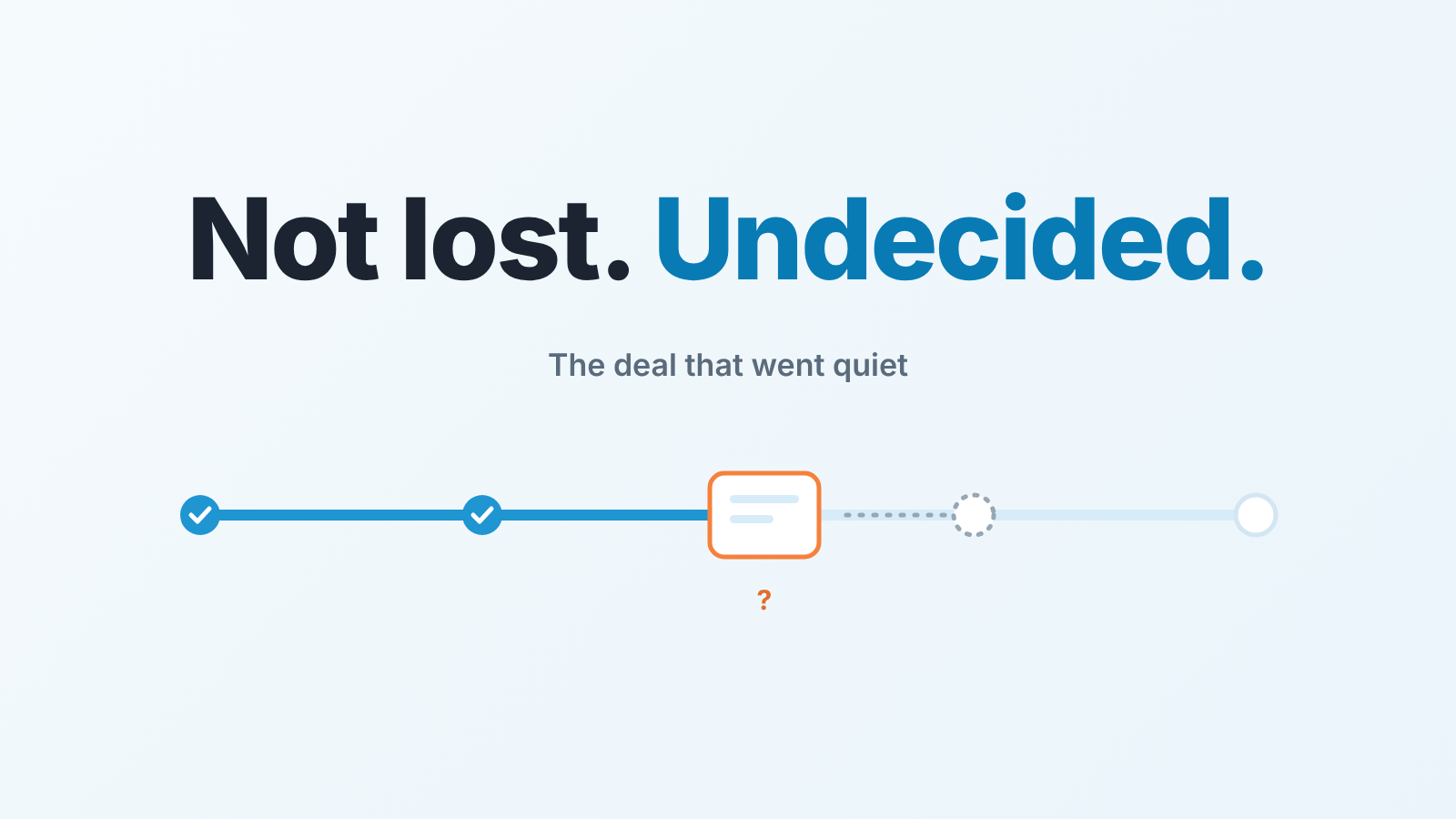
An objection is something the buyer says. Indecision is something the buyer does not say, and the deal goes quiet.
Here is how it usually looks in the pipeline. A deal with a real objection has a trail: an email about price, a note that security wants a questionnaire, a competitor’s name in the deal. The rep knows what the problem is even if they cannot solve it. A deal stuck in indecision has none of that. The last call “went well.” The buyer agreed the current setup is painful. They asked for one more reference, then one more comparison, then went silent, and the rep’s next activity has been pushed twice because there is nothing concrete to do.
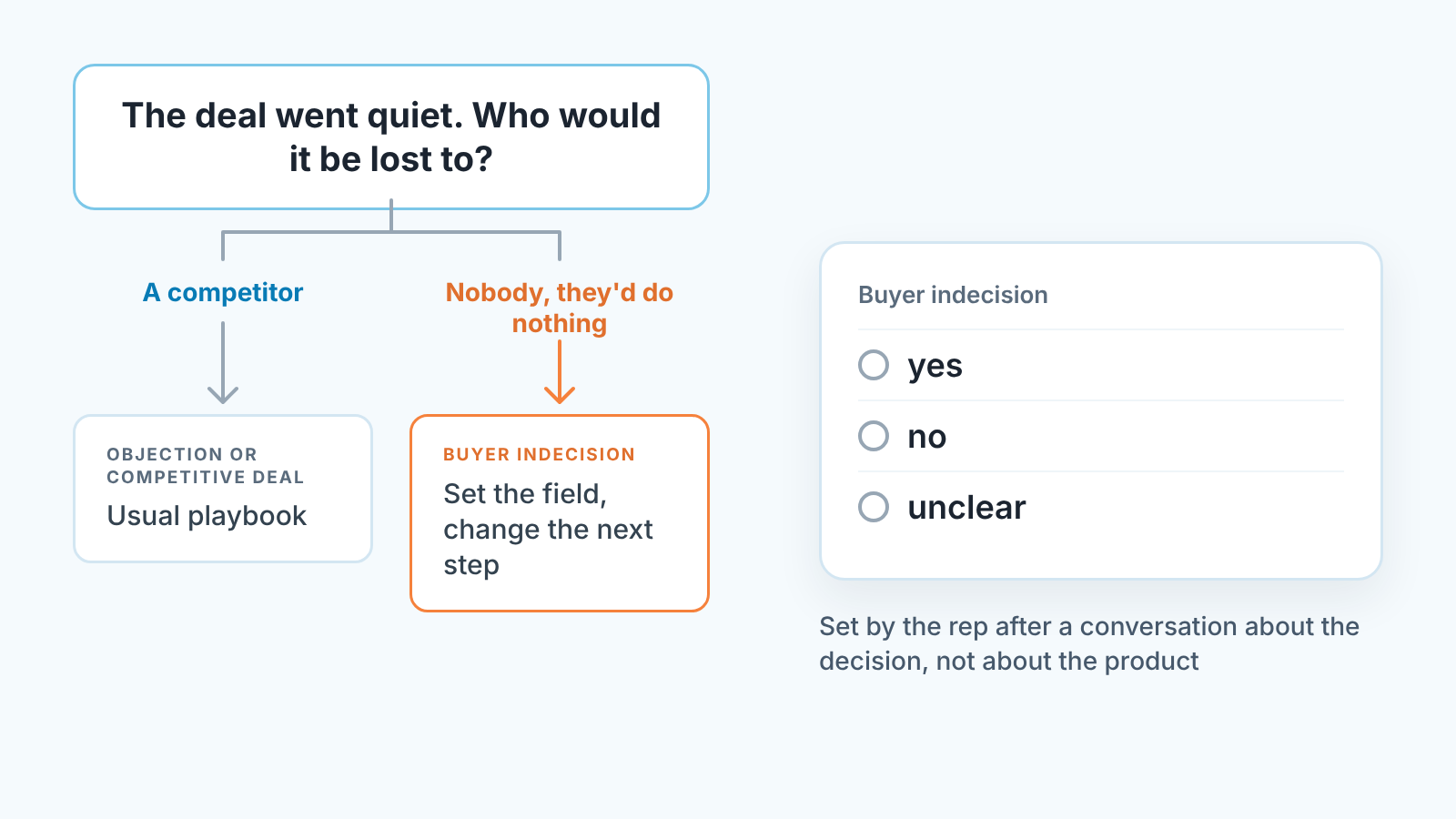
The simplest test we have found: ask the rep, “if we did nothing for a month, who would this deal be lost to?” If the answer is a competitor’s name, it is an objection or a competitive deal, and the usual playbook applies. If the answer is “nobody, they’d just not do it,” you are looking at indecision. The usual playbook (more proof, more value, more pressure on the status quo) is the one the authors say backfires. A quiet deal is also not automatically a dead one; our note on stalled deals vs. dead deals covers that line.
Two signals we treat as strong indecision markers in Pipedrive:
- the buyer keeps asking for more material, and each request is smaller than the last;
- the rep has rescheduled the next activity more than once without a note explaining why, and the deal has not moved stage.
Neither is proof. Both are enough to set the field we describe next and make the deal a review item.
One field: “Buyer indecision”
We add one custom deal field in Pipedrive. Name: Buyer indecision. Three values: yes, no, unclear. A single-choice field, not free text; free text turns into “see notes” within a fortnight.
Why three values and not a yes/no toggle? unclear is the honest state for every deal before the second real conversation, and a rep who has to pick between yes and no on day one will pick no. unclear on a deal that is past the middle stage is itself a signal: it means nobody has asked the buyer about the decision, only about the problem.
Who sets it: the rep, after any conversation in which the the buyer talked about the decision itself (not the product). When: at the stage where your team usually sends a proposal, and then again whenever the answer changes. We do not make it mandatory at deal creation, because it is meaningless there.
Setting it up takes a couple of minutes, provided your user has the permission to edit fields. In Pipedrive, open the account menu, go to Personal preferences > Data fields, choose the deal entity and click + Custom field; to create the field you must at least name it and select its type (Pipedrive: Custom fields). The field description, where you tell the team why and how to fill the field, needs the Growth plan or higher. Quality rules are split: marking a field as important starts on Growth, making it required starts on Premium (same page). On Lite you still get the field; you just write the instructions in your own onboarding doc instead.
If you already run some kind of deal-risk check over your pipeline, this field slots straight into it. We build SalesBond, a sales management layer on top of the CRM a team already uses; we started with Pipedrive, and a field like this is exactly the kind of signal we would rather see on the deal than buried in a call note. Still the field is yours, in your CRM, and it works with a saved filter and nothing else. If you want a second pair of eyes on which deals carry it, check your CRM with SalesBond.
The next step that fits indecision
“Follow up” is not a next step. It is a date.
The pattern the authors describe for indecisive buyers is to give them less to decide, not more to read (jolteffect.com). So when Buyer indecision is yes, the next activity on the deal has to be a specific action that shrinks the decision, and its subject has to name that action. We keep the menu to three moves.
The first is to recommend one option. Not three tiers, one. The rep writes the recommendation in the activity note before the call; for example, on a mid-size deal it might read “Recommend plan B, 12 users, because of X.” If the rep cannot write that sentence, its a sign they are not ready for the call.
The second is to close the exploration: say out loud what is not going to be evaluated further, and why. Something like “We won’t run a second pilot; the first one answered the question you had about imports.”
The third is to name the risk and take it off the table. Ask what the buyer is afraid of personally if this goes wrong, then answer that specifically: a shorter initial term, a named person on your side for the first month, a defined exit. Whatever your company can actually offer. Do not invent a guarantee you cannot sign.
Three moves, and that is deliberate. A rep facing a quiet deal needs a short menu, not a methodology.
The thing we stopped doing: sending another case study. For a buyer who already believes the problem is real, one more proof point is one more thing to evaluate, and the authors are blunt that piling on the case for change is what sellers do by reflex and what tends to backfire (jolteffect.com).
The review question for the weekly pipeline review
One question, asked about every deal where Buyer indecision is yes or unclear past the proposal stage:
“What exactly is the buyer afraid of losing if they pick us?”
Not “where are we with this?” and not “what’s the next step?” Both of those get an answer that sounds like progress. The fear question gets one of three answers, and each one tells the manager what to do.
The rep has a specific answer. For example, on a CRM migration deal: “she’s worried the migration will eat her Q1 and she’ll be the one blamed.” Good. The next step writes itself, and it is almost always the third move above, taking the risk off the table.
The rep has a vague answer (“I think they’re just busy”). That is unclear dressed as no. The next step is a conversation about the decision, not about the product, and the manager should hear what question the rep plans to ask.
The rep says the buyer is not afraid of anything, they simply have not got round to it. Then either the field is wrong and this is a status quo deal, where the buyer is genuinely content with what they have, or the rep has not asked. Our bet is on the second one more often than we would like.
Asked this way, the question keeps each deal short in the review. It also changes what reps write in thier notes, because they know which question is coming on Monday. If you want the rest of the meeting to stay as tight, here is how we run a 15-minute weekly pipeline review.
Where it overlaps with no-decision deals
If you have read our piece on deals that end in “no decision” in Pipedrive, you will recognise the territory. That article is about spotting the deal while it is still open and counting it honestly as its own lost reason. This one is about one specific cause of those deals, buyer indecision, and what to do differently once you have named it.
The two work together. The lost reason tells you, after the fact, how big the problem is. The Buyer indecision field tells you, before the fact, which open deals are heading there. If you run both, you can check whether the deals you marked yes actually ended up in that lost reason, which is the only way we know to find out whether the field is being set honestly.
It also sits beside the other methods we have written about for small teams. If you are choosing between frameworks, start with how to pick a sales methodology for a Pipedrive team; the authors themselves call JOLT complementary to any selling methodology rather than a replacement for one (jolteffect.com). Teams on Challenger will find the overlap obvious; our notes on Challenger for small sales teams cover where that method stops and this one starts.
A 10-minute check in Pipedrive
This is the Monday-morning routine, before the review.
- Open the Deals list view. Click the filter drop-down in the top right and choose + Add new filter (Pipedrive: Advanced filtering).
- Add a condition: Buyer indecision is
yes. Add a second condition for deals in or past your proposal stage. Keep both in the ALL section, so a deal has to meet every condition to appear (same page). - Save the filter with a name the team will recognise, something like
Indecision - review, and make it shared rather than private, so the people who run the review can see it (same page). - Make a second filter the same way with Buyer indecision is
unclearand the same stage condition. These are the deals where nobody has asked. - Open each deal in the first list and look at its next activity. If the subject is “follow up” or there is no activity at all, that deal goes to the top of the review, and the rep gets the fear question first.
Give it ten minutes. If it takes longer, the stage condition is probably too wide. The filter itself is the easy part; what matters is that you now have a list that answers “which of our quiet deals are quiet because the buyer is stuck?” and a question to ask about each one. Set the field up this week, run the check next Monday, and read the rest of the book when the list stops surprising you.