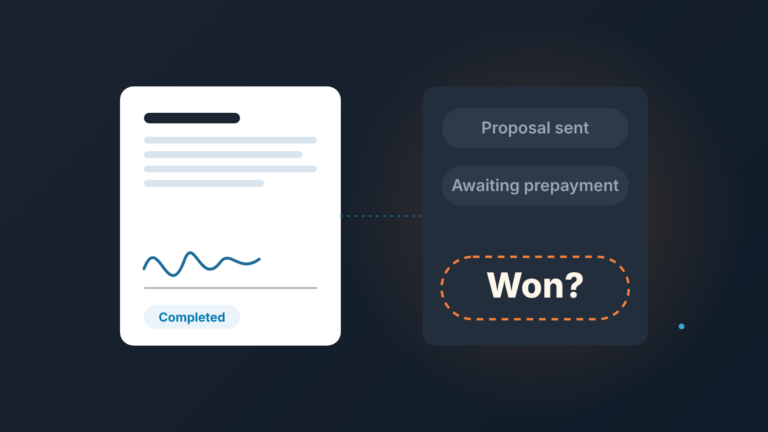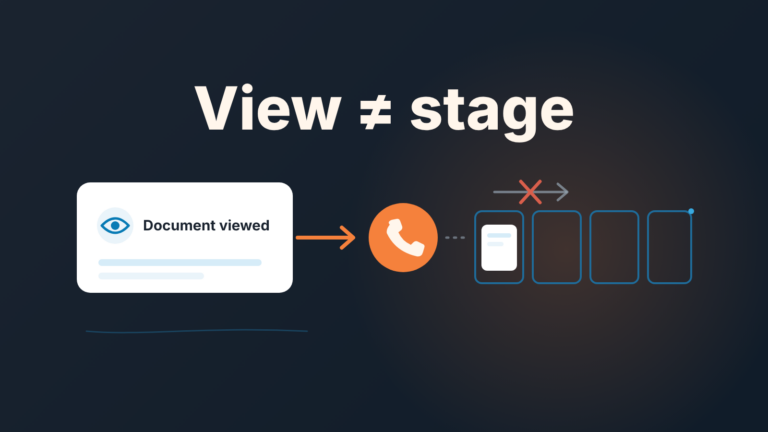
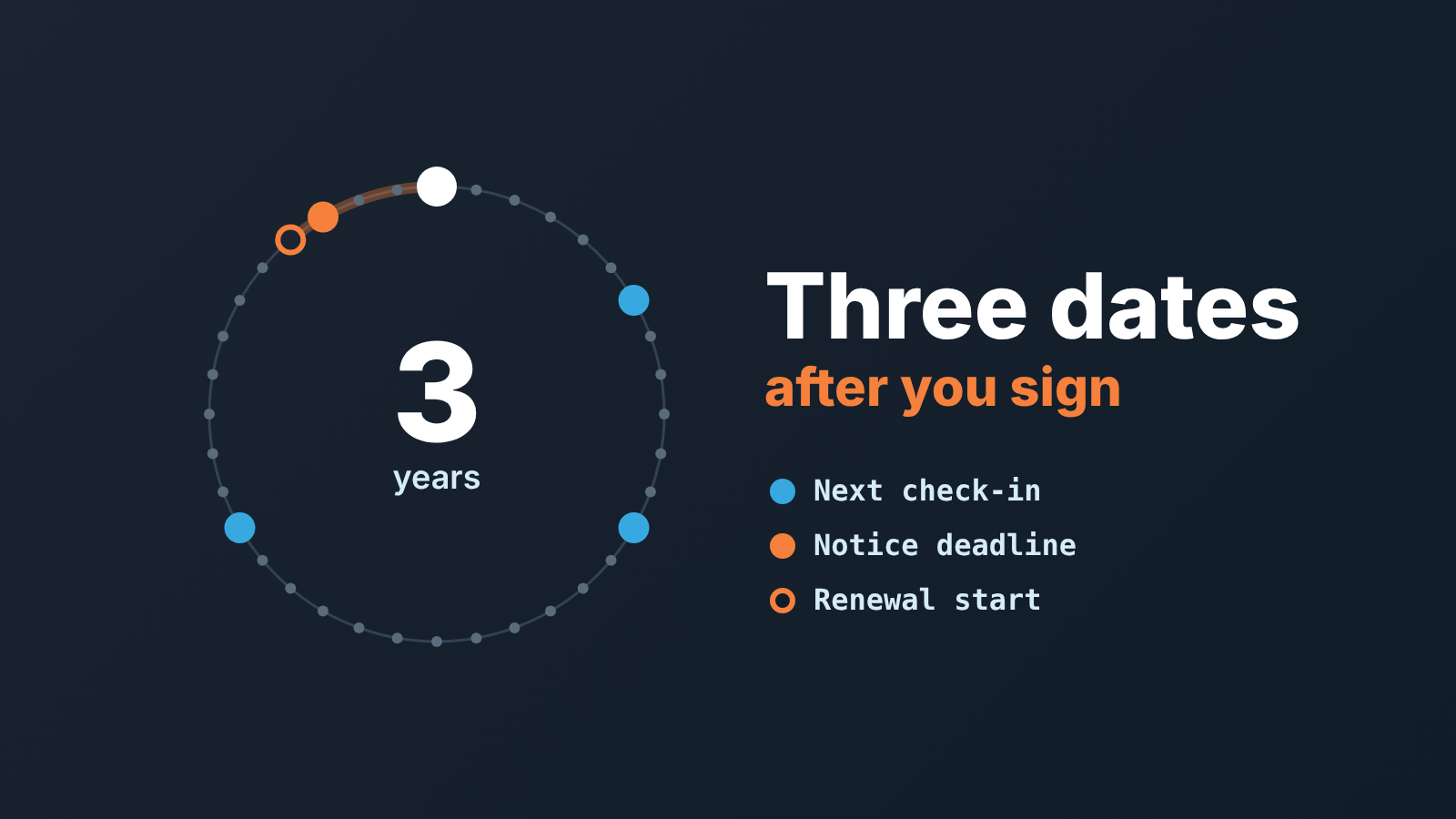
After a multi-year contract is signed, the thing to track in Pipedrive is not the amount but the calendar: the date the term ends, the date by which either side must give notice, and the date of the next check-in with the account. Add one short meeting every six to twelve months and the customer stays in view. Skip it and the account goes quiet for two or three years, because there is no open deal to remind anyone it exists.
Signed in October, remembered three years later
Leopold runs a six-person sales team that sells a subscription on 24- and 36-month terms. On October 3 three years ago they closed their biggest account to date: a three-year contract, $36,000 a year, signed by Gwendolyn, who had pushed the purchase through on the customer’s side (numbers in this article are an example). The deal moved to Won. Everyone went for dinner. The onboarding team took over for six weeks, and then the account did what every multi-year account does in a CRM built around open deals: it disappeared.
Not literally. The organization record was still there, the deal was still in the Won filter, the invoices went out on schedule. But the pipeline view shows open deals, the activity list shows scheduled activities, and this account had neither. Nobody on the sales side had a reason to open it. Gwendolyn changed jobs in month 11. Her replacement inherited the tool, never met anyone from Leopold’s company, and started trialing a competitor in year two. The first time Leopold heard any of this was when the renewal conversation started, 60 days before the term ended, with a procurement manager he had never spoken to. The contract had a 90-day notice period. By the time anyone called, the customer’s window to cancel had been closed for a month, and so had Leopold’s window to prepare.
Nothing in that story is a Pipedrive failure. The CRM did exactly what it was asked. The failure was that nobody asked it to do anything for 34 months. The rest of this article is about what to ask it to do.
When a multi-year contract is worth offering
A multi-year contract is an agreement whose term runs longer than one year; in the B2B subscriptions we write about, that usually means two or three years. We treat that term as something the customer gives us, not something we chase. It is a concession the buyer makes, and like any concession it should be traded for something, usually price, the same way you would trade any other term in a negotiation.
Buyers know this. Mostly Metrics, working from Tropic’s data on more than 15,000 contracts signed from 2022 to 2025, looked at the question from the buyer’s side. By the source’s estimate, a multi-year commitment earns roughly 2 to 3 percentage points more discount than an annual one. Customers who stay on multi-year terms continuously see that discount shrink by about 1.3 points over time. The best-paying path for a buyer was a one-year deal followed by a move to multi-year at renewal, worth about 2.5 extra points (Mostly Metrics). Read that as a seller and the conclusion is simple: the buyer is going to ask for the multi-year discount, so decide in advance what you want in return.
The second question is whether the contract is really multi-year. SaaStr’s answer to a commission question covers this well: a “multi-year” deal with an annual opt-out and only the first year prepaid is, in their words, barely an improvement on a standard one-year deal (SaaStr). We agree. If the customer can walk at month 12 without penalty, you have a one-year contract with a price list attached. Track it as a one-year contract and celebrate the multi-year part when year two actually invoices.
When the customer wants to start in phases instead, the structure is different.
What goes on the deal the day you sign
Three things, and only the first two take time.
The term and the money. The contract length, billing frequency and billing start date live in Pipedrive’s recurring products (available on some Pipedrive plans), which also give you the deal’s ACV and TCV without a calculator. How to set them up is in recurring products vs installments, and which number belongs in the Value field is in ACV vs deal value. We will not repeat either here. One detail matters for the rest of this article: Pipedrive’s documentation states that the ACV, TCV, MRR and ARR it calculates cannot be used in formula fields (Pipedrive: recurring products). And formula fields themselves, also available on some Pipedrive plans, calculate only from numeric and monetary deal fields (Pipedrive: formula fields). A date does not come out of either. So the notice date is one you type.
The three dates. An admin creates them as custom date fields (it takes the right global permissions) under Personal preferences > Data fields: pick Organization, then “+ Custom field” (Pipedrive: custom fields). They go on the organization, not the deal. The deal is Won; it leaves every pipeline view the moment you close it. The organization stays, and filters work on it’s custom fields, which is the whole point.
Next check-in: six months from signature the first time, then you move it forward at each check-in.Notice deadline: the last day either side can give notice under the contract. If the term is 36 months with 90 days’ notice, that is month 33, not month 36.Renewal start: the day you open a renewal deal in the pipeline. We set it 30 days before the notice deadline so the deal exists before anyone has to decide anything.
For Leopold’s October 3 contract that works out to a term ending October 2 in year three, a notice deadline of July 4 and a renewal start of June 4.
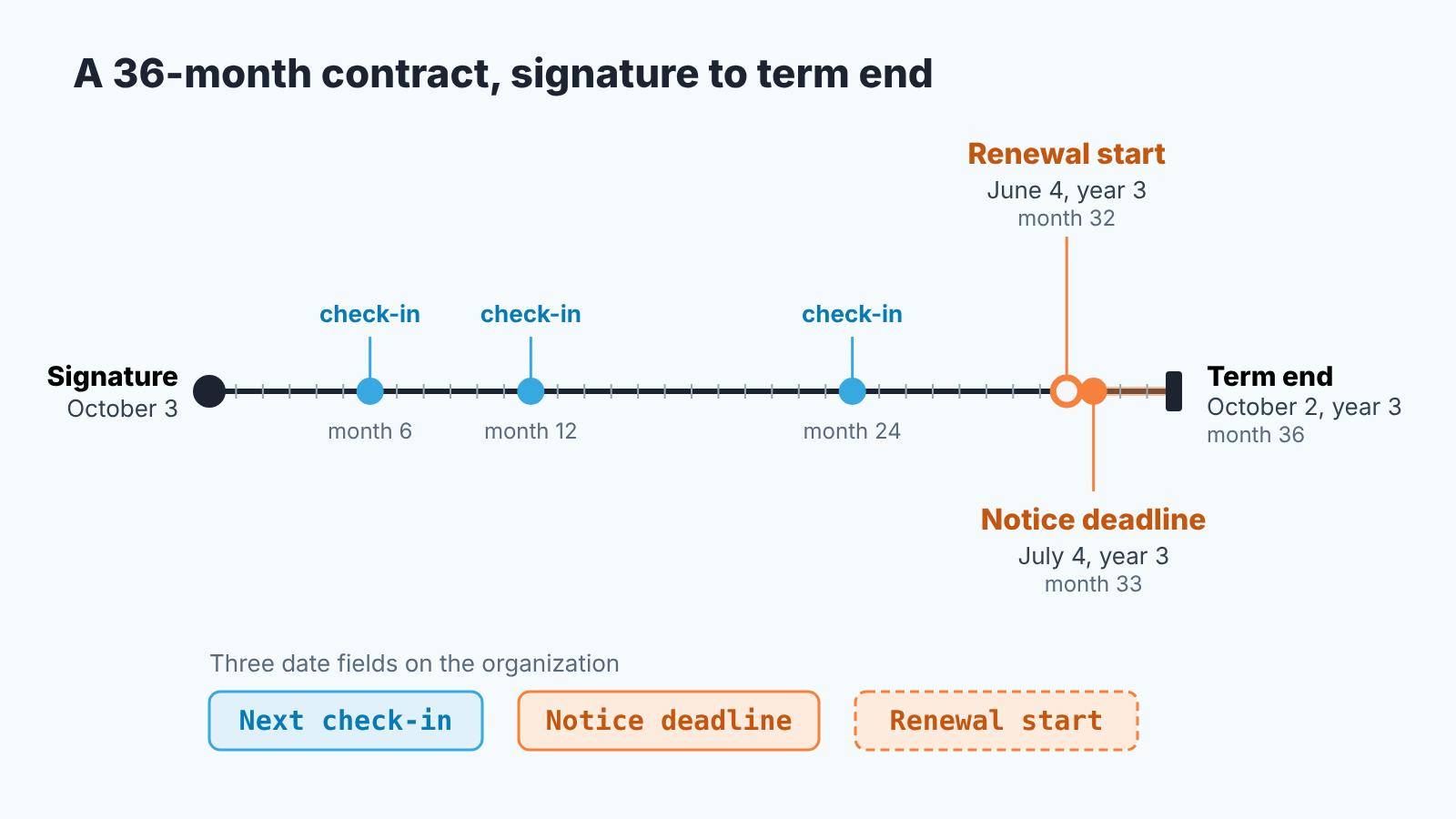
With those three fields filled, one saved filter on organizations (Next check-in is before today or Renewal start is before today) shows every multi-year account that needs a call, and nothing else. From there an account enters the renewal process when its date arrives; this article stops where that one starts. Check at the same time whether a master service agreement covers that account and when it lapses.
A side note on the mirror image: when a prospect is locked into someone else’s three-year contract, the same date, their notice deadline, is the one you want on your deal. We wrote that up in incumbent contract end date.
Price steps and escalators: our workaround
Many multi-year contracts do not have one price. Leopold’s three-year deal had a 5% escalator: $36,000 in year one, $37,800 in year two, $39,690 in year three, so a TCV of $113,490 (example). Others ramp the other way, with a discounted first year while the customer rolls out. Either way the price changes and the CRM needs to know when. Check the same contract for a most favored customer clause; it ties what you may offer comparable customers to this one.
Here we have to be honest about the tool. Nothing in Pipedrive’s recurring products documentation describes a price that changes partway through the term; the recurring product has a billing frequency, a start date, and either a fixed number of cycles, up to 208, or a “renews until canceled” setting (Pipedrive: recurring products). We have not found a field for “year-two price”. So we use a workaround, and we call it that.
Two more custom fields on the deal: Year-2 price and Year-3 price (monetary, so you can filter on them). Plus one note pinned to the deal that quotes the escalator clause from the contract word for word, with the clause number. The recurring product carries the year-one price, so ACV and the product revenue forecast in Insights, which Pipedrive builds from the billing cycle and date, are right for the first twelve months and understated afterwards. That is the limit of the workaround. We would rather have a forecast we know is low in year two than a deal Value that is high today.
Why a note as well as the fields? Because in year two somebody who did not sign the the contract will have to explain the new invoice to somebody on the customer side who did not sign it either. The field tells them the number. The note tells them where it came from.
The check-in at months 6, 12 and 24
The check-in is a 30-minute call, not a QBR, and the sales owner runs it, not support. It exists to find out whether the account you sold to still exists in the shape you sold it. Five questions, asked more or less in this order:
- Is the person who signed still there, and still the one who would sign again? A champion leaving is a calendar event for this account, and the day you learn it is the day the next check-in moves up. (What to do when the answer is no: sales champion.)
- Who is new on thier side since we last talked? New VP, new finance lead, new procurement process. Each one is a person to add to the organization in Pipedrive.
- What are they actually using, and what did they stop using? Not a satisfaction score. Names of features and names of teams.
- What has changed in their business that changes the renewal? Headcount, a merger, a new budget owner, a competitor’s trial.
- Does the price step in year two still match what they remember agreeing to? Better to hear “what price step?” at month 12 than at the invoice.
If questions one and four look familiar, they are the same drift signals we describe in the renewal process. The difference is that here you ask them on a date, not when something already feels off.
Log the call as a completed activity on the organization, move Next check-in forward, and update any field the answers changed. In Leopold’s story question one at month 12 would have surfaced Gwendolyn’s departure one month after it happened, and question four at month 24 would have surfaced the competitor’s trial. Neither needed a tool. They needed a date.
Why by hand? We build SalesBond, a sales management layer on top of the CRM a team already uses; we started with Pipedrive. Its Customer Health module works out each repeat customer’s buying cycle from won deals, and a cycle needs at least two purchases. A customer with one three-year contract is a new customer with no cycle, so until the renewal is won there is nothing for Customer Health to say about Leopold’s account. That is why the check-in dates in this article are kept by hand. When the renewal deal does open, Deal Health checks it against more than 20 rules on stage, activity and data, the same as any other deal in the pipeline. Check your CRM with SalesBond if you want to see which open deals it would flag today.
Commission and reports in years two and three
Pay on cash. SaaStr’s position is that until a company is at roughly $10 to $20 million in ARR, commission on multi-year deals should follow cash collected, not bookings, and we think that is right for every team of the size we write for (SaaStr). The reason is not distrust of the rep. A three-year booking is a promise and a year-one payment is money, and a plan that pays a $113,490 commission base in October on a contract that can still fail in month 13 will one day pay for revenue that never arrived.
Our version of that, which is our practice and not SaaStr’s: year-one commission at signature or at the first invoice, and the year-two and year-three portions when those invoices are paid. The rep who closed the deal keeps the right to those later payments, which is also the cleanest reason for that rep to run the check-ins. If the contract has the annual out SaaStr describes, treat it as a one-year deal in the comp plan too . How this fits a small team’s plan overall is in sales commission structures for a small team.
The reports need the same discipline. In years two and three a multi-year account keeps paying while no won deal appears anywhere, so won-deal totals in Insights dip and new business looks worse than it is. Count the deal once, as a booking, in the month it was won; let the recurring product put the billings where they fall; and never report TCV as if it were this year’s revenue. The longer version is in bookings vs billings vs revenue.
Leopold’s team now signs multi-year contracts with three dates on the organization and two prices on the deal. The renewal from the October 3 account did not close, as it happens. A two-year contract signed the following March renewed 24 months later, after check-ins at months 6, 12 and 18 and one champion change they heard about the week it happened. If you have a multi-year account signed more than six months ago, open its organization today and fill in the three dates.