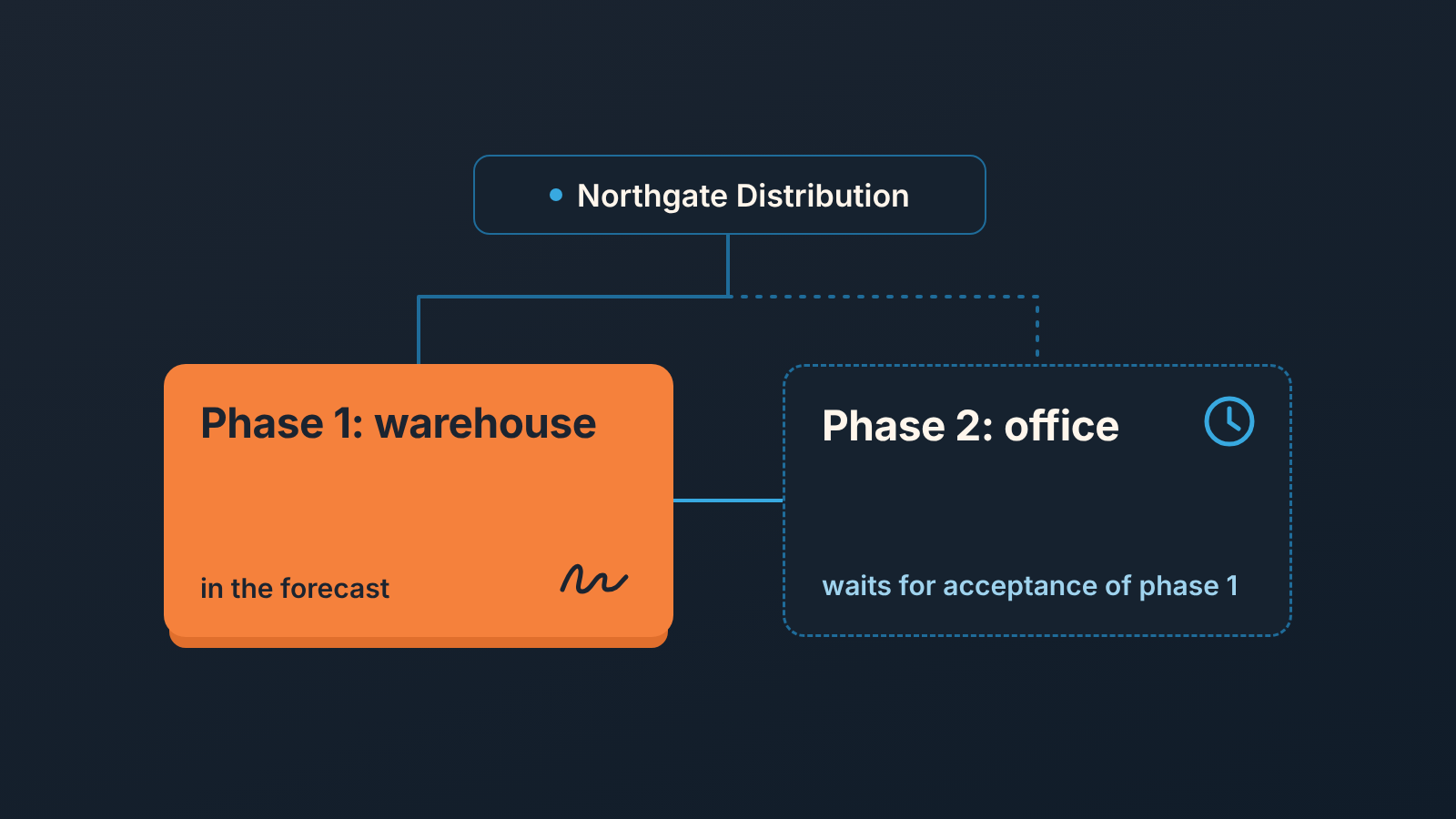
When a customer wants a phased rollout (a phased implementation, in contract language), keep each phase as its own deal in Pipedrive, under the same organization, with a “Phase” field that says which one it is. Only the phase the customer has signed goes into this quarter’s forecast. The second phase lives as a separate deal with its own expected close date and a written start condition (“after acceptance of phase 1”), and its probability stays low until that condition is met. One deal titled “Phases 1 and 2” shows money that does not exist yet, and that is the thing to avoid.
“Let’s start with one warehouse”
Rasmus runs a six-person sales team that sells a system installed site by site. The example is illustrative and the figures are made up, but the shape will be familiar.
Sigrid, head of operations at a distributor with one warehouse and a head office, had been through two demos and liked what she saw. On the third call she said the thing phased buyers say: “Let’s start with the warehouse. If it works, the office follows in the spring.” Zara, the rep on the account, did what most reps do with good news. She kept the deal she already had, $64,000 for both sites, moved it to Negotiation and wrote “warehouse first, office in Q2” in a note.
Three weeks later the warehouse contract came in at $24,000. The deal was still showing $64,000. Rasmus marked it won, because the customer had signed, and the pipeline lost the other $40,000 without anyone deciding to lose it. Nobody owned the office rollout: no deal, no expected close date, no activity. In April Sigrid’s company was busy with a warehouse move, and the spring conversation happened in September, started by Sigrid, not by Zara.
Two mistakes, pulling in opposite directions. For three weeks the forecast carried $40,000 that nobody had agreed to. Then, for five months, the same $40,000 did not exist anywhere a sales manager would look.
One deal or two for a phased rollout
The case for one deal is tidy: one record, one conversation history, one place to look. Sigrid made one decision, and the proposal was one document. Splitting it feels like bureaucracy.
We still split it, and the reason is what a deal is for. A deal in a pipeline is a claim about money and a date. A phased rollout is two claims with different evidence behind them. Phase 1 has a signature. Phase 2 has an intention, and an intention has no close date, no value finance will accept and nobody with an activity on the calendar. Billing tools already see it this way: Salesbricks describes a phase as a slice of a contract with its own dates and its own commercial terms (Salesbricks: order phases). If the people who invoice phased contracts keep each phase as its own record, the people who forecast them should too.
The one-deal approach fails in both directions. Before signature, it overstates what the customer agreed to. After phase 1 is won, the deal is closed and phase 2 has nowhere to live. So: one deal per phase, created the day the customer says “in phases”, not the day phase 2 becomes real.
One exception. If phase 2 is a line in the proposal with no date, no price and no condition, it is not a phase yet. It is an upsell idea. Write it in the organization notes and open a deal when it has at least a quarter attached to it.
What has to be written down about phase 2 before phase 1 starts
An undefined phase 2 is the one that quietly turns into “later”. We are not lawyers and will not tell you what makes the second phase binding, your contract does that, or doesn’t. What the sales side needs is a few lines on paper, in the proposal or the kickoff email:
- The trigger. What has to be true for phase 2 to start: acceptance of phase 1, a named milestone, a date. “After go-live in the warehouse and a two-week stability period” is a trigger. “When they’re ready” is not.
- The window. A month or a quarter in which phase 2 should begin if the trigger is met. This becomes the expected close date of the second deal.
- The scope, in a line: which site, how many users, what is excluded. (Agreeing scope before price is covered in the statement-of-work article.)
- The price, or the pricing principle: a number, or a rule such as “same per-seat price as phase 1”. A phase 2 with no pricing principle gets renegotiated from zero, and that renegotiation is where spring becomes autumn.
- Who decides. Sigrid could sign for the warehouse; the office may belong to someone else.
Five lines. They fit in an email. Each one maps to a field or a date on the phase 2 deal, so the deal can be reviewed on a Monday instead of remembered in September.
A customer who wants proof before even phase 1 is asking for a pilot, which is phase 0 with its own rules.
How it looks in Pipedrive: two deals, a Phase field, one organization
Pipedrive has no concept of a phased deal, so the structure is built from deals, organizations and custom fields. Here is the setup we use.
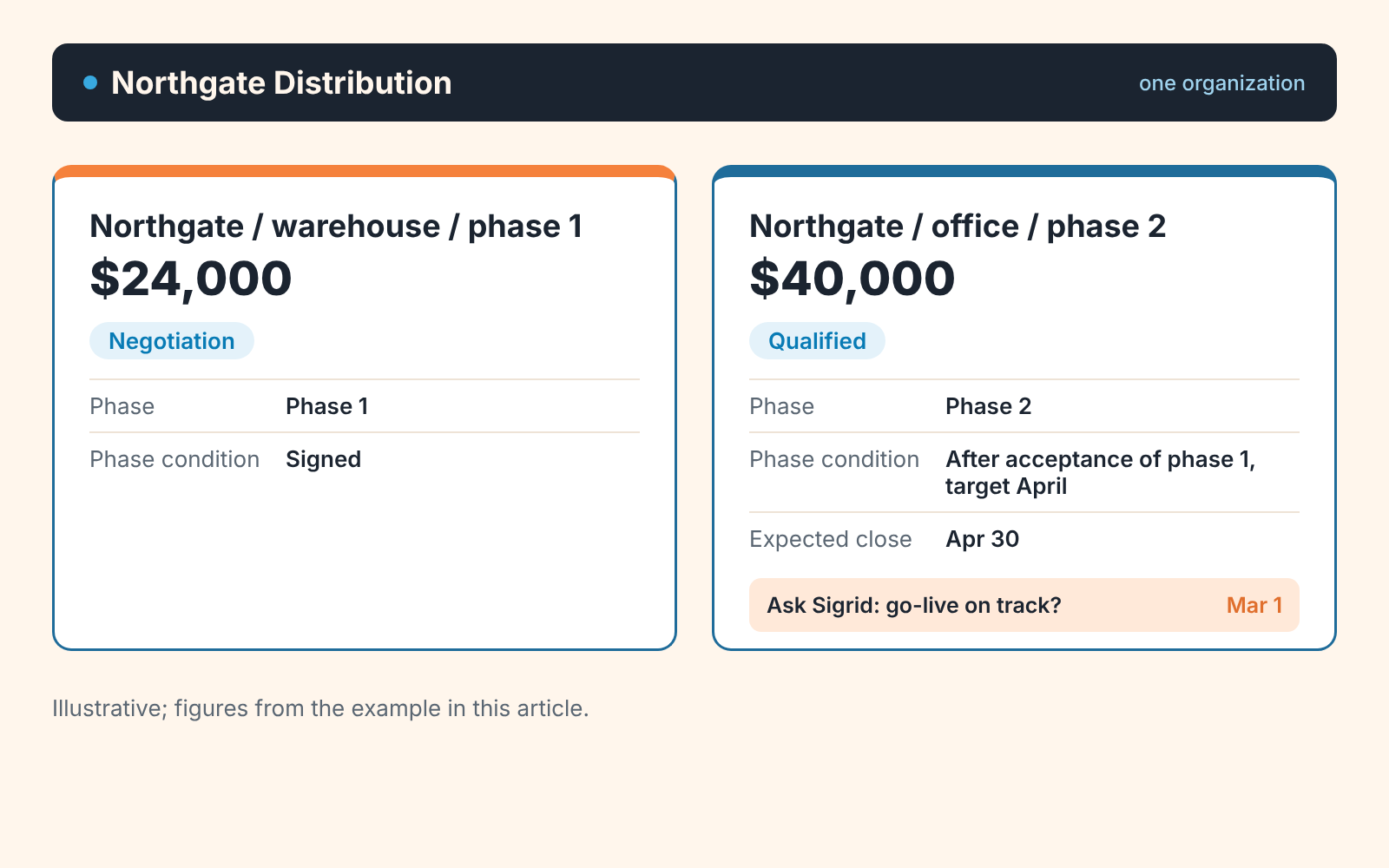
- Create a deal custom field called “Phase”, single option: “Phase 1”, “Phase 2”, “Phase 3”, “Single”. Custom fields can be used in filters (Pipedrive: custom fields), and the filter is the whole reason the field exists.
- Add a second deal field, “Phase condition”, free text, one line: “After acceptance of phase 1, target April”. That puts the trigger and the window in the the place a reviewer will see them.
- Open the phase 1 deal as usual. Value: phase 1 only. Phase: “Phase 1”.
- Open the phase 2 deal the same day, under the same organization. Value: the phase 2 price. Expected close date: the end of the window. Phase condition: filled in. Stage: the earliest stage in your pipeline, because the customer has not qualified, seen a proposal or negotiated phase 2 yet.
- Name the deals so the link is visible in a list: “Northgate / warehouse / phase 1” and “Northgate / office / phase 2”, the same pattern as our deal naming convention.
- Schedule one activity on the phase 2 deal, a couple of weeks before the trigger should fire. Make it specific: “Ask Sigrid whether warehouse go-live is on track for March 15”.
Why not link the deals directly? Pipedrive has no deal field that points to another deal. Projects (included on Premium and higher, a paid add-on on lower plans) can be linked to deals, but it is built for organizing delivery work (Pipedrive: deals vs. projects). For two open sales deals, the organization and the naming convention carry the link.
If your plan allows it, make “Phase condition” required. Required fields block saving a deal until the data is filled in; important fields only highlight what is missing. Important fields come with Growth, required fields with Premium (Pipedrive: custom fields). Without them, a Monday filter does the job: Phase is “Phase 2” or later and Phase condition is empty. It should come back empty. When it doesn’t, someone opened a phase 2 deal on hope.
What goes into the forecast
Only the phase with a signature, or a signature in the pipeline on its own merits. In the example the quarter’s forecast carries $24,000 for the warehouse and nothing for the office. The phase 2 deal sits in the pipeline with its value and date at the earliest stage. If your pipeline uses stage probabilities, it carries that stage’s probability (how that interacts with deal-level probability is in deal vs. stage probability).
The habit to watch is raising it by hand because “they already bought phase 1”. A customer who bought phase 1 is warmer than a stranger, true. But teh trigger has not fired, the budget may belong to someone else, and the warehouse may have a bad first month. A higher probability before acceptance puts the $40,000 back into the forecast through the side door.
Splitting does not double the revenue. Pipedrive’s forecast view (Professional and higher) adds up each deal’s value by expected close date, weighted if probabilities are set (Pipedrive: forecast view), and the two values are separate. You only double-count if the phase 1 deal keeps the full amount, the way Zara’s did.
It does move other numbers. One customer can now produce two won deals, so the won count goes up, the average deal size goes down, and a lost phase 2 shows up in win rate where a single deal would have hidden it. When you compare quarters, filter by Phase or count by organization.
A very large phase 2 is a concentration question (one big deal in the forecast); if your “phases” are really contract years or instalments, see multi-year deals and recurring products versus instalments.
When phase 2 never comes
It happens, and it should happen on a date, not by erosion. When the expected close date passes and the trigger has not fired, the deal either moves to a new date with a reason in the Phase condition field (“warehouse go-live slipped to June, office still planned”) or it is lost, with a reason: budget moved, phase 1 underperformed, sponsor left. Both are fine outcomes. A phase 2 deal pushed three times without a note is the September call waiting to happen.
We build SalesBond, and its Deal Health module checks every open deal against more than 20 rules on activity, progression and data. A phase 2 deal with no scheduled activity and a close date drifting past is the kind of deal it flags, with the reason and a suggested next step. It does not know whether Sigrid’s warehouse went live. It knows the deal has not moved, and for a phase 2 deal that is the question. Check your CRM with SalesBond to see which open deals it would flag today.
The person running the warehouse rollout hears from Sigrid’s team every week and will know before sales does whether the office will follow. So when phase 1 is won, add one line to the closed-won handoff under “what was promised”: “phase 2 deal open, trigger is acceptance, tell Zara the day go-live is confirmed”. And if a customer said “in phases” this quarter, open their phase 2 deal before Friday.