In Pipedrive, a customer is an account: an organization with at least one won deal. The last activity date on that organization shows only the most recent activity that was marked as done, not the most recent purchase. So a quiet customer is found in two passes. First, list customers with no open deal and no completed activity in the last few months. Second, for every repeat buyer, compare the time since their last won deal with the gap they usually keep between purchases. The first pass is a filter plus one date per customer. The second needs an export and a spreadsheet, and it is the one that catches customers who still pick up the phone but have stopped ordering.
The customer who bought three times and then went quiet
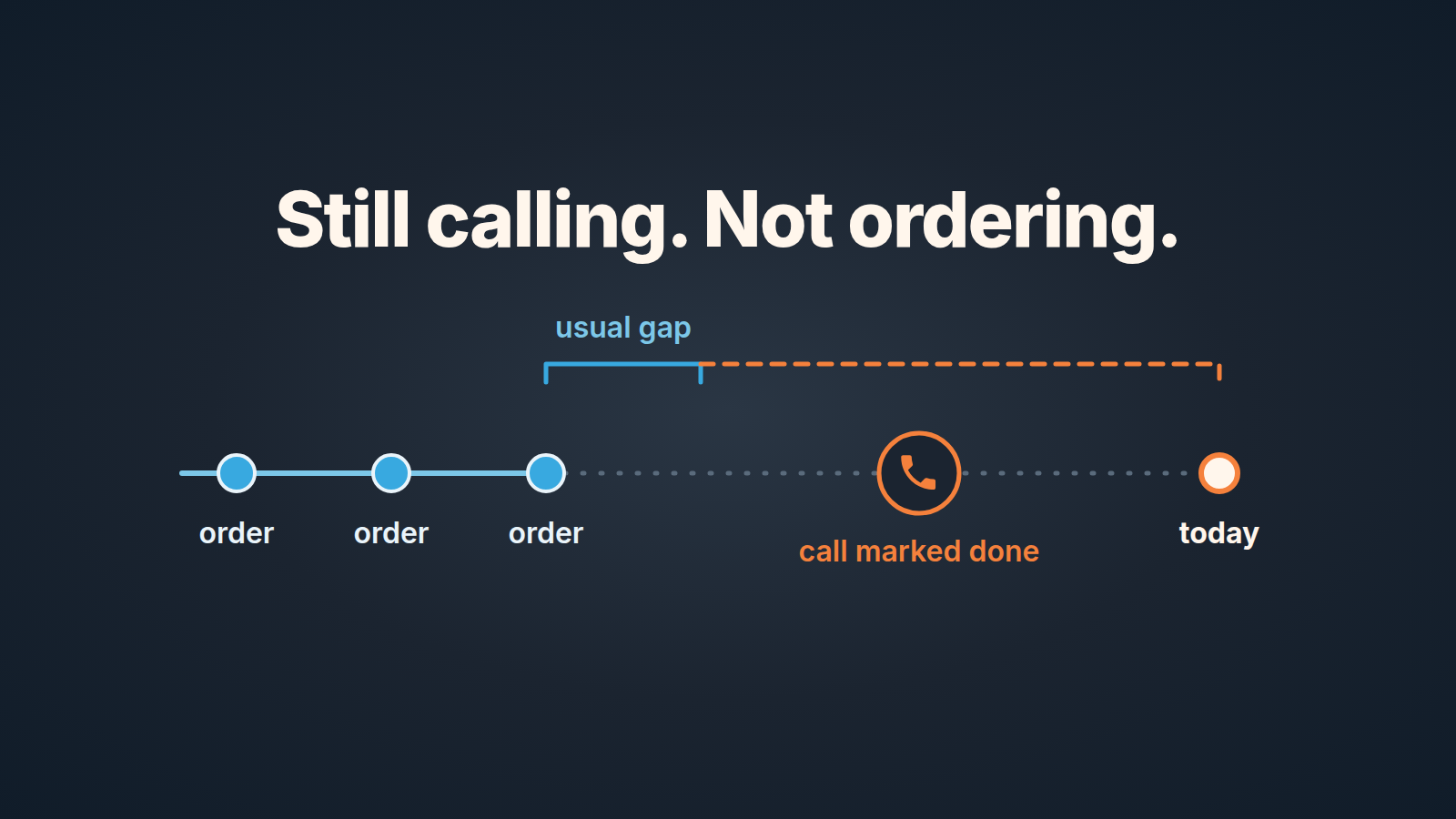
A made-up scene, so the numbers can be exact. Rafael Duarte runs sales at a seven-person company that sells packaging to food producers. Linnea Strand handles the smaller accounts. One of hers is a bakery chain with four shops that ordered three times in 2025: won deals on February 11, July 8 and November 25. The gaps between those orders were 147 days and 140 days. Call it a purchase every 144 days, a little under five months.
On Thursday, October 1, 2026, Rafael opens the organization and sees nothing alarming. Last activity date: August 18, a call Linnea logged and marked done. No open deal, but that is normal for a customer between orders. Nobody is worried about an account that was on the phone six weeks ago.
The number nobody looked at is 310. That is how many days have passed since November 25. At a 144-day rhythm, the next order was due around the middle of April. It is now more than twice the usual gap. The August call was Linnea asking about a new shop opening; the bakery said they would be in touch. They were not, and in Pipedrive that silence left no trace, because the call itself counted as activity.
What Pipedrive calls an account, and what “last activity” actually means
Pipedrive’s glossary defines an account as an organization with at least one won deal; the account is created the first time a linked deal on that organization is marked won (Pipedrive glossary). So the list of your customers is already there, and it is a list of organizations, not of deals.
Three dates on those records matter here, and the same glossary spells them out. Last activity date is the date of the last activity marked as done. Next activity date is the date of the next scheduled activity that is not done yet. Update time is the last change of any kind to the record. None of the three is a purchase date. Purchase dates live on deals, as the won time of each won deal, and the API confirms that an organization carries last_activity_date and next_activity_date while its deals carry won_time (Pipedrive API: Organizations).
That split is why this takes two passes. Activity is on the organization, purchases are on the deals, and Pipedrive does not compute “days since last purchase” for you. It also stays at the level of organizations; for the people nobody has touched, there is the contacts timeline with follow-up frequency. A customer health score for repeat buyers compares those days with the usual buying cycle of each customer.
The fast pass: accounts with no open deal and no recent completed activity
The fast pass answers an easier question: which customers has nobody touched lately? It starts from a filter on organizations and ends with one date checked per customer.
- Start from organizations, not deals. The deal list would show you the open pipeline; the quiet customers are precisely the ones with nothing in it.
- Keep only customers, meaning organizations with at least one won deal. Pipedrive’s filter article walks through the opposite case, a filter for organizations with at least one open deal, and says the same filter can be built for people. It also explains that the linked-deal condition covers open deals only: won and lost deals need conditions of their own, placed under ANY rather than ALL, because one deal can’t be won and lost at once (Pipedrive: common uses of filters). Here you only need the won condition.
- Set aside customers who already have an open deal. Somebody is working those, so leave them to the pipeline. The open-deal filter from the same article tells you who they are.
- Look at each remaining customer’s last activity date (the last activity marked done) and keep the ones older than your cutoff. Ninety days is a reasonable start for a business that sells several times a year; a company that sells once a year would set it longer.
- Save the won-deal filter under a name a rep will understand, and write the owner next to every customer who made it to the end.
What you get is a list of customers with no open opportunity and no completed activity since the cutoff. For a small team it is often the first time anyone has seen the customer base as people to call rather than as a pile of closed deals. A quiet account is a reason to call, but time alone is a reason to check in, not to pitch.
The list is also wrong in one direction. The bakery chain is not on it.
Why recent calls can hide a lapsed buyer
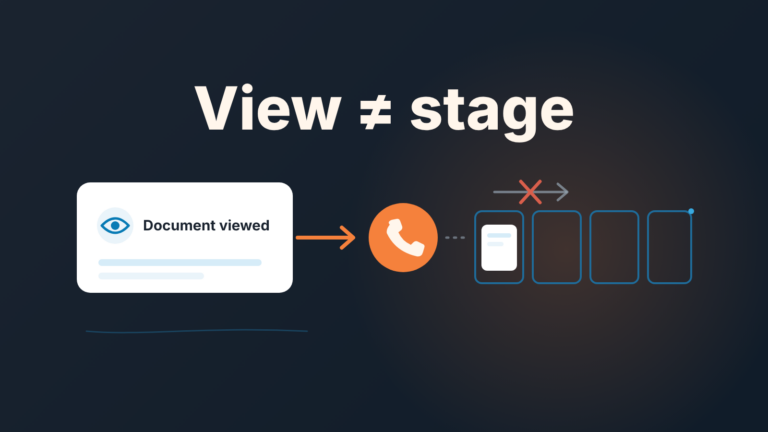
The fast pass leans on the last activity date, and that date moves every time anyone marks an activity done. A logged call, a finished task, a meeting marked done: each one refreshes it. Linnea’s August call pushed the bakery’s last activity date to August 18, and on October 1 that is 44 days ago, well inside a 90-day cutoff. The organization looks alive.
It is a reasonable design: Pipedrive records what the team did, and the team did something. But “we spoke to them” and “they bought from us” are different facts and the fast pass only sees the first. The worst cases are the customers your reps like. Friendly accounts get calls, calls get logged, and a customer can go a year without an order while every report says they were contacted last month.
The date also ignores rhythm. Four months without contact is nothing for a customer who orders every five months, and a real problem for one who orders every six weeks.
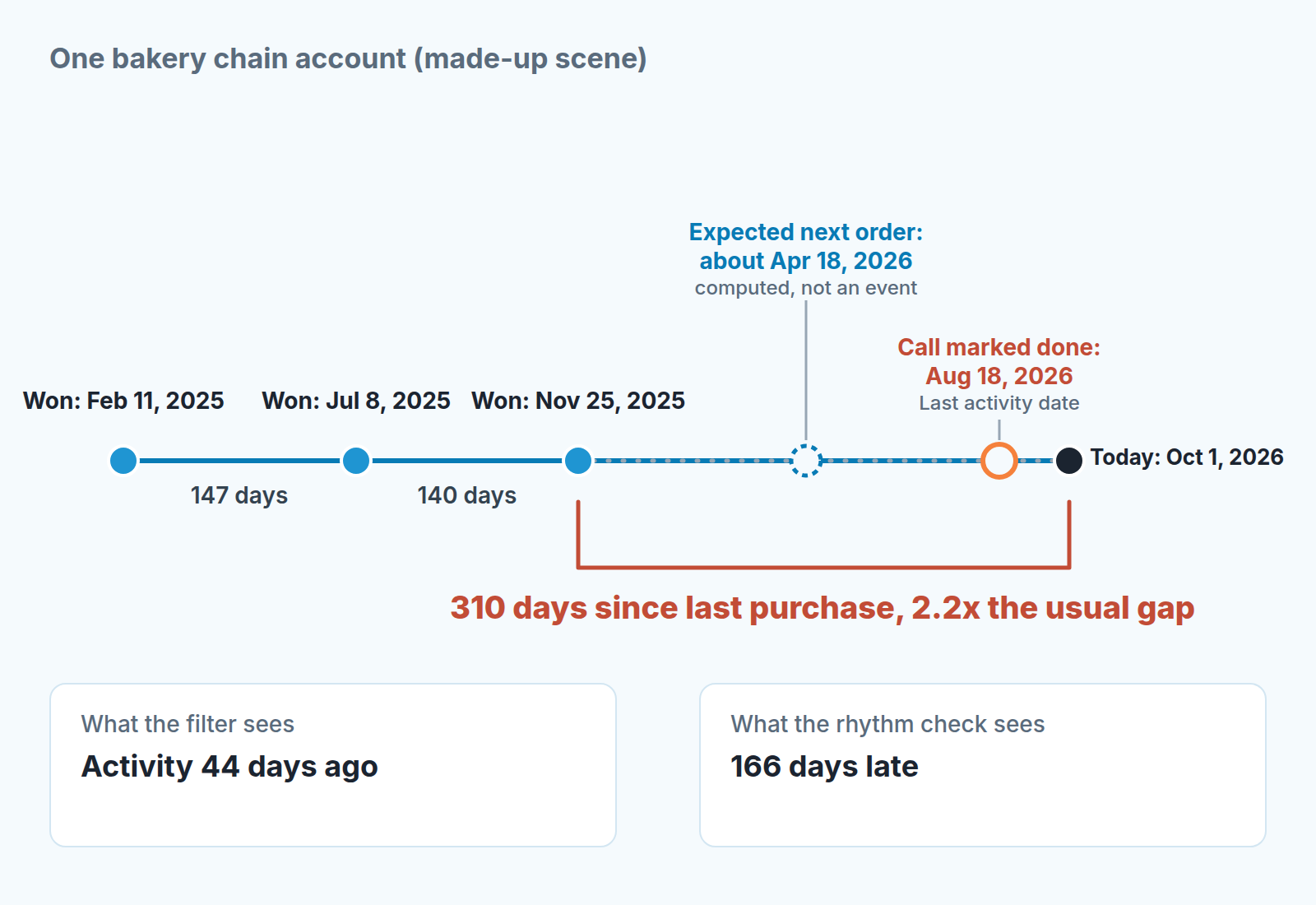
The rhythm check: gap between won deals versus time since the last one
The rhythm check asks the question the filter cannot: is this customer later than they usually are? It needs purchase dates, and purchase dates are on deals, so it starts with an export rather than a filter.
Export the won deals with their organization and their won time. If anyone on the team edits the won time at month end to make a report look tidy, the rhythm will be wrong by the same amount, which is one more reason to leave the won time alone. Sort the sheet by organization, then by won time, and for every customer with two or more won deals compute three columns.
| Column | How | Bakery chain on Oct 1, 2026 |
|---|---|---|
| Usual gap | median of the days between consecutive won deals | 147 and 140, so 144 (rounded) |
| Days since last purchase | today minus the most recent won time | 310 |
| Ratio | days since last purchase divided by usual gap | 2.2 |
The ratio is the number to sort by. Below 1.0 the customer is inside their normal rhythm and a call is optional. Between 1.0 and 2.0 they are late. Above 2.0 they have missed a whole cycle and started on the next one, and in our experience that is where a customer stops being yours without ever telling you.
Two honest limits. A customer with one purchase has no gap to measure; they are new, not quiet, and belong on a different list. A customer with two purchases has one interval, so teh median may be a fluke; treat the ratio as a hint until a third order confirms the rhythm. Rafael’s sheet, built from a few dozen customers, took part of an afternoon and surfaced four accounts above 2.0. The bakery was the one everybody thought was fine.
What to do with the list: one task per customer, one owner, one date
The list is only worth the afternoon if it turns into activities. The rule we use is boring on purpose: each customer on the list gets one task in Pipedrive, assigned to one person, with one date. Not a note, not a label, not a “we should reach out” in the weekly meeting. A task is either done or overdue, and Rafael can see both without asking.
The task has a reason written in it, because the rep opening it three days later will not remember the sheet. “Usually orders every 144 days, last order Nov 25, now 310 days” is a reason. “Check in” is not. Linnea’s call to the bakery goes differently when she knows she is 166 days late rather than making a courtesy call: she asks about the shop that was opening, finds out whether a competitor got the order and learns something the sheet could not tell her.
Owner matters more than it looks. Quiet customers are nobody’s problem by default, because the rep who won the deal has moved on to the deals that are moving. If the account is one of the few the business cannot afford to lose, it belongs on a one-page key account plan with a quarterly review rather than a single task. If it is one of forty small repeat buyers, a task every time the ratio crosses 1.0 is enough.
Set the date close. A quiet customer discovered on October 1 and scheduled for “sometime this month” is a customer discovered in November. Two or three working days is the right distance for the first call. Before the call, look at whether the customer has open tickets; a quiet buyer is sometimes one nobody answered. And when a customer writes that they are leaving, the first two hours decide a lot.
Where the manual version stops working
The fast pass rests on a saved filter, so most of it is waiting for you next time. The rhythm check does not. The sheet is a snapshot: the day after Rafael built it, every “days since last purchase” was off by one, and a month later new won deals had changed the the list. Someone has to rebuild it, and in a seven-person company that someone has a quota. In our experience the sheet gets rebuilt twice, then at quarter end, then not at all. The thing it was built to catch, a customer drifting past their usual gap while still answering the phone, needs a weekly check, not a quarterly one.
That weekly check is the part we built. We build SalesBond, a sales management layer on top of the CRM a team already uses; we started with Pipedrive. Customer Health does Rafael’s arithmetic for every customer who reorders without a contract. A purchase is a won deal. A customer’s buying cycle is the median number of days between their purchases, so it needs at least two, and the days since the last purchase are measured against it. Inside the cycle the customer is on track, past it they are overdue, past twice the cycle they are leaving; those 1.0 and 2.0 lines are defaults you can change. One purchase reads as new, a cycle that can’t be determined reads as undefined, and an overdue customer who has an open deal and recent contact shows as in work. What comes out is a status per customer, never a number, and no machine-learning model is guessing at churn: it is the same division as in the spreadsheet, without anyone rebuilding it. Customers who are overdue or leaving turn up in Sales GPS as one card each, and accepting a card creates one task in your CRM. SalesBond never contacts your customers itself; the call stays with your team. To see which of your contract-free buyers are already past their usual gap, check your CRM with SalesBond.
And if your customers have a contract with an end date, this is the wrong article: quiet is not the signal there, the date is, and the answer is a renewal pipeline built around that date. The rhythm check is for the customers who never signed anything and simply order again, until one day they don’t.