When a customer cancellation request lands, answer the same working day, find out what changed before you decide whether to offer anything, and then record the outcome in Pipedrive: close the renewal deal as Lost with a reason you set up in advance, and paste the customer’s own words into the note. The call is the part everyone talks about. The record is the part that makes the next cancellation easier to see coming, and it is the part most small teams skip.
The Thursday email and the discount reflex
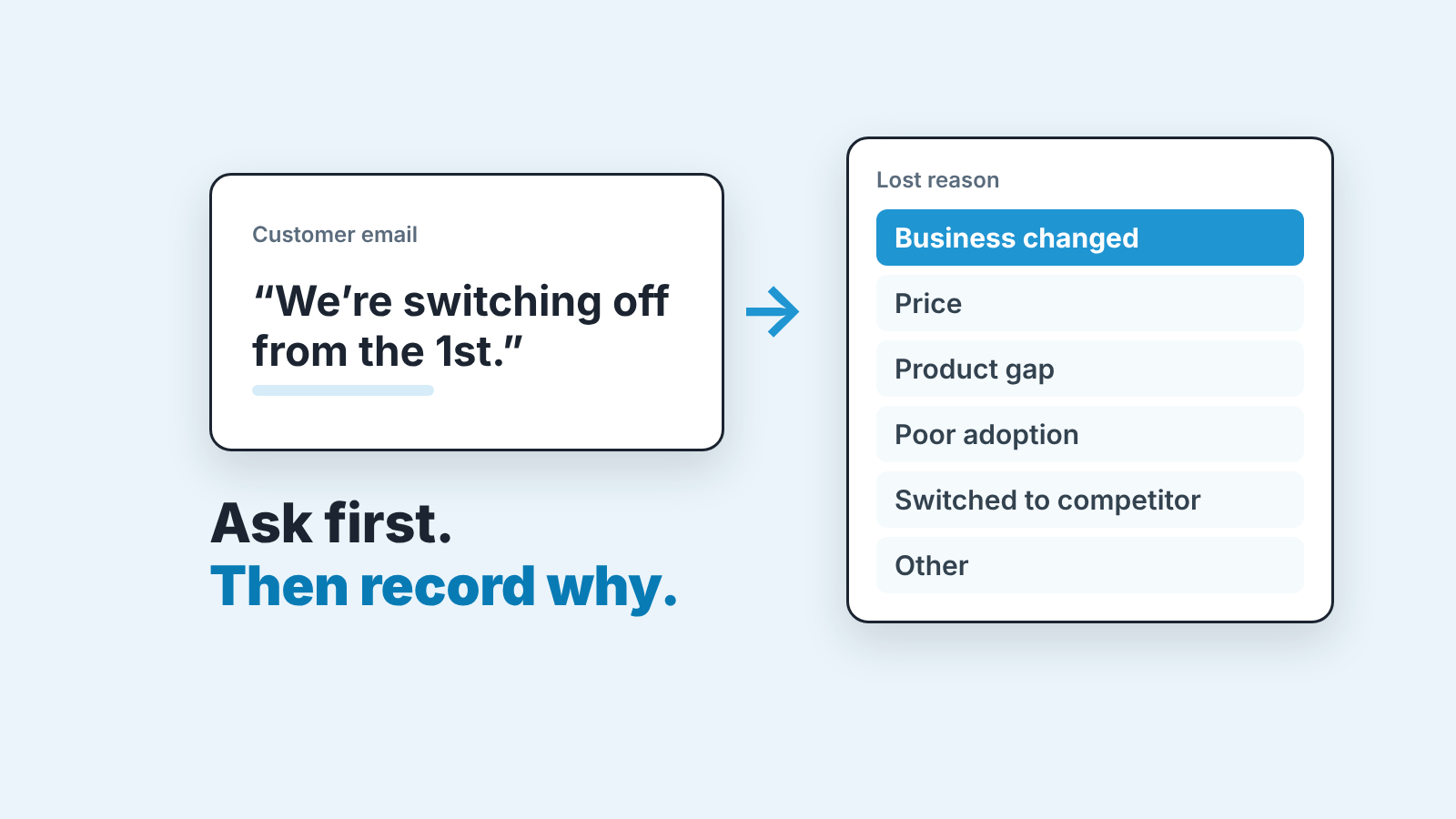
The scene is illustrative, names included. Marlowe manages 35 accounts at a company that sells an order-intake subscription to print shops. One of them is Tidewater Print, run by Halden. On a Thursday afternoon Halden writes: “We’re switching off from the 1st. The spreadsheet is enough for us now.”
Marlowe’s first instinct, and most people’s, is to reply within ten minutes with a discount. Don’t.
A discount answers a question nobody has asked yet. If the print shop has far fewer orders than a year ago, a cheaper tool for orders they don’t have is noise.
The first two hours after a cancellation request
Reply the same working day, and keep it short. Thank them for telling you directly, because plenty of customers just stop paying. Say plainly that you will honor the request, so there is no suspicion you are stalling. Then ask for twenty minutes before the switch-off date and offer two concrete slots. Marlowe’s reply was three sentences: “Thanks for letting me know, Halden. We’ll switch you off on the 1st as you asked. Could we talk for twenty minutes before then, Friday at 10 or Monday at 2?” Nothing about price, nothing about features, no “I’d love to understand how we can win you back”, which reads as a script because it is one.
Inside Pipedrive, do two things in the same two hours. Open the renewal deal and add a note with the date and the customer’s sentence word for word, pasted from the email. Then schedule the call as an activity on that deal, so anyone who opens it sees a save call is due instead of a routine renewal. (If you don’t track renewals as deals yet, start with our renewal process in Pipedrive.)
What you are buying with those two hours is the right to ask questions. A customer who has been thanked and told “yes, we will do as you ask” relaxes. One who has been argued with in the first reply spends the whole call defending the decision.
What to ask on the save call
Ask, then stop talking. We use five questions, roughly in this order, and we rarely get through all of them because the first one usually opens everything up.
- What changed in your business since you signed up? For Tidewater Print the answer was “orders dropped by about half”, not “it’s too expensive”.
- When you bought this, what did you expect it to do for you, and did it?
- Who made the decision to cancel, and when?
- Is there something we did, or failed to do, that pushed this along?
- If your situation changes, what would need to be true for you to come back?
Write the answers down during teh call, in the deal note. The sentence the customer uses for the first question is the one you will want in three months, and the one you will not remember.
When to try to save, and when to let go
We think there are three kinds of leaving, and only one of them deserves an offer on the first call.
The need ended. The print shop has fewer orders; the company was acquired; the project the tool was bought for is finished. There is nothing to save here, and trying insults the customer. Keep the relationship, agree on a date to check in, and make the exit easy. If your product has a pause or a smaller plan, mention it once.
We let them down. Support took a week, a promised integration never arrived, the product failed when they needed it. This is the one case where a discount or a credit is honest, because it is compensation for a specific failure rather than a bribe. Fix the thing first, then offer the credit. If your support history lives in another tool, read the tickets before the call, not after.
Price. It is rarely the only reason, even when it is the stated one. Before you talk price, look at usage. A customer who logs in a couple of times a month and says “too expensive” is telling you the product never made it into their routine, and a cheaper price for a tool nobody uses is just a slower cancellation. A customer who asks to pay less rather than leave is a different case; here is what to do when a customer asks to pay less, not to leave. The exception is a customer who leaves right after you raised prices; that one starts earlier, with how you announced the increase.
Beyond the type, we weigh whether the reason is addressable at all, how long the relationship has lasted and how much this account matters to your year. A two-year customer with an addressable complaint gets a second call. A four-month customer whose business changed gets a warm goodbye.
Recording it in Pipedrive so the reason survives the quarter
After the call, the renewal deal gets one of two outcomes. Either it closes as Lost today with a predefined lost reason, or it stays open with a new expected close date and a note saying why, for instance “pause agreed, review in March”.
Pipedrive supports both freeform and predefined lost reasons; the predefined list is created by a user with Deals admin rights and holds up to 100 reasons, and the comment you type when marking the deal lost is saved as a note on the deal (Pipedrive: lost reasons). That comment is where the customer’s sentence goes. The reason is the category; the note is the evidence.
Which reasons to set up for customers leaving? Our list: Business changed, Price, Product gap, Poor adoption, Switched to competitor, Other. That is our starting point, not a Pipedrive rule; how to build and clean a reason list is in our lost reasons article. One note on it: “Poor adoption” is the honest name for many “Price” cancellations, and the the person who was on the call is the only one who can tell them apart.
One boundary: a customer who cancels an order right after the deal was marked Won is a different record, and we covered it in what to do when a customer cancels after Won. This article is about a live subscription or contract ending.
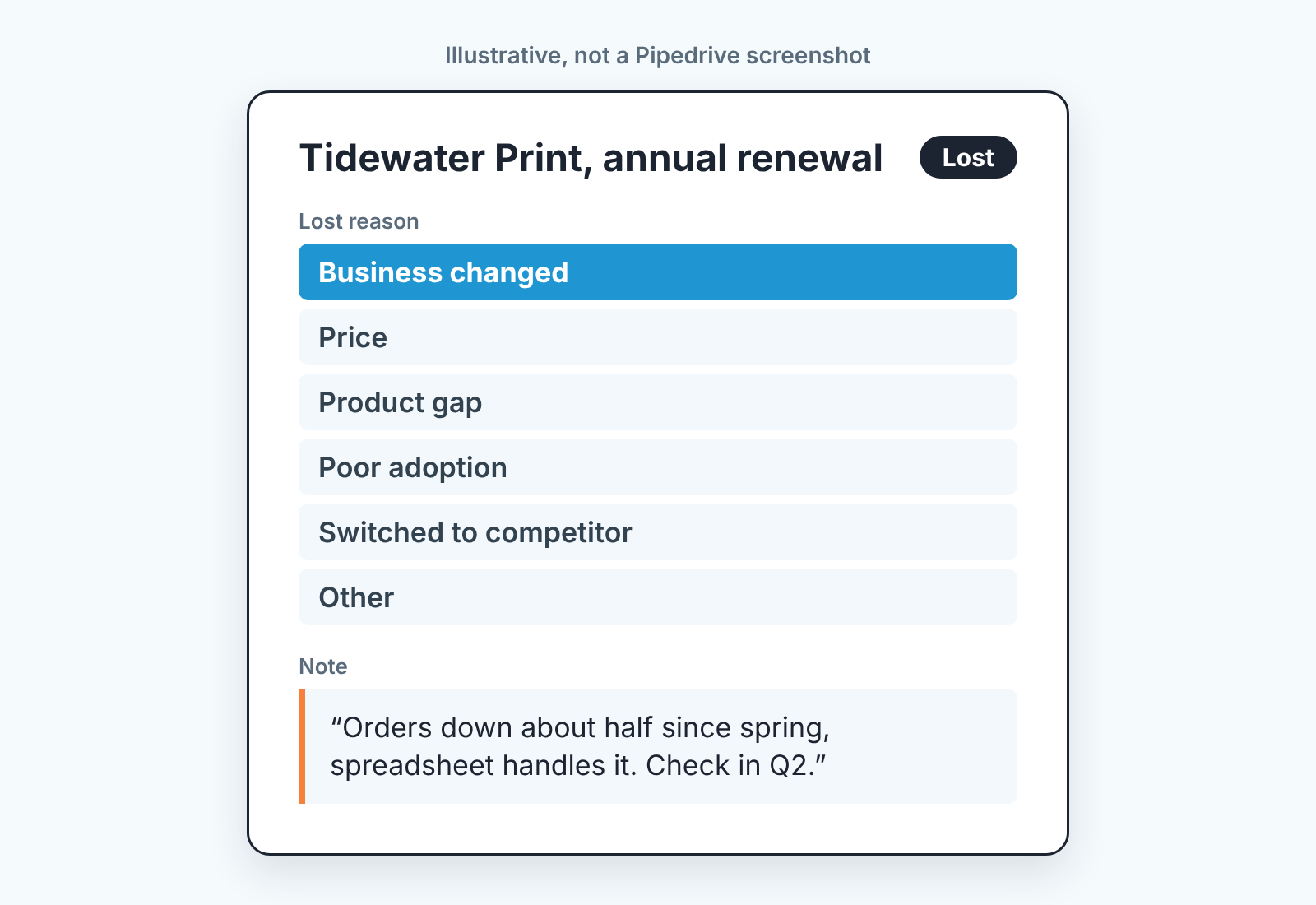
The rule we hold to: the person who was on the call records the reason the same day. Not the manager at quarter end, not from memory. If you want a safety net, Automations (Growth plan and above) can trigger when a deal is updated and create a follow-up activity for the owner, as a reminder to check the note (Pipedrive: workflow automation).
Our other rule is to fill in the reason before anyone archives the deal. An archived deal keeps its status, but its title, value, stage, owner and fields can no longer be changed, while notes stay editable (Pipedrive: archive deals and leads; when to archive at all is in our archiving article).
The quarterly look at who left and why
If you already run the monthly loss review from that lost reasons article, this is the same habit pointed at customers instead of new deals. Every quarter, filter the deal list to the renewal deals lost in the period and group them by reason. The Deal performance report in Insights shows how many deals were started, won and lost, lets you set the view, the measure and the segment, and takes filters (Pipedrive: deal performance report). Then answer three questions, in writing.
Which of these cancellations were visible before the email arrived? A customer whose usual buying cycle had passed with no order, or whose last activity was a support complaint, was visible. Our inactive customers filter finds those accounts while they are still customers, and a customer health score built on buying cycle and overdue status is the same idea made routine.
Which were not visible, and could not have been? The business that closed, the acquisition. Count them too, so nobody treats them as a failure of the account manager.
What changes next quarter, named and owned? One change is plenty. “We call every account that misses its usual reorder date” is a change. “Improve customer communication” is not. The customers counted in the first answer are also the list for deciding who among the churned is worth a win-back call.
This is where most “our customers leave because of price” stories die. When the list reads six “Poor adoption” and two “Price”, the conversation about discounting ends and the conversation about onboarding begins.
What Marlowe did on Friday
Marlowe called Halden on Friday morning, asked what had changed, heard about the drop in orders, and never mentioned a discount. The deal went to Lost that afternoon with “Business changed” and the note “Orders down about half since spring, spreadsheet handles it. Open to coming back if volume returns. Check in Q2.” The account was not saved; the routine was never about one account. In March when someone asks why renewals dipped in the fall, the answer will be a filtered list, not an argument.
We build SalesBond, a sales management layer on top of the CRM a team already uses; we started with Pipedrive. Its Customer Health marks repeat customers as overdue or leaving by their own buying cycle. If you want to see which of yours already are, check your CRM with SalesBond.