When a customer with an overdue invoice asks for a new order, don’t refuse and don’t say yes on the spot. Agree with whoever does your books, before it happens, on two things: how late an invoice can be before a new order needs a decision, and what that decision usually is. Ours is “take the order, ship it once the old invoice is paid.” Keep each account’s payment status on the organization in Pipedrive, where the rep can check it the moment the reorder arrives, and let the rep tell the customer the order of events instead of a reproach. This article is about whether to sell on credit again. Collecting the old invoice is a different job, and we leave it to the people who do it.
A reorder, and an invoice twelve days late
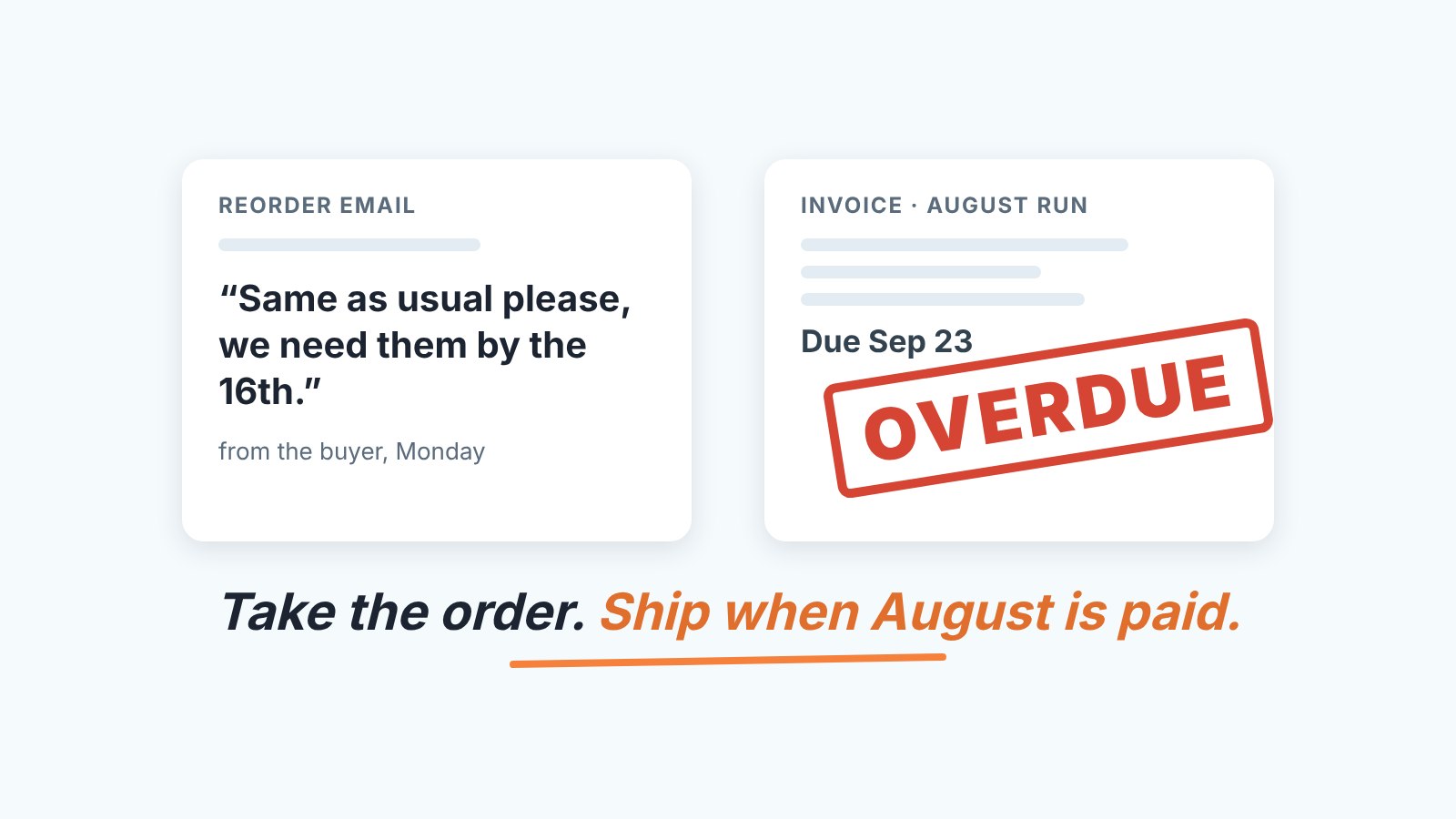
A made-up scene, so the dates can be exact. Clementine owns a seven-person company that prints labels and sleeves for small food producers. Matthias runs the accounts. One preserves maker has ordered roughly every six weeks since spring; the August run was invoiced on August 24 on net 30, due September 23.
On Monday, October 5, 2026, the buyer emails Matthias: “Same as usual please, we need them by the 16th.” Matthias duplicates the August deal, checks the quantities, confirms the date. Takes him four minutes.
On Wednesday the bookkeeper asks Clementine whether she knows they are about to print for a customer who hasn’t paid for August. The invoice is twelve days late. Nobody told Matthias. Why would they? The invoice lives in the accounting software, the reorder lives in Pipedrive, and the two have never met.
Now Clementine has a choice she doesn’t want: stop a job the customer is counting on, or print and carry a second unpaid order on top of the first. Both answers are bad for the same reason. The decision is being made on Wednesday, under pressure, by the the one person who happened to notice.
Whose call it is: sales, the books, or both
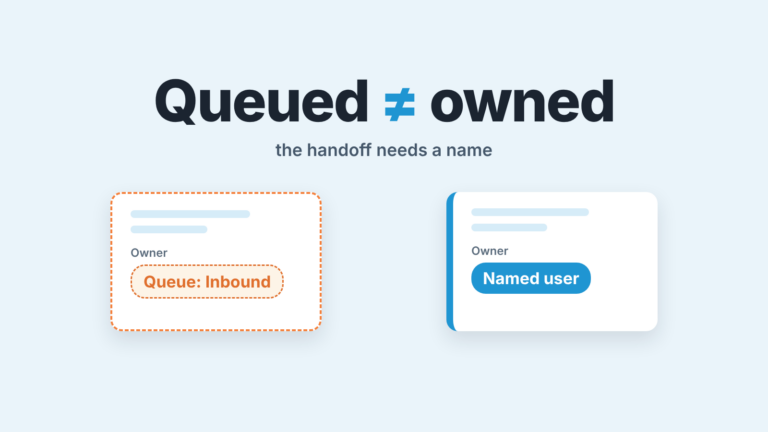
Chaser, writing from the receivables side, argues for shared responsibility between sales and accounts receivable, with “clear policies and procedures” and early communication with the customer, and makes the point that sales reps “know their customers best” (Chaser: should sales reps be responsible for overdue receivables?). We’d split it more sharply. Whether the company sells on credit again to a customer who hasn’t paid is a financing decision, so the rule belongs to the owner and whoever runs the books. Delivering the message belongs to the rep, for exactly the reason Chaser gives: Matthias knows the buyer, the bookkeeper doesn’t.
Bigger companies answer this with a credit hold. In an ERP like Acctivate, an order for a customer on credit hold or with overdue invoices can’t be invoiced until credit is approved on the order, by a user with the permissions to release it (Acctivate: processing orders for customers on credit hold or with overdue invoices). A seven-person company on Pipedrive has no such switch, and we don’t think it needs one. It needs a rule short enough to remember, written once, that the bookkeeper and the rep both agreed to.
Ours is three lines.
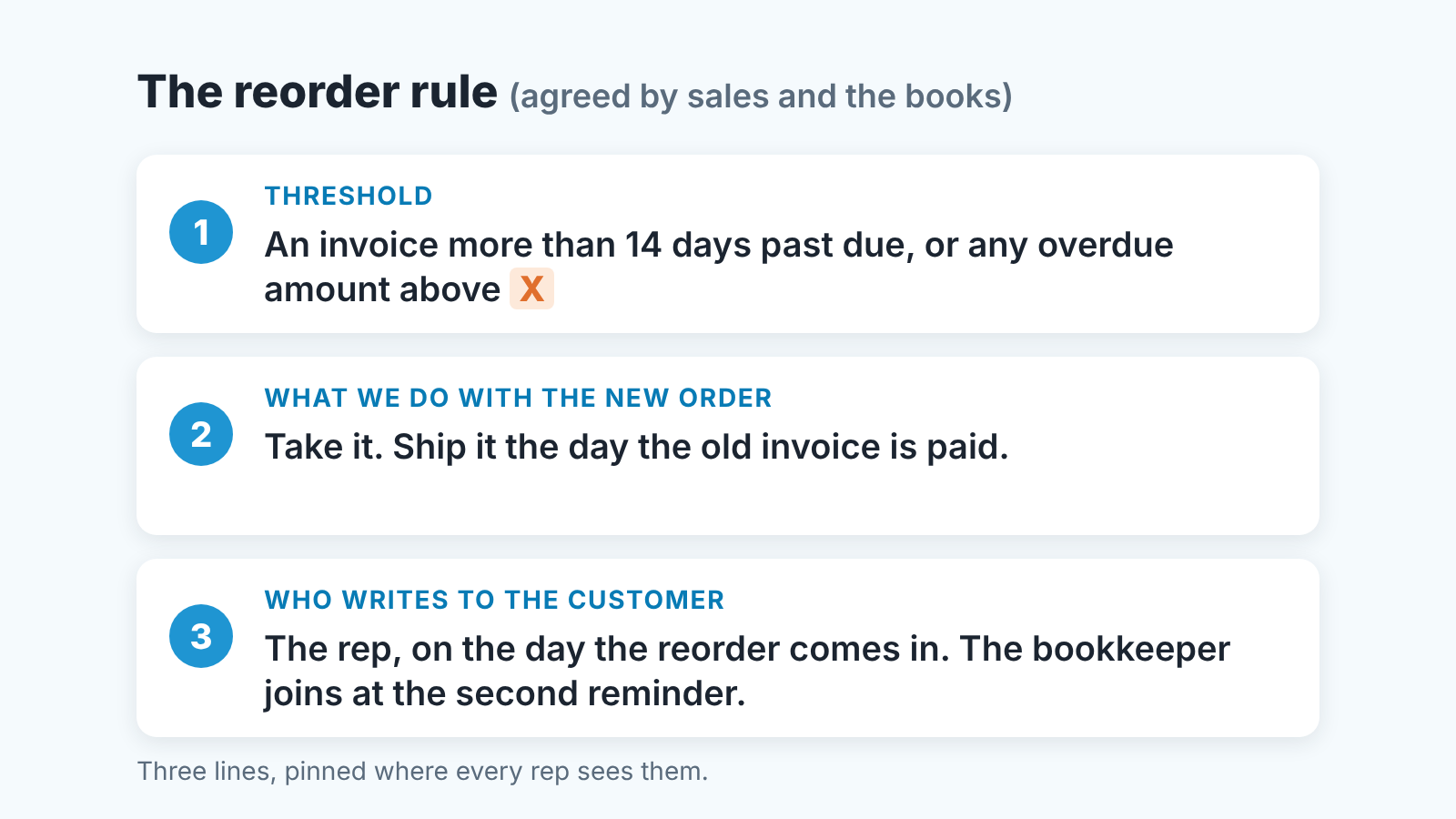
The threshold. How late, or how much, before a reorder needs the rule at all. We use days past due. A customer three days late is usually a customer whose accounts payable runs on Fridays, and treating that as a credit problem costs more goodwill than it protects. If your invoices are large relative to the company, add an amount as a second trigger.
What happens to the new order. The default answer, not the exception. The next section has the three we use.
Who writes to the customer, and when. A name, not a department. In Clementine’s company it’s the rep, on the day the reorder arrives, with the bookkeeper copied from the second reminder onward.
Once it’s written down, the Wednesday conversation doesn’t happen. Matthias answers the Monday email with the rule.
Three answers when a customer with an overdue invoice reorders
Every reorder from an account over the threshold gets one of these. The rule says which is the default; the rep picks a different one only with the owner’s yes.
- Take the order, ship when the old invoice is paid. Our default. The order goes into Pipedrive as a new deal the normal way, production is scheduled, and the dispatch date is tied to the payment date. The customer loses nothing if they pay this week, and most do once someone asks.
- Ship only after both invoices are paid. For an account that has been over the threshold more than once, or when the new order is big enough that two unpaid invoices would hurt. In practice this is a prepayment on the new order. Send it as a pro forma invoice so the buyer has a document to pay against. How to hold that deal in Pipedrive without marking it Won is covered in when a Won deal isn’t really Won until the money lands.
- A partial order. The customer needs one SKU by the 16th and the rest can wait. Ship the urgent part against a payment on the old invoice; the remainder follows when the account is clear. This is the answer for a customer you believe has a cash squeeze rather than a habit, and its the one that usually gets the old invoice paid fastest, because it gives them something concrete to pay for.
Two answers are not on the list. A flat refusal, because it ends a six-week ordering pattern over a twelve-day delay. And “ship as usual and hope”, because that is how one overdue invoice becomes two, and the second conversation is harder than the first.
One more thing about option one. If the held order never ships because the customer never pays, mark that deal Lost. Add a lost reason of your own for it, something like “Unpaid prior invoice”, and you’ll see how often it happens. If you had already marked the deal Won on confirmation, record the cancellation the way we described in when a customer cancels after Won, so won revenue doesn’t quietly include a job that never left the building.
What to say out loud
The customer wrote a one-line email. The reply is two sentences and a question, in that order.
The first sentence accepts the order. “Thanks, we’ve got the usual run in for the 16th.” The customer hears what they wanted to hear. That’s the point: you are not opening a dispute, you are confirming a job.
The second sentence states the order of events. “We’re showing the August invoice still open on our side, so we’ll dispatch as soon as that’s settled; can you check where it’s sitting with you?” The facts, said plainly, then a question that turns it into their task. Most of the time the honest answer is dull: wrong inbox, a missing purchase order number, someone on vacation. The question lets them say so without losing face.
If the rule says option two, the second sentence becomes “for this run we’ll need August settled and the new invoice paid before dispatch.” Nothing else changes. Don’t explain why. The customer knows why.
What Matthias doesn’t say. “Your account is on hold”, because it sounds like a system decided and he’s only the messenger, and the buyer will go over his head to find the system. “We can’t ship until you pay” as an opening line, because the first thing the customer reads sets the tone of the whole thread. Anything about trust.
And he doesn’t write to accounts payable. He writes to the buyer, the person who sent the reorder and wants the labels on the 16th, because that person has a reason to move the invoice and AP doesn’t.
Don’t apologize for asking either. Payment terms were agreed when the account opened, and if they were negotiated, they were priced and traded for at the time. Holding the customer to them is the deal you both signed up for.
The mark in Pipedrive: on the organization, not the deal
Here is why Matthias didn’t know. When he duplicated the August deal, Pipedrive copied the organization, the people, the products, the stage and the pipeline; it did not copy the notes, the activities or the emails (Pipedrive: how can I duplicate a deal). Even if the bookkeeper had left a note on the August deal saying “chasing payment”, the October deal would have arrived clean. A reorder starts from a copy of the past with the past’s warnings stripped off. (The reorder routine itself, and what to fix by hand on every copy, is in one deal per order in Pipedrive.)
So put the mark where it travels with the customer: on the organization.
Add a single-option custom field on organizations called Payment status with two values, OK and Overdue. Two, not six. The field answers one question, “can we sell to this account as usual today”, and every extra value makes the rep think instead of act. If you also keep the deal-level Payment status field from the prepayment article, the two dont collide. That one describes one invoice on one deal; this one describes the account.
Who updates it is the part most teams skip, and the field is worthless without it. The person who sees the invoices sets it, on two occasions only: the day an invoice crosses the threshold, and the day it is paid. Not the rep, who never sees the bank. The same gap appears when finance issues a credit memo on a deal that is already won: the invoice changes, and the deal never hears about it.
The deal’s sidebar links the organization (Pipedrive: deal detail view), and the organization’s detail view shows its custom fields (Pipedrive: detail view), so Payment status is one click from the October deal. Because the field lives on the organization, it’s the same mark whichever of that customer’s deals the rep opens from. A note on one deal never gives you that.
Then one saved filter on the organizations list, run every Monday before the pipeline review, with two conditions under ALL: Payment status is Overdue, and Open deals is more than 0 (the same open-deals condition Pipedrive shows in Filters: common uses). That is the list of customers you are currently selling to on credit while they owe you. Every line gets a name and a date: who writes to the customer this week, and when the bookkeeper flips the field back. A customer on that list three Mondays running moves from option one to option two. The rule makes that call, not the rep. A subscription customer has a version of the same gap: a failed subscription payment sits in billing while the renewal deal in the CRM still looks healthy.
When paying late is a signal about the account
A customer who used to pay on day 28 and now pays on day 45, and keeps reordering, is a different animal from a customer who stopped ordering. We treat the first as a cash or process problem at the customer, handled by the rule above, and we keep selling. What Clementine actually loses sleep over is the second: the preserves maker who was due to reorder in mid-October and hasn’t written.
Those are two lists and it helps to keep them apart. The Monday filter answers “who owes us money and is still buying”. The order that didn’t come is answered from the organization’s won dates and the gaps between them, the method in which Pipedrive customers have gone quiet and, with a buying cycle per customer, in a buying cycle per customer, built from Pipedrive dates.
We build SalesBond, a sales management layer on top of the CRM a team already uses; we started with Pipedrive. Its Customer Health part works out the second list for you: each repeat customer gets a buying cycle from their won deals, and a status of on track, overdue or leaving depending on how far past that cycle they are. One thing to be clear about, because the word overlaps. “Overdue” in Customer Health means the next purchase is late, not that an invoice is. It reads the CRM’s deal dates, not your bank, so the Payment status field is still yours to keep. If the preserves maker’s October order is late, it’s on that list whether or not August has been paid. Check your CRM with SalesBond.
The August invoice was paid on Friday, October 9, four days after Matthias’s reply. The labels shipped on the 16th.
This week, sit down with whoever sees your invoices and write your three lines. Then create the field. The next reorder from a late payer should take the rep four minutes, same as Matthias’s did.