
Sales meeting cadence here means the team’s own internal meetings, not the sequence of calls and emails a rep sends a prospect. For a small team that cadence is four recurring meetings: a weekly pipeline review, a short weekly 1:1 with each rep, a monthly look at conversion and cycle length, and a quarterly reset of quota and territories. Anything beyond that has to earn its place by a decision it makes. No daily standup by default, no separate forecast call, no monthly all-hands where the manager reads numbers off a dashboard.
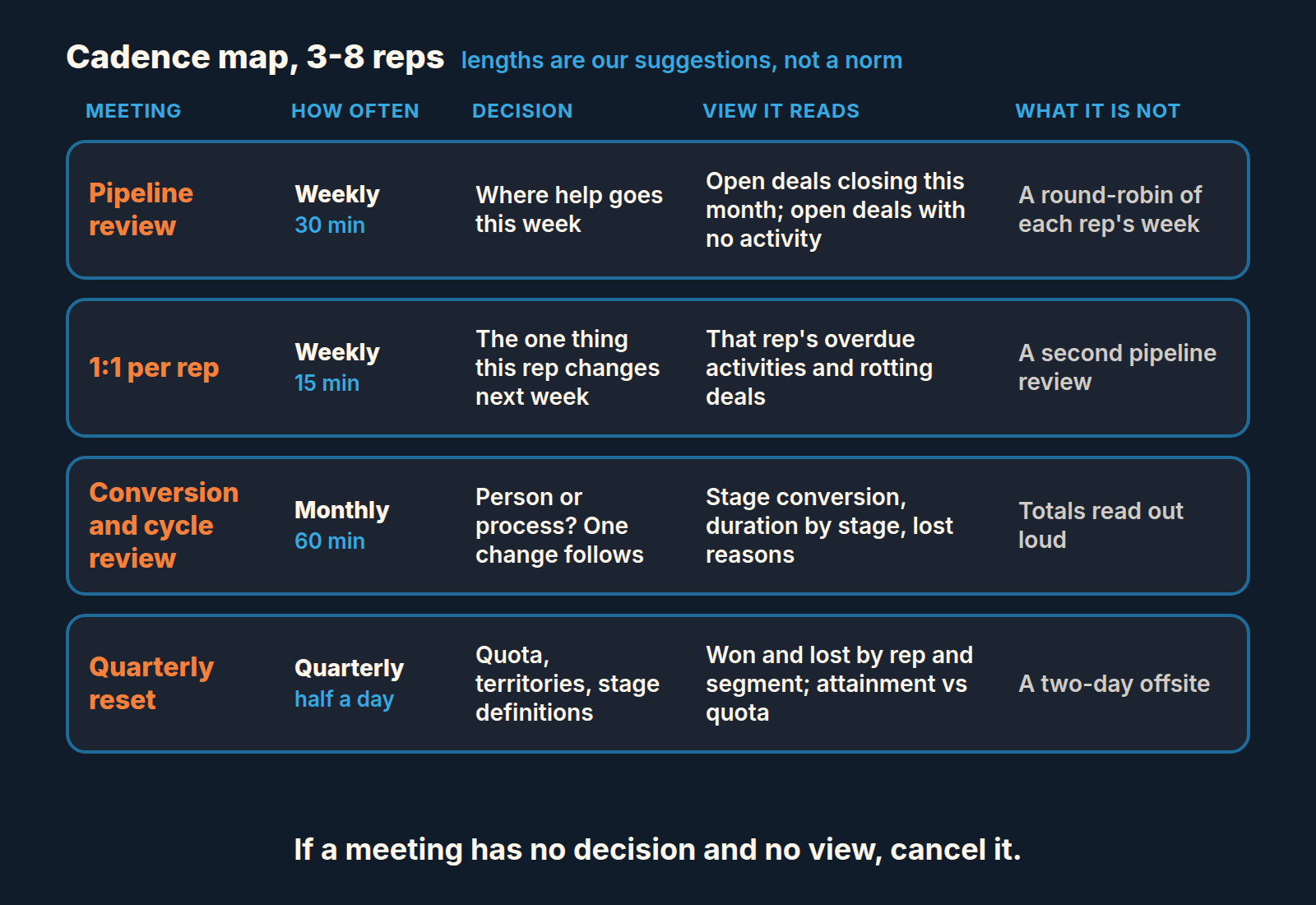
This is the map. Each meeting on it has its own depth page, linked where it belongs, so this post stays about the shape of the week and the month rather than the agenda of any single meeting. The lengths below are what we would book, not an industry rule.
One decision per meeting, or it goes
Here is the test we apply to every recurring slot on a sales calendar. Name the decision this meeting makes. Then name the CRM view it reads to make it. If either answer is blank, the meeting is a status read-out, and a status read-out is a report with chairs.
The decision has to be one that people cannot make alone from the CRM. “Which deals are at risk” is not a decision; a Pipedrive filter on deals with no scheduled activity answers it in two seconds, before anyone sits down. “Which two of those deals the manager joins calls on this week” is a decision, because it costs something and two people might disagree about it. The weekly pipeline review exists for the second question, not the first.
The view matters as much as the decision. A meeting that opens with “so, how are things going” runs long whatever you put on the invite, because nobody is looking at the same thing. A meeting that opens with a filter already on the screen runs as long as the filter is tall. It works best as a shared filter with saved columns, so everyone is looking at the same thing. Whether a weekly meeting feels short or endless comes down, almost entirely, to whether the data was open before it started.
There is a second half to the test, and it is where small teams win. With three to eight reps, the manager can see every open deal in one scroll. A twenty-rep team needs tiers of meetings because no one person can hold the pipeline in their head. You can. So every meeting a big-company playbook adds for coordination is a meeting you can skip, and the four that remain are the ones that make a decision the pipeline view cannot make for you.
Weekly sales meetings: the pipeline review and the 1:1s
Two meetings carry the week. They look alike from the outside and do different jobs, which is why teams that merge them end up with one long meeting that does neither. The meeting rhythm covers the team; the deal-level sales cadence covers what each rep does between meetings.
The pipeline review
- When and how long: one fixed slot, same day every week. We book 30 minutes. If the pipeline is clean it finishes early; the 15-minute version is what a clean pipeline looks like, and the depth page covers how to run it.
- Who: the whole team, manager driving. Once the team splits into two or more groups, consider a Monday review by team, one group at a time.
- The decision: where help goes this week. Which deals get a second person on the call, which get a discount conversation, which get closed lost today instead of next month.
- The view it reads: the Pipedrive pipeline view, filtered to open deals with an expected close date inside the current month, plus a second filter for open deals with no activity scheduled. Those two filters are the agenda. There is no other one.
- What it is not: a round-robin where each rep narrates their week. The meeting is about deals not people. If a rep’s name comes up more than their deals do, that conversation belongs in the 1:1.
The 1:1
- When and how long: once a week per rep; we’d book fifteen minutes. Fixed slot, not “when we both have time”, because the slot that floats is the slot that gets skipped the week it was most needed.
- Who: the manager and one rep. Nobody else, ever.
- The decision: the one thing this rep changes next week. One. A prospecting habit, a stage they keep skipping, a proposal that has been “almost sent” for ten days.
- The view it reads: that rep’s deals with overdue activities, plus the ones Pipedrive marks as rotting. Rotting counts from the deal’s last update, not from the day it entered the stage, so a rotting deal is one nobody has touched in a while. Not the whole pipeline again; the pipeline review already did that.
- What it is not: a second pipeline review with a smaller audience. The 1:1 agenda page has the structure; the short version is that the rep talks and the manager asks.
One more thing the weekly cadence does not include: a meeting to go through the numbers. That is what the weekly sales report is for. It goes out before the pipeline review, people read it in three minutes, and the meeting starts from the deals instead of from the totals.
Monthly and quarterly
A week is too short to see a pattern on a team of five. Three deals slipping in one week is noise. Three deals a week slipping at the same stage for a month is a process problem, and that is the kind of thing the monthly meeting exists to catch.
| Meeting | How often, how long (our suggestion) | The decision | The data it reads |
|---|---|---|---|
| Conversion and cycle review | Monthly, we’d book 60 minutes, manager plus reps | Whether the problem this month was a person or the process, and what one change follows from that: a coaching focus for someone, or a change to a stage, a field, a rule | Stage-to-stage conversion for the last 90 days against the 90 before; deal duration by stage; lost reasons, grouped |
| Quarterly reset | Once a quarter, we’d give it half a day, manager plus reps, owner or founder if they set quota | Quota for the next quarter, who owns which territory or segment, and whether the stage definitions still describe how deals actually move | Won and lost by rep and by segment for the quarter; attainment against quota; where in the pipeline deals died |
The monthly meeting is the one most small teams skip, and it is the one that changes the most. The “people versus process” question is the whole agenda: when conversion from Proposal to Negotiation drops, is it one rep’s proposals or is it everyone’s, in which case the proposal step itself is the thing to fix. How to read stage conversion rates in Pipedrive is its own page. Leading and lagging metrics are the vocabulary for the discussion, and managing sales by process is the reason you want it monthly rather than whenever someone is worried. Pull the conversion and duration reports from Pipedrive Insights the day before, screenshot them into the invite, and nobody opens the meeting by asking what the numbers are.
The quarterly reset is where the pipeline stages get re-examined. If reps have been skipping a stage for three months, the stage is wrong, not the reps. This is also the only meeting on the list where it is fine to leave without a decision made on the spot: quota and territory changes deserve a night’s sleep. Write the proposal down in teh meeting, confirm it within the week, and do not let the reset turn into a two-day offsite with a slide deck. Half a day, with the quarter’s won and lost deals open on the screen, is enough.
The first 90 minutes of that half day can be a proper sales QBR for a small team: five numbers, three questions, three decisions. If you also want the quarter to start with one practiced behavior, that is a separate meeting: a half-day kickoff for a small team.
What to cancel
Start with the daily standup. Any single one sounds harmless until you multiply it by five working days and six people. On a team of three to eight the standup does one of two things: it repeats what the pipeline view already shows, or it drifts into a deal discussion that should have been a 1:1. We run one only when a rule triggers it, and the rule carries an end date. A new rep’s first four weeks. The last two weeks of a quarter when the team is close to number. A product launch. When the trigger ends, the standup ends, and it does not get renewed out of habit.
Then the separate forecast call. If the pipeline review reads deals with an expected close date this month, the forecast is already on the screen; a second meeting to say the number out loud adds nothing. Fold it in. The number gets stated at the end of the pipeline review, after the deals have been looked at rather than before.
The monthly all-hands sales update goes next. If the manager is reading totals to the team, that is a report with an audience. Send the report. Keep the monthly slot for the conversion and cycle review, which is a discussion and not a broadcast.
Standing deal reviews are the last one. A fixed weekly slot to walk through big deals fills up with whatever deals are around that week. Make it a trigger instead: a deal over a threshold you set, or a deal entering Negotiation, gets a review when it gets there, booked the the day it crosses the line. The questions worth asking in that review are about what the buyer did. Some weeks that is two reviews. Some weeks it is none, and nobody has to sit in a room pretending otherwise.
Deals with unusual payment or delivery terms work the same way: a same-day review catches them before they reach any meeting.
What is left, for a manager with five reps, is roughly two hours of meetings a week, one more hour a month, and half a day a quarter. Every one of those slots can say what it decided last time. If a slot on your calendar cannot, that is the one to cancel next, and the pipeline view will not miss it.