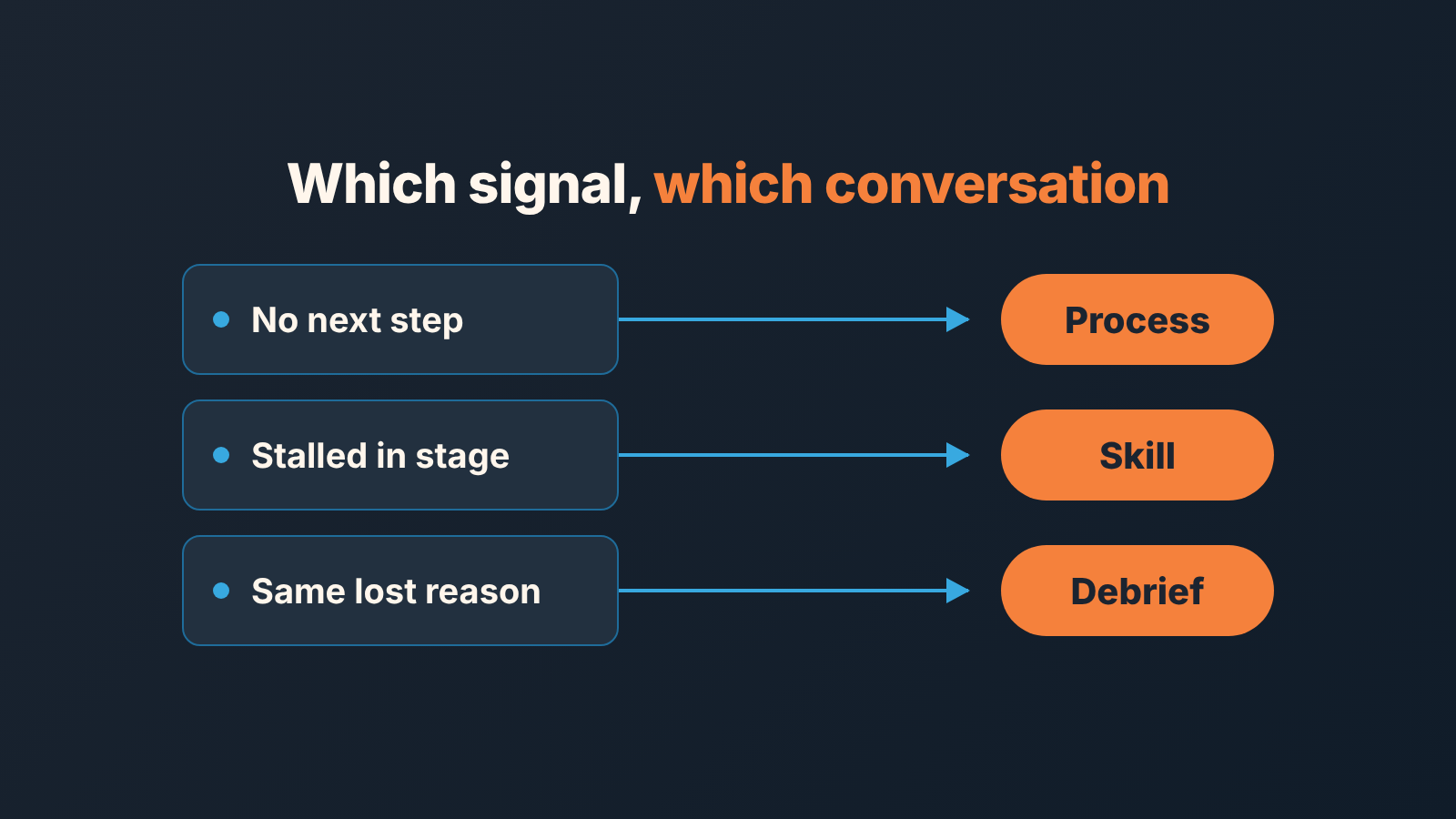
Sales coaching is regular one-to-one work with a rep on specific behaviors that affect results. The CRM tells you where to start: a deal with no next step, a stage where one rep’s deals stall, a loss reason that repeats. Each signal calls for a different conversation, and the first question is always whether it’s the person or the process.
This article is the map. The individual conversations are taken apart in their own pieces, and we link to them rather than repeat them here.
What sales coaching is, and what it is not
Sales coaching is a manager working with one rep, over weeks, on one behavior you can name; training teaches a skill to many people at once and then stops.
Other definitions say much the same. Revenue Grid describes coaching as “a process where sales managers or experienced individuals guide and mentor salespeople to improve their performance”, and as “a continuous process that goes beyond initial training and onboarding, focusing on individual needs” (Revenue Grid: What is sales coaching). The Brooks Group is shorter: “The core of effective sales coaching is evaluating behavior and providing feedback to improve performance” (The Brooks Group: sales coaching best practices for managers).
Three words in there matter: individual, behavior, continuous.
Training is the opposite on all three counts. It is one-to-many, it covers a skill in general rather than what this rep did on Tuesday, and it ends when the course ends. Management is different again: targets, pipeline review, who gets which lead, the decision to let a deal go. A manager of five does all three in the same week, often with the same person, and the mistake we see most is doing them in the same meeting. A pipeline review that turns into feedback on the demo is neither a good review nor good coaching. The rep hears “my numbers are being questioned” and stops listening.
So coaching, for this article, means: one rep, one behavior you can name, a conversation you will have again next week.
Start from a signal, not from a feeling
“I think Tom is weak at closing” is usually a memory of the last deal Tom lost. It feels like a diagnosis. It is one data point, chosen because it was recent and because it hurt.
The CRM is the only record you have of what a rep did while you were not in the room. Not a complete record, and not a fair one when fields are empty, but a record. It tells you which deals have no activity scheduled, how long each deal sat in each stage, what the rep wrote as the lost reason, and how that compares with the rest of the team working the same pipeline. That is enough to pick what to talk about, and to walk in with the deal open instead of with an impression.
Why a number looks the way it does is a separate question, and we covered where the data runs out in AI sales coaching from deal data.
One more rule we hold to: one signal per conversation. A rep who gets four things to fix on Monday fixes none of them. If coaching is not enough and you are weighing courses, we looked at sales training programs for a small team and what the CRM numbers say about them.
Six signals in the CRM and the conversation each one calls for
If you came looking for examples of sales coaching, these are ours. They are the six we look at first, in any CRM: the field names vary, the data does not.
An open deal with no next activity
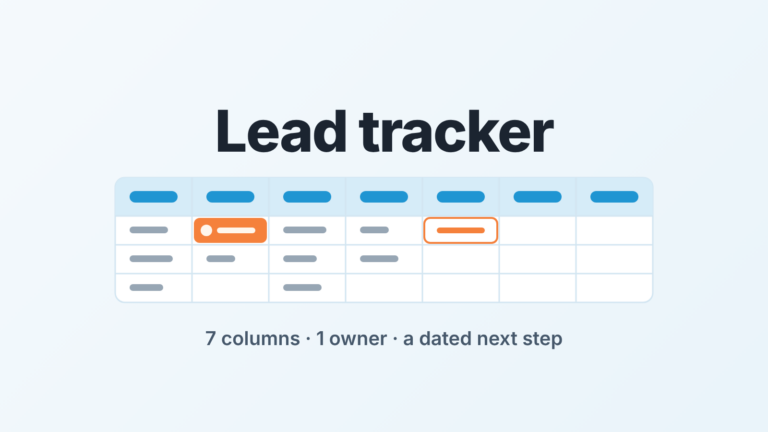
This is the one we would start with on any team. It is cheap to find and it is almost never a skill problem. The rep either has no agreed next step with the buyer, which is a process conversation about how deals should move, or has one and did not log it, which is a conversation about fields. Both are fixed by asking what the buyer did last and what the buyer agreed to do next. We would not coach “closing skills” off this signal. The questions are in Deal review questions: ask what the buyer did.
One rep’s deals sit in one stage longer than the team’s
Before it becomes a skill conversation, check how that rep defines the stage. If “Proposal sent” means “I mentioned a price on the phone” to one rep and “a document is with the decision maker” to another, the data is comparing two different things. Only when the definitions match is it about skill at that stage, and then you need to hear a call, not read a column. The sales call review scorecard is how we listen.
A low demo-to-proposal rate for one rep
It looks like the stage signal and is cleaner. If the team converts demos and one rep does not, something is happening in that rep’s discovery or in the demo itself. That is a skill conversation, and it starts with a recorded demo and the same scorecard.
Many losses with the same lost reason
The signal most often read backwards. One rep losing on “price” five times is a conversation with that rep. Everyone losing on “price” is a conversation with yourself about who you are selling to, your pricing, or where the leads come from. For the first case, debrief before you decide anything; How to debrief a lost deal with your rep is written for that, and it is deliberately not a trial. If the repeated reason is an objection the rep keeps meeting, logging objections in the CRM and coaching from them turns a hunch into a list you can go through together.
Empty fields on one rep’s deals
A habit, or a field nobody explained the use of. Habits are coached in the open, with the monthly scorecard on the the table, not by a reminder in the CRM. A reminder nags; a scorecard shows the rep what the blank costs them. The one-pager we use is in Sales rep scorecard: a monthly one-pager.
Weeks without a win from a rep who usually wins
Here the honest first move is no coaching at all. You do not know yet whether it is a streak or a decline, and they call for opposite responses. Read the rep against their own history first: Sales slump on a small team: streak or decline?
Two situations do not fit the list but come up every week. When a signal makes you want to step into a deal yourself, agree the role before you join the rep’s deal, because “I’ll jump on tomorrow” is a signal the rep reads too. And if you carry your own quota, your own deals are a signal to the team whether you like it or not; the player-coach piece covers how to keep them out of the team’s numbers.
Person or process? One check before you coach
Before you coach, put the rep’s number next to the team’s on the same pipeline and period. Every signal above has this fork hidden in it, and we think it is the most expensive fork in sales management to get wrong. Coach a rep for a problem the whole team has, and you lose thier trust and keep the problem. Rebuild the process for a problem one person has, and you slow down four people to fix one.
If the rep is where the team is, the signal is about the pipeline, the stage definitions, the lead source, the pricing. If the rep is clearly apart from the team, it is a person conversation. If you cannot tell, because a few dozen deals is not a dataset, say so and wait a month rather than coach on noise. The four checks and what to do after each verdict are in Is it the rep or the pipeline?
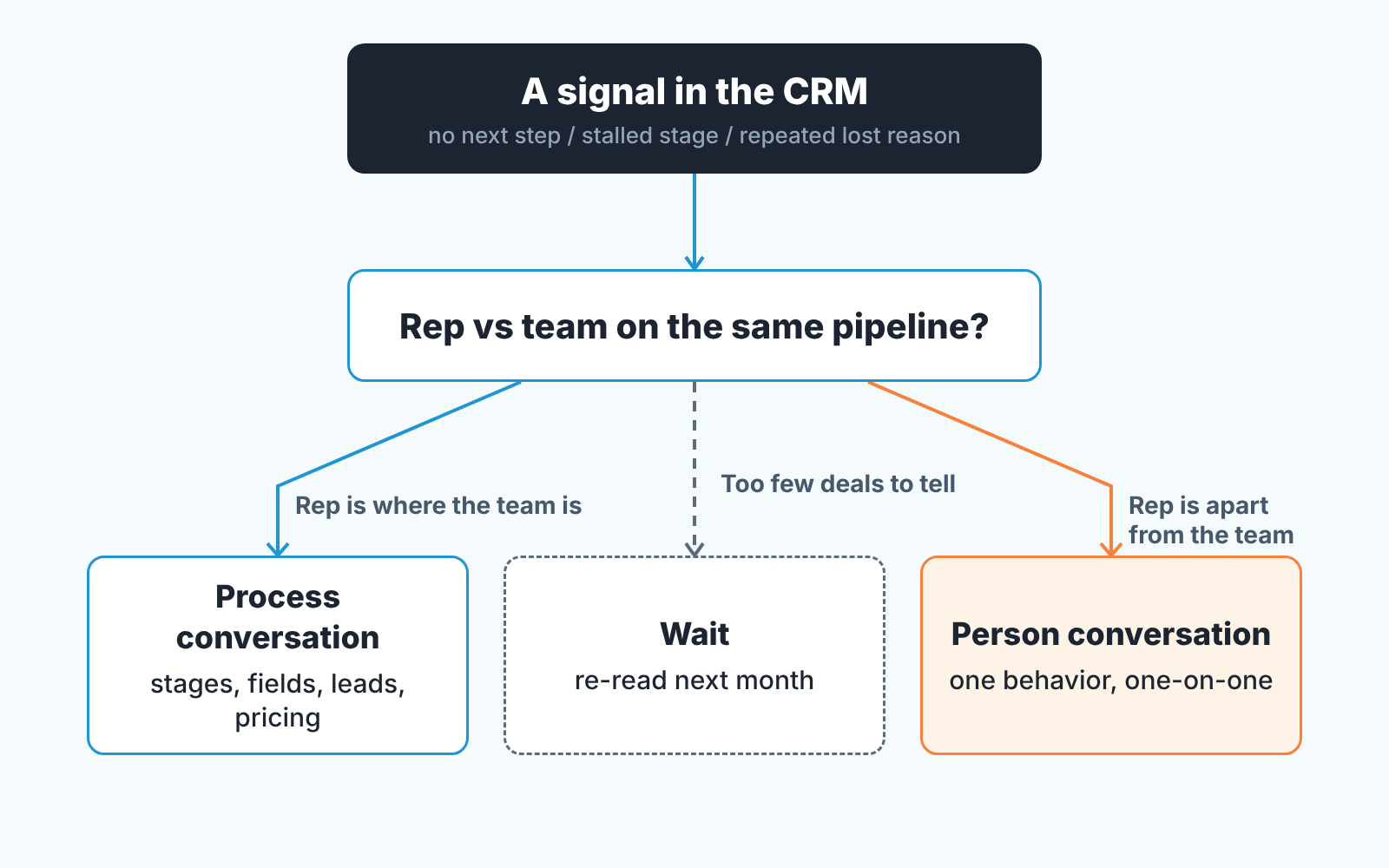
We put this check before every coaching conversation, not only the dramatic ones. It takes two minutes with a filter and it changes what you say in the first sentence.
A 30-minute rhythm for coaching a sales team
Here is the shape we use with managers of three to eight reps.
The coaching conversation is the weekly 1-on-1, and it is the one meeting that does not move. Pipeline review is a separate slot, ideally a different day so the rep knows which room they are in. Before the 1-on-1 you spend ten minutes in the CRM picking one of the six signals for that rep and running the person-or-process check on it. Then the meeting itself:
- The first half is the rep’s: what they want help with, which deal is worrying them. You will learn more from this than from the filter.
- The second half is your one signal. Open the deal, ask what the buyer did, agree one thing the rep will do differently this week.
- The last five minutes write it down: one line in the 1-on-1 notes, one line on the deal if it is about a deal.
Next week you open with that line. If the behavior moved, you say so and pick the next signal. If it did not, you stay on it. That is the “continuous” in the definition, and it is the part most small teams drop first when the quarter gets busy. The full agenda, with what goes in each half and what to leave out, is in our sales 1-on-1 agenda.
A disclosure, since the ten minutes of preparation is the part people ask us to shorten: we build SalesBond, a sales management layer on top of the CRM a team already uses, and its Deal Health check scores every open deal against more than 20 rules, including whether a next activity exists and how long the deal has sat in its stage. The signals above arrive as a list per rep rather than as filters you build on Monday morning. Which conversation the signal calls for, and whether it is the person or the process, is still your read. Check your CRM with SalesBond.
What CRM data cannot tell you
A rep’s deals can stall after the proposal for a month, and the CRM will show you that to the day. It will not show you that the rep opens every pricing conversation with an apology. It will not show you that the buyer’s boss was on the demo and asked a question nobody answered. It will not tell you that the rep is good at exactly the stage the data says they are bad at, and the problem is upstream, in who they let into the pipeline.
Those are conversations, and the only way to coach a conversation is to hear one. For a small team that does not mean recording everything and buying a platform to score it. Two calls a week, a scorecard with five criteria and a single thing to coach from each is enough to keep the skill side honest; the method is in the call review scorecard. The CRM tells you whose calls to listen to and which stage to listen for. Coaching is one part of sales enablement, and the CRM shows which part a team of five is missing.
So here is this week’s job. Open your CRM, find the rep with the most open deals that have no next activity, and put one of those deals on the agenda of your next 1-on-1.