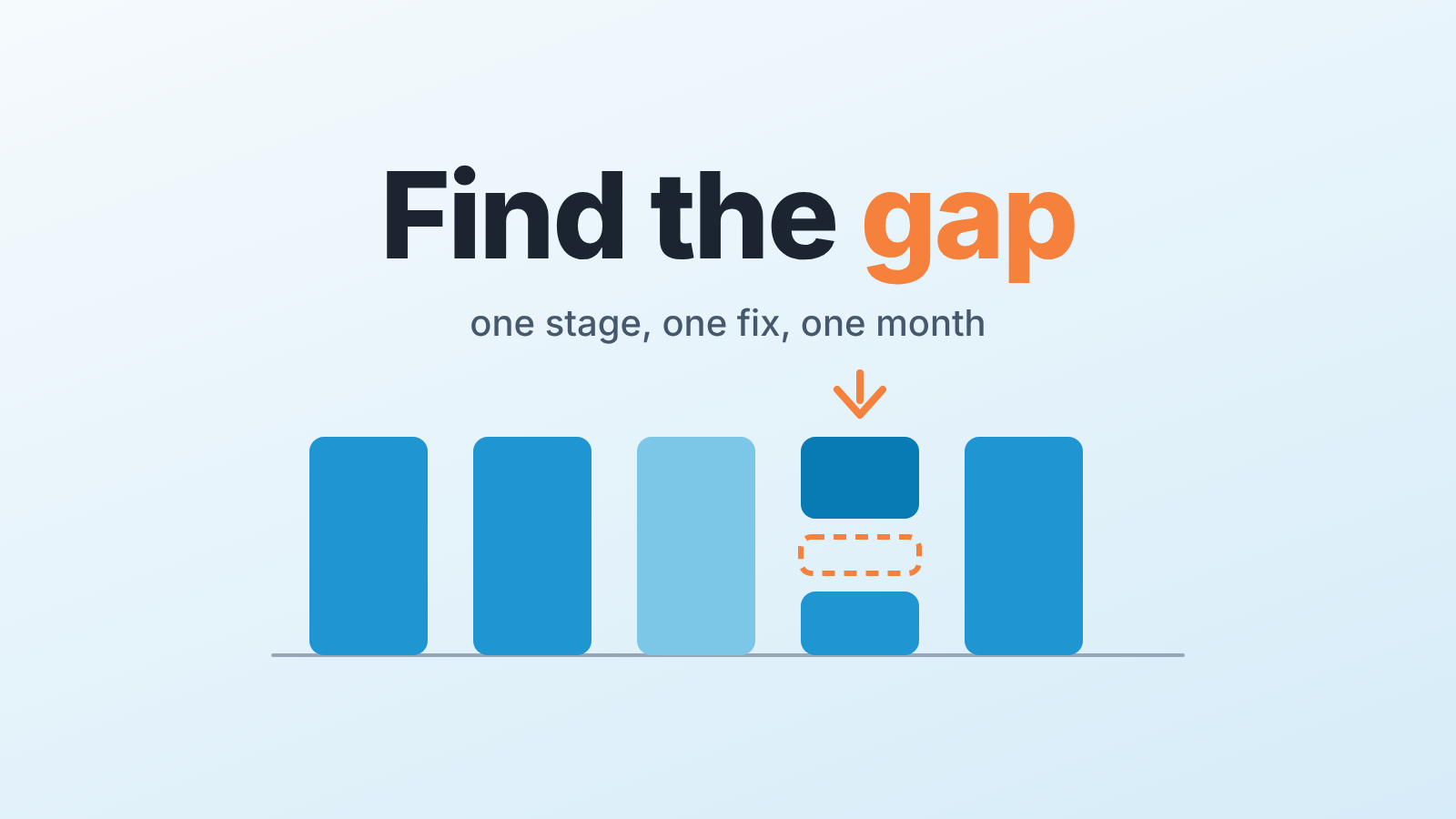
Sales enablement is everything that helps reps sell: content, training, coaching, process and tools. In a team of five you do not build it as a department. You take one CRM number a month, the one that shows where deals get stuck, and give the reps one specific thing for that stage. Then you look at the same number four weeks later.
That is the whole method. The rest of this article is about choosing the number and choosing the thing.
A sales enablement strategy without an enablement team
Almost everything written about sales enablement assumes a company with an enablement manager, a content library and a learning platform. Your company is a manager and five reps. There is no enablement role and there will not be one for a while. Copy the big-company version and you get a shared drive with twelve documents, a training calendar nobody follows and a feeling that enablement is one more thing you are behind on.
You will also see people ask about the “five pillars” or the “three pillars” of sales enablement. The lists vary by vendor, but content, training, coaching, process and tools show up in nearly every version, and the three-pillar lists usually keep content, training and coaching. At five reps the useful question isn’t how many pillars there are. It is which one your pipeline points to this month.
We think the honest strategy at this size is a monthly decision, not a function. Every month the manager answers one question: what single thing would help the team move deals through the stage where they lose the most right now? The answer is a one-pager, a call review, a practice session or a change to the process. One of those. Not a program, and not a new hire.
What makes this work is that you don’t have to guess where to start. The CRM already keeps the record of where deals slow down and where they die. The gap is written in the pipeline stage by stage, and a manager with a filter and a spreadsheet can read it in an hour.
Three CRM numbers that point to the gap
The three CRM numbers are stage conversion, the share of open deals with no next step, and days in stage. Pull each one per stage, for the last full quarter or the last ninety days, whichever gives you more deals.
Stage conversion. Of the deals that entered a stage, how many reached the next one? Count a cohort, keep the lost and stalled deals in the denominator, and look for the one transition that is clearly weaker than the others. We took this apart for Pipedrive teams in the piece on pipeline stage conversion rates. The cohort logic is the same in any CRM, only the export changes.
Deals without a next step. Of the open deals in each stage, how many have no next activity scheduled? Filter open deals, group by stage, show the next activity date column and count the blanks. A stage where a third of deals have nothing planned doesn’t have a skills gap. It has a habit gap, and the help for it looks different.
Days in stage. How long does a deal sit in each stage before it moves? If your CRM does not report this directly, export the deals with their stage change dates and work it out in a spreadsheet. You are looking for the stage where the median is far above the others.
Three numbers, one hour. Don’t add more.
One caution on sample size. Five reps over a quarter may give you a few dozen deals, and a single stage may hold twelve. Twelve is not a rate, it is twelve deals. Read them one by one before you believe the percentage.
From number to action: material, call review, practice, or process fix
Each number tends to point to a different kind of help. This is how we read them.
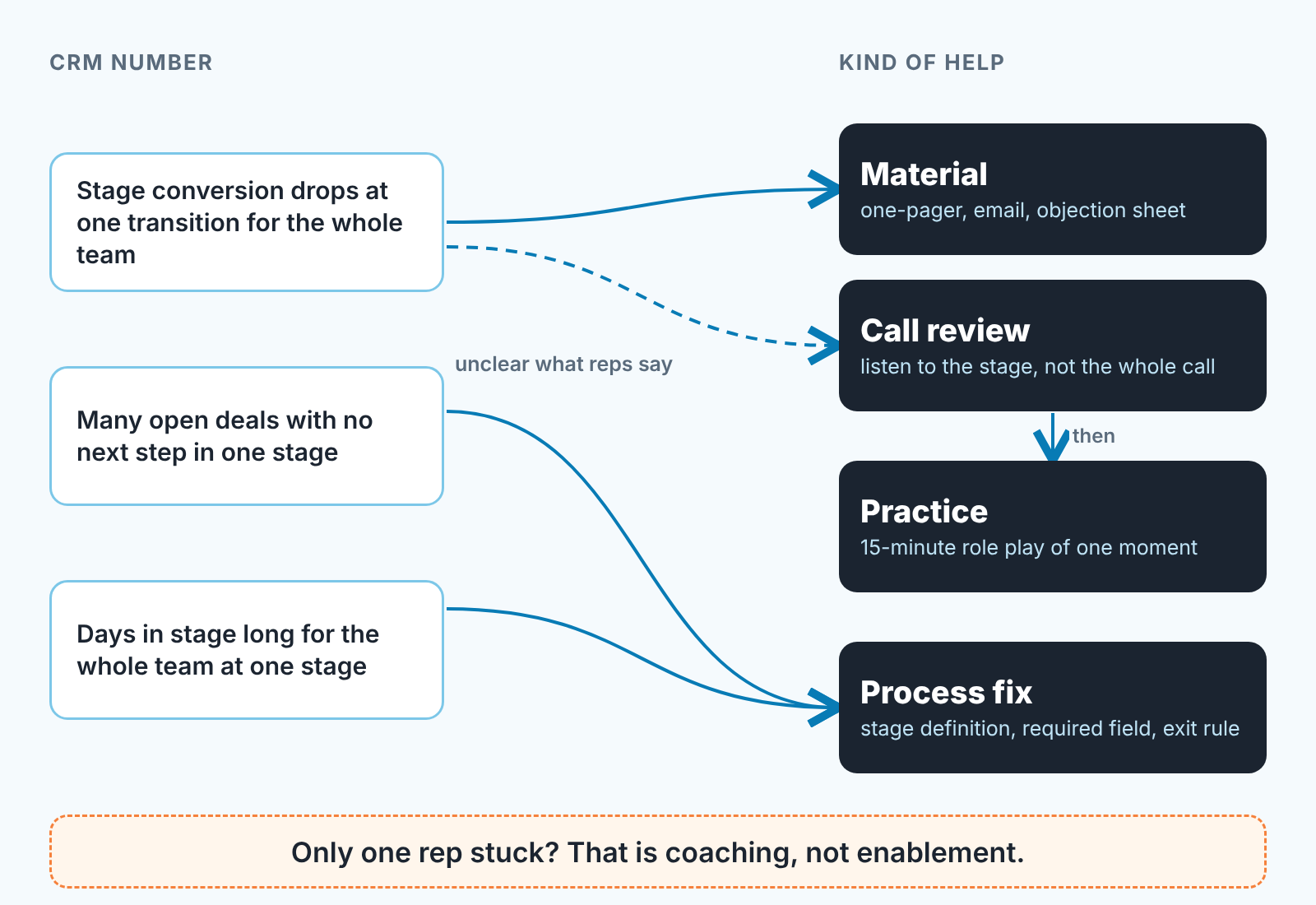
If conversion drops at one transition for the whole team, the reps are usually missing something to say or send at that stage. That calls for material: a one-pager, a pricing explainer, an objection sheet for that one stage. Material is the cheapest kind of enablement and the one small teams reach for first, which is why most of them have a folder of it nobody opens. Write it only when the conversion number says the whole team is stuck at the same place. Our articles on a sales playbook for small teams and battlecards built from lost reasons cover how to write and maintain it. This one is about deciding whether you need any this month.
If the conversion drop is there but you can’t tell what is going wrong in the conversation, start with a call review. Here that means something narrow. You listen to how the team handles one stage, not score whole calls: the last five minutes of three demos from different reps, where the next step is or isn’t agreed. That is twenty minutes, and it usually tells you whether the gap is a missing page or a missing habit.
Practice follows from a call review. Its a fifteen-minute role play of one moment in the Monday meeting, with the manager playing the buyer. Expect it to feel awkward the first couple of times; keep it short and on one moment, and it stops feeling like a test. This is also where enablement and training part ways. Training teaches a skill to a group in a session, and enablement is the wider job of deciding which kind of help the team needs this month, so a training session is just one of the four answers.
If many open deals in one stage have no next step, or deals sit in one stage far longer than in the others, the answer is usually a process fix. Managers skip this one because it does not feel like enablement. It is often the right answer anyway. If a third of the deals in Proposal have no next activity scheduled, no training will fix that. A stage exit rule (“next activity scheduled”) and a weekly five-minute check will. When everyone is slow in the same stage, the stage definition is often fuzzy: split the stage, or write down what “in” and “out” mean.
And if only one rep is stuck while the others move? That is coaching, not enablement. The one-on-one that follows belongs to sales coaching, which has its own article. This one stays at team level.
A sales enablement example: one stage, one month
Here is how a month goes. The numbers are invented for the example; the shape is what we see.
A manager with five reps pulls last quarter’s deals. Stage conversion is steady through Qualified and Demo and then drops hard between Proposal and Negotiation. Days in Proposal are long for everyone. Open deals in Proposal: eighteen, and seven of them have no next activity scheduled.
All three numbers point at the same stage. That’s the common case. The pipeline usually leaks in one place.
Now the manager has to decide wich kind of help to give. The no-next-step count says process first: the exit rule for Proposal becomes “proposal sent and a follow-up call booked in the CRM”, and from now on a deal cannot sit in Proposal without a date. That is a Monday-morning announcement and a saved filter, not a project.
The conversion drop across the whole team suggests a material gap as well. The manager asks each rep what the buyer says after the proposal arrives. Four of five say the same thing: the buyer goes quiet, then comes back asking about price versus a competitor. So the month’s material is one page, written by the manager and the rep whose Proposal conversion is highest, on how to present price and what to send when the competitor’s name comes up.
That is the month. One process rule, one page. The manager writes both down with the the date and the numbers they started from, because in four weeks they will need to compare.
What the manager did not do: buy a platform, schedule a training day or write a playbook chapter for every stage. None of those would have moved the Proposal number.
If a new rep starts this month, the monthly action still applies to the team, and the new rep gets the 30-60-90 onboarding plan on top of it. Onboarding is a separate track. Don’t count it as the month’s enablement.
How to check it worked in four weeks
Pull the same three numbers for the same stage, on the deals that were open during the month. Not last quarter’s cohort, the current one.
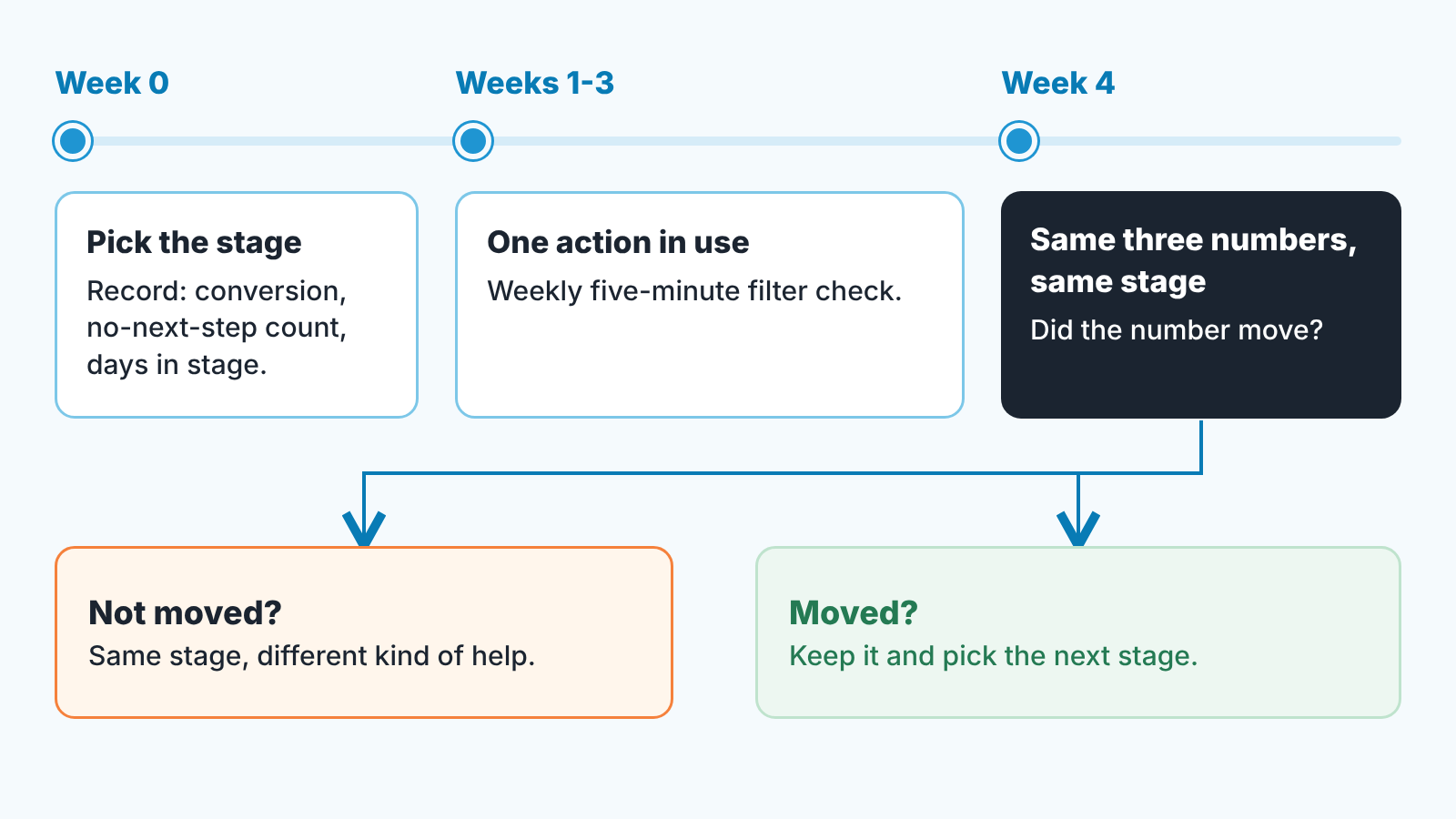
There are three possible outcomes.
The number moved. In the example above, the no-next-step count in Proposal might go from seven to two, with the median days in stage getting shorter. Keep the rule, keep the page where reps can find it, and pick next month’s stage. Don’t declare victory on conversion yet. A month is too short to see a conversion change on a dozen deals; what you can see in a month is behaviour: next steps booked, proposals followed up, time in stage.
The number did not move. The most common reason is that you picked the wrong kind of help. The team got a one-pager when the problem was that nobody books the follow-up, or a process rule when the reps simply don’t know what to say about price. Go back to the previous section, pick the other kind of help, same stage, another month. Same stage twice is fine. Same stage three times means the problem probably isn’t enablement, and that is a conversation about whether it is the rep or the pipeline.
The number moved for four reps and not for the fifth. This is the most informative result. It tells you the material and the rule were right, and one person needs a conversation instead. That is where coaching takes over.
A disclosure, since this is where tooling comes in: we build SalesBond, a sales management layer on top of the CRM a team already uses; we started with Pipedrive. Its Deal Health product checks every deal in the connected CRM against more than 20 rules, around the clock. The manager sees which deals need attention and the reason, for example no next activity scheduled, so nobody rebuilds the same filter every Monday. Deciding what the team needs and writing the one-pager are still yours. If you want to see what your own pipeline shows this month, check your CRM with SalesBond.
When a platform is worth paying for
Enablement platforms store content, push it to reps inside the CRM, track who opened what and run training modules. That is real value when there are forty reps in three offices and the library changes every week. At five reps the manager can find out who read the one-pager by asking, and the folder is small enough to know by heart. The same goes for call recording tools: they earn their cost once listening to calls is a weekly habit, and our piece on AI sales coaching for small teams covers where that point is.
In our experience a platform starts to pay when the monthly method has run long enough that you have real material for most stages, more than one manager uses it, and keeping it current is a job rather than a fifteen-minute pass. Until then, spend the money on the CRM you already have and the hour a month it takes to read it. Next month, that hour starts with the three numbers above and one stage.