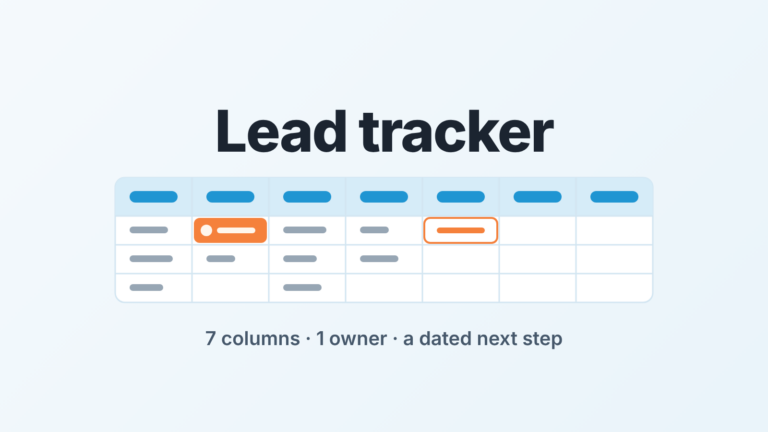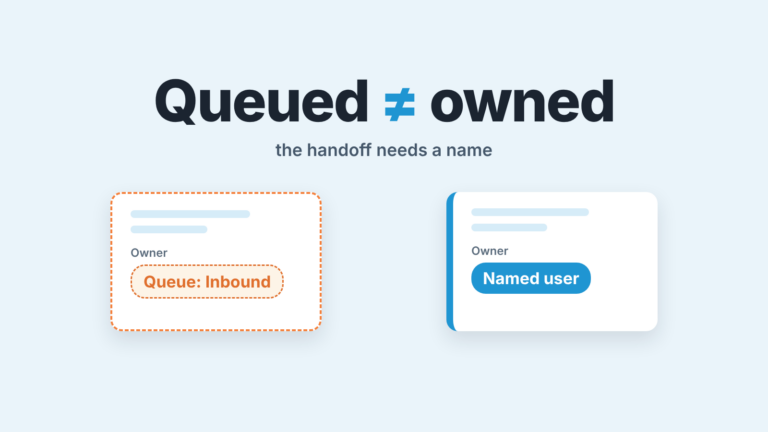
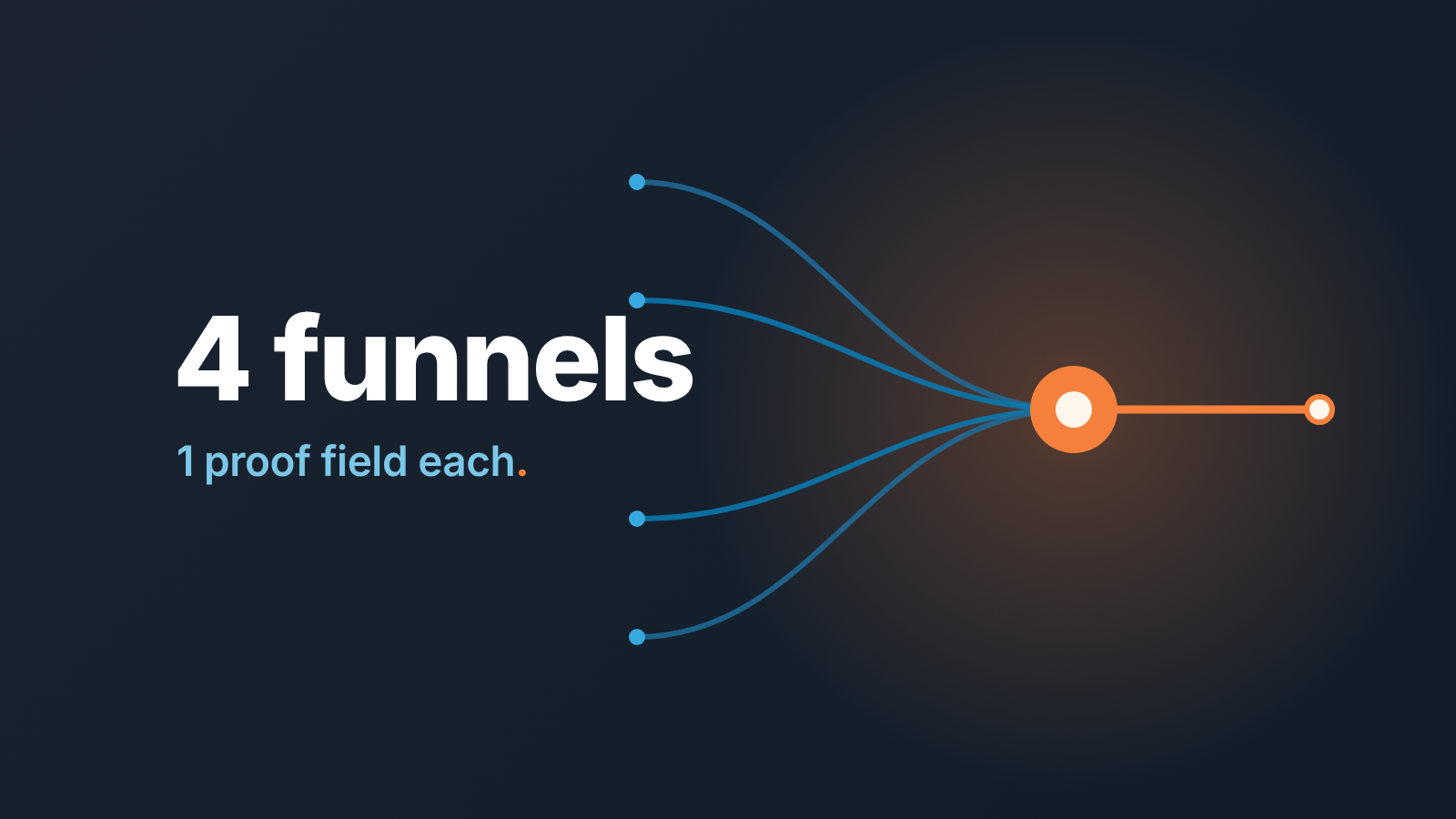
A sales funnel example is useful only if every step becomes a CRM stage with an exit rule, a condition the deal must meet before a rep moves it. For a small team, four funnels cover most of what gets sold: inbound with a trial, outbound B2B, services by referral, and renewal and upsell. Each one below comes with its Pipedrive stages, the exit rule for every stage, and the one field or activity a manager can open to confirm the move actually happened.
The funnel examples you find in search are mostly marketing funnels: traffic, landing page, email sequence, sale. They stop where the sales team’s work starts. We won’t explain the difference between a funnel and a pipeline here, that article exists. What follows is four funnels you can build in Pipedrive on Monday.
A funnel example is only useful if you can read it in your CRM
A funnel drawn on a slide has steps. A funnel in a CRM has conversions: say 40 deals entered a stage and 22 reached the next one (illustrative numbers, not a benchmark). Only the second kind tells a manager anything, and it exists only if a stage means the same thing for every rep on the team.
So each stage below gets a name that describes something that happened, an exit rule a rep can check a deal against, and one proof: a field that must be filled or an activity that must be marked done before the deal moves. Pipedrive’s own guidance points the same way, asking for action-oriented stage names such as “Meeting scheduled” or “Proposal sent” instead of “In progress” (Pipedrive: how to design your sales process). The general logic of turning a process step into a stage is in sales process steps and CRM stages; here we only apply it.
Why one proof and not two? With two fields per stage, reps fill them on Friday from memory. With one, they fill it when the thing happens.
A last rule before the examples. Different sales motions get different pipelines. Pipedrive recommends separate pipelines when teams follow different processes, and warns that moving a deal through several pipelines can affect reporting in Insights (same help article). An inbound trial and a renewal never share a pipeline, even when the same rep works both.
Example 1: inbound SaaS with a trial
These deals come from your website: content, ads, a pricing page, a sign-up form. The buyer has already signed up, so the question is not “will they talk to us” but “did the trial turn into a buying conversation”. Four working stages: Trial started, Activated, Call held, Proposal sent, then won or lost.
The exit that matters is the first one. A trial is activated when the account did the one thing your product exists for: first import, first report, first invoice. Proof is a date field, call it Activation date. Empty field, the deal stays in Trial started, whatever the rep feels about the account. From Activated the deal moves when a call or meeting with the user is logged as a completed activity, not on a note saying “reached out”. From Call held it moves when the rep sends price and plan and sets the expected close date.
Count conversion from Activated, not from Trial started. The share of sign-ups that never activate is a product number, and mixing it into the sales funnel makes every rep look bad for something they didn’t do. We covered the handover in detail, including what to do with a trial that never activates, in where the trial ends and the deal begins, so this example stays short.
Example 2: outbound B2B
Here the deals start with you: a list, a sequence, cold calls. Outbound is where funnel pictures lie the most, because the top is huge and nobody wants to admit how little of it is real. Our position: a deal in Pipedrive begins with a reply. The sequence, the connect attempts, the unanswered emails live in your outreach tool or in Leads. The moment a human writes back or picks up and talks, the deal is created in Contacted.
Stages: Contacted, Meeting held, Qualified, Proposal sent, Verbal yes, then won or lost. Pipedrive’s advice is to create fewer stages so the pipeline stays easy to scan, and outbound teams need that advice most.
The exit rules:
- Contacted to Meeting held: the meeting happened. Proof is the meeting logged as a completed activity with the buyer on it. A booked meeting is not a held meeting; no-shows stay in Contacted.
- Meeting held to Qualified: the buyer named a problem and a reason to solve it this year. Proof is a text field, Problem in the buyer’s words. If the rep can only write “interested in our solution”, the deal isn’t qualified and the field stays empty.
- Qualified to Proposal sent: price and scope went out, recorded in a date field, Proposal sent on.
- Proposal sent to Verbal yes: the buyer said they are going ahead, or sent the contract to legal. Proof is a field, Verbal yes from, naming someone who can sign.
Where outbound deals die is between Meeting held and Qualified and the lost reason you want there is honest: “No problem confirmed”. A pile of those is not a pitch problem. It is a targeting problem, and the funnel just told you that for free. Give every deal a source value at creation too, so you can compare this funnel with the inbound one later; we wrote up how in inbound vs outbound for a small team.
Example 3: services sold by referral
An agency, a law practice, an installer. Most new work arrives because someone said “talk to these people”. The funnel looks short and comfortable, and it hides its top step completely, because nobody logs the the introductions that never called back.
So the first rule here is about when the deal is created, not which stage it sits in. Create it in Referred the day the referrer makes the introduction, with a Referred by field filled in. Not the day the prospect finally calls. Otherwise your conversion out of Referred is always perfect and tells you nothing, and you never learn which referrers send introductions that turn into work and which just send names. On Pipedrive’s higher plans you can make that field required, so a deal can’t be saved without it (Pipedrive: custom fields).
From Referred the deal moves to Conversation held on a completed call or meeting. From there to Scope agreed when the rep can write one line in a field called exactly that, Scope in one line: what will be delivered, for whom, by when. A scope that needs a paragraph is not agreed yet. Then Proposal sent, with a date field as proof, then won or lost.
Referral deals go quiet in a polite way. The prospect liked you, meant to call, didn’t. This is the one funnel where we always turn on rotting for the first two stages: Pipedrive’s rotting feature highlights deals that stay in a stage too long (same help article), and a rotting deal in Referred is a cue to go back to the referrer, not to the prospect. The referrer made the introduction and usually wants it to land.
Example 4: renewal and upsell
These deals come from a contract you already have. A renewal is a sale with a deadline, so the funnel runs against the calendar. Separate pipeline, always. Stages: Renewal opened, Usage reviewed, Offer sent, Confirmed, then won or lost.
Open the deal one notice period before the contract ends, or a quarter before if the contract has no notice period, with Contract end date filled at creation. That date is the proof for the whole pipeline. A renewal deal with no end date is a guess.
Renewal opened moves to Usage reviewed when someone has actually looked at what the customer does with the product and recorded a verdict in a dropdown field, Usage verdict: growing, flat, shrinking. Usage reviewed moves to Offer sent when the offer went out, and the proof is a second dropdown, Offer type: same terms, expanded, reduced. That field is where upsell lives. You don’t need a separate upsell funnel. You need to know, for every renewal, whether the offer was bigger than the current contract and whether it closed. Offer sent moves to Confirmed on written agreement, and Confirmed moves to won when the signed order or payment is in.
A renewal funnel reads backwards from the end date. The transition to watch is Renewal opened to Usage reviewed, and the question is not how many got there but how many got there with time left. A usage review done the week before expiry is a formality. If most reviews land in the final two weeks, the fix is the opening date, not the reps.
Four sales funnel examples side by side in Pipedrive
Put the four next to each other and the pattern is plain: four or five working stages each, and one stage where the funnel is decided. For inbound that is Activated, proven by Activation date; for outbound, Qualified, proven by Problem in the buyer’s words; for referral, Scope agreed, proven by Scope in one line, with Referred by set when the deal is created; for renewals, Usage reviewed, proven by Usage verdict, with Contract end date set at creation. Everything else in each pipeline is bookkeeping around that one stage.
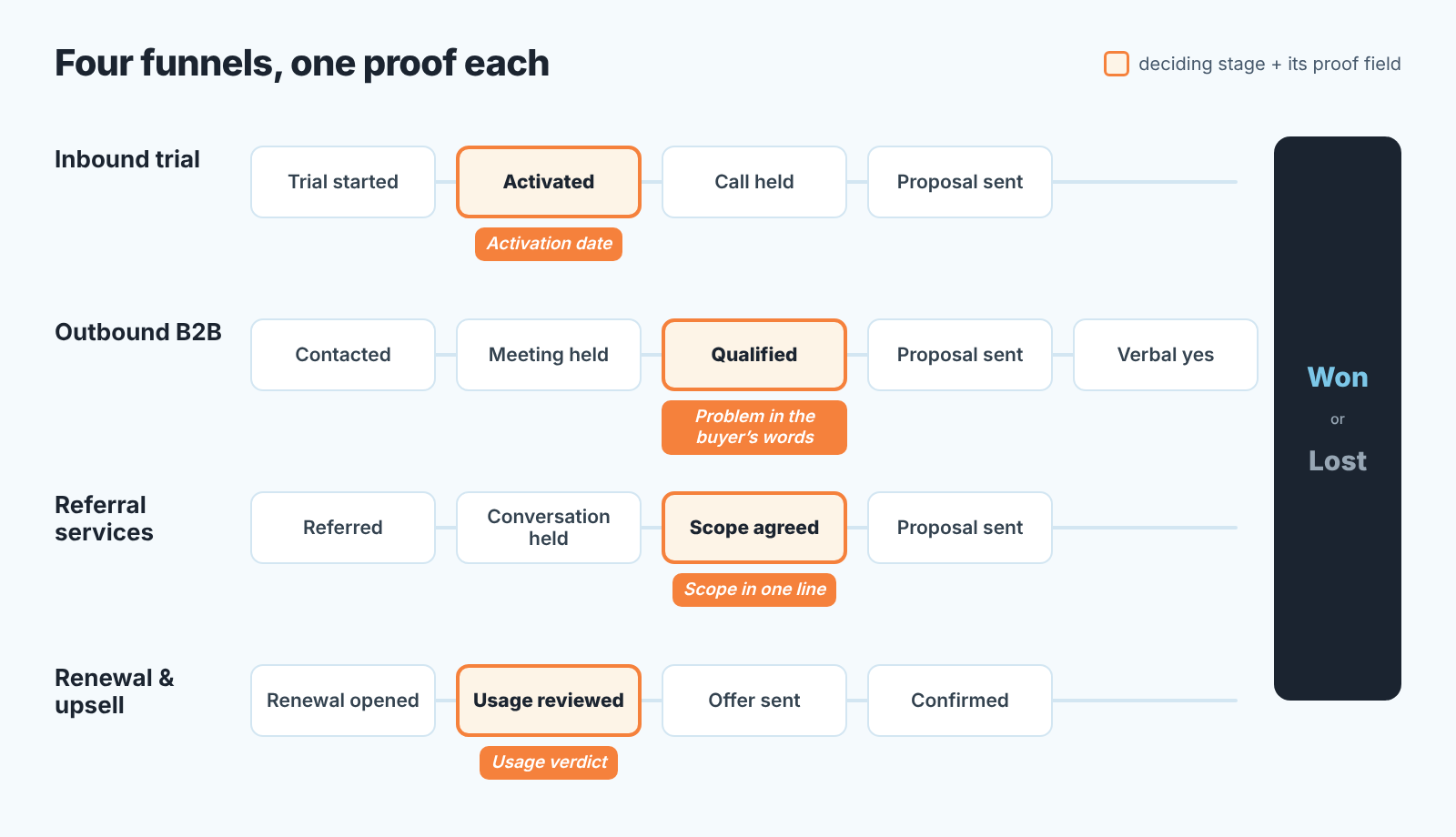
Setup notes, in the order you will hit them. Only users with deal admin permissions can set up and edit a pipeline in Pipedrive, so decide who owns the stage list before the first argument about it. Deleting a stage also deletes the deals in it, so move them to another stage first. And leave stage probability off for now: Pipedrive suggests setting it if you have historical performance data, and a fresh funnel has none. All three points are in the same Pipedrive article.
The proof fields are ordinary custom deal fields: a few dates, a couple of text fields, two dropdowns. Resist adding a stage for every nuance you discover. If two reps disagree about where a deal belongs, the answer is a sharper exit rule, not a new column.
Which transition to watch in each funnel
Count a cohort of deals created in a closed period, not today’s column counts; the method is in pipeline stage conversion rates in Pipedrive.
Each of the four funnels has one transition worth a weekly look: Activated to Call held for inbound, Meeting held to Qualified for outbound, Referred to Conversation held for referral, and Renewal opened to Usage reviewed for renewals, measured against the end date. The proof field makes a second check possible that the conversion number alone doesn’t. Filter deals in a stage where the proof field is empty. Those are deals that moved without meeting the rule, and there count is the honest measure of how real your funnel is this month.
We build SalesBond, a sales management layer on top of the CRM a team already uses; we started with Pipedrive. Its Deal Health runs more than 20 rules across open deals and explains each flag, so the deals that need a look come with a reason attached. Check your CRM with SalesBond if you’d rather not build every filter yourself. Building them by hand works too. Four pipelines is not a big job.
FAQ
What is a typical sales funnel?
The textbook version has four stages, Awareness, Interest, Decision, Action (Forbes Advisor). In a CRM, Awareness and most of Interest happen before a deal exists, so the stages above start where a sales conversation is real: an activated trial, a reply, an introduction, a contract end date. Everything earlier belongs to marketing data or Leads, not to the pipeline.
What are the stages of a B2B sales funnel?
In our outbound B2B example they are Contacted, Meeting held, Qualified, Proposal sent and Verbal yes, then won or lost. The exit that decides the funnel is Meeting held to Qualified, and the proof is a filled Problem in the buyer’s words field.
How many stages should a funnel have?
Our examples use four or five working stages plus won and lost; add a stage only when you can name its exit rule and proof field in one breath. The longer answer is in how many pipeline stages you really need.