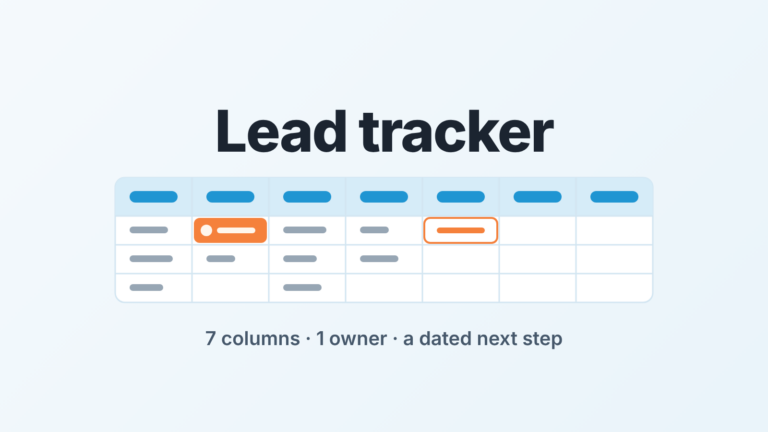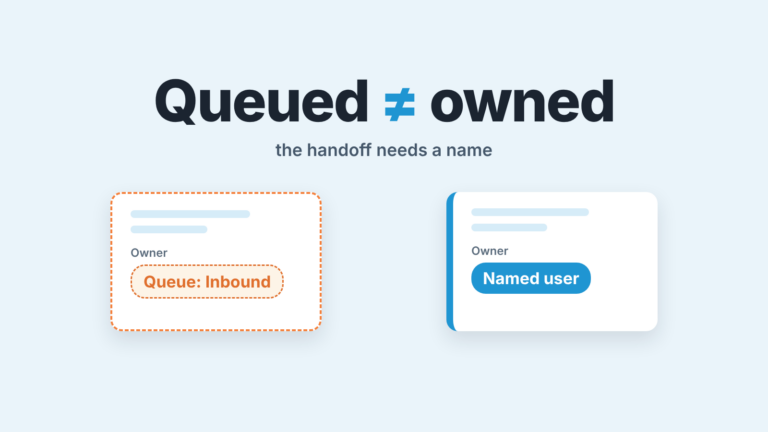
Give a new rep early-stage leads and a few stalled deals with a clear next step, keep late-stage deals and your biggest accounts yourself or share them, and put a next activity with a date on every deal you transfer. A new rep’s first deals should teach them your process, not decide your quarter.
The leftovers problem
Here is how it usually goes. A founder or a sales manager has been carrying the whole pipeline alone. They hire a second seller, agree the pay (we wrote about setting OTE for a first sales hire), set up the account, and on the rep’s first Monday they open Pipedrive and hand over everything they never got to. The cold ones. The ones that went quiet in spring. The ones they are tired of.
The rep spends weeks one to four calling people who stopped replying to someone else. Nothing moves. By the end of the month the rep has decided the product is hard to sell, or that they are bad at this, and the manager has decided the hire was a mistake. Neither is true. The sample was wrong. Those deals were leftovers because they did not move for you, with your product knowledge and your relationships, so they were never going to move for someone in week two.
The opposite mistake is quieter and we see it almost as often: handing the rep the deal that is closing next week “so they get a win”. If it closes they learned nothing, because the work was done before they arrived. If it slips, you have lost a deal you were counting on and taught the rep that their first act in this company is an apology.
Our position: a new rep’s first deals are a training set. You pick a training set for what it teaches, not for what it is worth. The deal that decides your quarter is the one deal you should not use for that.
Three buckets for assigning deals to a new rep: give, keep, share
Sorting the book by stage is the standard move when a rep leaves. ORM Technologies’ guide to reassigning accounts does it that way, and so does our own playbook for when a rep leaves. The same sort works for a rep arriving, with the direction reversed. On a departure, late-stage deals go to the strongest closer. On an arrival, late-stage deals stay away from the newcomer.
Give. Early-stage deals: inbound that has not had a first call, discovery booked but not held, and stalled deals where the buyer’s problem is still real and there is one concrete thing to do next. Add fresh inbound from day one. New inbound is the best training material there is, because nobody has disappointed the buyer yet. If you route leads by rule rather than by hand, add the rep to the routing rules for a small Pipedrive team; from then on new leads run on that rule’s clock, not on the day-30 review below.
Keep. Anything with a proposal out and a decision due this quarter. Your largest accounts, including the ones with no open deal right now. Anything you have already counted in your commit. These deals have a relationship behind them and no time to rebuild it.
Share. Mid-stage deals where discovery is done and no proposal has gone out. The rep takes the Owner field and does the work; you stay on the calls that matter while the rep finds their feet. How and when you step back is a question for the 30/60/90 onboarding plan, so we will not repeat it here.
Count deals, not deal value. A rep with ten early-stage conversations in week one learns your process ten times. A rep with one large deal learns it once, under pressure, in front of your most important buyer.
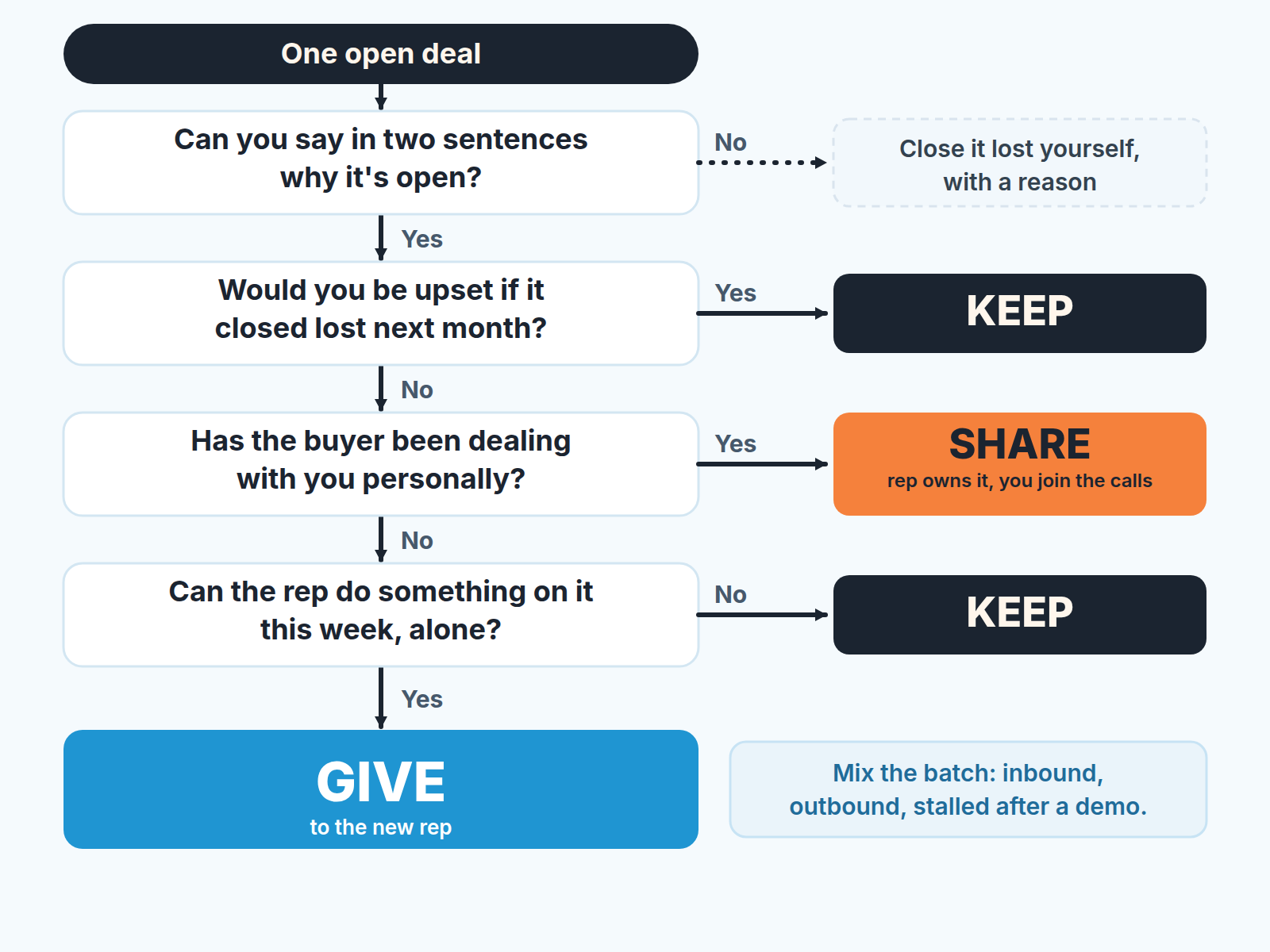
Five questions before a deal goes to the new rep
The buckets give you a rough cut. These questions decide each deal. Go through the open deals in the list view with the questions next to you.
-
Would I be upset if this closed lost next month? If yes, keep it. This is the rule we hold hardest: the first deals a new rep works must not be the ones your quarter depends on. The rep needs room to lose a few while they learn, and you need to be able to let them.
-
Is there something the rep can do on this deal this week, alone? A call with a named person about a known topic counts. “Waiting for budget approval” does not; that deal would sit in teh rep’s pipeline teaching them to wait.
-
Has the buyer been dealing with me personally? If the buyer knows your name, the rep inherits a downgrade in the buyer’s eyes, and the first conversation is spent explaining why you are not on the call. A lead that has spoken to nobody is cleaner. If you still want the rep on that deal, share it rather than give it.
-
What does this deal teach? Pick for variety: one inbound, one outbound, one that stalled after a demo, one from each segment the rep is expected to sell into. A batch of near-identical deals teaches one lesson over and over.
-
Can I say in two sentences why this deal is open at all? If you cannot, it is not a deal. Its a reminder you never processed. Close it lost yourself, with a reason in the note, instead of making the rep do your cleanup and calling it onboarding.
How many to hand over is a judgement about the rep’s week, not a number we can give you. Enough that there is a real conversation to have every day of week one, few enough that each deal gets looked at before the call. We would rather give too few and add a second batch on Friday than give too many and find on day ten that half of them are untouched.
What the rep needs to hear from you before the first call
Pipedrive holds the activities, the stage and the expected close date. It does not hold the promises. The buyer was told something, or allowed to believe something, by you, and the rep is about to walk into that conversation blind.
So before the rep calls anyone, sit together over the deals in the give and share buckets and say out loud, deal by deal: what was promised or hinted (a discount if they sign by month end, a pilot, a feature “coming soon” that is not coming soon); who actually decides, as opposed to who you have been talking to, since those are often two different people; why the deal went quiet, in your honest reading rather than the stage’s reading; and what you would do next if it were still yours. The rep will ask questions, and the the questions they ask are your first read on how they think.
Then the written version, kept short. Three lines in the deal notes: promised, decides, why quiet. The spoken version comes first because the note cannot carry the parts you would say but would never type, like which contact is prickly about contract length. The rep needs those. The CRM does not.
Moving the deals over in Pipedrive
The mechanics are the same as when a rep leaves, so we will not repeat them: the filter, the bulk edit and what gets left behind are in the rep-leaves playbook, and before you run any bulk edit on a live pipeline, read why bulk edit in Pipedrive needs a safety routine. What the rep can see of the deals you kept is a permissions question, covered in access and permission sets for a new rep.
One addition that costs nothing: label every deal you hand over, so a month from now you can pull the batch apart from what the rep found on their own. Give it a label of its own, something like “Handover Oct”, and leave the “Inherited” label from the departure playbook alone. That one feeds a different list, and a shared label would mix the two. Pipedrive lets you set a label on the whole batch through bulk edit and then filter the deals list by it.
Day 30: what did they do with what you gave them
The day-30 review of a new rep’s first deals is an audit of the batch you handed over, one deal at a time: what happened to each deal you gave, not what the rep closed and not how the rep is coming across. The batch is small enough to open deal by deal with the rep in the room. Filter by the handover label and go down the list.
- Was every deal touched in week one? Look at the first activity completed after the handover date. A handed-over deal that sat for two weeks means the rep is avoiding the phone, or you gave too many, and you can tell which by asking. This check is for the batch only; fresh inbound follows your routing rule.
- Does the history show the rep’s own judgement: a new contact added, a stage moved back, a next step the rep chose rather than the one in your handover note?
- How many went to closed lost, and does the note say why? Zero losses in a batch of stalled deals is the bad sign, not the good one.
- Did any stage move because of something the rep did, not something that was already in motion?
What you decide on day 30 comes from that list. A batch that was worked, trimmed and moved gets a second batch, larger, and the shared deals move fully to the rep. A batch that sat gets a conversation, not more deals. And if the rep closed something out of the give bucket, be honest with yourself about whether it was going to close anyway. Those deals were chosen so that the answer could be “no”, which is exactly why a close there means something. The signals about the rep as a person, rather than about the deals, are covered in the day-30 part of the 30/60/90 onboarding plan.
We build SalesBond, a sales management layer on top of the CRM a team already uses; we started with Pipedrive. Its Deal Health product checks every deal against more than 20 rules, in categories such as Activity and Progression. For each rep it shows the specific problem on each deal and what to do about it, so trouble in the handed-over batch is in front of you before the day-30 review rather than discovered during it. Check your CRM with SalesBond if you would rather not build that view by hand. Choosing which deals to give is still yours to do, and it is the part that decides how the first month goes.