
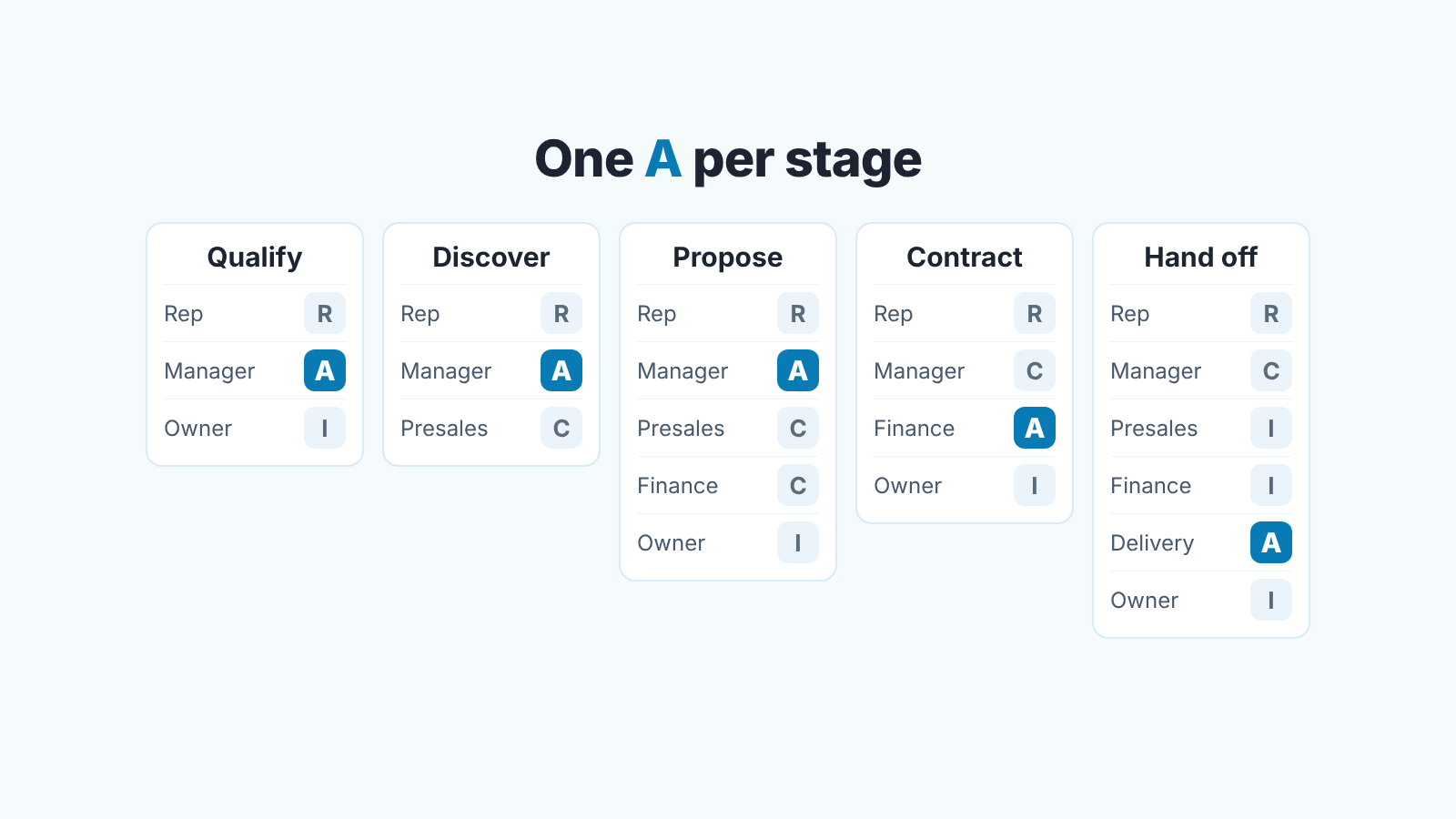
A RACI chart, also called a RACI matrix or responsibility assignment matrix, shows for each task who is Responsible for doing it, who is Accountable for the result, who is Consulted and who is Informed. For a sales team, build one row per deal stage and name exactly one accountable person per row. The rest is about making that survive a real pipeline, where the rep thinks the manager approved the discount and the manager thinks finance did.
The four letters, translated for a deal
Most RACI explainers come from project management. Here is the sales version.
| Letter | Meaning | What it looks like on a deal |
|---|---|---|
| R Responsible | Does the work | The rep who writes the proposal |
| A Accountable | Signs off and answers for the result | The manager whose name is on the stage if the proposal goes out wrong |
| C Consulted | Gives input before the decision; two-way | Presales checking the scope, finance checking the payment terms |
| I Informed | Hears about it after; one-way | Delivery learning a contract was signed |
Those are the standard definitions (Wikipedia, Asana). The one people get wrong is C versus I. Consulted means you wait for an answer. Informed means you send a message and move on. If finance is “consulted” on every contract but nobody actually waits for their reply, they’re informed, and the chart should say so.
The accountable person signs off on work the responsible person delivers, so they don’t have to do it themselves. Coursera adds that each task should ideally have a single R as well (Coursera).
Where small sales teams actually need one
Coursera lists when a RACI pays off: a lot of people involved, unclear roles, new hires or high turnover, overlapping tasks (Coursera). A deal in a five-person company touches the rep, you, whoever scopes the work, whoever issues the invoice, whoever delivers, and the founder who still wants to see every large contract. Six people on one deal. Nobody wrote down who decides what.
Deals rarely stall in the middle of a stage. They stall at the seam between two stages, when work has to move from one person to another. The rep finished discovery and is waiting for presales to confirm scope. Presales thinks the rep will ping them if its urgent. The deal sits for a week with the next activity blank.
We’ve written about the biggest of these seams, the closed-won handoff, and about who owns CRM data when there is no ops person. This is the layer above both: one page that says, for every stage, who is on the hook.
A RACI chart example for five deal stages
Here’s the version we would start from. The roles are the rep, the sales manager, presales (or whoever scopes the work), finance, the delivery lead and the owner. Map the stages to your own stage names rather than renaming your pipeline to fit the chart.
| Stage | Rep | Manager | Presales | Finance | Delivery | Owner |
|---|---|---|---|---|---|---|
| Qualification | R | A | – | – | – | I |
| Discovery and demo | R | A | C | – | – | – |
| Proposal and pricing | R | A | C | C | – | I |
| Contract and signature | R | C | – | A | – | I |
| Handoff to delivery | R | C | I | I | A | I |
You can copy the table as a template. A few decisions in it are deliberate, and you may disagree with them.
The manager is accountable for the first three stages. The rep does the work. The manager answers for whether a bad-fit deal got into the pipeline or a proposal went out below floor price. Making the rep both R and A for qualification sounds like trust, but in practice nobody reviews qualification until the deal is lost.
Finance is accountable for the contract stage. The rep still drives the paperwork, but the person who answers for payment terms should be the person who understands them (more on that stage in the quote-to-cash handoff). The manager drops to C here: asked about commercial exceptions only.
Delivery is accountable for the handoff, and this is the row most teams get backwards. The rep closes, writes a note, and is “done”. Delivery later discovers the promised start date was never checked. If delivery owns the stage, they’re the ones who refuse a handoff with blanks in it.
Almost everywhere, the owner is only informed. If you’re a founder and your instinct is to put a C in your column on every row, that instinct is the bottleneck.
One name per stage (and the caveat)
The golden rule of RACI is one Accountable per task: exactly one person answers for each stage, while Consulted and Informed can be as many people as you need (Asana, Coursera). Wikipedia is more careful and says the single-A rule comes from only some theories of project management (Wikipedia).
We side with the strict version for sales, and for a specific reason. When two people share A for the proposal stage, the question “why did this go out below floor price?” gets two answers, and both start with “I assumed”. One name will not make the mistake less likely, and it does make the Monday conversation shorter, because there is one person to ask and that person knew in advance it would be them.
Test your chart with that question. For each stage, picture the worst plausible outcome and ask who you would call. If you hesitate, the row is wrong.
Moving the chart into the CRM
A RACI on a wiki page gets read once, so the version that holds is the one the CRM enforces without anyone remembering the chart exists. Three mappings do most of the work.
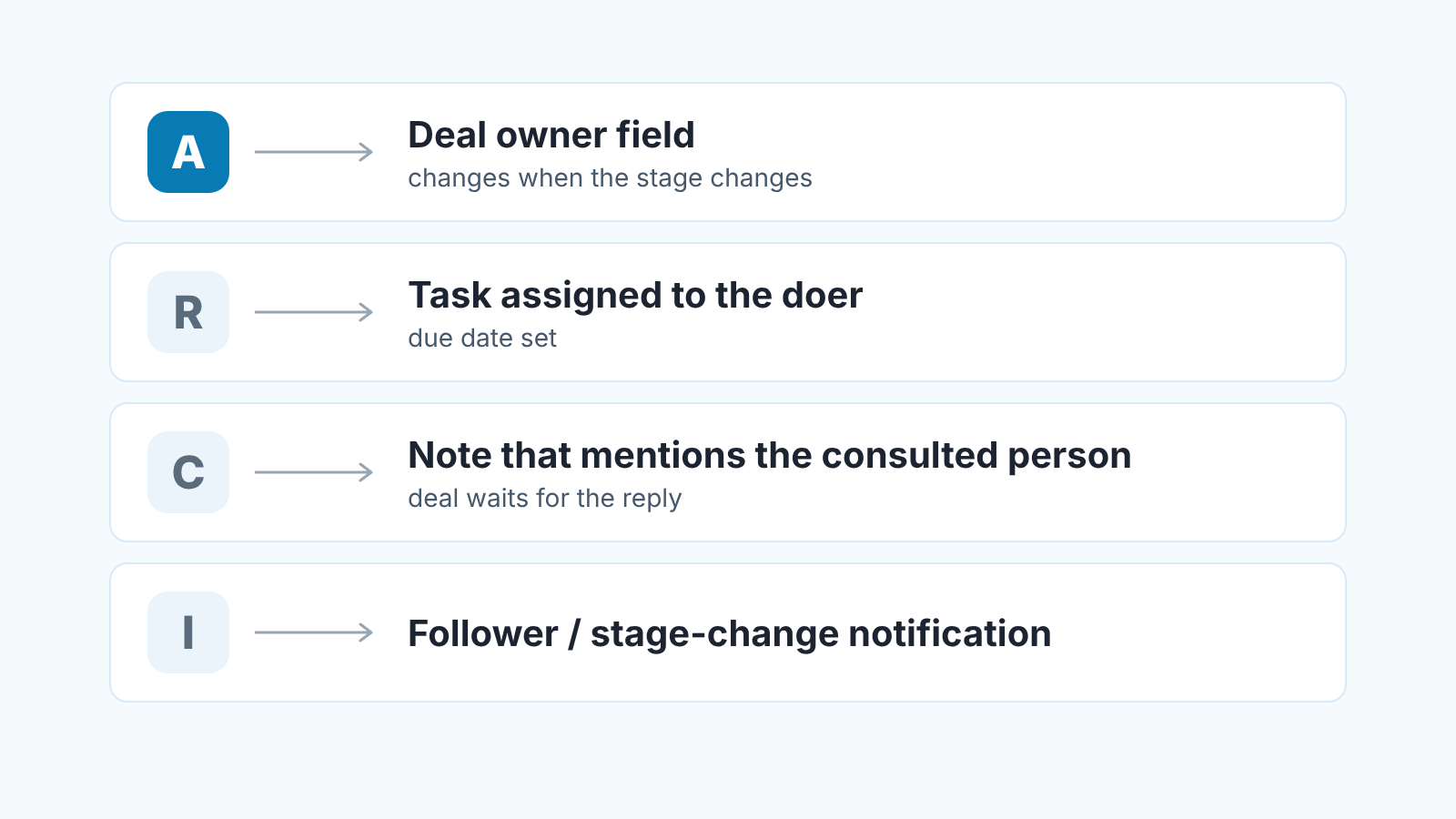
Accountable is the deal owner field. In Pipedrive each item can only have one owner (Pipedrive), and in HubSpot the deal owner is the one user the deal is assigned to (HubSpot). That single slot maps onto A. Through Proposal the owner is the sales manager, at Contract the finance person, at Handoff the delivery lead. Yes, this means the rep never owns the deal in the CRM, so explain the change to reps before the first deal moves.
Responsible is a task. Whoever does the work gets an activity or task on the deal, with a due date, assigned to them by name. A stage with no open task and an owner who isn’t the doer is a stage where work has stopped.
Consulted is a note that waits. Mention the presales or finance person in a note on the deal and treat the deal as blocked until they answer. Informed is cheaper: in Pipedrive, add the person as a follower so they get notified about the deal without owning it, or set up a stage-change notification, and don’t expect a reply.
For any of this to work, the stage names in the CRM have to be the stage names in the chart. If your pipeline has nine stages and the chart has five, the chart loses. We covered what each stage should leave behind in the sales process steps article, the RACI adds who answers for it.
A disclosure: we build SalesBond, a sales management layer on top of the CRM a team already uses. It checks the deals in your CRM against a set of rules and shows which ones need attention. The chart and the owner check described here you can build in an afternoon without us. If you want a second look at your pipeline anyway, check your CRM with SalesBond.
Is RACI too heavy for five people?
For a five-person team the full RACI is usually too heavy; a two-column version (who does it, who answers for it) keeps the part that matters. Six roles by five stages is thirty cells, and in a small company several of those roles are one person wearing two hats. The owner is also finance. The manager is also the top rep, which is its own problem, covered in the piece on the owner’s four sales management jobs.
Is RACI outdated? The part a sales team uses, one accountable name per stage, has held up while the extra letters came and went. Project management answered “too heavy” by adding letters: RASCI and RASIC add Support, RACI+F adds Facilitation, DACI and PARIS reshuffle the roles (Wikipedia). For a small sales team we’d go the other way and drop letters. Keep two columns per stage and write C and I as one line under the table, for example “finance is asked before any non-standard payment terms; delivery hears about every signed contract the same day”. That version still forces the one decision that matters, which is the A.
A founder-led company has an even shorter version. The founder is A for everything until the first sales hire, and the chart is what you hand that hire on day one, together with the CRM baseline you pull before hiring.
Review it when the team changes, and once a quarter anyway
The chart goes stale the moment a role changes hands. A rep leaves and the manager picks up their deals and quietly becomes R and A for everything. Finance hires a bookkeeper, and now the contract stage has two people who both think the other one signs.
So put the review on the same calendar as your pipeline review. Open the chart next to the the pipeline filtered by stage and check two things. Does the deal owner in each stage match the A in the chart? Does every stage with deals in it have at least one open task for the R? If the owner field says “rep” on every deal in Handoff, start with that row.