
Liabilities are what a business owes: money, goods or work it must hand over to someone else. On the sales side, a signed deal often creates some of them, and those liabilities from sales are what this guide is about. Sage defines a liability as “a debt or something owed to other people or organizations”, and from the other side, a claim those people have against your business (Sage: What are liabilities?). They come in two kinds, current (due within about a year) and long-term (Business Literacy Institute: Liabilities).
A customer who pays before you deliver is owed the delivery. A refund you agreed to is owed. The commission on the deal is owed to the rep until payday. Your CRM holds the deal data behind each of these; the amounts on the books come from accounting. The whole statement they sit on is covered in the balance sheet guide; this piece stays on the liabilities side and on the lines that start as deals.
Liabilities in the accounting equation
Sage, in the same article, states the accounting equation as assets = liabilities + owner/shareholder equity, and then flips it: liabilities = assets minus equity. That second form is the one to remember. Everything the business has, minus the owners’ share, is what it owes to other people.
Liabilities deserve their own read because they are the side owners look at least. Pipeline reports and revenue dashboards are all about what is coming in, and nothing in a CRM is designed to show what is owed, so the liabilities a sales team creates are the ones most likely to be a surprise when the accountant sends the quarter.
Current vs long-term liabilities, and where a sale lands
Current liabilities are the short-term ones, such as short-term loans and accounts payable. Long-term liabilities come due over a longer time frame, like long-term debt (Business Literacy Institute), and the same source points out that money a company borrows, in any form, lands on one of these liabilities lines. Sage draws the same current/long-term split and calls the second group a “catch-all for everything else”, with mortgages as the typical example (Sage). CFI adds a third bucket, contingent liabilities, for obligations that depend on something happening first (CFI: Liability).
What does the current side usually hold? Accounts payable to vendors, wages payable, income, payroll and sales taxes payable, interest payable, bank overdrafts, short-term loans, accrued expenses and deferred revenue are the common lines between the two lists from Sage and CFI (Sage, CFI). Only a few of them start in the sales team.
Most of what the sales team creates is current. A prepayment on a six-month project clears inside a year. A commission is paid next month or next quarter. The split matters to whoever reads the sheet because current liabilities are set against current assets to judge whether the business can pay what is due soon; CFI lists the current ratio, quick ratio and cash ratio as the usual measures, all of them built on current liabilities (CFI). So when a rep closes a big annual prepaid contract the number the accountant watches goes up on the same day the cash does. That is normal, just something an owner should know is happening.
The long-term side is loans, leases, bonds, deferred taxes (CFI). Sales does not touch it, with one odd exception the Business Literacy Institute names: deferred bonuses or compensation can sit there too (Business Literacy Institute). If your commission plan pays out a year or more after the deal, that is where it goes.
Three IOUs inside one signed deal
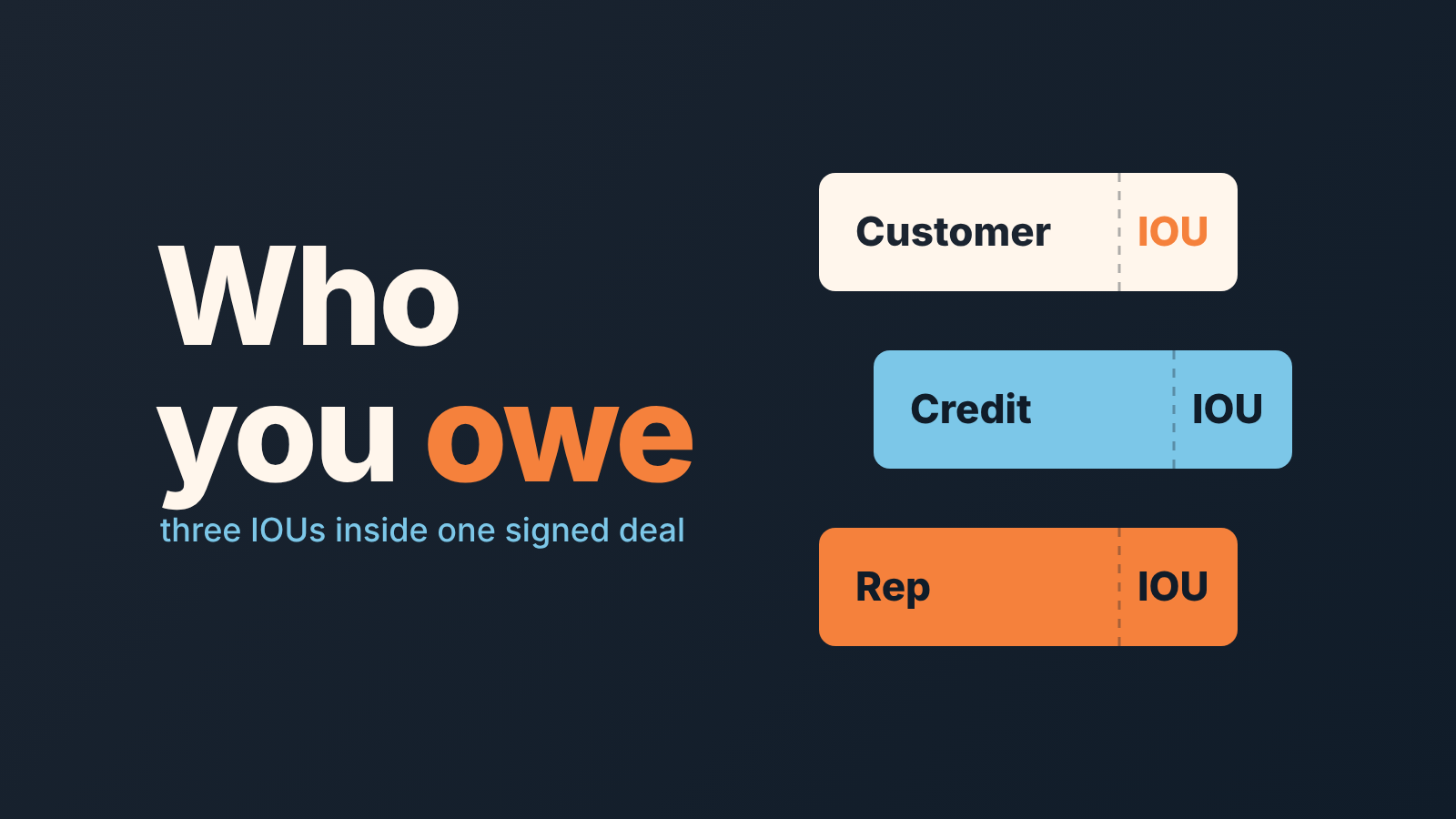
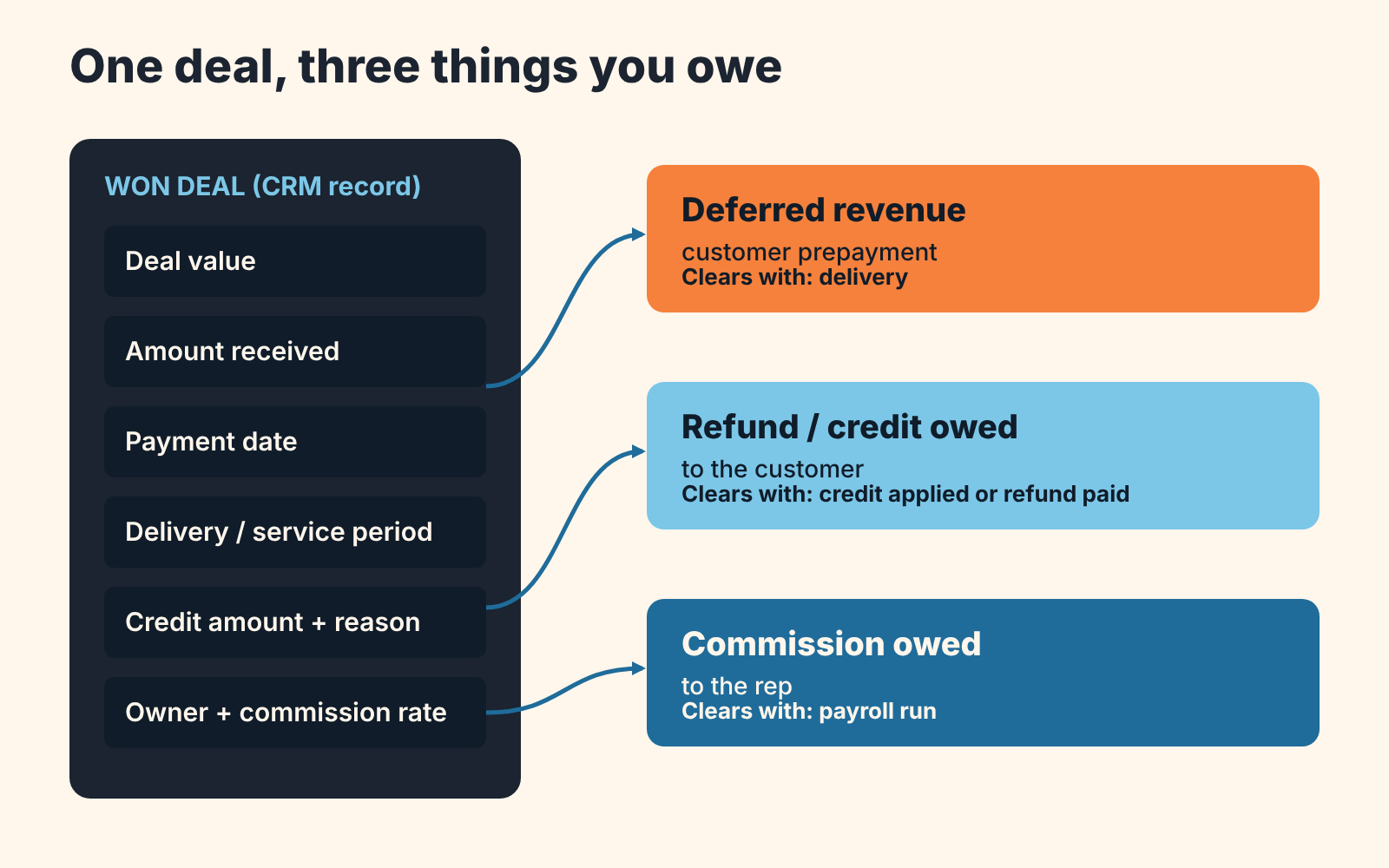
A signed deal can create three liabilities: deferred revenue from a prepayment, a refund or credit owed to the customer, and commission owed to the rep. Open a won deal in your CRM. Depending on how the rep structured it, that one record may have produced all three.
The customer paid before you delivered. A deposit, a 50% upfront, a full year billed in advance. The cash is in the bank, and the customer is still waiting for what they paid for. Is a customer deposit a liability? Yes, until you deliver, because until then the business owes that customer the goods or the work. Accounting calls this deferred revenue, or unearned revenue, and CFI defines it as what is “generated when a company receives early payment for goods and/or services that have not been delivered or completed yet” (CFI). It sits among the current liabilities and shrinks as you deliver. A rep selling prepaid annual plans is, in book terms, raising a liability with every signature, and that is fine as long as the owner reads the cash line with that in mind.
You promised the customer money back or a credit. A refund agreed after a complaint, a credit note for a missed SLA, a “we’ll knock it off the next invoice” said on a call. Money you have taken and expect to give back has a name: under the US revenue standard, ASC 606, it is recorded as a refund liability (RevenueHub: Rights of return). Credits off a future invoice are less clear-cut. Whether and when the bookkeeper records one depends on how firm the promise is and on your accounting policy, which is their call to make. What we can say from the sales side: a credit that lives only in a rep’s email is a promise nobody in finance knows about yet.
You owe the rep. Commission is earned when the plan says it is earned and paid when payroll runs. So is a sales commission a liability? Between those two dates, yes: it is money the company owes an employee. Sage lists employee wages and benefits among the plain examples of liabilities (Sage), and CFI describes accrued expenses as costs already incurred with no invoice yet (CFI), which is exactly the state of a commission between close and payday. Once payroll runs, it is a settled expense and the liability is gone. A strong quarter builds a commission liability at the same time as it builds revenue.
Some invoices carry one more obligation that has nothing to do with the deal itself. If you charge sales tax, Sage describes it as tax paid by customers “which the company then owes to the relevant taxing authority” (Sage). That one your CRM rarely sees at all.
What all of this asks of the sales team is a deal record that carries enough data for someone to count each one.
Where each one sits on the deal record
We will stay CRM-neutral here, because the fields involved exist in every mainstream CRM, sometimes under slightly different names. The question for each liability is the same: can an accountant open the deal and find the number and the date without calling the rep?
For the prepayment, the deal needs the amount actually received (not the deal value), the date it was received and the payment type or terms: deposit, percentage upfront, paid in full. If your CRM supports products or line items, attach the prepaid amount to the right one, because a deposit on hardware and a prepaid year of support clear on different dates. Then the field people forget: the delivery date, or for services the start and end of the service period. Deferred revenue stops being a liability as delivery happens (CFI). Without the dates, the bookkeeper is guessing when.
For refunds and credits, one custom field pair does the job: credit amount and credit reason, both on the deal, set at the moment the promise is made. Some teams prefer a separate small deal or a ticket linked to the the original deal. Either works, as long as the promise lands somewhere finance can see, which an email thread never does.
For commissions, the deal already knows it’s owner and its won date. What it usually does not carry is the rate, and the rate is where plans get complicated: split deals, accelerators, a different percentage for new business and renewals. If the plan is simple, a commission rate field on the deal (or on the owner record, if it never changes per deal) is enough. If it is not, the CRM holds the inputs (deal value, owner, close date, product mix) and the calculation happens in a sheet or in payroll. We would leave the payout calculation to that sheet or to payroll and spend the effort on keeping those inputs complete and current. If you are not sure how reliable those inputs are today, SalesBond’s free CRM audit reads the last 30 days of your CRM and sends a PDF report on what it finds in the deal data.
What the CRM will not tell you
What a CRM holds is the deals behind the liabilities. The line called deferred revenue is a sum the bookkeeper builds from prepaid deals and their delivery dates, so the CRM supplies the list and the bookkeeper makes the total and the journal entry.
When the deferred line turns into revenue is a question for ASC 606 revenue recognition, and sales supplies the delivery dates.
It will not tell you when an obligation cleared. A prepaid deal is marked won on the day it is signed and stays won forever. The liability it created falls every month as the service is delivered, and that movement happens in the accounting system, outside the pipeline. Same for commissions: the CRM knows the deal closed, payroll knows the rep was paid. Where the cash actually went in and out over the period is what the cash flow statement shows.
It will not show you the liabilities that have nothing to do with sales. Accounts payable to your own vendors, which CFI calls the largest current liability for most businesses, interest payable, income taxes payable, overdrafts, loans, leases (CFI), most of which Sage lists too (Sage). A team can post its best quarter while those lines grow for reasons the pipeline never sees, so they are worth reading in the full statement, the one the balance sheet article goes through line by line.
And it will not tell you whether the business can afford what it owes. That needs cash and receivables set against the current liabilities, which is a working-capital question; we covered the sales owner’s side of it in working capital, payment terms and open deals, and the gap between closed-won and money in the bank in accounts receivable: closed-won vs cash.
How heavy those obligations are against what the owners put in is what the debt-to-equity ratio measures, and it is worth reading before you borrow for growth.
A ten-minute monthly check for the owner
A short list of questions you can answer from the CRM in ten minutes, and hand to the person who keeps the books.
- Filter won deals from the last month where the amount received is greater than zero and the delivery or service end date is in the future. That is your new deferred revenue, deal by deal. Check every one has a delivery date. The ones that do not are the ones the accountant will phone you about.
- Filter deals, won or lost, with a credit amount filled in. Read the reasons. If the field is empty across the whole month and you know at least one credit was promised, the field is not being used and the obligation is invisible.
- Sum deal value by owner for the month’s won deals. That sum is the base the commission will be calculated on, and handing it over lets finance accrue the commission before payroll runs.
- Pick two prepaid deals at random and open them. Could a stranger work out what was paid, when and what is still owed to the customer? If not, fix the field and leave the rep alone.
- Send the three lists to accounting with one sentence: “these are the deals that created obligations this month.” They will tell you whether anything else is needed.
One thing the first list will do the first time you run it: show a deferred revenue total that looks alarming. Usually it is not. A large balance means customers trusted you with money ahead of delivery, which tends to come with good terms. It does mean the cash line is not all free to spend, because part of it is owed back as work. Read the two together next month, and if you want the other half of the picture, the net income piece covers why a won deal and a profitable month are not the same thing.


