
ASC 606 is the US accounting standard for revenue from contracts with customers. A company recognizes revenue when it hands over what it promised, in the amount it expects to receive, and it gets there in five steps: identify the contract, identify the performance obligations, determine the transaction price, allocate that price, recognize revenue as each obligation is satisfied. For a sales team the consequence is short. A signed deal is a booking, and revenue shows up later, on delivery.
This is a sales-side reading of the standard and it’s not accounting advice. Your accountant or auditor decides how ASC 606 applies to your contracts.
ASC 606 in one paragraph: who it applies to
First, the letters. ASC stands for Accounting Standards Codification, the FASB’s body of US GAAP. Topic 606, Revenue from Contracts with Customers, entered the Codification through Accounting Standards Update 2014-09, according to the joint IASB and FASB announcement of May 28, 2014, and it replaced the older revenue guidance in Topic 605.
Does a 12-person company with a CRM and a bookkeeper have to care? KPMG’s Revenue recognition handbook page (checked November 2026) lists the applicability of ASC 606 as “All companies,” and its separate handbook for software and SaaS (December 2025 edition) covers “all software and software-as-a-service companies.” So if your financial statements follow US GAAP, your revenue number follows this model. Whether your books do follow US GAAP is a question for your accountant, and the answer often changes the first time a lender or an investor asks for audited statements.
BDO, in an article published February 20, 2026, states the standard’s core principle as to “recognize revenue to depict the transfer of promised goods or services in an amount reflecting the consideration expected.” Read that sentence with a deal in mind. It talks about transfer and about the amount expected. The signature date and the day the money lands never come up.
The five steps, and what sales records for each
Where does each line come from? The step names are quoted from the contents of KPMG’s handbook page, and the plain-language notes come from the IFRS Foundation’s summary of IFRS 15, the international standard that lists the same five steps (page checked November 2026). The “Sales records” part of each step is ours, and it’s the part a sales manager can act on this week.
- Identify the contract(s) with a customer. Which agreement does the revenue come from? Sales records: signature date, contract term, a link to the signed document.
- Identify the performance obligations in the contract. The IFRS 15 summary defines performance obligations as “promises in a contract to transfer to a customer goods or services that are distinct.” Sales records: every promised item as its own product line (subscription, onboarding, training, hardware).
- Determine the transaction price. That’s “the amount of consideration to which an entity expects to be entitled,” and a variable amount (usage fees, say, or a performance bonus) has to be estimated, which is where most of the arguments with auditors start. Sales records: total contract value, discounts, credits, refund or cancellation terms, any usage-based part.
- Allocate the transaction price to performance obligations. Allocation runs “on the basis of the relative stand-alone selling prices of each distinct good or service.” Sales records: list price of each line next to the price actually sold.
- Recognize revenue when (or as) the entity satisfies a performance obligation. Control passes to the customer, at a point in time or over time. Sales records: service start date, end date, the date each one-off deliverable was completed.
Look at who fills in the “Sales records” lines. Finance applies the steps, yet almost every input sits in a rep’s head or in a PDF attached to an email thread.
Closed-won vs recognized revenue: one worked example
Say a six-rep team sells a software subscription with paid onboarding. The numbers are invented for this example, and we assume finance has concluded that onboarding is a separate performance obligation (that call belongs to your accountant).
On November 20 a rep closes a deal worth $27,000. The annual subscription lists at $24,000 and onboarding lists at $6,000; to get the signature, the rep sells onboarding at half price, $3,000. The subscription starts December 1. Finance invoices the full $27,000 that day. Onboarding wraps up on January 15.
Step 4 changes the split first. The list prices add up to $30,000, so the subscription carries 80% of the deal and onboarding 20%. Applied to the $27,000 actually sold, that gives $21,600 for the subscription ($1,800 a month over twelve months) and $5,400 for onboarding.
Now follow it month by month. In November the CRM shows $27,000 closed-won, while invoices and recognized revenue for the deal are both $0. On December 1 the subscription starts and the $27,000 invoice goes out; December recognizes $1,800, and $25,200 sits in deferred revenue at month end. In January onboarding is completed on the 15th, so January recognizes $1,800 + $5,400 = $7,200 and deferred revenue drops to $18,000. From February to November it’s $1,800 a month until deferred revenue reaches $0. The CRM shows nothing new after November.
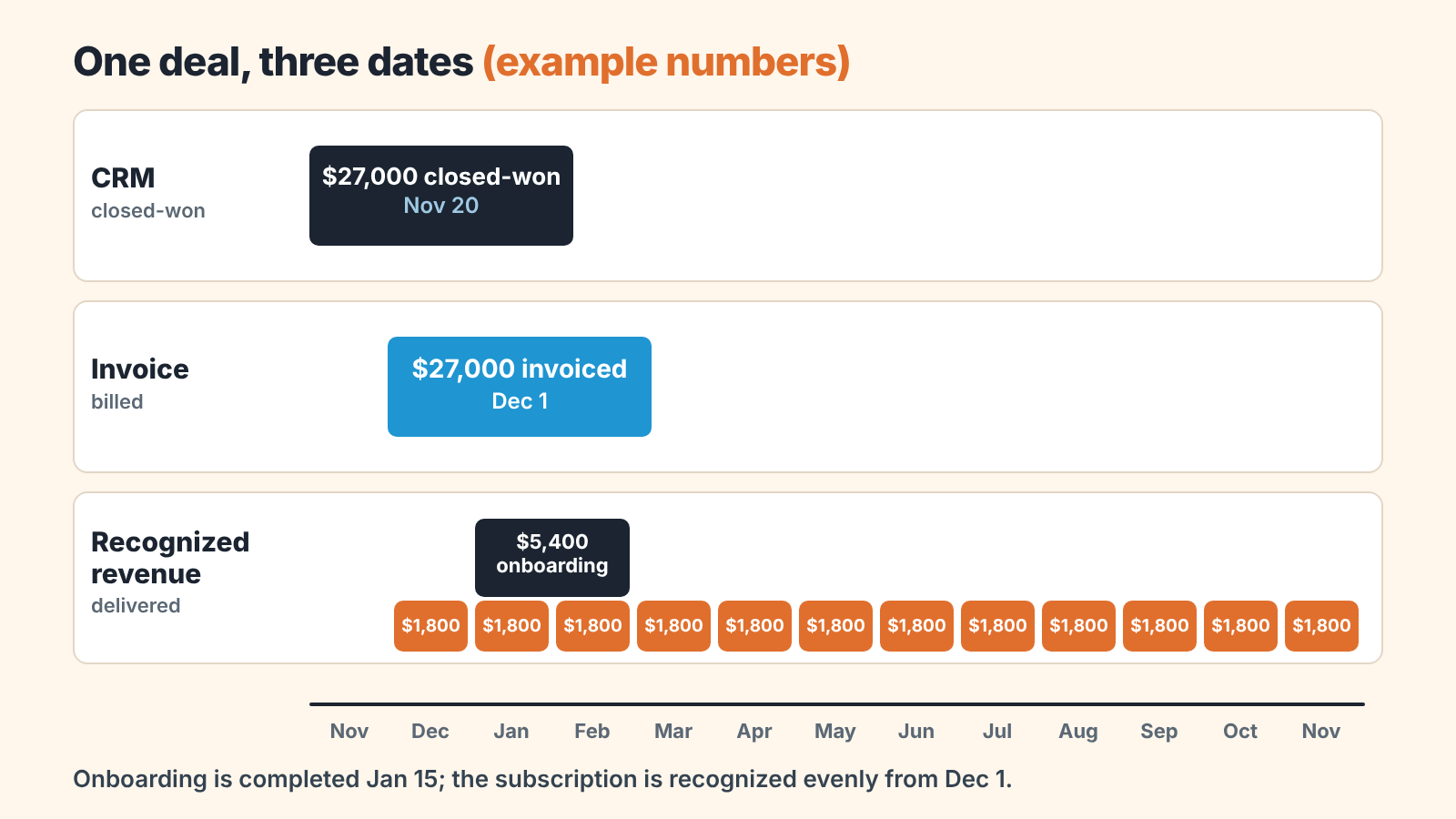
The sales dashboard for November says $27,000. The income statement for November says zero from this deal, and December adds only $1,800. If the owner planned hiring around “we sold $27,000 in November,” the plan was built on a number the books won’t show for a year.
Why the discount moved to the subscription
The rep recorded $24,000 for the subscription and $3,000 for onboarding. Finance ends up with $21,600 and $5,400 for the same deal. Both versions add up to $27,000.
Step 4 explains it. The IFRS 15 summary describes allocation by relative stand-alone selling prices, which spreads a discount across the items in proportion to what each would sell for alone. “50% off onboarding” is how the negotiation went. In the books the same $3,000 discount lands mostly on the subscription ($2,400 of it).
Who should care? Anyone who reports revenue by product line, and anyone whose commission plan pays a different rate on services than on subscriptions. Agree with finance on which split drives commission before the quarter starts, because the two versions differ by $2,400 on this one deal.
There’s a practical requirement hiding here too. Finance can only run the allocation if the list price of each line survives on the deal. A single amount field that says $27,000 leaves them guessing, or emailing the rep in January.
Fields to add to a deal
Dates first. Most recognition questions are date questions, and a deal needs a signature date, a service start date and a service end date as three separate fields. The close date in most CRMs is the day the rep moved the card, and that’s rarely the day the service began. Our example has eleven days between the two, enough to push the first month of revenue from November into December. If you add only one field this quarter, make it the service start date. Without it every subscription deal needs a question to the rep before the first month can be booked.
Then the items. Put each promised thing on the deal as its own product line with a list price and a sold price, so the discount is visible per line and in total. Onboarding, training, a setup fee, a block of consulting hours: if the customer was promised it, it gets a line, even at $0. Free onboarding is still a promise, and finance will want to know it exists.
One-off deliverables need a completion date that someone actually fills in. In the example $5,400 waits for January 15. If nobody records that onboarding finished, finance has no trigger, and the amount sits in deferred revenue until someone asks.
Last, the terms. Payment terms and the billing schedule (annual upfront, quarterly, monthly) tell finance when invoices go out and how deferred revenue will move. Then whatever can change the price after signing: a refund window, a cancellation right, a usage-based component, a credit promised for a late start. A short text field named “Non-standard terms” plus a yes/no checkbox is enough; finance reads the contract for the rest. When a contract is amended mid-term, log the amendment on the deal with its date instead of overwriting the original amount. In Pipedrive, HubSpot, Salesforce or Zoho CRM all of these are ordinary custom deal fields and product line items, so there’s nothing to build.
Deferred revenue, proration, bookings vs billings
These terms get mixed up in pipeline reviews more than any others, and the $27,000 deal has a place for each.
Bookings are the value of contracts signed in a period, so this deal books $27,000 in November. It bills $27,000 in December, when the invoice goes out. The difference between those two and revenue is the subject of bookings vs billings vs revenue.
Recognized revenue is what the company earned by delivering, $1,800 in December and $7,200 in January here. If your team still reads cash in the bank as revenue, cash vs accrual accounting for a sales owner covers the gap.
Deferred revenue is money invoiced or paid for service still owed to the customer. At the end of December that’s $25,200, and it sits on the balance sheet as a liability, which liabilities for a sales owner walks through.
Proration means charging or recognizing part of a period. Had the subscription started December 16, roughly half of December’s $1,800 would have been recognized that month. Mid-term upgrades are where it bites, see proration for a sales owner.
Should the CRM say “revenue” at all?
A common piece of advice goes the other way from this article: put a recognition schedule on every deal and let the CRM report recognized revenue, so sales and finance look at one system. We disagree. Steps 2 and 4 involve judgment that belongs to an accountant, and a schedule maintained by reps will drift from the books the first time a contract is amended or a start date slips. Then the owner has two revenue numbers and a meeting to reconcile them .
Our view is narrower. The CRM holds the facts of the deal (dates, lines, prices, terms) and the accounting system holds revenue. The sales dashboard should label its big number “bookings” or “closed-won.” Half of the confusion in a month-end meeting comes from one word on a chart. If you want to see where the posting actually happens, it’s laid out in what posts from a closed-won deal to the general ledger.
What finance needs from sales each month
Before the books close, finance needs one export and a few answers. The export is every deal won in the month with its product lines, list and sold prices, signature date, service start and end. If the fields above exist, it’s a saved filter and you don’t have to chase anyone.
The answers are about change. Which deals had a start date move? Which one-off deliverables were finished this month, and on what day? Did anyone agree to a credit, a refund or an early cancellation? Were any contracts amended mid-term (an upgrade, extra seats, a changed end date)? Each of these can change what finance recognizes, and none of them appears on an invoice.
That export is only as good as the the deal data behind it. SalesBond’s free CRM audit checks that side: it looks at the last 30 days of your CRM and sends a PDF report with money at risk, a CRM score, findings and what to fix, then a second PDF seven days later showing what changed. It works on CRM data and does no bookkeeping or revenue recognition. Check your CRM with SalesBond before month-end, so the list you hand finance has fewer blanks.
FAQ
Is a closed-won deal revenue under ASC 606?
No. Closed-won records that a contract was signed, which is step 1 of five. Revenue is recognized at step 5, when or as the performance obligations are satisfied; in the example above that runs from December through the following November.
Does ASC 606 apply to small private companies?
KPMG’s handbook page lists the applicability as “All companies” (checked November 2026). What matters for you is whether your statements are prepared under US GAAP, and your accountant can answer that in one email.
Is ASC 606 the same as IFRS 15?
They were issued together. The IASB and the FASB announced on May 28, 2014 that they had “jointly issued a converged Standard” on revenue from contracts with customers, which became IFRS 15 and Topic 606, according to the IFRS Foundation’s news release. IFRS 15 uses the same five-step model and has been effective for annual periods beginning on or after January 1, 2018. Details can differ between the two, so a company reporting under both should ask its auditor where.
If the customer pays the whole year upfront, is that revenue?
Payment timing doesn’t decide it. In the example the customer is invoiced $27,000 on December 1 and only $1,800 is recognized that month. The other $25,200 is deferred revenue until the service is delivered.
How do SaaS companies recognize revenue under ASC 606?
Mostly over time. A subscription is usually recognized evenly across its term, the way the example spreads $21,600 as $1,800 a month (a mid-month start gets prorated), while one-off services such as onboarding are recognized when they’re delivered, provided finance treats them as a separate performance obligation. KPMG keeps a separate software and SaaS handbook for the harder cases.


