

A general ledger is the master record of a business’s accounts. Every transaction is posted to it as debits and credits, and it’s the record your financial statements are built from. A closed-won deal in your CRM posts nothing to the general ledger; revenue appears there only when the invoice or the payment is recorded in your accounting system.
So what happens between “won” in the CRM and “posted” in the books? We’ll follow one $12,000 deal across that gap, entry by entry.
What is in a general ledger: accounts, debits and credits
Open the ledger in any accounting system and you see a list of accounts, each with its own running history. Wikipedia’s entry on the general ledger (checked November 2026) puts it this way: the ledger “contains a page for all accounts in the chart of accounts,” and those accounts are grouped into categories such as income, expense, assets, liabilities, and equity.
Each line on a page is a posting. According to the same Wikipedia entry, posting means recording amounts as debits on the left side and credits on the right, with extra columns for a running total. In accounting software that page usually reads as date, reference, description, debit, credit and balance. Double-entry bookkeeping debits one account and credits another for the same amount, and that’s what keeps the ledger in balance.
Which side makes an account grow? Wikipedia’s article on debits and credits states that debits increase asset and expense accounts, while credits increase liability, equity, and revenue accounts. A sales leader can get by on two of those. Revenue goes up with a credit. Cash and the money customers owe you are assets, so they go up with a debit (you’ll see both in the $12,000 example below).
You don’t need more theory than that to read the example below. If you want the equation behind it, we covered it in the accounting equation for a sales owner.
General ledger example: one closed-won deal from CRM to the books
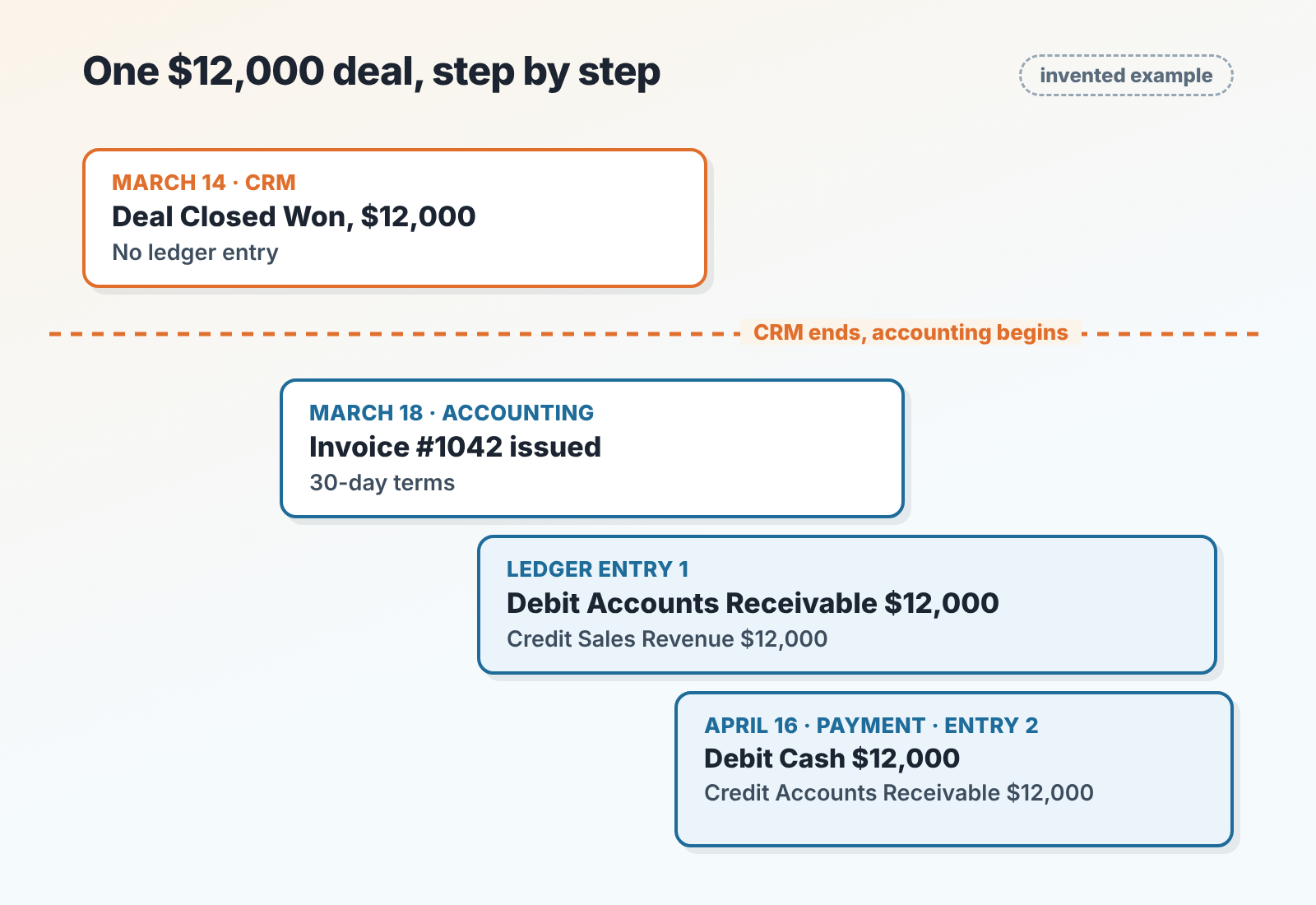
Say a five-rep team sells implementation packages. The numbers are invented, and the books run on simple accrual, where revenue is posted when the invoice is issued. On March 14 a rep drags a $12,000 deal to Closed Won. Finance issues invoice #1042 on March 18 with 30-day terms. The customer pays on April 16.
| Date | What happened | Where it is recorded | Debit | Credit |
|---|---|---|---|---|
| March 14 | Deal marked closed-won | CRM | nothing posted | nothing posted |
| March 18 | Invoice #1042 issued for $12,000 | Accounting system | Accounts Receivable $12,000 | Sales Revenue $12,000 |
| April 16 | Customer pays $12,000 | Accounting system | Cash $12,000 | Accounts Receivable $12,000 |
Read the three rows as three different answers to “did we get the money?”
On March 14 the ledger knows nothing. The CRM shows $12,000 won, the sales dashboard counts it toward the month, and every account balance in the books is exactly what it was the day before.
On March 18 the ledger gets its first entry. Revenue rises by $12,000 and so does Accounts Receivable, the account that tracks what customers owe. The income statement for March now includes this deal, while the bank balance still shows $0 from it.
On April 16 the second entry moves the $12,000 from Accounts Receivable into Cash. Revenue is untouched, because it was already recorded in March. After both entries the three balances from this one deal are Sales Revenue $12,000, Cash $12,000 and Accounts Receivable $0.
Two caveats before you take this table to your bookkeeper. A business on cash-basis accounting would post a single entry on April 16 (debit Cash, credit Sales Revenue) and nothing in March; the difference is laid out in cash vs accrual accounting for a sales owner. And your accountant may recognize revenue on delivery or across the contract term instead of at invoicing. Ask which rule your books follow. This article is an explanation for sales people and doesn’t replace accounting advice.
One thing holds in every variant. The entry is triggered by an accounting document, such as an invoice, a payment or a credit note, and moving a deal between CRM stages triggers nothing in the books.
What your CRM never holds
A CRM holds deals and the activity around them. The balances, invoices and payments your accountant works from live in the accounting system.
Take the March 14 row again. The rep did everything right, the deal is real, and still there is no trace of it in the books. Now flip the question. What’s in the books that no CRM pipeline will ever show you?
- Account balances. The CRM can sum won deals, but it has no Cash account, no Accounts Receivable and no running balance for either.
- The invoice as an accounting document, with its own number, date and final amount (which can differ from the deal amount after a last-minute discount or a split into two invoices).
- Whether the money arrived. Some teams add a “paid” checkbox to the deal; the ledger has the actual receipt.
- Credit notes and refunds posted after the deal was won.
- Everything on the cost side, from payroll and rent to the write-down of equipment described in depreciation for a sales owner.
- Liabilities and equity, the half of the balance sheet that sales activity never touches directly.
It works the other way to. The ledger has no open pipeline, no lost deals, no next activity and no idea which rep owns the account. Wikipedia’s general ledger entry notes that an account can carry the date of sale, the invoice number, customer details and the amount due, and that’s about as close to a deal record as the books get.
You’ll often hear that the CRM should become the single source of truth for revenue, with invoicing fields, payment status and recognition dates all rebuilt on the deal. We disagree with that advice. A second set of revenue numbers maintained by reps can drift from the books (a discount here, a split invoice there), and then there are two answers to every question the owner asks. We’d keep revenue in the ledger and give the deal three small fields: invoice number, invoice date, paid date. That’s enough to match one system against the other. If you’re on HubSpot and QuickBooks, the invoice and payment sync on the deal fills those fields without retyping.
The monthly check: closed-won total against revenue in the ledger
Once a month, after the books for the previous month are closed put two numbers side by side. From the CRM, take the total of deals won with a close date in that month. From the accounting system, take the Sales Revenue account for the same month. Expect a gap. The useful work is explaining it line by line: timing first, then amounts, then whatever is left.
Continuing the example (still invented numbers), here is how March could reconcile for the same team.
| Line | Deals | Amount |
|---|---|---|
| Closed-won in the CRM, close date in March | 9 | $86,000 |
| Won in March, invoiced in April | 2 | minus $14,500 |
| Won in February, invoiced in March | 1 | plus $6,000 |
| Invoice lower than the deal amount (discount never updated in the CRM) | 1 | minus $1,500 |
| Expected March revenue | $76,000 | |
| Sales Revenue account in the ledger, March | $73,600 | |
| Unexplained | $2,400 |
The first three adjustments are timing and data hygiene. They’re normal, and each one tells you something about how long finance takes to invoice or how carefully reps update amounts. The last line is the one that pays for the hour. To find it, export the nine won deals and the March invoice list and match them by customer and amount. In this example the $2,400 turns out to be a small deal that was won and delivered and never invoiced at all.
Who should do this? The bookkeeper owns the ledger side and the head of sales owns the the deal list, so it takes both for about an hour. Agree on one rule up front, which is that an unexplained line doesn’t roll into next month without a name next to it.
The CRM half of the comparison is only as good as the deal data behind it (close dates, amounts, owners). SalesBond’s free CRM audit covers that half: it looks at the last 30 days of your CRM and sends a PDF report with money at risk, a CRM score, findings and what to fix, then a second PDF seven days later showing what changed. It works on CRM data and does no bookkeeping. Check your CRM with SalesBond before the next month-end and the won-deals export you bring to the bookkeeper will need fewer corrections.
General ledger vs chart of accounts vs trial balance
These three terms show up in the same conversation, usually in one sentence from your accountant. Which of them do you ask for when you want to see what was posted from your invoices?
| Term | What it is | What a sales owner asks it |
|---|---|---|
| Chart of accounts | “A list of financial accounts and reference numbers, grouped into categories,” per Wikipedia’s chart of accounts entry; how to set one up around what sales sells is in chart of accounts for a sales owner | Do we have separate revenue accounts for each product line we sell? |
| General ledger | Every posting to every account on that list, with dates and amounts | What exactly was posted to Sales Revenue in March, and from which invoices? |
| Trial balance | A list of the closing balances of all ledger accounts at a specific date, per Wikipedia’s trial balance entry; total debits must equal total credits | Are the books balanced and ready for the statements to be produced? |
From the trial balance the accountant produces the reports you actually read. Which CRM fields feed each of them is covered in the three financial statements for a sales owner.
Questions owners ask about the ledger
How do you keep a ledger book?
In a small business, you mostly don’t keep it by hand. Each invoice, bill and bank transaction you record in the accounting software creates the debit and credit lines, and the ledger is the report that lists them by account. Your part is recording documents on time and looking at the postings once a month. A bookkeeper or accountant closes each period. Prefer paper? A ledger book follows the same logic, with one page per account.
Does a CRM have a general ledger?
No. A CRM stores deals, contacts and activities. Some CRMs can create quotes or invoices or sync with an accounting system, and the postings still live in the accounting system.
When does a won deal show up as revenue?
Under accrual accounting, when the accounting system records the invoice (or when your accountant’s recognition rule says the revenue is earned). Under cash-basis accounting, when the payment is recorded. In the example above that means March 18 on accrual and April 16 on cash basis, for a deal won on March 14.
Can I read the general ledger myself?
Yes, and one account is enough to start. Ask your bookkeeper for the Sales Revenue account detail for last month and compare the invoice lines with your list of won deals. How many of last month’s won deals can you find in it?


