
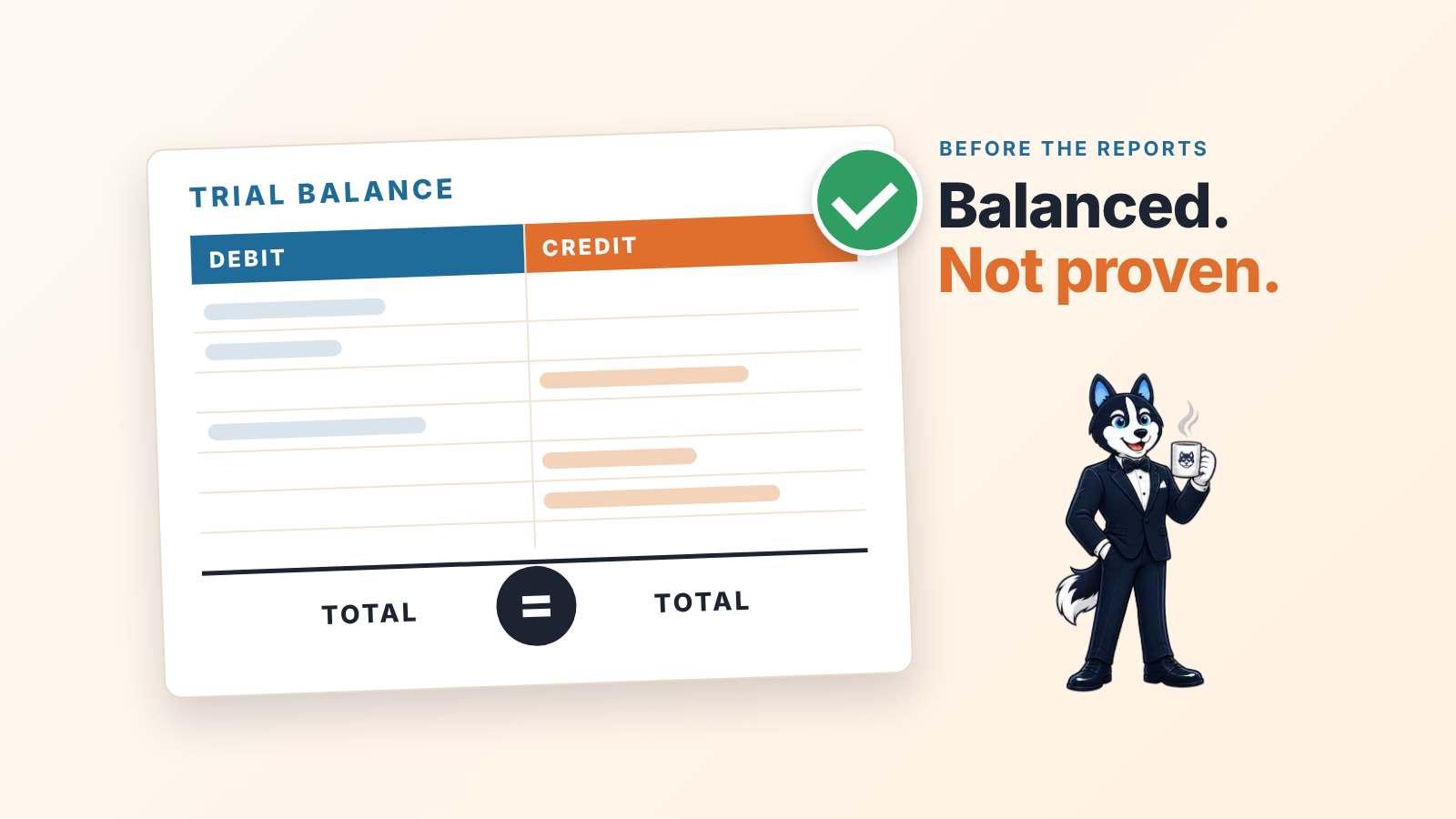
A trial balance is a list of every ledger account with its debit or credit balance at one date. It checks one thing. Total debits should equal total credits before the financial statements are prepared. It doesn’t prove the numbers are correct (a page can balance and still be thousands off), and it doesn’t contain your CRM deals unless they were invoiced and posted.
That last part matters most to an owner whose numbers come from sales. Below is one invented month, with a trial balance that balances perfectly while the CRM says something else.
Trial balance example: one month, nine accounts
Say a six-rep agency sells website build projects. The numbers are invented for this example. Its fiscal year starts on October 1, the books run on accrual, and revenue is posted when an invoice is issued. On October 31 the bookkeeper prints this:
| Account | Debit | Credit |
|---|---|---|
| Cash | $41,000 | |
| Accounts Receivable | $27,000 | |
| Equipment | $12,000 | |
| Accounts Payable | $5,000 | |
| Owner’s Equity | $50,000 | |
| Sales Revenue | $71,000 | |
| Salaries Expense | $38,000 | |
| Rent Expense | $6,000 | |
| Software Expense | $2,000 | |
| Total | $126,000 | $126,000 |
Account name, a debit column, a credit column and a total under each make up the whole trial balance format. Each account sits in one column only. Wikipedia’s trial balance entry (checked November 2026) lists which side is normal: assets and expenses carry debit balances, while liabilities, equity and revenue carry credit balances. So Sales Revenue belongs on the right, and the money customers still owe you belongs on the left.
The two totals match at $126,000. According to the same Wikipedia entry, a mismatch “would show that there is an error in the nominal ledger accounts,” and “this error must be found before a profit and loss statement and balance sheet can be produced.”
Once the totals agree the statements come straight out of these rows. Revenue of $71,000 less $46,000 of expenses gives a $25,000 profit for the profit and loss statement. Cash, receivables and equipment add up to $80,000 of assets, which equals $5,000 of payables plus $50,000 of equity plus that $25,000 profit.
One caution for any month after the first. Wikipedia describes closing the books as “zeroing out all the revenue and expense amounts at the end of an accounting period (typically a fiscal year),” so in month five the Sales Revenue row holds five months. Ask your bookkeeper for the month’s activity on that account when you need one month.
Trial balance vs general ledger vs balance sheet
You’ll need all three, for different questions. The general ledger is where you go to find a single invoice. Before the reports are built, the trial balance puts every account total on one page, and the balance sheet is what a bank or investor reads when they ask what the business owns and owes.
| General ledger | Trial balance | Balance sheet | |
|---|---|---|---|
| What it holds | Every posting, account by account. Per Wikipedia’s general ledger entry, “a ledger account is created for each account in the chart of accounts” | One closing balance per account, in a debit or a credit column | Per Wikipedia’s balance sheet entry, assets, liabilities and ownership equity “listed as of a specific date” |
| Revenue and expenses shown? | Yes, each entry | Yes, one row each | No, they arrive only as profit inside equity |
| Where a won deal shows up | As the invoice entry, with date and amount | Inside the Sales Revenue total | Inside Accounts Receivable until the customer pays |
| Question to ask | “Show me the entry for invoice 1107” | “Does the revenue row match what sales closed?” | “How much of what we sold is still unpaid?” |
New to the ledger itself? The general ledger guide for sales owners follows one deal through it entry by entry, and you’ll find the other two reports side by side in the three financial statements and the CRM fields that feed them.
How a trial balance is prepared, and the adjusted version
Who builds this page, and from what? The bookkeeper takes each ledger account’s closing balance, drops it into the debit or credit column, totals both columns and compares them. OpenStax’s Principles of Accounting, Volume 1 (section 3.6, checked November 2026) calls that first pass the unadjusted trial balance, which “includes accounts before they have been adjusted.”
Then the bookkeeper posts month-end adjusting entries and runs it again. In section 4.4 OpenStax defines the adjusted trial balance as “a list of all accounts in the general ledger, including adjusting entries, which have nonzero balances,” and section 3.6 adds that “a more complete picture of company position develops after adjustments occur.” That’s the copy you want for the monthly check further down.
The third kind shows up once the books are closed. OpenStax’s section 5.2 says the post-closing trial balance is used “to double-check that the only accounts with balances after the closing entries are permanent accounts.” Revenue and expenses are gone from it, so a sales owner rarely needs to read it.
What a trial balance catches and what it misses
Go back to the agency’s October. Suppose a $9,000 invoice was sent to the customer and never entered in the books. Accounts Receivable would read $18,000, Sales Revenue $62,000, and both columns would total $117,000. Balanced. Wrong by $9,000.
Wikipedia calls this an error of omission, “when a transaction is completely omitted from the accounting records,” and its Limitations section opens with the reason the check can’t see it: “A trial balance only checks the sum of debits against the sum of credits.”
Two more errors from that list land on the sales side often enough to know by name. An error of original entry is “when both sides of a transaction include the wrong amount.” Key the $9,000 invoice as $6,000 and both columns come out $3,000 short, still equal at $123,000. An error of commission, in Wikipedia’s wording, is when entries land at the correct amount and on the appropriate side while “one or more entries are made to the wrong account of the correct type.” If the agency kept separate revenue accounts for builds and for maintenance retainers, a build invoice posted to the retainer account would leave every total untouched and make one service line look better than it is (how to split those accounts is covered in chart of accounts for a sales owner).
What does the check catch, then? Entries where one side is missing or the two sides differ, and an account total left off the list. Wikipedia adds one more signal you can use without any training. A reversed entry may occasionally show up as an account sitting on its unusual side, such as cash with a credit balance. Scan the page for that. Sales Revenue in the debit column or Accounts Receivable in the credit column is a question for the bookkeeper the same day.
Where revenue from closed-won deals appears
Take one deal from the example. A rep marks a $9,000 build project as won on October 6. Nothing changes in the books that day.
On October 9 the invoice goes out. The bookkeeper posts one entry with two sides (debit Accounts Receivable $9,000, credit Sales Revenue $9,000), so both rows of the trial balance grow by the same amount and the totals stay equal. The customer pays on October 30. Cash goes up by $9,000, Accounts Receivable goes down by $9,000, and the Sales Revenue row doesn’t move at all, because that revenue was already recorded on the 9th.
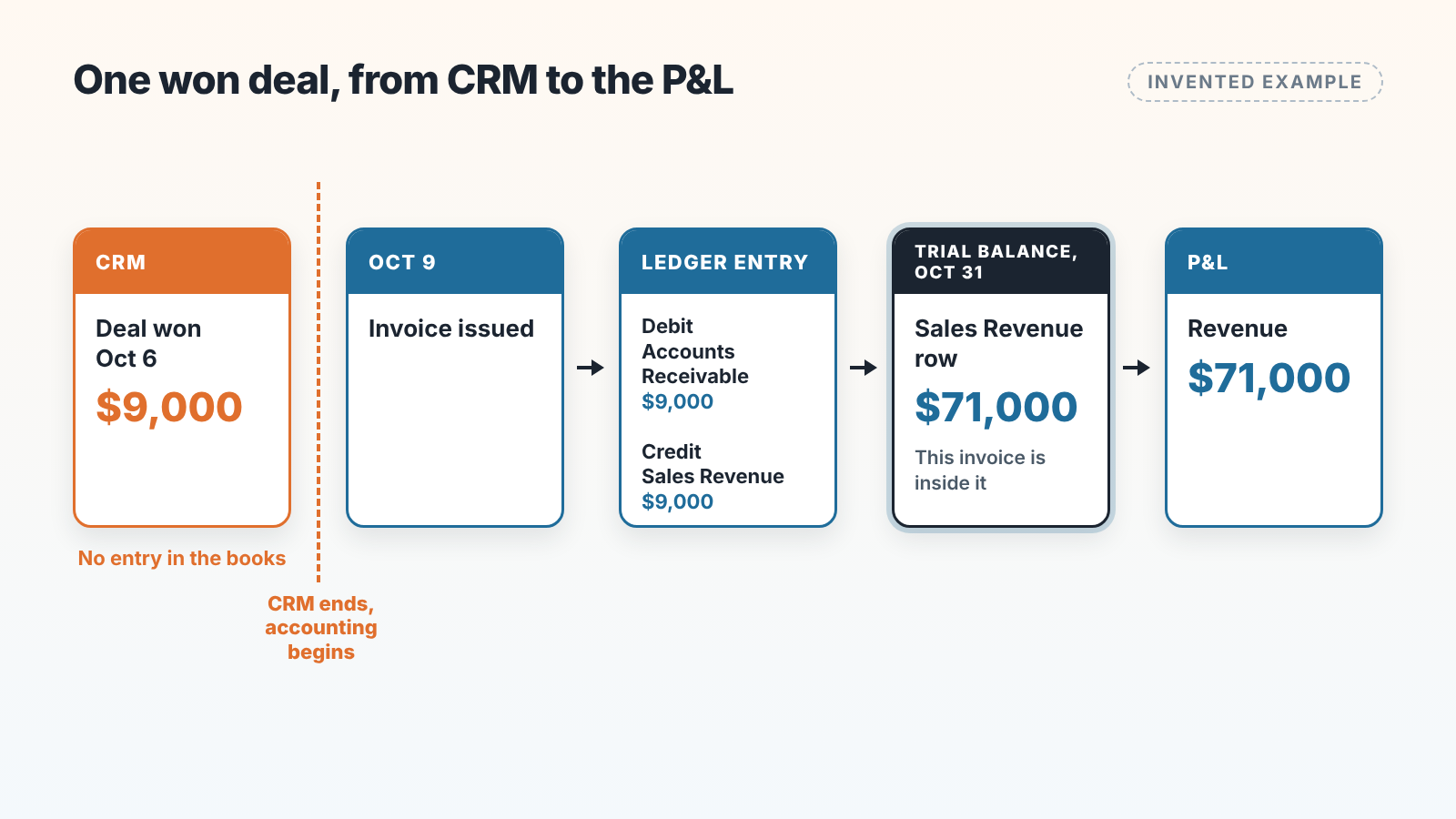
So the deal has no row of its own. By October 31 it’s one of the invoices inside the $71,000 on the Sales Revenue row, and nothing on the page names the customer or the rep. To find it you’d go from the trial balance row to the Sales Revenue account in the ledger and from there to the invoice.
Books kept on a cash basis would post this revenue on October 30, the payment date. The two methods are compared in cash vs accrual accounting for a sales owner. Which one do your books use? Ask your accountant before you compare anything (none of this replaces accounting advice).
The monthly check: CRM closed-won against the revenue row
Who should see this page before the P&L goes out? Owners are usually told to read the P&L and leave the trial balance to the bookkeeper. We disagree when sales drive the business. By the time revenue reaches the P&L it’s a formatted figure that everyone treats as settled. The trial balance is the last page where the Sales Revenue row can still be questioned cheaply, and the owner is the one person who knows what sales believes it closed.
The check needs two numbers. From the CRM, filter won deals by close date for the month and total the amount. From the books, take the month’s Sales Revenue. In the example the CRM says $84,000 and the trial balance says $71,000. Then explain the $13,000 gap, row by row:
| Step | Amount |
|---|---|
| CRM: deals won with a close date in October | $84,000 |
| Less: two deals won on October 28 and 30, invoiced in November | -$18,000 |
| Plus: invoices issued in October for deals won in September | +$9,000 |
| Less: discount agreed at invoicing, deal amount never updated in the CRM | -$1,500 |
| Less: credit note issued for a reduced project scope | -$2,500 |
| Books: Sales Revenue for October | $71,000 |
The first two rows are timing, they sort themselves out next month. The discount row is a CRM fix. Someone edits that deal’s amount down to what was actually invoiced ($7,500 on a $9,000 deal with the $1,500 discount), so next month’s won-deals total starts clean. And the credit note? That’s news the the sales team may not have heard yet.
What if a remainder is left after every row is explained? That’s where the errors from the previous section live. An invoice that was never posted, or one keyed with the wrong amount, shows up here and nowhere on a balanced trial balance. Bring the unexplained figure and the list of won deals to the bookkeeper and match invoice by invoice. Ask as well whether the copy you were given was printed before or after month-end adjustments; Wikipedia’s entry says a trial balance should be run again whenever an adjustment is made.
The CRM half of this check is only as reliable as the close dates and amounts on the deals. SalesBond’s free CRM audit looks at that half: it reads the last 30 days of your CRM and sends a PDF report with money at risk, a CRM score, findings and what to fix, and seven days later a second PDF shows what changed. It works on CRM data and does no bookkeeping. Check your CRM with SalesBond before month-end, and the won-deals total you carry into this table will need less explaining.
What your CRM never holds
Look at the nine rows of the example again and count the ones a CRM could fill in. Sales Revenue comes close, after invoicing. Accounts Receivable could be approximated if someone records payment dates on deals.
The other seven rows have no deal behind them. Salaries, rent and software are bills you’d pay in a month when nobody closes anything. Cash is a bank figure. Equipment, payables and owner’s equity belong to the balance sheet, and no pipeline stage maps to them. And credit notes, write-offs, month-end adjustments? The bookkeeper posts those, and they don’t travel back to the deal on thier own.
A CRM also holds things the trial balance will never show: the $18,000 won in the last days of October, the open pipeline behind it, who owns each deal. An owner who reads both pages once a month knows which of those two views a number came from.
FAQ
What is the purpose of a trial balance?
Per Wikipedia’s entry, “the primary purpose of preparing a trial balance is to ensure the accuracy of an entity’s double-entry bookkeeping system.” In practice it confirms that total debits equal total credits before the profit and loss statement and balance sheet are produced.
Is a trial balance the same as a balance sheet?
No. A trial balance is an internal list of every account, revenue and expenses included, in debit and credit columns. A balance sheet is a financial statement that lists only assets, liabilities and equity at a date. In the example, the trial balance totals $126,000 per column while the balance sheet built from it shows $80,000 of assets.
If the trial balance balances, are the books correct?
They can still be wrong. An invoice that was never posted leaves the totals equal, and so does one entered with the wrong amount on both sides or an amount posted to the wrong account of the same type. You’d catch the first two by comparing the revenue row with won deals from the CRM.
Who prepares the trial balance, and how often should an owner see it?
Wikipedia notes that it “is usually prepared by a bookkeeper or accountant.” We’d ask for it once a month, after the books for the month are closed and before the P&L is sent around.
Do I need a trial balance if my accounting software makes the reports?
Yes, as a page to read once a month. Whoever or whatever builds it, the errors of omission, original entry and commission still leave both columns equal. The CRM comparison above is how you catch the first two.


