
Cost accounting is a way of recording and analyzing what it costs to make a product or deliver a service, so managers can set prices and control spending. In a sales-led business it’s the habit of knowing what each deal costs to win and serve, alongside what it brings in.
Most guides to the subject are written for an accountant in a manufacturing company: materials, machine hours, factory overhead. A sales owner’s question is narrower. Two deals closed last quarter at the same amount. Did they earn the same? The revenue report says yes. Cost them out by stage and you may get two very different answers, because the gap sits in hours and support tickets that nobody attached to a deal.
What is cost accounting when the thing you sell is a deal?
Wikipedia’s cost accounting article (read November 18, 2026) defines it as “the process of recording, classifying, analyzing, allocating, and reporting an organization’s costs” and says it is used mainly within management accounting, to give managers information for planning, pricing and other decisions (Wikipedia: Cost accounting).
Every cost in that process gets attached to something. Accountants call the something a cost object, and Wikipedia’s direct costs article lists the usual candidates as “a particular project, facility, function, or product” (Wikipedia: Direct costs). A factory picks the product. A sales-led business should pick the deal, since that’s where price, discount and effort get decided, and it already has a record in the CRM.
A deal collects costs in four stages: winning it (the lead and the selling time), closing it (commission, payment fees), delivering what was sold, then serving the customer afterwards. Write those four words on a whiteboard before you touch a a spreadsheet. If a cost can’t be placed under one of them, it probably belongs to the company as a whole and stays out of the deal.
Cost accounting vs financial accounting
Financial accounting reports the whole company’s results to outsiders under accounting standards; cost accounting gives managers costs per product, job or deal for internal decisions. Your accountant already produces a profit and loss statement, so why keep a second set of numbers? Because they’re read by different people. Per the same Wikipedia article, financial accounting is “primarily concerned with reporting a business’s financial position and results to external parties according to accounting standards”, while cost accounting is “principally concerned with information for internal management”.
For a sales owner that splits along a few lines. The P&L goes to the tax authority, the bank and investors, it’s kept by account for the company as a whole and it’s audited to the cent. The deal view is for you and your head of sales. It asks which deals, customers and deal types make money, works from good estimates checked against the books once a quarter, and follows rules you set yourself, as long as you apply them the same way every month. It lives in a report built from CRM fields plus two or three rates from the accountant.
That last point matters before you build anything. Bookkeeping stays where it is, and how a cost is treated in the books is your accountant’s call (this article is management arithmetic for an owner, so don’t read it as accounting or tax advice). If your revenue accounts and your CRM products don’t line up yet, fix that first with a chart of accounts that matches the products on your deals.
Direct and indirect costs of a deal
Take a won deal and ask what the company paid only because this deal exists. The rep’s commission. A referral fee to the partner who sent the lead. The subcontractor’s invoice, the product bought from a supplier, shipping, the card fee on the payment. Each of these direct costs has an invoice or a formula that points at this deal and no other, so you’d lose the cost if you lost the deal.
Everything else is indirect. Wikipedia describes indirect costs as “costs that are not directly accountable to a cost object” (Wikipedia: Indirect costs), and in a sales team that covers the rep’s base salary, the sales manager, the CRM seats, the support desk, rent.
The common advice for small companies is to stop at direct costs. Fair enough. You subtract them from the deal amount, call the rest contribution and leave the indirect pile alone (for pricing and discount decisions that’s all you need, and we cover it in contribution margin per deal).
We’d still add two indirect costs to every deal, the rep’s selling time and the support load after the sale, because they vary from deal to deal far more than anything in the direct column. Commission moves with the deal amount, so two $12,000 deals carry the same commission. Selling time doesn’t behave like that. One deal closes in three calls and another takes four months of demos, security questionnaires and a rewritten proposal, and a direct-cost view shows them as identical. After the signature support repeats the pattern: 9 tickets from one customer, 30 from the next.
Rent, admin salaries and the owner’s own time we leave out. Spread rent across deals and teh per-deal figure changes every time the deal count changes, so what it ends up describing is how busy the month was.
Job costing, activity-based costing, standard costing: which one fits a sales team
Three methods from the textbooks translate to deals. The quotes below come from the Wikipedia article on each method, read November 18, 2026, and the translation to deals is ours.
Job costing “tracks the costs and revenues by ‘job’”, and a job can be “a specific project done for one customer”. In a sales team the deal is the job, with direct costs recorded against the deal ID. The same article sets a requirement that a CRM already meets halfway: the system “must allow job numbers to be assigned to individual items of expenses and revenues”. Every deal has an ID, and it’ll do as the job number on a supplier invoice or a timesheet line.
Activity-based costing (ABC) “identifies activities in an organization and assigns the cost of each activity to all products and services according to the actual consumption by each”. For deals, you put a price on an hour of selling and on a support ticket, then charge each deal for what it used. It pays off when deals of similar size differ a lot in effort.
Standard cost accounting, per Wikipedia, compares the labor and materials actually used with what the same goods would have required under “standard” conditions. Applied to deals, you set an expected cost per deal type and review only the deals that went over, which needs a few quarters of deal costs to set the standard from.
Two more names turn up in every list of methods. Absorption costing takes account of “the full cost of manufacturing a product or providing a service”, overheads included, and Wikipedia’s variable costing article notes that income statements under US GAAP must use absorption costing. Variable costing puts “only variable manufacturing costs” into the cost of a unit and leaves fixed overhead to the period. Keep rent and admin salaries off the deal and you’re much closer to variable costing, with two ABC-style charges added on top. Where the line between the two kinds of cost runs is covered in fixed and variable costs.
For a team of five to twenty people we’d run job costing plus exactly two ABC-style activities, selling hours and support tickets. A full ABC model with a dozen activities needs someone to maintain it, and in a small company that someone is you. Standard costing can wait until the first two give you history.
A worked example: one $12,000 deal from lead to support
Say a services firm closes a $12,000 implementation project that came from a partner referral. The numbers are made up, so swap in your own. Cost of a deal = cost to win + cost to close + cost to deliver + cost to serve, and most of those terms need a rate from the accountant.
Three rates, then. An hour of a rep costs the company $45. Accountants call that a loaded hourly rate, meaning salary plus payroll costs divided by working hours. The salaried delivery team’s hour costs $50 on the same basis, and a support ticket costs $35 (the support desk’s $4,200 a month over 120 tickets).
One more input comes from the CRM. This team wins one deal in four, and a lost deal takes 6 rep hours on average. So each win carries three losses with it: 18 hours, or $810. In the table, “allocated” means an indirect cost charged to the deal through one of those rates.
| Stage | Cost | Type | How it’s measured | Amount |
|---|---|---|---|---|
| Win | Partner referral fee | Direct | Partner invoice | $400 |
| Win | Rep time on this deal | Allocated | 22 hours × $45 | $990 |
| Win | Share of lost deals | Allocated | 18 hours × $45 | $810 |
| Close | Commission | Direct | 8% of $12,000 | $960 |
| Deliver | Subcontractor | Direct | Invoice | $3,600 |
| Deliver | Salaried delivery team | Allocated | 40 hours × $50 | $2,000 |
| Serve | Support, first 12 months | Allocated | 9 tickets × $35 | $315 |
| Total cost of the deal | $9,075 |
Direct costs come to $4,960, so the direct-only view leaves $7,040, or 58.7% of the deal amount. With the allocated lines the deal leaves $2,925, or 24.4%.
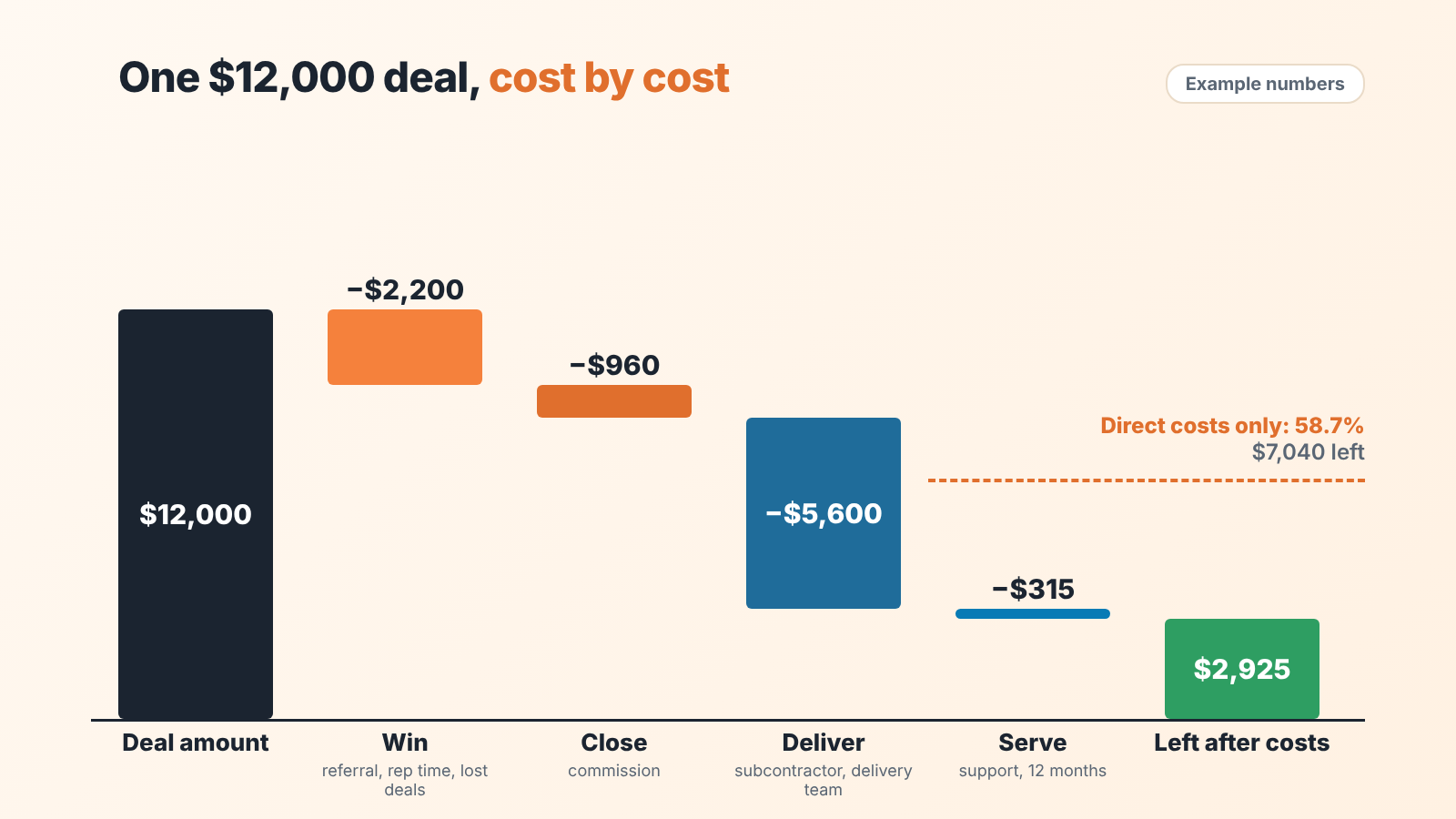
Now put a second $12,000 deal next to it. Same referral fee, same commission, same subcontractor and delivery hours, but the buyer needed 55 hours of selling and opened 30 tickets in the first year. Rep time becomes $2,475, support becomes $1,050, total cost rises to $11,295, and the deal leaves $705, which is 5.9%.
| Deal A | Deal B | |
|---|---|---|
| Deal amount | $12,000 | $12,000 |
| Left after direct costs | $7,040 (58.7%) | $7,040 (58.7%) |
| Rep hours on the deal | 22 | 55 |
| Support tickets, 12 months | 9 | 30 |
| Left after all deal costs | $2,925 (24.4%) | $705 (5.9%) |
In the revenue report and in the direct-cost report these two are the same deal. Wikipedia’s customer profitability article attributes a definition to Philip Kotler (without saying where he wrote it) that describes what the fuller view checks: a profitable customer is one who, over time, “yields a revenue stream that exceeds by an acceptable amount the company’s cost stream of attracting, selling and servicing the customer” (Wikipedia: Customer profitability). If Deal B’s customer renews at the same price, would you take the renewal?
The win-stage total ($2,200 here) is also the per-deal input for CAC payback, and the delivery lines are where this sum meets gross margin and COGS. Add up the deal costs for a quarter and you have the spend side of the ROI formula for a sales team.
CRM fields that help, and what stays in the accounting system
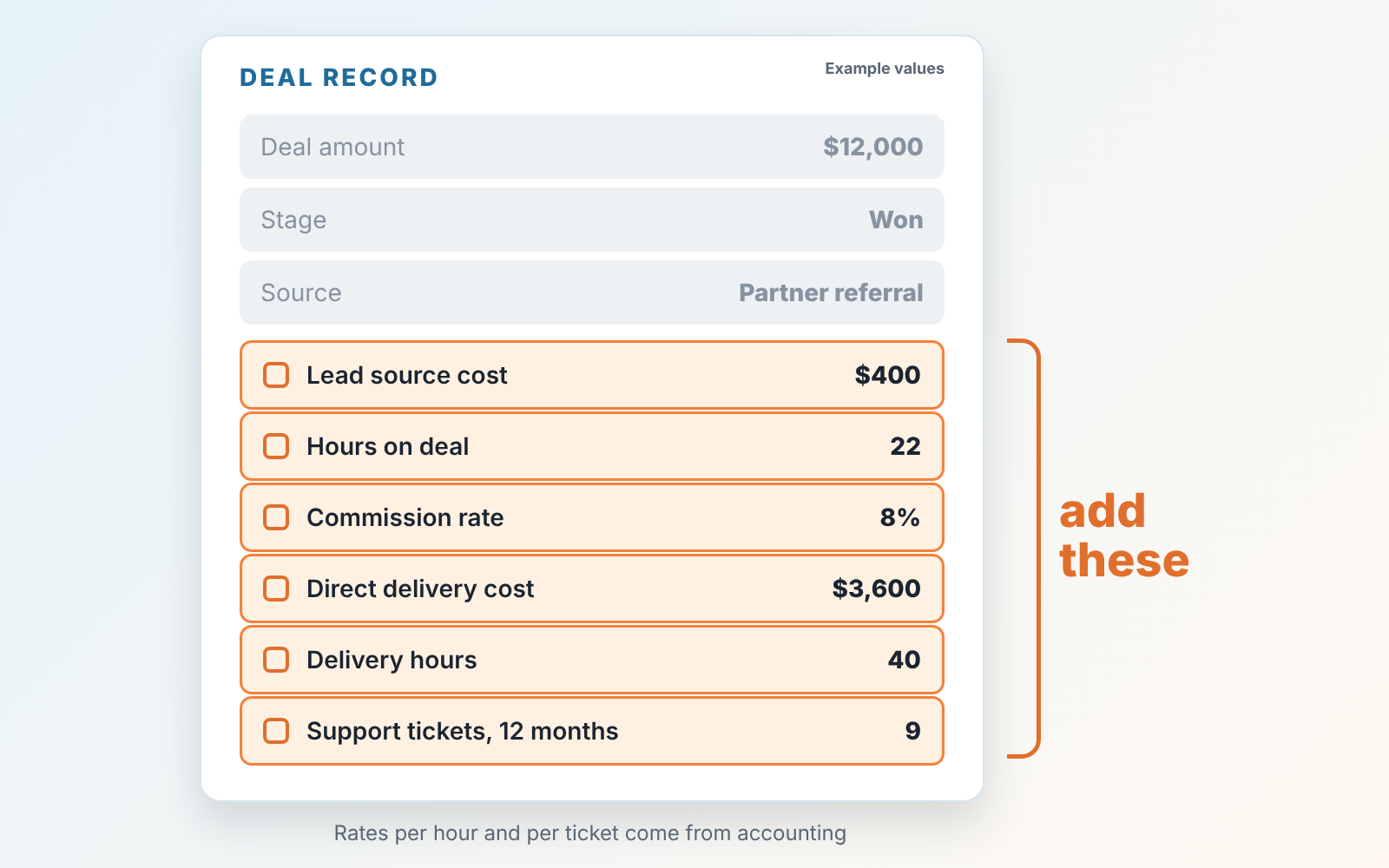
Which of those numbers can live on the deal record? More than most teams store. The amount, owner, source and won or lost status are usually there already. The rest are six custom fields, and the names are suggestions that work in any CRM with custom deal fields:
- Lead source cost, a currency field filled by whoever approves the referral fee or event invoice (win, direct).
- Hours on deal, a number from the rep. A count of logged calls and meetings can stand in for it.
- Commission rate as a percent, set once per plan.
- Direct delivery cost, which the delivery lead copies from the subcontractor or supplier quote.
- Delivery hours, entered by the delivery lead at handover.
- Support tickets, 12 months, copied from the helpdesk each quarter for the serve line.
Hours on deal is the field reps resist. If nobody will log hours, count activities instead and agree on a rough length for a call and for a meeting (say 30 minutes and an hour). At those lengths the example deal’s 22 hours would be something like 14 calls and 15 meetings.
Payroll stays with the accountant. So do the hourly rates derived from it, supplier invoices and actual payments, overhead, depreciation, tax and the financial statements. The CRM needs three numbers from that side (the rep rate, the delivery rate, the cost per ticket), refreshed once a quarter. Lost-deal hours need one more thing from the CRM itself: are won and lost statuses set on every closed deal, with dates?
A note from our side, since we build SalesBond, a sales management layer on top of the CRM a team already uses. It doesn’t do cost accounting, store costs or calculate any of the figures above. Where it touches this topic is the data underneath, because the deal sum only works if amounts, stages and close dates on the record are right. The free CRM audit looks at the last 30 days of your CRM and sends a PDF report (money at risk, deal health, the pipeline bottleneck, top-10 clients), then a second PDF a week later with what changed. Check your CRM with SalesBond before you build cost fields on top of records with gaps.
FAQ
Is cost accounting the same as management accounting?
It’s a part of it. Wikipedia’s cost accounting article says cost accounting is “primarily used within management accounting”; management accounting also covers budgets, forecasts and performance reports that have nothing to do with a single deal.
Does a small sales team need accounting software for this?
No. The direct costs and the three rates come out of whatever your accountant already uses. The per-deal sum can be a CRM report or a spreadsheet export with one formula per row.
Which cost accounting method should a small team start with?
Job costing, with the deal as the job. Add selling hours and support tickets as two allocated activities once the direct costs are recorded reliably, which usually means after a full quarter of filled-in fields.
What is job order costing?
It’s another name for job costing, which Wikipedia notes some call job order costing: costs and revenues are tracked by job, and a job can be one project for one customer. For a sales team the job is the deal, as described in the methods section above.
Should rent and admin salaries be allocated to deals?
We wouldn’t. They don’t change with any one deal, and a per-deal share of rent moves whenever the number of deals moves. Keep them as a monthly total that the sum of what your deals leave has to cover.


