
Fixed vs variable costs comes down to one question: does the expense move when you sell more? Fixed costs stay the same however much you sell: rent, salaries, insurance, software subscriptions. Variable costs rise with every deal: the rep’s commission, delivery, payment fees, a subcontractor’s invoice. What is left of the price after the variable costs is what a deal contributes toward the fixed costs, and the size of that number tells you how deep a discount you can afford.
The accounting definitions are everywhere, and they are correct. What they skip is the question a sales owner actually has on a Tuesday: a rep wants to give 10% off to close by Friday, so what does that do to the month? We think the honest way to answer it is to treat every deal as a small P&L of its own. We do exactly that here with made-up but realistic numbers, and three custom fields are enough for your CRM to do the sum.
Fixed vs variable costs: examples from a sales business
A fixed cost is a business expense that stays the same over a set period regardless of how much you produce or sell; variable costs rise and fall with sales volume (Xero: what is a fixed cost). Ramp frames the same split as time-based versus activity-based (Ramp: what are business fixed costs). In sales terms, rent is due every month, and a commission is due when a deal closes. Xero’s test is the simplest one. In a month with zero sales the fixed costs are still due, while the variable costs drop to zero or close to it.
In practice you sort your own expenses into two columns and do one subtraction per deal.
Putting those costs on each deal is what cost accounting does.
| Fixed (paid per month) | Variable (paid per deal) | |
|---|---|---|
| People | Base salaries, the office manager | Sales commission, a freelancer booked for this job |
| Premises and tools | Rent, insurance, CRM and other subscriptions | Shipping, packaging, per-transaction payment fees |
| Delivery | A retained delivery team | Materials, subcontractor invoices, travel to the customer |
The fixed column follows Xero and Ramp. The per-deal column is what we see in sales teams’ deal records.
If you want it as a formula: total cost = fixed costs + variable costs, and total variable cost = variable cost per deal × number of deals. Per deal, the variable cost barely moves. The monthly total goes up and down with how many deals you close.
What one more deal adds to your costs is worked out in marginal cost.
Variable costs: what grows with every deal
Start from a won deal and ask what money leaves the company because this deal, specifically, was won. In most small sales businesses the list is short.
Commission is the obvious one. If the plan pays 10% of the deal amount, every extra deal costs 10% of its amount. Ramp lists sales commissions and transaction fees among the costs that often grow with revenue in a service business, and payment fees behave exactly like commission: a card or marketplace fee is a percentage of what the customer paid.
Then there is the cost of delivering the the thing you sold. For a reseller it is the product bought from the supplier. For a service business it is the subcontractor’s invoice, or the hours of whoever does the work if that person is paid per project. For anything physical, add shipping and packaging.
One trap. A salaried delivery team is not a variable cost just because they deliver deals. Their salary arrives whether the month had two deals or twenty. That salary is a stepped cost, and it changes the arithmetic more than any other line.
The month with no sales
Fixed costs are easiest to list by imagining the month in which nothing closed. What still gets paid? Rent, base salaries (your own too, if you draw one), insurance, loan payments, the CRM seats, the phone system, the accountant. Xero’s worked example adds up to a monthly total: $2,000 rent, $500 insurance, $8,000 salaries and $300 in software subscriptions make $10,800 of fixed costs. We use that $10,800 below, because it is a plausible figure for a small team and it is already published.
Sales owners get two things wrong here. First “fixed” does not mean “forever”: a lease ends, a subscription can be cancelled, a salary is a decision you made and can unmake. Fixed means it does not move with this month’s sales. Second, your own time is a fixed cost even if you never invoice it. A founder who sells and delivers is paying the business in hours. Leave that out and every deal looks more profitable than it is.
What one deal leaves for the rent
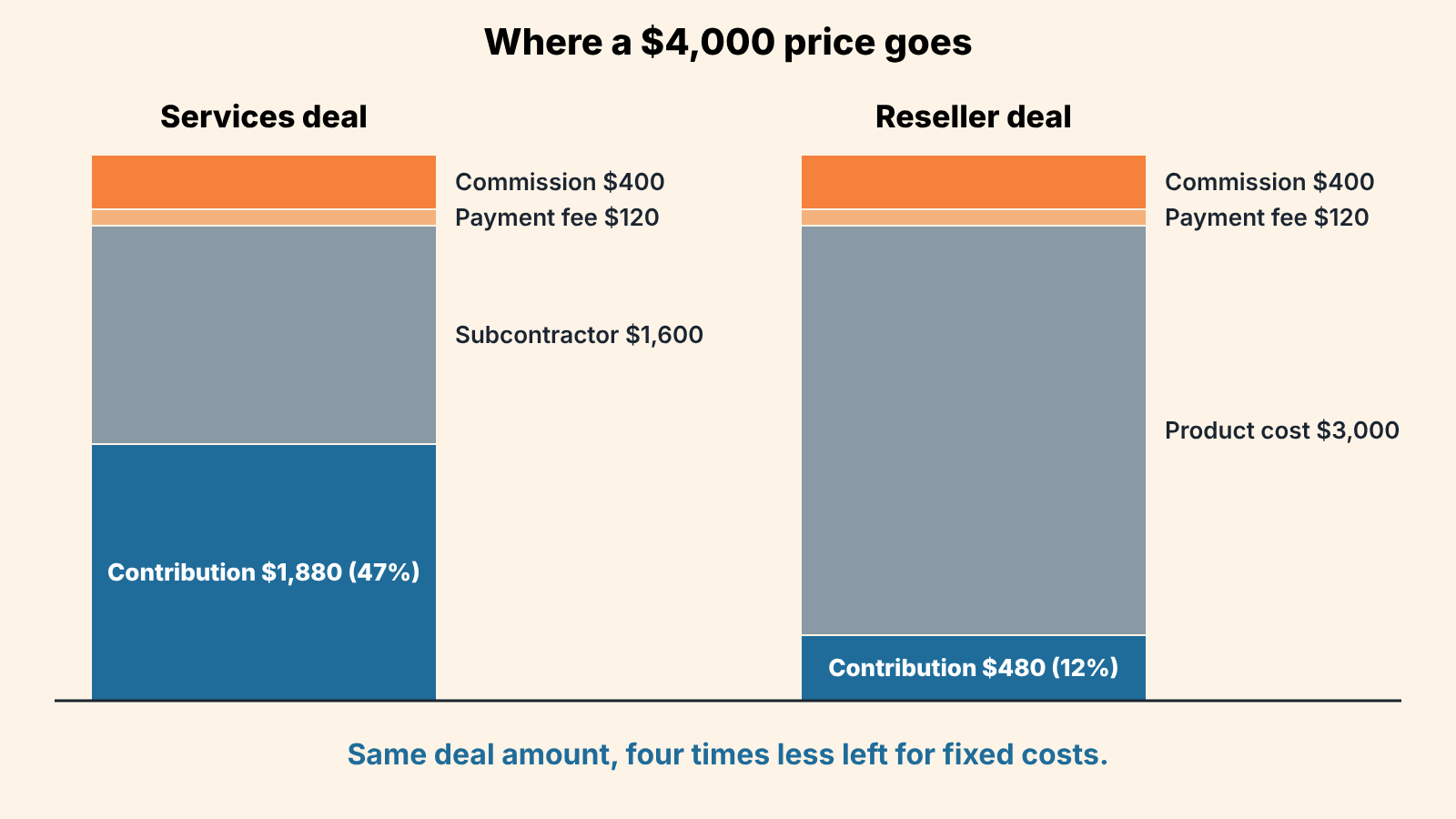
Take an illustrative deal from the services column. The customer pays $4,000. The rep’s commission is 10%, so $400. The payment fee is 3%, so $120. A subcontractor does the work for $1,600. Variable costs total $2,120, and the deal contributes $1,880 toward the fixed costs, or 47% of its price. Finance people call this contribution margin, and the full per-deal version, with discounts and commission plans, is in contribution margin per deal.
Contribution per deal = Price − commission − payment fee − direct cost of delivery
                      = 4,000 − 400 − 120 − 1,600 = 1,880
Now a reseller deal at the same price. Commission $400, fee $120, but the product costs $3,000 from the supplier. Contribution: $480, or 12%. The CRM shows the same amount and the same commission for both deals, and this one leaves about a quarter as much toward the rent.
We think this number belongs next to the deal amount in every pipeline review. Not sure whether a line counts as “direct cost of delivery”? The gross margin and COGS breakdown sorts that out.
How many deals cover the fixed costs
Divide the monthly fixed costs by the contribution of a typical deal and round up. Add a target profit to the fixed costs and the same sum becomes cost-volume-profit analysis for a sales owner.
Deals needed per month = Fixed costs ÷ contribution per deal
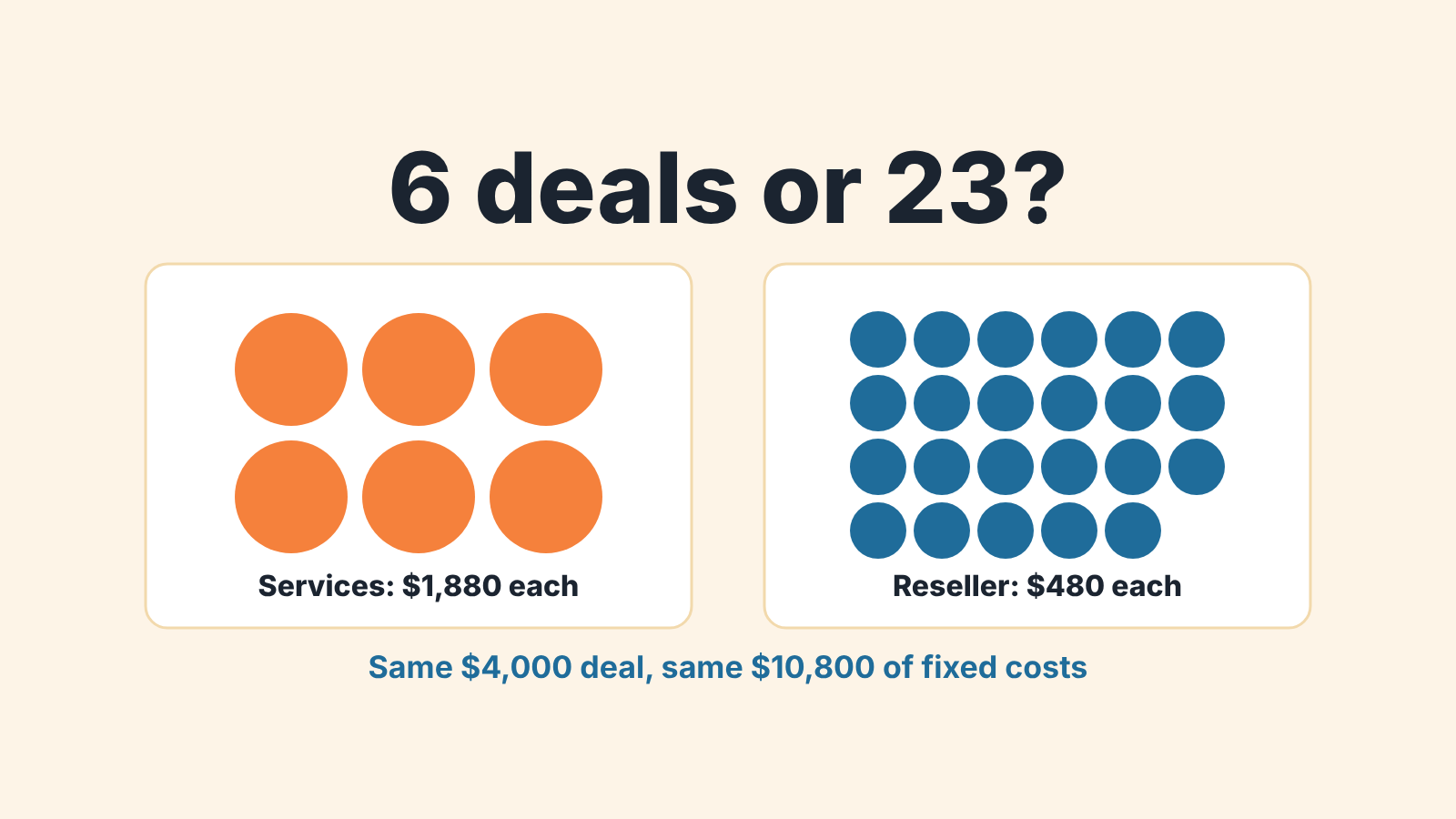
Services:  10,800 ÷ 1,880 = 5.7  →  6 deals
Reseller:  10,800 ÷ 480  = 22.5 →  23 deals
That count is your break-even point, expressed in deals: six a month for the services business, twenty-three for the reseller, with the same fixed costs and the same deal size. Each won deal after that count adds its contribution to profit.
Say the number out loud at the Monday meeting. “We need six won deals this month before we make anything” lands with a rep faster than any margin percentage. It also reframes the pipeline. Suppose your win rate is 25%: the team then needs about 24 qualified deals in play to land six, and that is a count you can pull from the CRM in seconds.
Deal sizes all over the place? Use last quarter’s average contribution, or work the number out per product line. The point is to have a number at all.
Why the same discount hurts one deal and not another
A discount comes off the price, but the cost of delivery stays put. Commission and the payment fee shrink a little, since they are percentages of a smaller price, and that is all the relief there is. Give the services deal 10% off and it contributes $1,532 instead of $1,880: the price fell 10%, the contribution fell 18.5%, and the month now needs eight won deals instead of six (10,800 ÷ 1,532 = 7.05). The reseller deal at 10% off leaves $132, under 4% of its price.
So a flat “reps may give up to 15%” rule can be harmless on one product line and quietly lose money on another. Where each deal’s floor sits is worked out in contribution margin per deal, how to build an approval rule around it is in markup vs margin for discount approval, and your won deals already show which rule you actually have (what closed-won discounts reveal about pricing).
Mixed and stepped costs: commissions, tools, extra headcount
Not every cost sits cleanly in one column, and the ones that straddle are the ones that surprise owners.
Semi-variable costs have a fixed base plus a usage part. Xero and Ramp both use the phone plan as the example: a flat monthly fee plus charges for usage. In a sales team the common one is pay itself. A rep on base salary plus commission is a fixed cost up to the base and a variable cost above it. For the deal arithmetic, count only the commission part per deal; the base already sits in the $10,800.
Stepped costs are flat until they jump. CRM and tooling priced per seat stay fixed until you hire the sixth person and buy the sixth seat. A delivery team handles twelve projects a month on the same salaries, then you hire, and fixed costs step up by a whole salary at once. Ramp’s phrase is that fixed costs stay stable within a relevant range. The sales owner’s job is to know where the edge of that range is before the pipeline crosses it. An owner can also go the other way and turn part of a fixed sales cost into a variable one by paying per result, with a commission-only rep, an outsourced sales agency paid per meeting or per deal, or a referral partner on a percentage.
This is where the deals-needed number earns its keep. If covering costs takes six deals and the delivery team can handle twelve, deals seven to twelve are the cheapest money the company makes, because they carry no new fixed cost. Deal thirteen triggers a hire, and for a while its back to covering a bigger fixed base. Knowing that in advance changes how hard you push for deal thirteen in a given month, and what you charge for it.
What your CRM should store on each deal
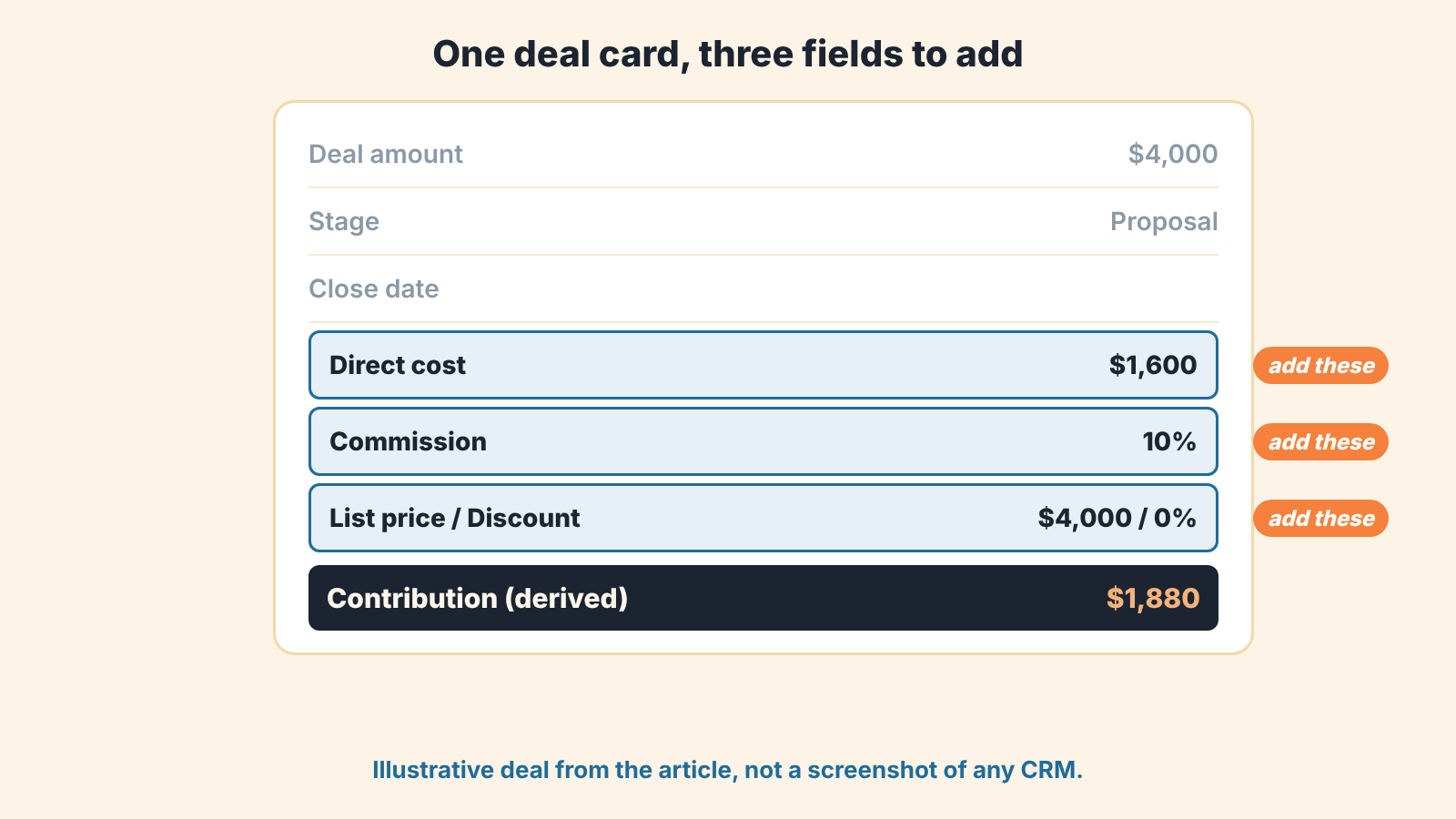
Most CRMs ship a deal with an amount, a stage and a close date, and nothing about what the deal costs to win or deliver. Three custom fields are enough for every sum above. We would not add a fourth until these three are filled on every won deal.
The first is a direct cost field, in money: what delivering this deal costs in supplier price, subcontractor quote, materials and shipping. Fill it at proposal, correct it at won. The second is commission. If your plan is one flat percentage, skip the field and apply the rate in the report; if it varies by product or by rep, store it per deal (how small teams structure commission covers the plans that need it). The third is the list price, kept next to the final amount, so the discount is derived and nobody has to remember to update two numbers.
Payment fees are usually one rate across the business, so they belong in the report rather than on the deal. Contribution itself can be a formula field where the CRM supports one: the setup for one CRM is in formula fields for deal margin, and the same three inputs work anywhere.
Make the direct cost field required at the won stage and leave it optional before that. Reps do not know the subcontractor’s quote at the first call, and a required field with a guessed value is worse than an empty one. At won the number exists, so capture it then. A month later the owner’s P&L gets its sales side from the CRM instead of from memory, which is the handover described in which P&L lines your sales CRM feeds.
One note from our side, since we build SalesBond: it does not store costs or calculate margin, so the fields above and the arithmetic stay in your CRM. What it watches is the revenue side, and the break-even count is only as good as that side. Deal Health flags deals with no amount or no close date, the Sales Dashboard puts closed revenue next to the plan, and the free CRM audit looks at the last 30 days of your CRM and sends a PDF report (money at risk, deal health, the pipeline bottleneck, your top-10 clients), then a second PDF a week later with what changed. Check your CRM with SalesBond. It won’t give you contribution per deal, but it will show how many deals are missing the amount you’d need to work it out.
FAQ
Is rent a fixed cost?
Yes. Rent is the textbook example: the same amount each month however many customers you had. It stays fixed until the lease changes, which makes it a stepped cost over a long horizon and a fixed cost in any given month.
Do variable costs stay the same?
Per deal, roughly yes: a 10% commission is 10% of every deal. In total, no. The monthly sum rises and falls with the number of deals you close.
Is sales commission a variable cost?
Commission paid per deal is variable: no deal, no commission. A rep’s base salary is fixed. A plan with both is semi-variable, and for per-deal arithmetic you count only the commission part against the deal.
What is a semi-variable cost?
A cost with a fixed base plus a part that moves with activity: a phone plan with a flat fee and usage charges, or a utility bill with a base rate plus usage (both Xero and Ramp give these examples). Split it in two: the base goes into monthly fixed costs, the usage part into the deals that caused it.