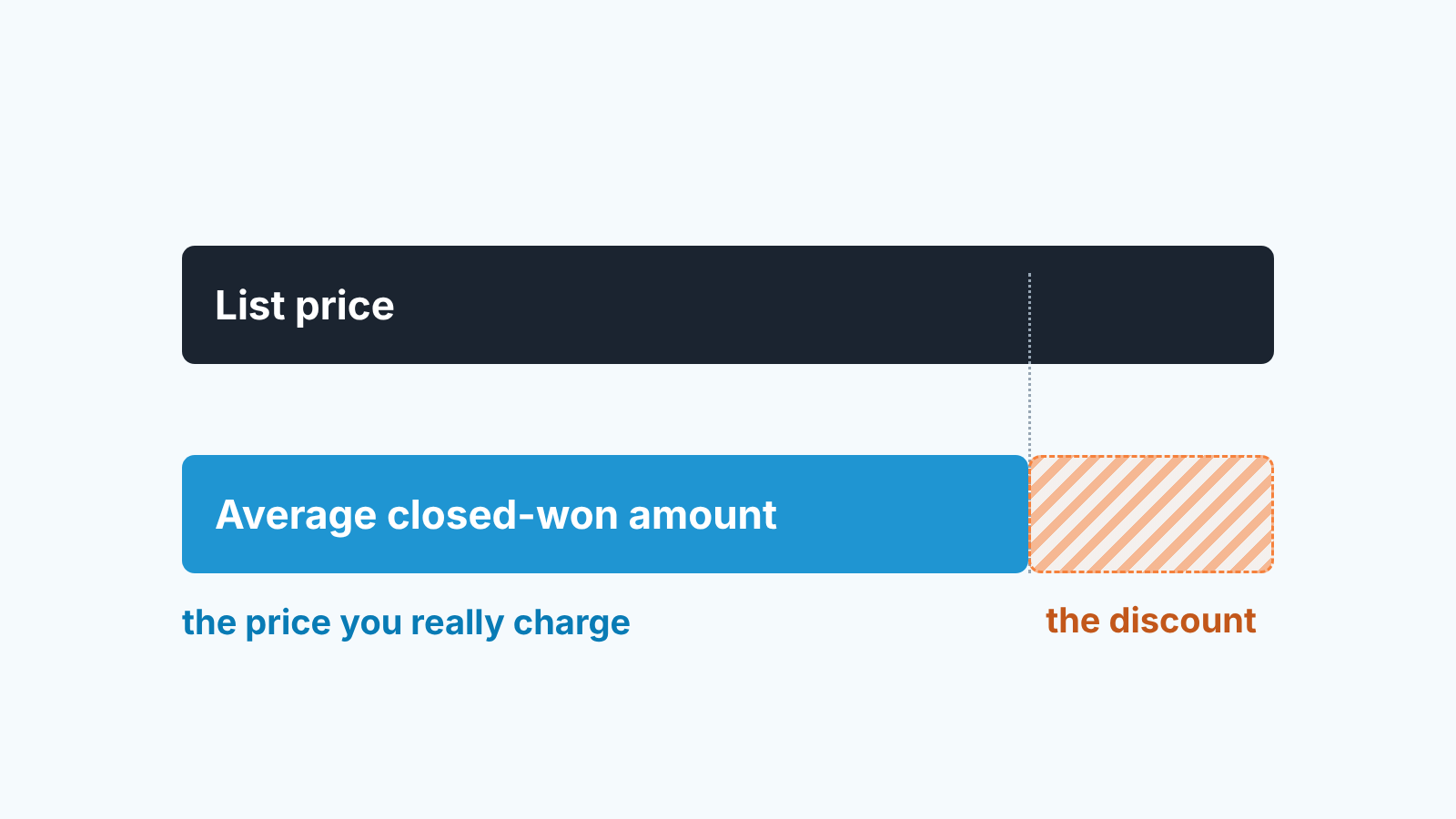
A pricing strategy is the method you use to set prices: from your costs, from the value to the customer, or from competitors’ prices. For a sales team the useful test is what the CRM shows: the gap between list price and closed-won amount, who discounts and when, and whether lower prices actually win more deals. If the gap is wide and the win rate does not move with price, the strategy actually in force is the reps’ discounting habit.
This article is for the owner or sales manager of a small team who wants to know which strategy is really in force. Margin is a separate question; gross margin for a sales owner covers that, and we will point to it where the two meet.
Types of pricing strategies: three families
There are three families of pricing strategy: cost-based, value-based and competition-based. Cost-plus pricing belongs to the first, competitive pricing to the third, and penetration, skimming or discount pricing are tactics you run inside one of them. Lengow’s short guide lays out the three groups with the pros and cons of each (Lengow).
Longer lists exist. Shopify counts ten pricing strategies and then walks through them industry by industry (Shopify); Melio lists seven and spends a section on analysing competitors before you set a price (Melio). Both are written for someone who sells to many anonymous buyers at a sticker price. In B2B sales with a small team, every price is a conversation, and the strategy shows up in how that conversation ends.
Cost-based is the easiest to defend internally and the weakest in the room. The rep knows the floor, so the floor becomes the price the moment the buyer pushes. Value-based needs a rep who can state the buyer’s problem in the buyer’s numbers, and a CRM record that holds those numbers; without them the quote slides back to cost-plus by the second call. Competition-based is where many small teams end up without deciding to, because “they got a cheaper offer” is the objection reps learn to repeat word for word.
So a strategy is only in force if the price that leaves the building matches it. A value-based price list that gets cut by a fifth on every second deal is, in practice, competition-based pricing run by the reps. We think the honest question for an owner is which family the closed deals put you in, and the CRM already holds the answer.
What you actually charge: list price vs net price
Take every closed-won deal from the last two quarters. For each one you need two numbers: the list price of what was sold, and the net price, meaning the amount the deal was marked won at. Divide the second by the first. Across the whole list, that ratio is the price you really charge. It is often called price realization, and one minus it is your effective discount.
Say the list price for your standard package is 10,000 and the average closed-won amount for it is 8,600. Your real price is 8,600 and your effective discount is 14%, whatever the price list says. Those figures are made up to show the arithmetic; yours will be different, and that is the point of running it.
Two things go wrong here. First the CRM only knows the list price if someone put it there. If deals carry a bare Amount with no product behind it, you have the closed-won number and nothing to compare it to, and the first fix is a required product or price book field on every deal. Second, reps discount by editing the Amount by hand, which leaves no trace of the price before. Where the discount should be recorded, and how to catch the hand-edited amount, is in what to record on a deal in HubSpot line items; the logic is the same in any CRM with products on deals.
Read the result by product as well as in total. A 14% average often hides one product sold at list and another sold at 30% off, and then the second product’s list price is a number nobody pays.
Discount by rep, by stage, by deal size: three CRM reports
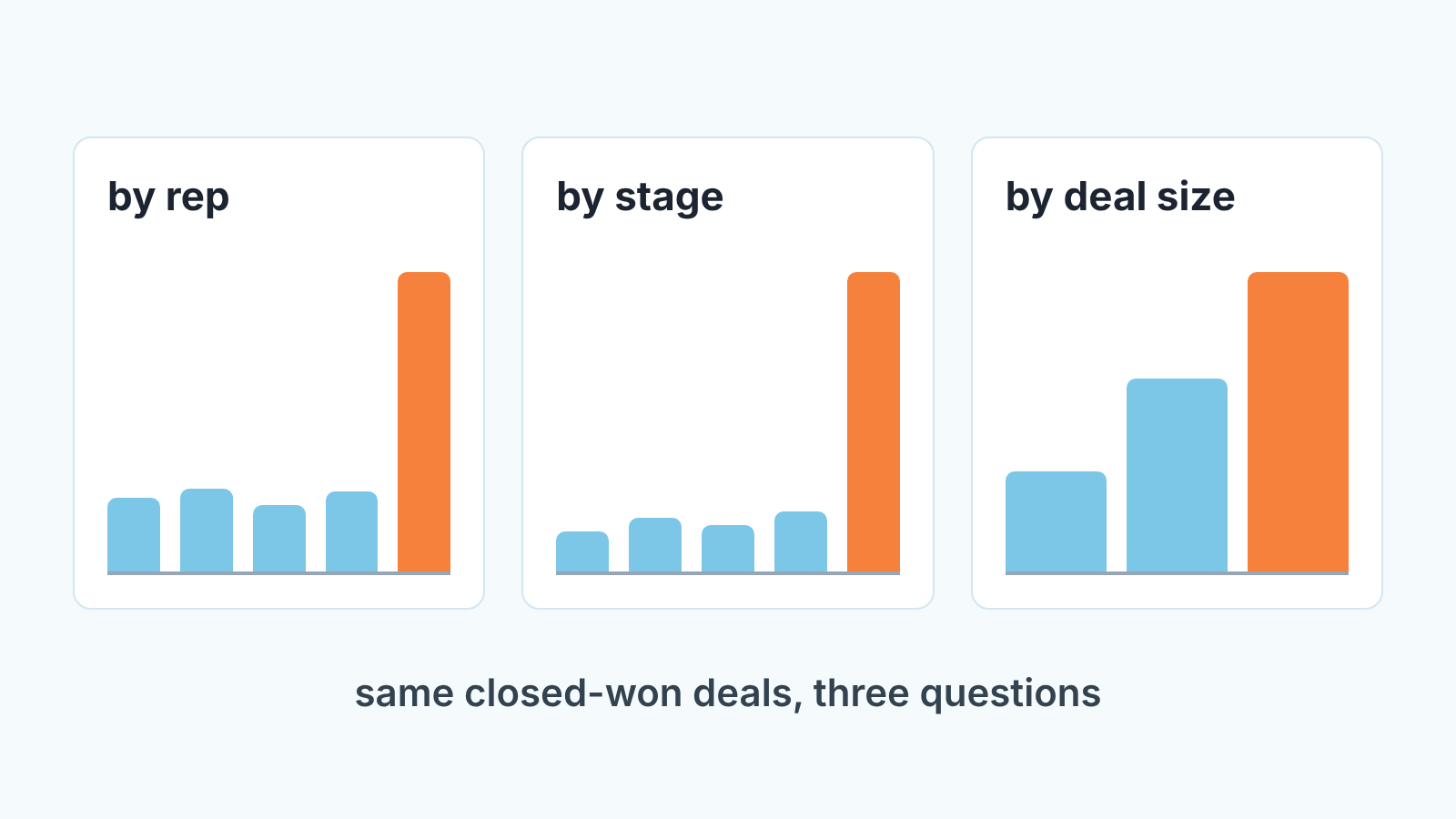
Grouping closed-won deals by rep, by stage and by deal size shows where the discount comes from. Each grouping answers a different question.
| Report | Group closed-won deals by | What you are looking for |
|---|---|---|
| Discount by rep | Deal owner | One rep whose effective discount sits well above the others on the same product. That points to skill or confidence; the price itself may be fine. |
| Discount by stage | Stage at which the amount last changed | Discounts that appear at the final stage, after the proposal. Those were given to close: the deal was already decided and the discount bought nothing. |
| Discount by deal size | List-price band (small, medium, large) | Discount depth rising with deal size. Some of that is normal volume pricing. Most of it is reps treating a big number as permission. |
The stage report needs one thing your CRM may not report on directly: when the amount last changed. If you can’t get it, use the proposal-sent date instead, compare the amount on the proposal with the amount at won, and count any drop between the two as a late discount.
What you do next depends on the pattern. One rep over the line is a coaching conversation and, if it repeats, an approval threshold. We wrote up how small teams set a discount policy, and the most useful idea in it is to set the threshold in margin points rather than as a percentage off the price. The reason is in markup vs margin for sales managers: a 10% price cut takes much more than 10% of the profit, because the cost does not move.
Win rate by price band: is the cheaper deal really easier?
Every rep believes that a lower price wins more. Check it. Group won and lost deals by the list price of what was quoted (not the discounted amount, which already carries the answer you are testing) and compute win rate for each band. Then, inside each band, split the deals into discounted and sold at list, and compare again. Use wins divided by wins plus losses, open deals excluded; the traps in counting it are in the win rate you can trust, and they apply whichever CRM you run.
For illustration, imagine the mid band wins 35% of deals at list and 37% with a discount. Two points for an average cut of 12% is a gift to the buyer. If instead the discounted deals win at 55%, price is doing real work in that band, and the honest conclusion may be that the list price is too high for those buyers. Either answer is useful.
A small team will not have enough deals for teh numbers to be stable every month. Run it on a rolling two quarters and treat anything closer than a few points as “no difference”. You are mostly testing a belief the team already holds.
Four signs the discount is a habit, not a strategy
The first sign is that the discount is the same on every deal. A strategy produces different prices for different buyers and situations. A habit produces 10% off, because that is the number the rep has said a hundred times and it sounds reasonable.
The second is that the discount arrives before the buyer asks. Read the email threads on on recent wins. If the rep offers “and of course we can do something on price” while the buyer is still describing the problem, the rep gave the discount before the negotiation began.
The third is that nobody can say what the buyer gave in return. A strategic concession trades price for something: a longer term, a reference, a faster signature, a smaller scope. If the deal record shows a smaller amount with the same scope and terms, the discount bought nothing you can name.
The fourth is the one owners find hardest to hear. Discounted deals win at the same rate as list-price deals. Then the team has been paying for a result it was going to get anyway, and the work to do is in how the deals are sold, while the price can stay.
How to test a price change with a small team
You don’t need a pricing department to test a price, whether it’s a rise or a price reduction. You need a rule, a date and the discipline to leave the rule alone for a quarter.
- Pick one product and one change: list price up by a set step, or discount authority cut to a fixed ceiling. Change two things and you will not know which one moved the result.
- Write down the before numbers from the CRM: effective discount, win rate and average closed-won amount for that product over the last two quarters. Do it before the test starts.
- Tell the reps the rule, the reason, and the end date. A rep who believes the price is permanent will fight it; a rep who knows it ends in twelve weeks will usually run it honestly.
- Make the CRM enforce what you can: a required discount-reason field, an approval step above the ceiling, a product field that cannot be left empty. Otherwise you are testing memory.
- At the end date, run the same three reports and the win rate by band for the test period only, compare with the baseline, and decide: keep, revert, or extend because the deal count was too small to call.
In our experience, the win rate usually holds. The average closed-won amount rises, and one rep’s numbers fall because that rep was selling on price, so that’s the rep you’d coach first.
What to put in front of the owner each quarter
Four numbers on one page, in the same format every quarter so the trend is readable: effective discount overall and by product; discount by rep against the team average; win rate by price band, discounted versus list; and the share of closed-won amount that came from deals discounted beyond the approved ceiling. Under them, write one sentence that names which pricing family the deals say you are in. If it doesn’t match the family on the price list, that sentence is the agenda for the quarter, and what each discounted deal left after cost, the margin side of the same page, is covered in the gross margin article.
We build SalesBond, a sales management layer on top of the CRM a team already uses; we started with Pipedrive. It reads the closed-won deals, their amounts and their owners, which is the raw material for the reports above, and it does not know your list price unless the deals carry it. To see last quarter’s closed-won deals by rep before you build anything, check your CRM with SalesBond.