
Marginal cost is the extra cost of producing or delivering one more unit. For a sales team it is what one more deal adds to your costs (commission, delivery, support time) once the fixed costs are already paid: a discount that still covers that number adds profit, one that does not loses money.
What a deal leaves after those variable costs is its contribution margin.
Most explanations stop at factories and cost curves. A sales owner meets the idea on an ordinary Thursday, when a rep asks whether a deal at 20% off is worth taking. Answering that needs one number per deal and one honest look at how busy the delivery team is.
What is marginal cost, and what’s the formula?
Marginal cost is the change in total cost divided by the change in quantity. Wikipedia’s article on marginal cost (checked November 2026) defines it as “the change in the total cost that arises when the quantity produced is increased” and writes the formula as MC = ΔC / ΔQ, where Δ is an incremental change of one unit.
Marginal cost = change in total cost / change in quantity
Say a six-rep team sells an installed service at a list price of $6,000 and closes 30 deals a month. Every figure for this team is invented, so don’t read it as a benchmark. With 30 deals the month costs $154,800 in total. With 31 it costs $158,160. Quantity went up by one deal and total cost by $3,360, which makes $3,360 the marginal cost of deal 31.
The same Wikipedia article says marginal cost “includes all costs that vary with the level of production, whereas costs that do not vary with production are fixed”, and uses a car as the illustration: labor and parts for the additional automobile count, the factory building doesn’t. Swap the factory for your office lease and base salaries and you have the sales version.
Textbooks then draw the curve. Wikipedia describes short-run marginal cost as a U-shape with quantity on one axis and cost per unit on the other. For a sales team the useful part sits on the right-hand side, where the next deal suddenly costs more because the people who deliver it are full. In the example further down that jump takes a deal from $3,228 to $5,228.
Marginal vs average vs fixed cost
Three cost numbers sit behind every deal, and each one answers a different question. The example team pays $54,000 a month in fixed costs (salaries, rent, software), which spread over 30 deals comes to $1,800 a deal.
How to sort each line into fixed vs variable costs is a separate exercise.
| Question it answers | Example team | Use it when | |
|---|---|---|---|
| Marginal cost | What does one more deal add? | $3,360 at list price | Deciding the lowest price for a single deal |
| Average cost | What does a deal cost with everything spread across all deals? | $5,160 ($154,800 / 30) | Setting list price and checking the year pays |
| Fixed cost | What is due in a month with zero deals? | $54,000 a month | Working out how many deals the month needs |
Wikipedia keeps it short. Marginal cost is different from average cost, “which is the total cost divided by the number of units produced.” The $1,800 gap between $3,360 and $5,160 is rent and salaries (the lease, the reps’ base pay, the CRM subscription) that get paid whether deal 31 happens or just sits in the pipeline. How to sort your own expenses into the two columns is covered in fixed vs variable costs for a sales owner.
Isn’t marginal cost just variable cost with a fancier name? For most deals you’d get the same number. Variable cost per deal is an average across all deals, and marginal cost belongs to the next one, so it’s the only one of the two that catches the jump when capacity runs out.
What one more deal actually adds
Open a deal that closed last month and ask what the company paid because that deal, specifically, was won. Commission comes first. On a plan that pays 8% of the amount, the rep’s payout exists only because the deal does. Card or marketplace fees behave the same way, a percentage of what the customer paid.
Delivery is next and it’s usually the biggest line. A reseller pays the supplier. A service business pays a subcontractor, or books a freelancer for the job. Anything physical adds shipping, and that’s per deal too.
The line teams forget most often, we think, is the hours after the signature. Onboarding calls, setup, the customer who emails support twice a week for the first month. If those hours come from someone paid by the hour or per project, they belong in the sum.
Salaried staff with free time don’t add anything to this month’s costs. That changes the week they run out of hours, and from then on a new deal costs overtime, a contractor, or a project for another customer that slips by a week.
A salaried rep works the same way. While they have room for another deal their salary stays fixed and adds nothing to its marginal cost. Once the pipeline is full, the hours spent on a discounted deal come out of a list-price one, and that costs whatever the list-price deal would have left ($2,640 in the example below).
Where does the discount go? Keep it out of the cost list. A discount lowers the price side, and it pulls the percentage costs down with it, because 8% commission on $4,800 is smaller than 8% on $6,000. Counting the discount as a cost while also cutting the price counts it twice. The per-deal version of this sum, with commission plans, is in contribution margin per deal.
A marginal cost example: the lowest price a deal can take
Back to the example team. A buyer will sign this month at 20% off, so $4,800 instead of $6,000. Here is the deal both ways.
| Line | At list, $6,000 | At 20% off, $4,800 |
|---|---|---|
| Commission, 8% of amount | $480 | $384 |
| Payment fee, 3% of amount | $180 | $144 |
| Subcontractor for the install | $2,400 | $2,400 |
| Onboarding, 6 contractor hours at $50 | $300 | $300 |
| Marginal cost | $3,360 | $3,228 |
| Price minus marginal cost | $2,640 | $1,572 |
| Share of fixed costs ($54,000 / 30) | $1,800 | $1,800 |
| Result after the fixed share | $840 | -$228 |
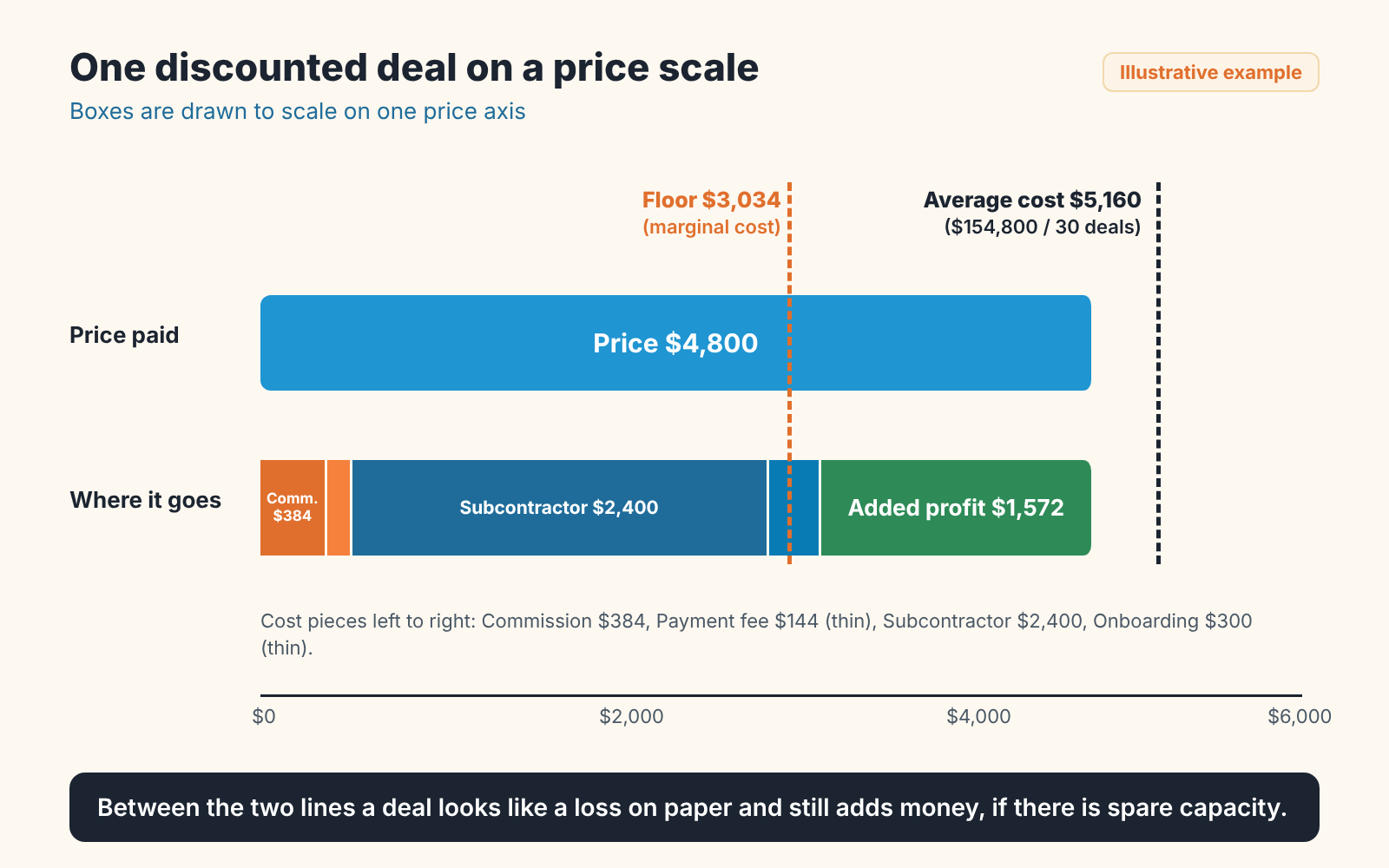
Read the last row and the discounted deal loses $228. Read the row above the fixed share and it adds $1,572. The arithmetic holds both ways. Which one applies depends on whether the $54,000 is already covered: the team needs 21 list-price deals to pay it ($54,000 / $2,640 is 20.5), and it closes 30. For deal 31 the fixed share is already paid, and $1,572 is the number that reaches the bank.
The floor is the price at which the deal adds exactly zero.
Price − 11% of price − $2,700 = 0
Price = $2,700 / 0.89 = $3,033.71
Call it $3,034, a little under half off list. Below that, every signature costs the company money, however good the logo looks on the website. A rep can run this in a minute if the the two inputs are known: the percentage costs (11% here) and the fixed-dollar costs per deal ($2,700 here).
When a discount still pays, and when capacity turns it into a loss
The usual advice comes in two flavors. Sales trainers say never discount. Pricing guides built on marginal cost say any price above it adds profit, so take the deal. We disagree with both as rules. The first one turns away the $1,572. The second holds for a single deal under conditions that pricing guides rarely list, and a sales team breaks them all the time.
A discount above the floor pays when all of these hold:
- Delivery has room. The installers and the onboarding person can take deal 31 without overtime or a new hire.
- The buyer wouldn’t have paid list. If they would, you gave away $1,068 (the gap between $2,640 and $1,572) for nothing.
- It stays with this deal. One customer, one reason, written down.
- The deal doesn’t push a full-price deal out of the same delivery slot.
Now break the first condition. Suppose the install crew handles 30 jobs a month and job 31 needs an extra contractor day rate of $2,000. Marginal cost for that deal jumps to $5,228, the buyer pays $4,800, and the company loses $428 on a deal that looked fine in the table above. That single row is the steep right-hand side of the textbook curve.
The third condition fails more quietly. Say the 20% becomes known and five buyers who would have paid list get it too. Each costs $1,068, so $5,340 in total. Each extra discounted deal adds $1,572, which means the team needs four additional deals just to get back to where it started, and all four need free delivery capacity.
Setting the price at marginal cost has a name, marginal cost pricing, and pricing guides like it because it squeezes out every last sale. For one decision about one deal it is a fair floor. As a list price it would sink the business: the $54,000 of fixed costs gets paid only from the gap between price and marginal cost, so a team that sold all 30 deals at the $3,034 floor would lose the full $54,000 that month. List price has to clear average cost ($5,160 here) with room to spare. How that gap turns into a margin percentage is in the gross margin formula.
So our rule for the Thursday question has two parts. Is the price above the floor? Is there an empty slot this month that no list-price deal is likely to fill? Two yeses and the discount is worth approving. For who approves and at what threshold, see markup vs margin and discount approval, and for testing whether past discounts changed your win rate at all, pricing strategy from closed-won discounts.
The deal fields the floor depends on
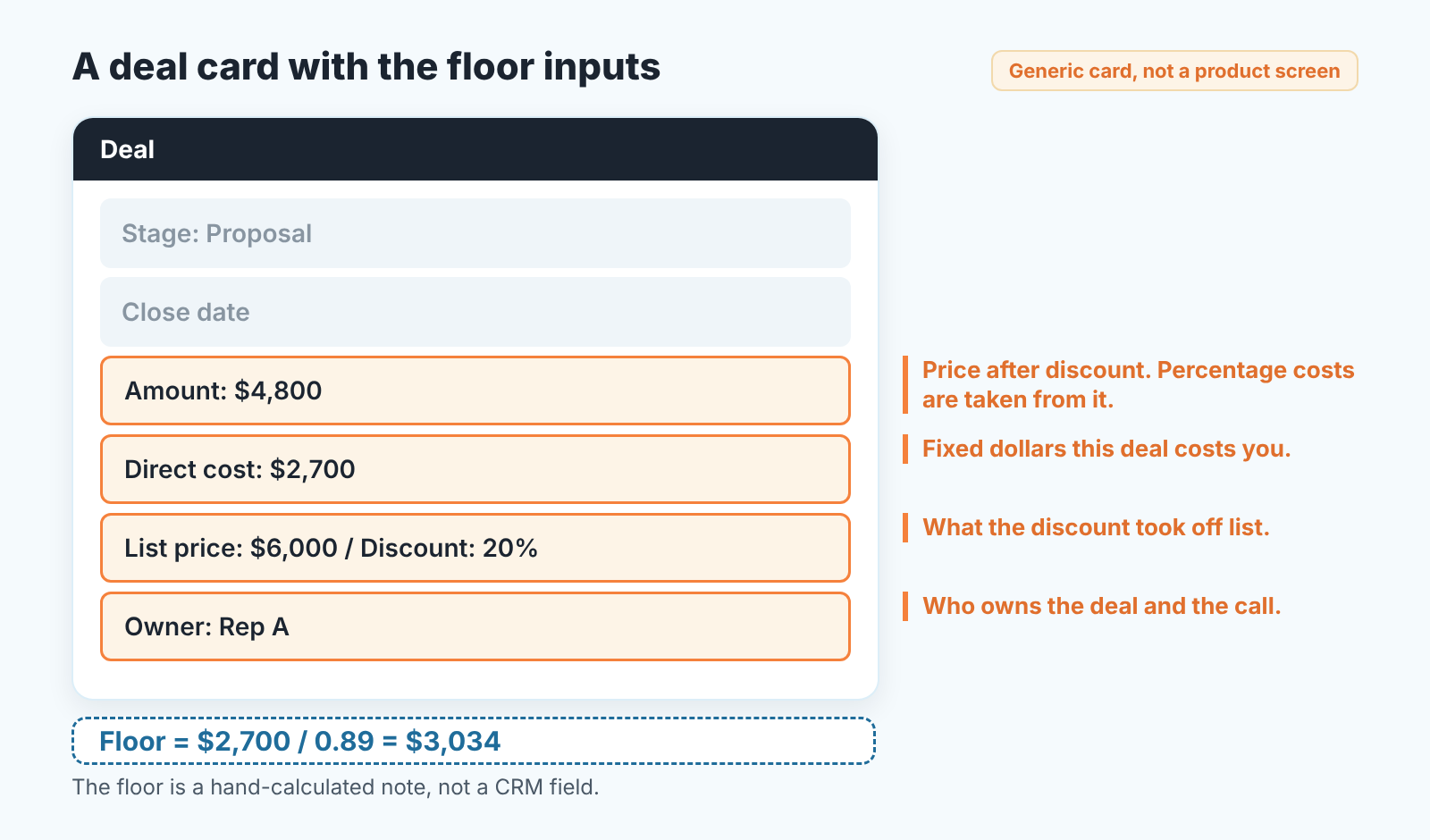
A CRM won’t hand you marginal cost. Costs live in accounting and in your head, and the sum above is a spreadsheet job. What the CRM can hold is the handful of inputs, so the floor gets checked before the quote goes out instead of at month end.
- Amount. The price the customer actually pays, after discount. Percentage costs are calculated from this.
- Direct cost, as a custom currency field if your CRM allows one: the supplier or subcontractor figure plus any paid hours. One number, filled in before the proposal stage.
- List price and discount, kept as separate fields. If reps only type the final amount, nobody can later tell a $4,800 deal from a $6,000 deal sold at 20% off.
- Owner. The commission rate usually hangs on the rep, and a report of discount by owner shows fast whether one person is giving away most of it.
With those four, the floor for any open deal is direct cost divided by one minus your percentage costs. Which open deals sit closest to it? Sort by discount, compare amount against the floor , and that’s the list for Monday’s pipeline review.
All of this needs complete records. SalesBond doesn’t do your accounting or calculate marginal cost. Its free CRM audit reads the last 30 days of your CRM and sends a PDF report on deal health, findings and how each manager is handling the pipeline, then a second PDF seven days later showing what changed. If amounts and owners are missing on a third of your deals, you want to know that before you build a pricing rule on them. Check your CRM with SalesBond.