

A business has three main financial statements. The profit and loss statement shows what you earned and spent over a period. The balance sheet shows what you own and owe on a single date. The cash flow statement tracks where money came from and where it went. Your CRM feeds the top line of the P&L and the expected collections behind cash flow. It doesn’t see costs, debts or the bank balance, which come from accounting.
The three financial statements, one paragraph each
Most owners open the profit and loss statement first (accountants also call it the income statement, or P&L). The SEC’s beginner’s guide describes it as a report that shows how much revenue a company earned over a specific time period, together with the costs and expenses of earning that revenue, down to a bottom line of net earnings or losses (SEC, Beginners’ Guide to Financial Statements, as read in November 2026). You read it top to bottom, from sales on the first line to profit on the last.
Before any of the three reports is built, the accountant runs a trial balance to check that the books add up.
The balance sheet covers a date, where the P&L covers a period. In the same SEC guide, a balance sheet shows what a company owns and what it owes at a fixed point in time, and it follows one formula: assets = liabilities + shareholders’ equity. Unpaid customer invoices sit on the asset side. Deposits you took for work you haven’t delivered sit with the liabilities. We go through that formula with sales numbers in the accounting equation for a sales owner.
Then there’s cash. The SEC guide says cash flow statements show the exchange of money between a company and the outside world over a period of time. This is teh report that explains why the bank balance moved by a different amount than the profit did.
The SEC guide actually lists four statements, and the fourth is the statement of shareholders’ equity. Most “types of financial statements” articles give all four equal space. We wouldn’t spend an owner’s hour on the fourth in a small private company, because you can already see the change in equity by putting two balance sheets side by side, and you know what you paid yourself. Leave it to your accountant and put the hour into the cash flow statement.
One P&L line the CRM never feeds is depreciation, the yearly slice of an asset’s cost that the ledger writes off.
Which question does each report answer?
An owner rarely wants “the financials.” They want one question answered.
“Did we make money this quarter?” goes to the P&L. Revenue there starts life as won deals in the CRM, while costs, payroll and overhead come from accounting; which P&L lines your sales CRM feeds walks through it line by line.
Which revenue account each deal lands on is set in the chart of accounts.
What do you own and owe today? That’s the balance sheet. It’s built almost entirely in the books, and the CRM explains only two of its lines, receivables and customer deposits, through the invoice date, payment terms and deposit fields on each deal. The rest is covered in the balance sheet for a sales owner.
Then the question that keeps owners up at night: where did the cash go, and will we make payroll? The bank and the bookkeeping show what already happened. For what’s coming, you need CRM close dates and payment terms. See the cash flow statement for how it’s laid out.
If you only remember one of the three, make it cash. A profitable quarter can still end with less money in the bank than it started with.
Which CRM numbers feed each report (and which don’t)
Open any won deal in your CRM. It records an amount, a won date, an owner, maybe a product line, and together that’s a signed commitment. Revenue on the P&L is a different event. IRS Publication 538 says that under an accrual method you generally report income in the year it is earned (IRS, Publication 538, as read in November 2026). A signature hasn’t earned anything yet. Your accountant decides when the work counts as earned, and in a project business that can be weeks after the rep clicks “won” (the difference is worked through in cash vs. accrual for a sales owner).
So the CRM contributes a short list of fields, and each one lands in a specific place:
- Deal amount and won date. These become revenue on the P&L once the work is earned and invoiced.
- Delivery or start date, if you keep one as a custom field: it tells your accountant which period the revenue belongs to.
- Payment terms and invoice date, which turn a won deal into a receivable on the balance sheet and into an expected collection date for the cash forecast.
- Deposit received. On the balance sheet this is a liability until you deliver.
- Expected close date and stage on open deals, for the forward-looking cash picture only. No statement records an open deal.
- Commission owed per deal (if you track it in the CRM) shows up as an expense on the P&L and, until it’s paid, as a liability.
Deposits and commissions owed have their own walkthrough in liabilities for a sales owner.
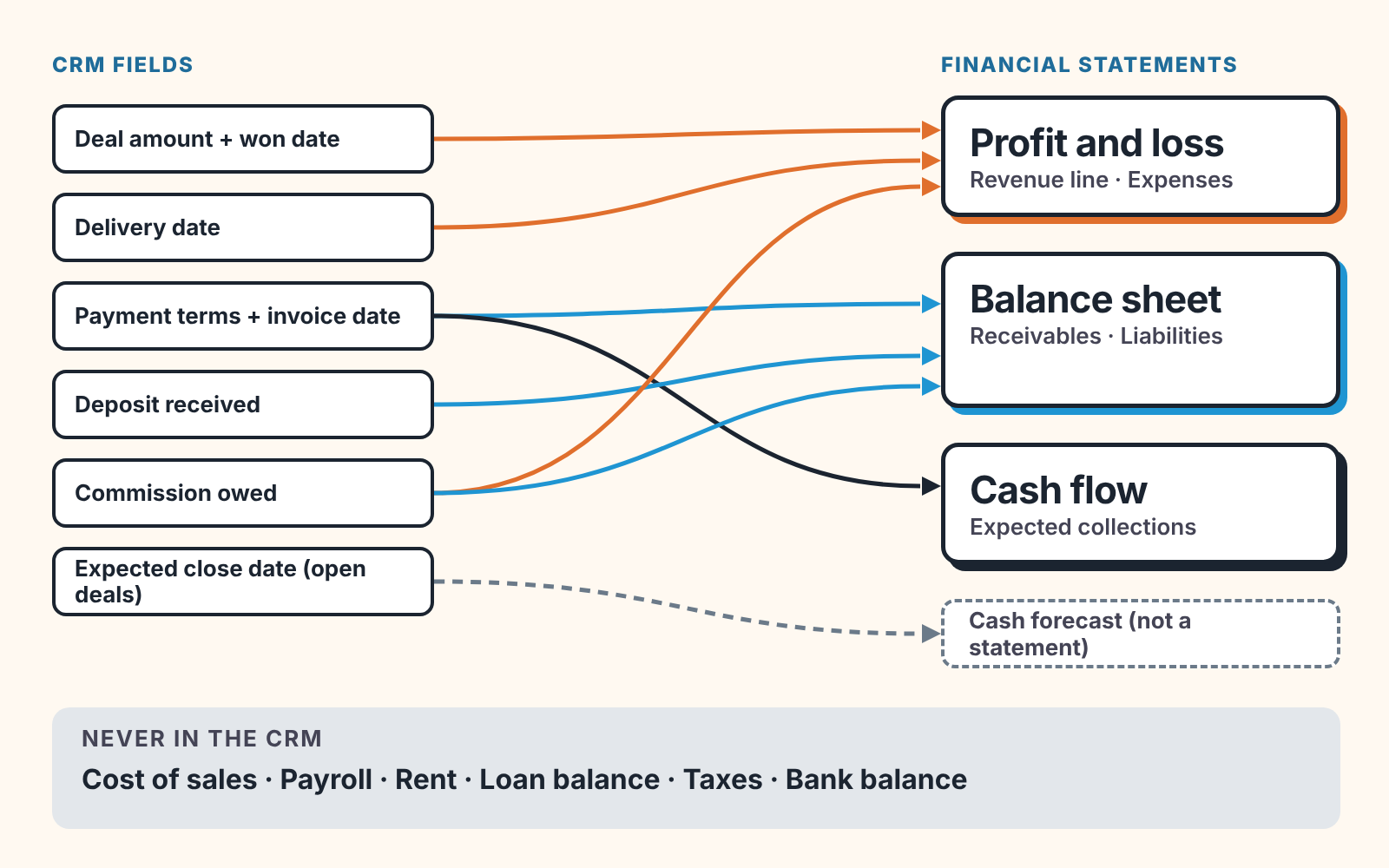
What will the CRM never show you? Cost of sales, payroll, rent, software bills, the loan balance, taxes and the actual bank balance. Those exist only in accounting. A CRM dashboard that says “$600,000 won” has no idea whether the quarter was profitable.
All of it is posted in the general ledger.
Those fields are only as useful as they are clean, and a won date typed in three weeks late moves revenue into the wrong month. SalesBond works on that side of the problem. Its free CRM audit looks at the last 30 days of your connected CRM and sends a PDF report on deal health, the pipeline bottleneck and what to fix, with a second PDF seven days later showing what changed. It does no accounting and no tax math. It checks the sales data your accountant will be handed. Check your CRM with SalesBond.
A financial statements example: five reps, one quarter
This is an illustrative example with made-up numbers. Say a five-rep company sells installation projects, and each rep closes $120,000 in the third quarter. The CRM shows $600,000 closed won. In this example the company counts a project as revenue when it is delivered and invoiced.
Now follow the money through accounting.
| What happened in the quarter | Amount |
|---|---|
| Closed won in the CRM | $600,000 |
| Of that, delivered and invoiced this quarter | $420,000 |
| Of that, projects starting next quarter | $180,000 |
| Deposits collected on those future projects | $60,000 |
| Plus: delivered this quarter from deals won last quarter | $90,000 |
| Revenue on the P&L ($420,000 + $90,000) | $510,000 |
The P&L for the quarter then reads like this.
| P&L line | Amount |
|---|---|
| Revenue | $510,000 |
| Cost of sales | $255,000 |
| Gross profit | $255,000 |
| Operating expenses (incl. $15,000 of September commissions, paid in October) | $195,000 |
| Net profit | $60,000 |
Cash tells a third story. The company opened the quarter with $80,000 in the bank and $70,000 of unpaid invoices from earlier work.
| Cash movement | Amount |
|---|---|
| Collected on this quarter’s invoices | $350,000 |
| Collected on last quarter’s invoices | $70,000 |
| Deposits received | $60,000 |
| Paid for cost of sales | −$255,000 |
| Paid for operating expenses ($195,000 less $15,000 unpaid commissions) | −$180,000 |
| Loan repayment | −$30,000 |
| Change in cash | +$15,000 |
Last the balance sheet on September 30. The asset side holds $95,000 in cash and $160,000 in receivables, $255,000 in total. Against that, $60,000 of customer deposits, $15,000 of commissions owed and $90,000 left on the loan, which is $165,000 in liabilities. Equity is the remaining $90,000, up from $30,000 at the start by exactly the quarter’s profit.
So the CRM said $600,000, the P&L said $510,000, profit came to $60,000 and the bank gained $15,000.
Reading them together: profit, cash, debts
Take the example and ask the three questions in order. Did we make money? Yes, $60,000. Where did the cash go? Receivables grew from $70,000 to $160,000, so $90,000 of billed work is still sitting in customers’ accounts, and $30,000 went to repay the loan. What do we owe? $165,000, and $60,000 of it is work the company still has to deliver.
Looked at one at a time, the reports disagree. The P&L says the quarter went fine. Cash says it was thin. You’d need the balance sheet to see why both are right, because the gap is parked in $160,000 of receivables and $60,000 of deposits.
The usual advice is to start the monthly review with the P&L. In a sales-led company we’d start with cash flow and receivables, for a practical reason: the P&L is a result you can no longer change, while a $160,000 receivables balance is a list of customers someone can call this week. If you want that sequence as a monthly routine, it’s laid out in the monthly money review for a small sales-led business.
What to ask your accountant each month
You don’t need to learn bookkeeping to use these reports. You need four questions, and you can send them in one email on the first working day of the month.
Ask for revenue on the P&L next to closed won from the CRM for the same period, with the difference explained in a sentence or two (in the example, that’s the $180,000 of future projects going out and the $90,000 of earlier deals coming in). Ask for the receivables list with ages, and forward anything past its payment terms to the rep who owns the account. Ask how much of the cash in the bank is customer deposits for undelivered work, since that money is already spoken for. And ask what the cash balance will be in 60 days if open invoices are paid on terms and nothing new closes.
That last one needs your CRM. Your accountant can’t see expected close dates, so send the the open-deal export along with the question.
FAQ
What is GAAP?
You’ll usually meet the term when a lender asks for “GAAP financials.” It stands for generally accepted accounting principles. The SBA’s guide to managing business finances describes it as a common way to standardize financial reporting using the accrual method, maintained in the United States by the Financial Accounting Standards Board, and notes that private companies aren’t required to follow it (SBA, Manage your finances, as read in November 2026). Lenders and investors may still ask for GAAP statements so check before you apply for a loan.
Can I prepare financial statements myself?
For your own management use, yes. Accounting software produces all three reports from your books, and their quality depends on how carefully each transaction was entered (a deposit booked as revenue will flatter the P&L). The same SBA guide suggests considering a certified public accountant or bookkeeper for help with accounting. A bank, an investor or a buyer of the business will usually want statements prepared or reviewed by a professional.
Is closed won in the CRM the same as revenue?
No. Closed won records the date a customer agreed to buy. Revenue is recorded when the work is earned, which in the example above meant delivered, and cash arrives when the customer pays. For one quarter in that example the three numbers were $600,000 won, $510,000 of revenue and $480,000 collected, including $60,000 of deposits.


