
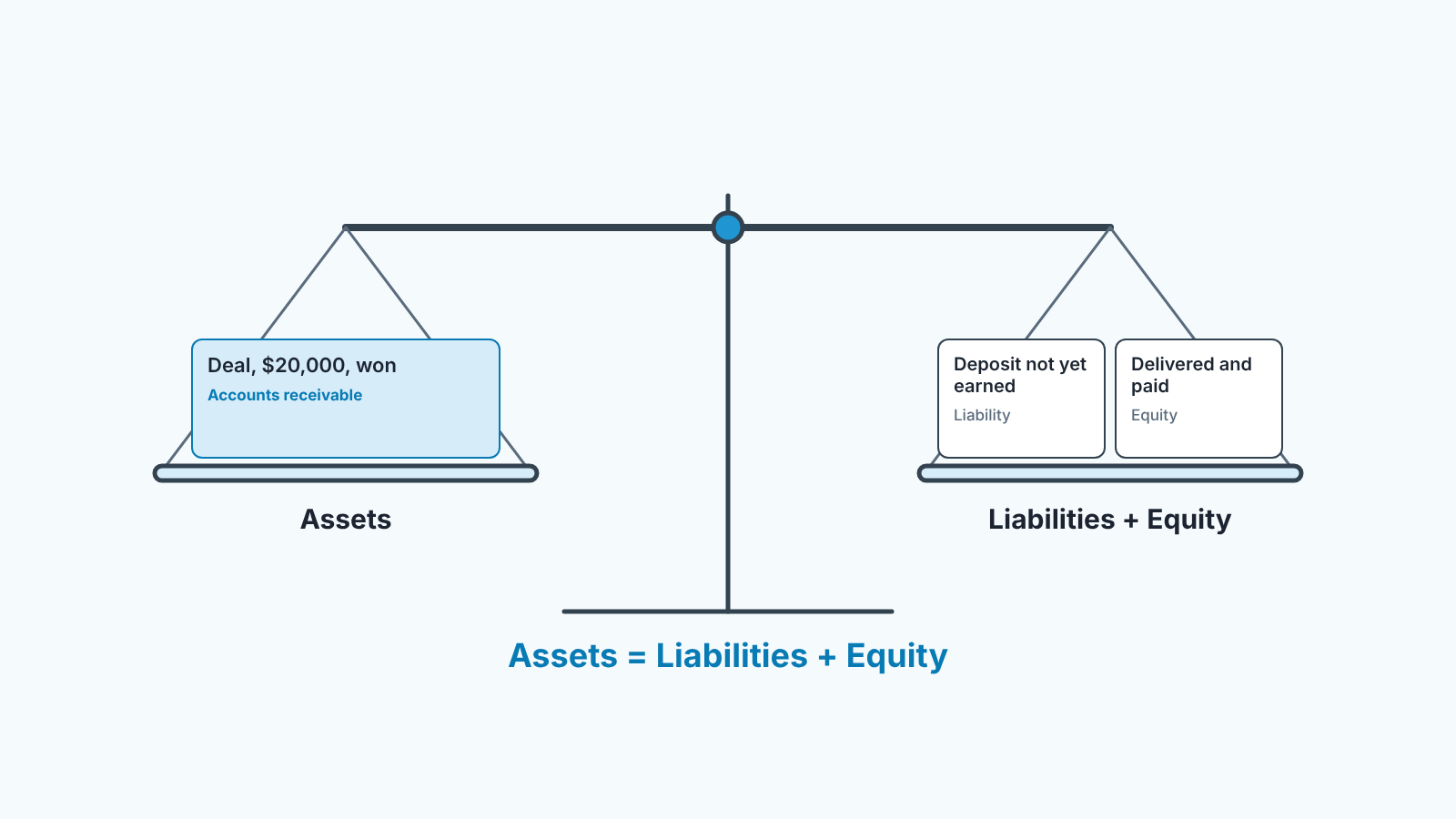
The accounting equation says assets equal liabilities plus equity (Wikipedia: Accounting equation; CFI: Accounting Equation). For a sales owner the useful part is this: a won deal changes nothing until you invoice or get paid, and then it moves both sides. An unpaid invoice raises assets, because the customer now owes you money. A deposit raises liabilities, because you owe the customer the work. Only work you have delivered ends up growing equity. The CRM shows the deal; the books show which side it sits on.
Assets = liabilities + equity, in one line
Assets = Liabilities + Equity
Wikipedia calls it the fundamental accounting equation and the foundation of the double-entry bookkeeping system, and adds that the two sides will always be equal (Wikipedia). There is no clever trick hidden in it. It is a definition. Equity is whatever is left after liabilities are taken away from assets, so the equation cannot fail to balance.
Every entry in the general ledger keeps the two sides equal.
Why should someone who runs a sales team care? Because the equation is where a “won” deal stops being a sales number and becomes a finance number, and the two do not move together. We have sat in enough month-end meetings where sales reported a record quarter and the accountant reported a cash problem to say this plainly: both were right. Sales counted won deals. Finance counted which side of the equation each of those deals had reached. If you understand the equation, you understand why your accountant does not get excited by the closed-won column, and you can talk to them in their language instead of defending yours.
The three parts in plain words
An asset is something the business owns or is owed. Cash in the bank is an asset. An invoice a customer has not paid is an asset too, called accounts receivable: the money is still with the customer, and you have a legal claim on it. For a sales team receivables are the most interesting line on the asset side, because every one of them started as a deal somebody closed.
A liability is something the business owes to someone else. Supplier bills, a loan, unpaid salaries. And one that surprises sales people: a customer’s deposit. When a customer pays you before you deliver, you have their cash (an asset) and you owe them the work (a liability). Accountants call that deferred revenue or unearned revenue, and it is a liability until the work is delivered (Wikipedia: Deferred income; AccountingTools: Unearned revenue). Commission your reps have earned but not yet been paid works like wages owed: an accrued liability until payday (Wikipedia: Accrued liabilities). This is the liabilities side of the accounting equation, and we cover it in more depth in liabilities for a sales owner.
Equity is the residual. Take everything the business owns, subtract everything it owes, and what remains belongs to the owners. The money the founders put in sits here, and so does the profit the business has kept over the years. This is the part a sales team moves most slowly and most indirectly, which is exactly why it gets left out of sales conversations. Put liabilities over this residual and you get the debt-to-equity ratio, the number a lender reads first.
Accountants often split equity open, and the result is called the expanded accounting equation (Wikipedia):
Assets = Liabilities + Contributed capital + Revenue − Expenses − Dividends
Small businesses without shareholders write owner’s draws where dividends sit. This version is the one a sales owner should keep in mind. Your won deals live in Revenue, and the commission on them lives in Expenses.
One $20,000 deal, four states, how the equation moves
Numbers below are an illustration we made up for this article. The structure is what matters, so follow the sides and ignore the amounts.
Say a rep marks a $20,000 services deal as won on the 14th. Here is what the equation sees in each state the deal can be in.
| State of the deal | Assets | Liabilities | Equity | What the accountant records |
|---|---|---|---|---|
| Won in the CRM, nothing sent | no change | no change | no change | Nothing. A won deal is a promise, not a transaction |
| Invoice issued, work delivered | +$20,000 receivable | no change | +$20,000 revenue earned | A receivable on the left, revenue (which flows into equity) on the right |
| 30% deposit received, work not started | +$6,000 cash | +$6,000 deferred revenue | no change | Cash in, an equal obligation to deliver. Equity untouched |
| Paid in full, work delivered | receivable becomes cash | deferred revenue cleared | +$20,000 earned, minus costs such as the rep’s commission | The deal has finished its journey through the equation |
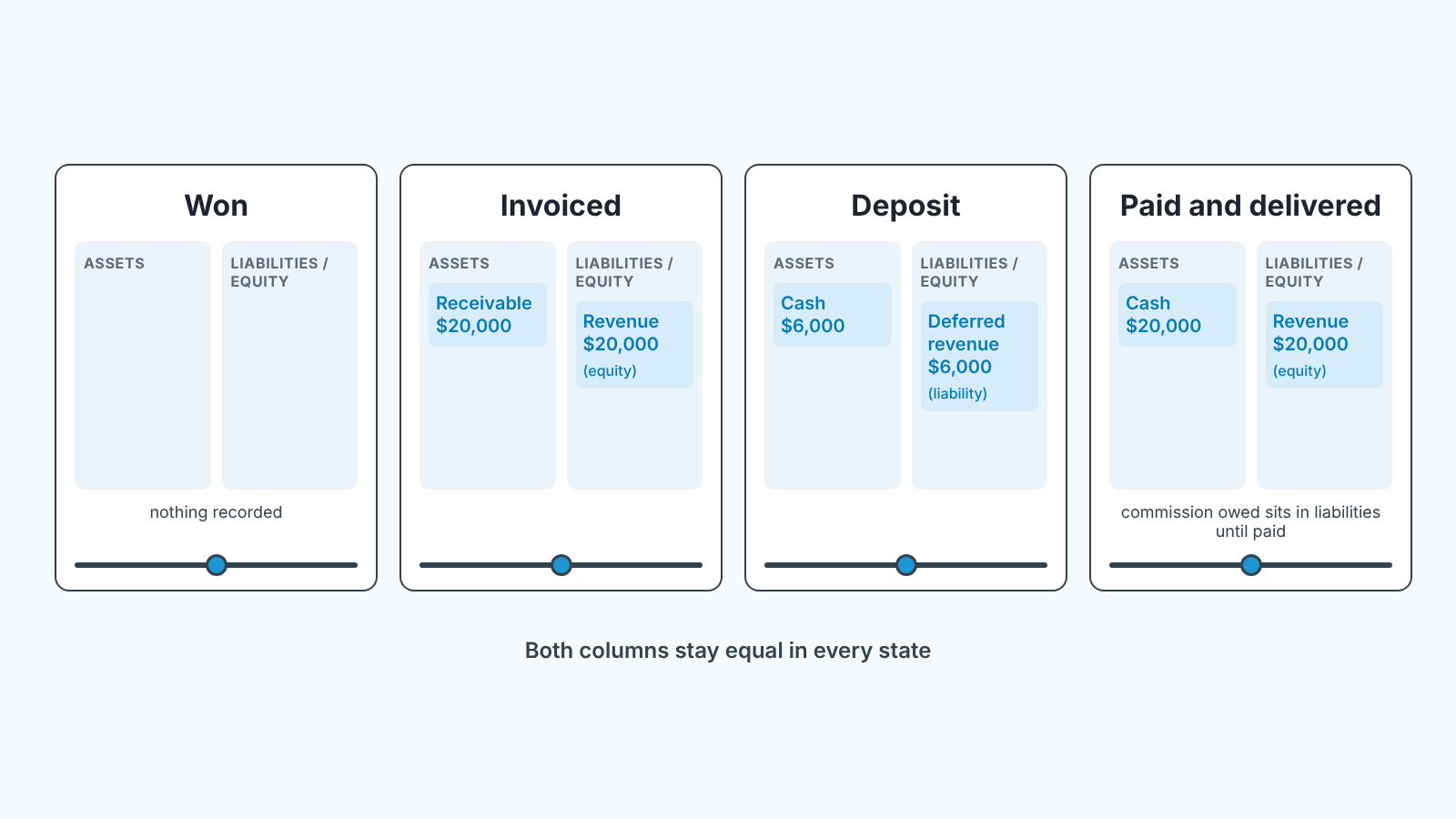
Read the first row twice. The moment your team celebrates, the equation does nothing at all. The deal exists in the CRM and nowhere else. This is the gap between closed-won and cash we describe in closed-won vs cash, and it is the reason a pipeline report and a balance sheet can tell opposite stories on the same day.
The second row is the one sales owners get wrong most often. Issuing the invoice brought in no money. It did create an asset, and the earned revenue did lift equity. On paper the business is $20,000 richer. In the bank nothing has moved. If that customer pays in 60 days, you carry the asset for 60 days, and your working capital carries the strain.
The third row is the mirror image. Cash came in, and most reps would call that a win. The accountant adds the same amount to liabilities. The business is not richer yet; it has borrowed $6,000 from the customer, to be repaid in work. Equity moves only when the work is delivered.
The fourth row is where sales and finance finally agree. And even here, the deal’s cost sits on the other side: the commission you owe the rep is a liability until payday, and once paid it reduces the profit that reached equity. A $20,000 win with a 5% commission (again, illustrative) added $20,000 to revenue and $1,000 to what the business owes its own people.
Which CRM fields feed which part
Four deal fields decide where a deal sits: won date, amount, payment status and deposit. Filled in honestly, they tell the accountant which row of the table above each deal belongs to, without a phone call. The CRM is still not a ledger, and nobody should pretend otherwise.
The won date fixes when the deal left the pipeline. It tells the accountant nothing about the equation by itself, but it is the anchor every other date is compared against. A won date with no invoice date three weeks later is a question to ask.
The deal amount is the size of the future receivable, or of the revenue, depending on the state. If reps round it or leave the amount from the first proposal, the asset side will be wrong before the invoice is even written. We ask teams to update the amount on the day the contract is signed, without waiting for month end.
Payment status, or an invoice stage. If your CRM has no such field, add a custom one: “Not invoiced”, “Invoiced”, “Partially paid”, “Paid”. This single field maps almost directly onto the asset side. “Invoiced” means receivable. “Paid” means cash. A deal that has been “Won” for 45 days and still reads “Not invoiced” is an asset that does not exist yet, and someone should ask why.
For a deposit or prepayment, a yes/no field plus an amount is enough. Any deal with a deposit received and delivery not started is a liability on the books, however good it feels in the sales report. Marking it in the CRM lets the accountant find deferred revenue without reading every contract.
That is the whole list. Four fields, filled in on time, and the CRM becomes a reliable upstream source for the receivable and deferred revenue lines. The free CRM audit from SalesBond reads the same deal records for the last 30 days and sends a PDF report with money at risk, a CRM score and what to fix. For the full balance sheet, what your CRM feeds and what it cannot show walks through which lines a CRM can supply.
Whether the books actually balance is what a trial balance checks.
What the CRM cannot show
Cash. The CRM may know a deal is “Paid” because someone changed a field, but it does not see the bank account. Payments arrive late, short, or to the wrong reference, and the bank statement wins every argument with a dropdown.
Depreciation. The van, the laptops and the office fit-out are assets that lose value every month on a schedule the accountant chose. None of that is a deal, so none of it is in the CRM, and yet it moves the asset side and, through expense, the equity side.
Owner’s equity. What the founders invested, what dividends they took, what profit was retained. The CRM has no record of any of it, and a sales owner who tries to estimate equity from won deals will be wrong by the the whole cost side of the business. Revenue is not profit; we spell out the difference in revenue vs profit, and profit is what reaches equity, after everything else.
Timing. Revenue is recognized when it is earned, no matter when the cash is received (Wikipedia: Revenue recognition), and a deferred revenue balance shrinks only as the work is delivered (Wikipedia: Deferred income). So a twelve-month service contract paid upfront in January is not one piece of revenue to the books. By 1 February roughly one month of it has been earned, the rest still waits as a liability. The CRM sees one won deal.
Our position, for what it is worth: a sales owner should not try to make the CRM carry the balance sheet. Use it to answer the questions it can answer well (which deals are won, invoiced, paid, prepaid) and let the accountant own the equation. Trying to track depreciation in a deal field has never ended well for anyone we have worked with.
What to ask your accountant once a month
A sales owner does not need to read the ledger. A short, repeated conversation does more, and we keep it to five questions. It helps to know two equity terms before the meeting: retained earnings, the profit kept in the business after closed-won turns into earnings, and return on equity, which divides the year’s net income by equity.
Start with closed-won: how much of this month’s won total is already a receivable, and how much is still not invoiced? The second number is deals that are won in the CRM but have not touched the equation yet.
Then deferred revenue: what is the total, and which deals does it come from? If the answer names deals your reps are celebrating as revenue, you have a vocabulary problem to fix on the sales floor before you have an accounting one.
Then receivables past terms. Each one is an asset losing quality, and teh rep who closed it is usually the fastest route to a payment date.
Then accrued commission. That liability belongs to sales, and it should match the won deals in the CRM to the dollar. When it does not, one of the two records is wrong.
Last, ask how much of the revenue recognized this month came from deals won in earlier months. That gap is the length of your delivery cycle, and it tells you how far the pipeline report runs ahead of the books.
Fifteen minutes, once a month, and you see your own won column reflected back from the other side of the equation, where it looks very different.
FAQ
Is revenue the same as equity?
No. Revenue is the income earned in a period; equity is the owners’ residual claim on the business. Revenue increases equity, but only after expenses are taken out, and that remainder is profit, or net income. A business can book $20,000 in revenue and add nothing to equity if it spent $20,000 earning it.
Does an unsigned deal count anywhere in the equation?
No. A deal at proposal stage, however likely, is not a transaction. It creates no asset, no liability, no equity. It belongs in the pipeline forecast and nowhere on the balance sheet. The equation starts caring the day you invoice or the day the customer pays, whichever comes first.
A customer paid a deposit. Is that revenue?
Not yet. It is cash on the asset side and deferred revenue on the liability side, in equal amounts. It becomes revenue, and reaches equity, as you deliver the work.
What are the five elements of the accounting equation?
Assets, liabilities, owner’s contributed capital, revenue and expenses; some lists add draws or dividends as a sixth. They are the parts of the expanded equation. Revenue and expenses are the two a sales team actually moves, and together they decide how much reaches equity.
Why does the equation always balance?
Because equity is defined as assets minus liabilities. Every entry that changes one side changes the other by the same amount, or moves two items on the same side in opposite directions (Wikipedia). If a balance sheet does not balance, there is an error somewhere.


