

Accounts payable is the money your business owes suppliers and other vendors for goods and services bought on credit. GoCardless defines it as “all the money that your business owes to third parties” and notes that, because these are short-term debts, they sit on the balance sheet as current liabilities (GoCardless). A sales owner meets accounts payable through closed-won deals. Each one can trigger a supplier bill, a subcontractor invoice, a partner fee or a commission, and the deal record should at least flag that those exist and roughly how big they are.
Accounting guides explain how an AP team pays invoices; they skip the morning after a good month, when the pipeline report says you sold a lot, the bookkeeper says you owe a lot, and nobody can connect the two lists.
Accounts payable is what you owe suppliers, and won deals often create it
Thomson Reuters describes accounts payable as “all of the bills a company owes to vendors and suppliers for goods and services provided to the business before they are paid”, listed as a current liability on the general ledger and the balance sheet, and removed from the sheet once paid (Thomson Reuters). The same guide breaks the AP process into four actions: purchasing the order, receiving the order, paying the invoice, and resolving the accounting records.
Now read that list from the sales side. Who decided to purchase? Usually a rep, promising a customer something the company does not make itself: the hardware in a reseller’s quote, the freelancer an agency needs for the build, the referral fee owed to the partner who brought the lead. Finance sees the bill weeks later.
We think this is why AP surprises owners of sales-led companies more than anyone else. The obligation is born in one system and recorded in another, and the person who created it has already moved on to the next deal.
Accounts payable vs accounts receivable, side by side
GoCardless calls accounts payable “essentially the opposite of accounts receivable” (GoCardless). For an owner one table beats two definitions.
| Accounts payable | Accounts receivable | |
|---|---|---|
| What it is | Money you owe third parties for goods and services bought on credit | Money customers owe you for what you have delivered and invoiced |
| Who owes whom | You owe suppliers, subcontractors, partners | Customers owe you |
| Where it comes from in sales | A won deal that needs something bought in, built by others or paid out to a partner | A won deal that has been invoiced and not yet paid |
| The date that matters | The supplier’s due date | The customer’s due date |
| What the CRM can hold | Cost on the deal, supplier terms, commission or partner fee owed | Deal amount, invoice date, payment terms, payment status |
| What stays in accounting | The supplier invoice, the AP ledger, the actual payment | The customer invoice, the AR ledger, the actual receipt |
| The ratio finance uses | AP turnover: net credit purchases divided by average accounts payable (Thomson Reuters) | AR turnover and DSO, covered in accounts receivable: closed-won vs cash |
The two columns move together. A deal that adds to the right column almost always adds to the left one too, and the left column usually comes due first. Which month a bill lands in also depends on cash vs accrual accounting, because that decides when the company books it.
Four payables hiding inside one won deal
Open last month’s won deal and ask who outside the company gets paid because it closed. Usually some mix of four.
The supplier of the thing you resold. If your quote includes equipment, licences or materials you do not make, somebody invoices you for it. This is AP in its purest form.
The subcontractor who does part of the work. Agencies, installers and IT shops often sell a project and then hire a freelancer to deliver a piece of it. That invoice is accounts payable from the moment it arrives, and it tends to arrive before your customer has paid for teh finished job.
The partner who brought the deal. Referral fees and channel commissions paid to another business are vendor payments and belong in AP like any other supplier invoice. Many teams track them nowhere, which is how a partner ends up chasing you for a fee you forgot you agreed to.
The rep who closed it. In the books an employee’s commission is payroll, not AP, and we covered its treatment in liabilities a sales owner creates. We count it here anyway, because it is cash that leaves because a deal was won, on a date the CRM already knows.
A founder-sold software subscription might have none. A reseller deal with a partner lead and an installer has all four, and looks like any other deal in the pipeline report.
Three fields on the deal: cost, supplier due date, commission owed
Every mainstream CRM lets you add custom fields to a deal, so we stay CRM-neutral. The names below are suggestions; the rule is that someone in the office can open the deal and see what the company owes without calling the rep.
Deal cost. One money field: the total you expect to pay suppliers, subcontractors and partners for this deal. If your CRM supports line items with a cost price use that instead and let the deal sum it. The rep fills it at the proposal stage, because the rep got the supplier quote. It is the same field the gross margin from CRM deal data article uses: margin on the way in, payables on the way out.
Supplier terms. A short dropdown is more honest than a date field here, because at proposal time nobody knows the invoice date yet. Values like “prepaid”, “on delivery”, “30 days” and “60 days” are enough.
Commission or partner fee owed. For an employee commission, the deal already knows its owner and its won date, so a rate field (or a rate on the owner record) gets you the number. For a partner fee, a money field plus the partner’s name. Don’t try to make the CRM calculate split commissions and accelerators. Make it reliable about the inputs and let the sheet or payroll do the arithmetic.
The timing gap: your customer pays in 60 days, your supplier wants 30
This is where AP stops being an accounting term and becomes a Tuesday problem.
Invented figures, to show the mechanics: a rep closes a $40,000 installation. The hardware costs $22,000 and the vendor’s terms are 30 days from delivery. The installer bills $6,000 on completion, 14 days. The customer signed on Net 60, counted from the invoice you send after installation. By the time the customer’s money is due, the hardware has been payable for about a month and the installer for six weeks. For most of that period the business is $28,000 out of pocket on a deal the pipeline report has counted as won since the signature.
Multiply that by a good quarter and you get the paradox: the more you sell, the less cash you have. Finance tracks it with two numbers, days payable outstanding (DPO), the average time your company takes to pay its suppliers (GoCardless), and days sales outstanding (DSO), the average time customers take to pay you. The gap between them decides whether a strong month needs an overdraft.
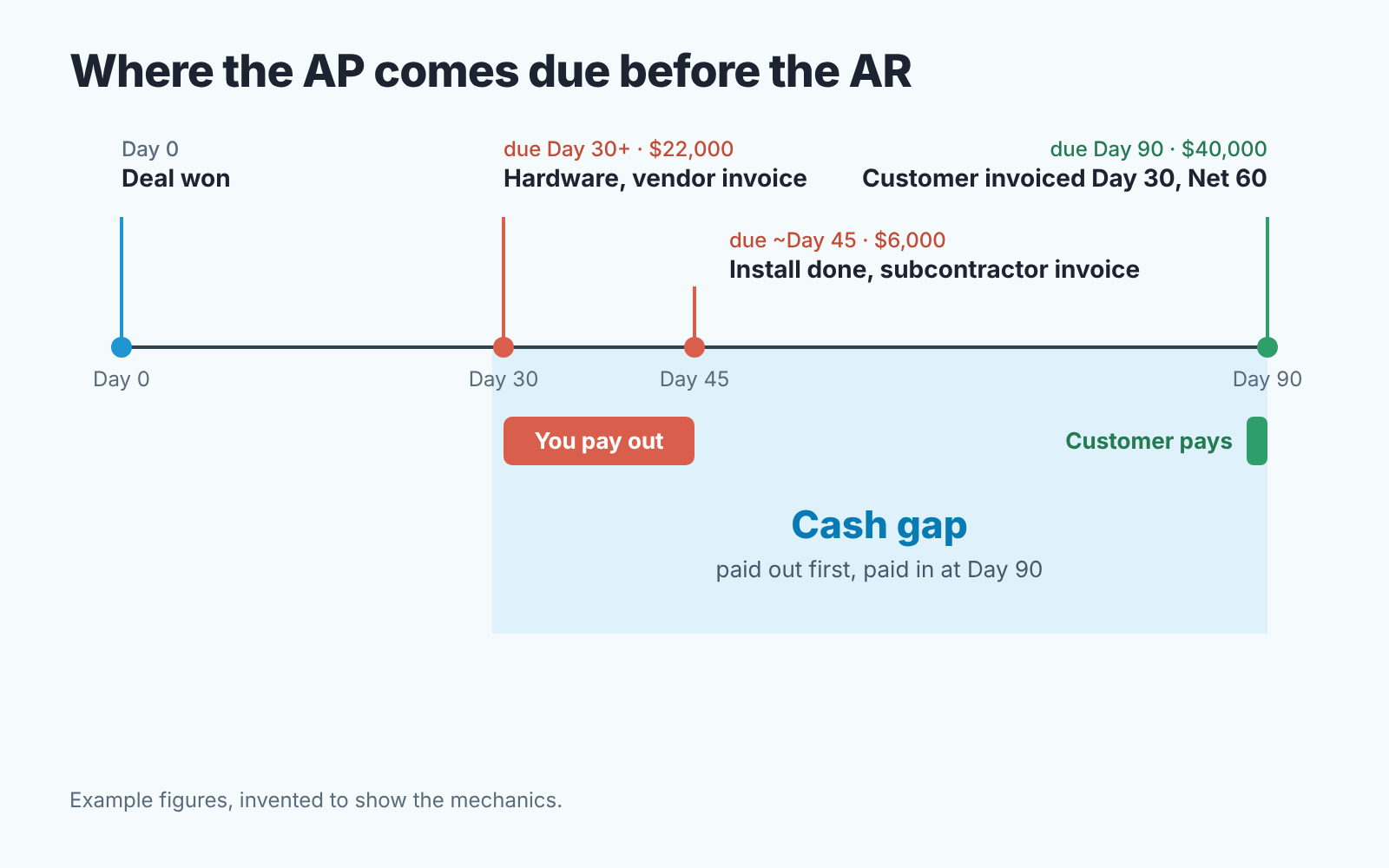
Our position: the fix sits with sales. Finance can stretch a supplier once, at the cost of the relationship. A rep can ask for a deposit that covers the hardware, or quote Net 30 instead of the customer’s template terms, on every deal. The working capital article covers what sales decides before finance sees the deal; payment terms move this gap the most.
What the CRM can show, and what lives in accounting
A CRM can show you a list: won deals in a period, with cost, supplier terms and commission owed, summed. That list is a forecast of payables, made by the person who knew the deal best. Almost nobody runs it.
What the CRM cannot show is accounts payable itself: of the four AP actions, only purchasing belongs in the CRM. The supplier invoice arrives at the office, not on the deal, and it’s amount may differ from the rep’s estimate. Don’t key the payment back into the deal. A team that tries ends up with two unreliable ledgers instead of one good one.
Don’t confuse this with the “accounts payable contact” on the customer’s side, who approves your invoice. That person belongs to receivables and has a separate guide, the billing contact and the customer’s AP in Pipedrive.
A monthly check that takes twenty minutes
Once a month, the week after the books close. We recommend it to any owner whose sales team and bookkeeper do not talk much.
Filter the CRM for deals won last month and export four columns: deal amount, deal cost, supplier terms, commission or partner fee. Sum the cost column. That is what sales believes the company committed to paying out in the month. Count the deals with an empty cost field; if there are more than a handful the number is not usable yet, and the first fix is a conversation with the the reps about filling it at the proposal stage. Empty fields rarely stop at one column, and SalesBond’s free CRM audit, which reads the last 30 days of the CRM and sends a PDF report with a CRM score, the top findings and what to fix, shows how far the gaps go.
Ask the bookkeeper for the AP list by vendor with due dates; a single total will not help. Set the two side by side . Vendor bills that match a won deal are fine. Vendor bills that match nothing in the CRM are the interesting ones: either a rep bought something for a deal that is not marked won, or the business is buying for stock and someone should know. Deals with a cost in the CRM and no bill yet are the third group, the payables still on their way.
Then put the AR list from the weekly receivables check next to both and look at the dates. If the payables from last month’s deals come due before the receivables from the same deals, you have found next month’s cash gap, with the deal names attached. That is the one number worth carrying into the cash flow statement conversation with your accountant, because it comes with a cause.
FAQ
Is payroll accounts payable?
No. Thomson Reuters defines accounts payable as “all business expenses except payroll” and states that it does not include payroll accounting, which covers employee compensation, payroll taxes, benefit withholdings and benefit payments (Thomson Reuters). Wages go through payroll.
Are sales commissions accounts payable?
It depends on who earns them. A commission paid to your own employee is payroll, so by the definition above it is not AP, even though the company owes it until payday. A commission or referral fee paid to another business (a partner, an agent or a reseller) arrives as that business’s invoice and is accounts payable like any other supplier bill. Earned but unpaid, an employee’s commission is an accrued liability, like wages; Wikipedia’s entry on accrued liabilities describes them as expenses “that have not yet been paid or logged under accounts payable” and lists accrued wages payable as an example. For cash planning the dates matter more than the label, and both should be visible on the deal.
Is accounts payable a liability?
Yes. Accounts payable is a current liability on the balance sheet, because it is short-term debt to suppliers (GoCardless), and it comes off the sheet once the bills are paid.


