
Quick answer
A meeting agenda is the plan you send before the meeting: what the meeting is for, who is in it, the items in order with a time for each, and what you expect to walk out with on every item. A good one starts with the questions that need a decision and pushes status updates to the end, or out of the meeting entirely.
That is the whole method. The rest of this article is how to apply it to a sales team, where the agenda is a list of deals and people rather than a list of topics. Below are three agendas we actually use: the weekly sales meeting, the one-on-one, and the pipeline review, with timing and the questions to ask. If you want to decide which meetings a small team needs at all and how often, that is a different question, and we covered it in how often a small sales team should meet.
What goes into a meeting agenda, and what does not
Every guide on the subject lists the same parts, and they are right. Asana names purpose, participants and their roles, the topics, the time for each one, and the pre-reading (Asana: how to write a meeting agenda). Zapier adds an owner for every item, links to the documents people will need, and space for notes and next steps (Zapier: meeting agenda templates).
What those lists do not say is which of these parts people skip, and it is always the same two: the expected outcome per item and the owner per item. “Q4 pipeline” is a topic. “Decide whether we drop the three stalled enterprise deals from the Q4 forecast, Anna presents” is an agenda item. The first one produces a conversation. The second one produces a decision, and the person who has to prepare knows its them.
The order matters as much as the parts. Voicit’s advice is to put the items that need a decision at the top, when people are still fresh and the room is full, and to keep the chair and the note-taker as two different people (Voicit: how to write a meeting agenda). We would go one step further for sales teams: pure status does not belong on the agenda at all. “Where is the Henderson deal” is an email, or a CRM filter, and it does not need ten minutes of eight people’s time.
What else stays out: anything that only two people care about, and anything you cannot phrase as a question. If you cannot phrase it as a question, you do not know what you want from the room yet.
If you need something to copy before the sales versions below, this is the skeleton we start from. Six lines, and it fits any internal meeting:
- Purpose: the one decision or outcome the meeting exists for
- Attendees, plus who chairs and who takes notes
- Items, each written as: question / owner / minutes / expected outcome
- Pre-read: the links people open before they walk in
- Time: start, end, and the buffer
- Summary: who sends it, to whom, by when
How to write a meeting agenda in ten minutes
Start with the sentence you will say when the meeting ends: “We decided X, Y and Z.” If you cannot write that sentence, cancel the meeting and send a note instead. If you can, the X, Y and Z are your first agenda items.
Then give every item an owner and a time. Asana’s seven steps cover the same ground: define the purpose, ask participants for input, list the key questions, state the goal of each topic, allocate time, name who leads each topic, then write it up and share it well ahead (Asana). The buffer is the part people drop. Zoom suggests planning about 20% more time per topic than you think it needs (Zoom: meeting agenda examples); Zapier adds 10% to the total meeting time (Zapier). Both are their authors’ rules of thumb, not research, and the exact number matters less than having one. A pipeline discussion with no buffer always eats the item after it.
How many items fit? Voicit’s figure is three to six per hour (Voicit). For a sales meeting we would keep the items that need a decision at the low end, which is why the weekly template below has two or three deal questions and fills the rest of its 45 minutes with short, fixed items.
Send it ahead. Voicit’s rule for internal meetings is 24 to 48 hours before; Zapier says 48 hours; Zoom says a board agenda goes out 72 hours to a week ahead (same sources). For a weekly sales meeting the previous afternoon is enough if the agenda is short and the CRM data is attached. Nobody reads a Thursday agenda for a Monday meeting anyway.
One more thing from the Zapier list: name the note-taker in the agenda, before the meeting starts. Otherwise the manager takes teh notes, and the manager is the one person who should be listening. What the note-taker writes down, including decisions and next steps, is covered in meeting minutes for a sales team.
Template: the weekly sales meeting
Forty-five minutes, the whole team, once a week. The manager chairs, one rep takes notes, and the rotation is written in the agenda.
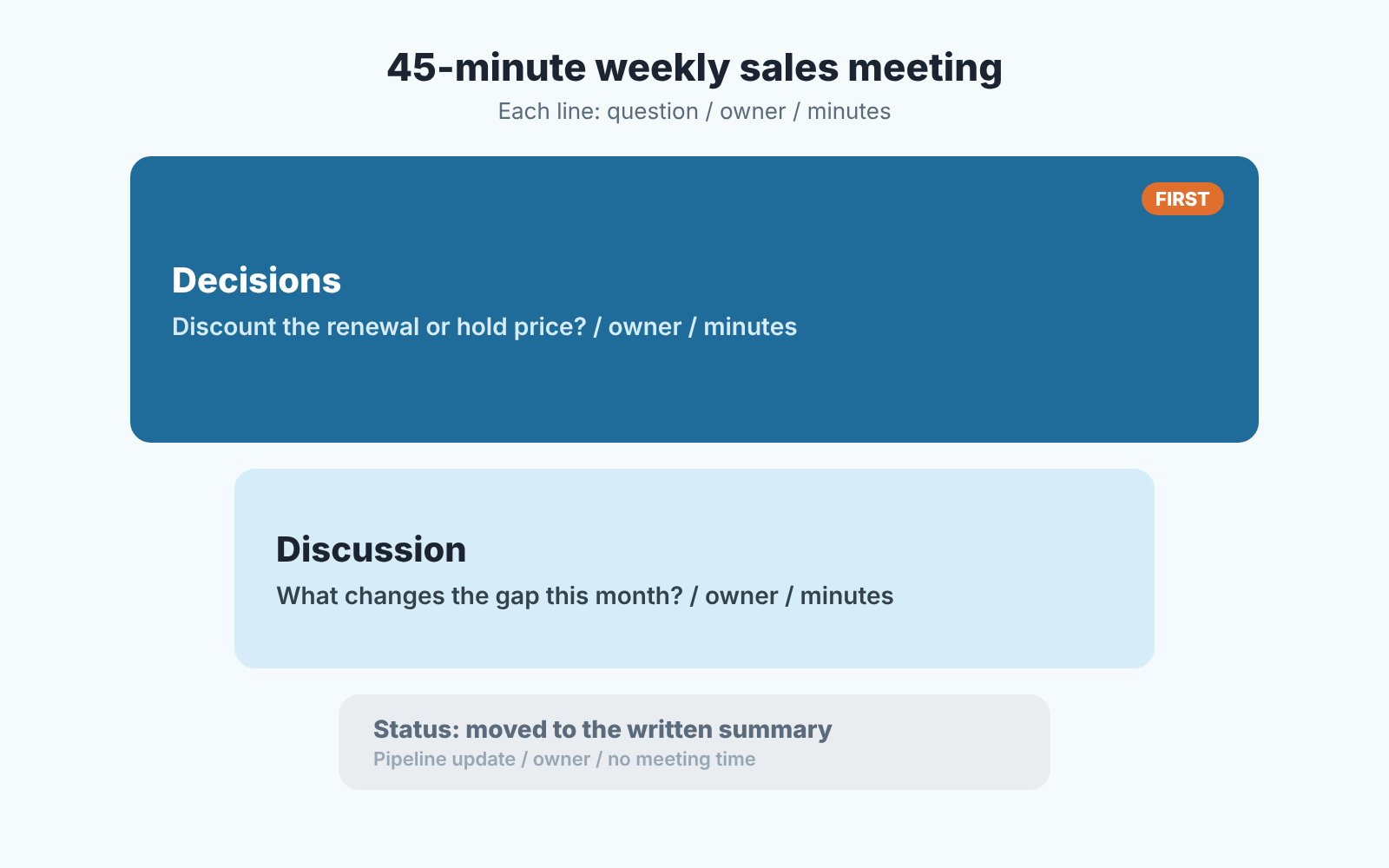
- Decisions, 15 min. Two or three deal questions that need the room: “Do we discount the Carter renewal to keep it in Q4, or hold price and accept the slip? Owner: Mark.” Each one ends with a yes, a no, or a named person and a date.
- Numbers against plan, 5 min. Closed this week, forecast for the month, the gap. Not read aloud from a slide: everyone saw it in the pre-read. The only question is “what changes the gap”, and the answer is one or two deals, named.
- Blockers, 10 min. Anything that stops a rep from working a deal: a missing quote, a legal review, a product answer. One sentence each, assigned on the spot.
- Lessons, 5 min. One deal that closed or died this week, and what the rep would do differently. Optional. Skip it when the room is tired.
- Next steps and who writes the summary, 5 min.
- Buffer, 5 min. Left empty for the decision that runs long.
What is missing from this agenda is the go-round where every rep reads out their pipeline. That goes to the pre-read: the open deals list from the CRM, sorted by expected close date. If the team needs a written weekly number in any case, it should be the same document, and we wrote about what goes into it in the weekly sales report: what to include and what to cut.
Template: the one-on-one
Thirty minutes, the rep and the manager, and the rep owns the agenda. Our order is the rep’s own items first, then a deal or two they want help with, then five minutes on one skill to try next week. The full version, with the questions and what to keep out of the room, is in a sales 1-on-1 agenda that isn’t a status update.
Template: the pipeline review, and what to pull from the CRM first
A pipeline review fails for one reason: people arrive and open the CRM live, and the meeting becomes data entry with an audience. The agenda for this meeting is a list of deals, and the list is built before the meeting from CRM filters.
Sixty minutes, the manager and the reps whose deals are on the list, every two weeks or monthly. This is the long version, for a proper pass over the whole pipeline. The weekly 15-minute check is a different meeting, and we laid it out in a 15-minute weekly pipeline review.
- Deals that moved on paper but not in reality, 20 min. Expected close date pushed since the last review. For each one: what happened, what is the new date based on, does it stay in the forecast.
- Deals with no next step, 15 min. Open, past the stage where a next activity should exist, and nothing scheduled. The question is “what is the next step and when”, and it gets entered during the meeting itself.
- Deals stuck in one stage, 10 min. Longer in the stage than the team’s normal cycle. Keep, requalify, or close as lost. Closing a deal as lost in the meeting is a legitimate outcome, and often the best one.
- Stage and forecast corrections, 5 min. Anything that should move backwards. Anything that should come out of the commit. Done in the meeting, by the rep, while everyone sees it.
- Buffer, 10 min. Kept free for the deal that needs a longer discussion.
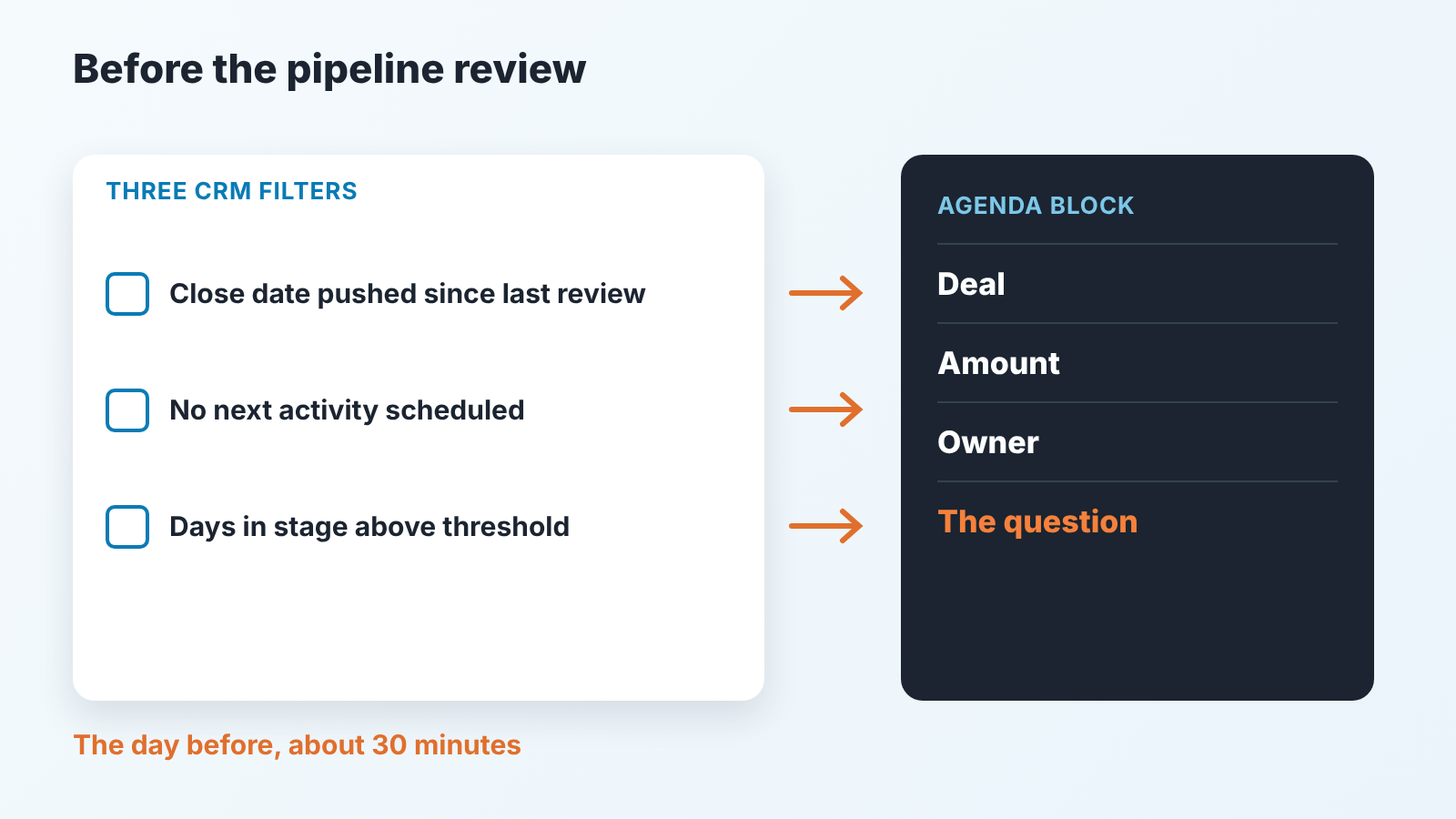
What to prepare, the day before: the open deals list filtered three ways, by pushed close date, by no next activity, and by days in stage over your threshold. Three saved filters in any CRM, run once, exported to the agenda with the deal name, amount, owner and the one question for it. That preparation is thirty minutes of the manager’s time, and it keeps the meeting on decisions.
A disclosure, since this is the part we automated. We build SalesBond, a sales management layer on top of the CRM a team already uses. Its Deal Health checks every deal against more than 20 rules and shows the specific violations on each one, so a good part of that list exists before anyone builds a filter. If you want to see what your pipeline review would look like before you run one, the free CRM audit does the first pass. SalesBond reads the last 30 days of your CRM and sends a PDF report with money at risk, the deal health picture, the pipeline bottleneck and up to five things to fix sorted by money, then a second PDF a week later with what changed. Check your CRM with SalesBond. A person still writes the agenda from that list.
After the meeting: the summary and the deadlines
The agenda is half the document. The other half is the summary, and the rule we hold to is that it goes out the same day, from the note-taker, in the same format as the agenda: the item, the decision, the owner, the date. Zapier’s advice is the same, send a recap with the next steps after every meeting (Zapier).
Three things make the summary useful rather then polite. Decisions are written as decisions: “Carter renewal: hold price, Mark confirms with the customer by Thursday”, not “we talked about Carter”. Every action has a date, and the date is in the CRM too: a next step agreed in the room is an activity on the deal before the summary goes out, because nobody looks for next steps in a meeting summary a week later. And the summary is the first item on the next agenda. Open with what was promised, check what was done, then move to new decisions. Teams that skip this find the same deal coming up three reviews in a row with the same question.
Status, the thing you took out of the agenda, lives here. The numbers and the closed deals go in the written summary, where people can read them in two minutes and nobody has to sit through them.
If the meeting you are planning is bigger than a weekly, a kickoff or a quarter start, the same structure holds, with longer pre-reads and more time for the decisions. We wrote that one up in running a sales kickoff for a small team.
FAQ
How long should a meeting agenda be? Three to six items per hour is Voicit’s range (Voicit), and for a sales meeting two or three decision items are plenty.
When should I send the agenda? Voicit’s rule is 24 to 48 hours ahead (Voicit), and for an internal weekly the day before is fine.
Does a daily stand-up need an agenda?
Not a written one each day. Zoom puts the daily scrum at about 15 minutes (Zoom), and the agenda is the same three questions every time: what closed or moved, what is blocked, what you need from someone in the room. Write it once and pin it.
What if nobody prepares?
Then the meeting has no decisions in it, and you should say so and end it early. Do it twice and preparation starts. A meeting that goes ahead unprepared teaches everyone that preparation is optional.
Who should run the meeting, the manager or the owner?
Whoever can make the decisions on the agenda. If three of the four items need the owner’s yes, the owner chairs or the items wait.