A good sales call script is a few short lines, each ending in something saved in the CRM. For a qualification call in Pipedrive that means an opening and a reason for the call, two or three questions whose answers go into deal fields or a note, and a close that creates the next activity with a date.
If a line has no record attached to it, it is small talk, and small talk doesn’t need a script.
This one is for an inbound lead or a qualification call, not a cold call. Cold openers are well covered; Pipedrive’s own blog has twenty-five. None of them say what should be different in the deal once the call is over, which is the only part a manager can check, so that is what this script is built around.
The call that went well and left nothing in the deal
Dana takes an inbound lead on Tuesday. Twenty minutes, easy conversation, the buyer laughs twice, asks about pricing, mentions a board meeting at the end of the month and says “let’s talk after that”. Dana hangs up pleased with herself and writes “Good call, interested, follow up after board meeting” in the deal.
On Friday her manager opens the deal before the pipeline review. Here is what he finds. A call activity, marked done. The stage, unchanged. Expected close date, unchanged. No next activity. One note, eleven words long, none of them the buyer’s.
Was that a good call? He has no idea. Dana remembers it as one. The deal remembers nothing, and the deal is what will still be here when the board meeting slips and nobody notices.
Dana followed the script she was given. It told her what to say. It never told her what to keep.
How to write a sales call script: start from the records
We think every line in a sales call script has two halves: what you say and what you write down. The scripts that rank for this query give you the first half only. Dana’s deal is what that produces.
So build it backwards. List what the deal must contain after a qualification call to be worth a second one, then write the question that gets each item. If you can’t name where an answer goes in Pipedrive, either the question doesn’t belong in the script or you are missing a field. Both are worth knowing before the call, not after.
Take the needed-by date. You want it in every deal that survives a qualification call, so you need a date field for it and one question that gets it said out loud. That is line four below. Do the same for each record and the script writes itself.
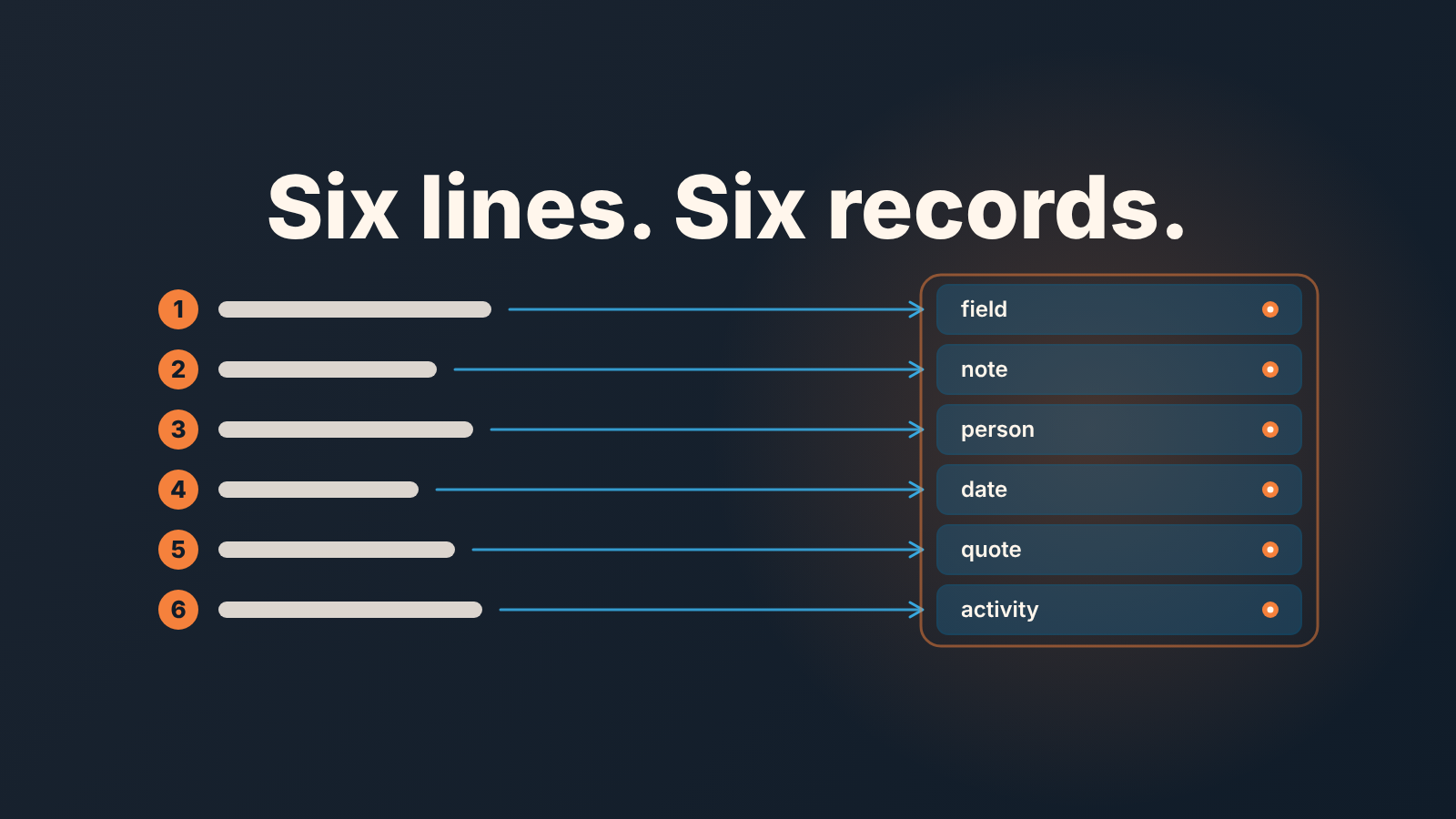
That keeps the script short. A qualification call decides whether this lead gets thirty minutes of discovery next week, and six records are enough to decide it. Our list has six lines because six things are worth keeping, not because six is a tidy number. Yours might have five or seven. It should not have twelve.
Six lines, six records: a qualification call script
The lines below are the gist, not a verbatim text, so say them in your own words. What you keep after each one is the part that doesn’t change.
-
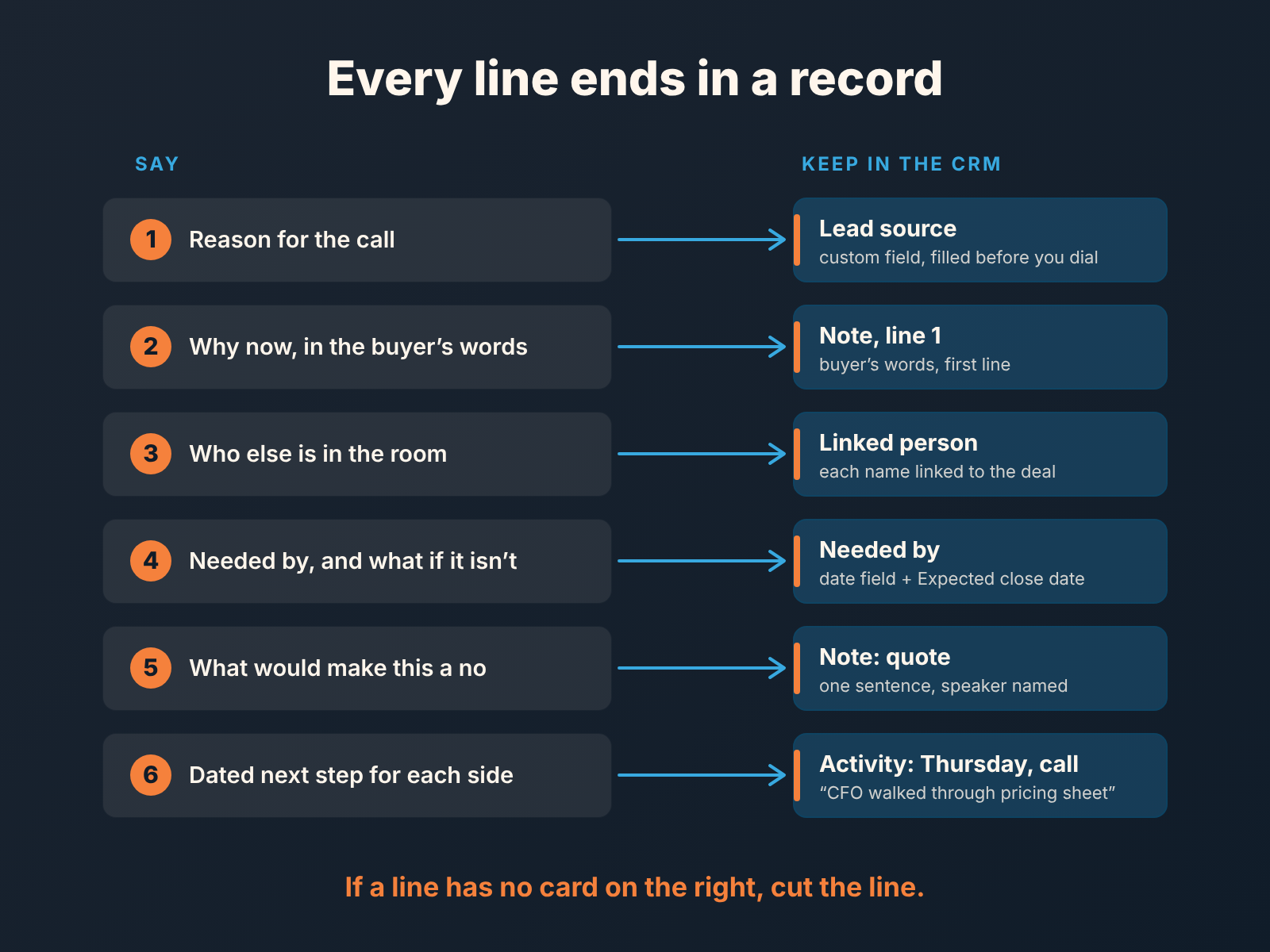
Say: “You asked about X on our site on Tuesday. I’ve got fifteen minutes to see if a longer conversation makes sense. Fair?” That gives the reason for the call in the buyer’s terms and asks permission to ask questions.
Keep in Pipedrive: a custom deal field for where the lead came from, filled in before you dial. Custom fields live under Personal preferences > Data fields (Pipedrive: custom fields).
-
Say: “What made you look at this now, rather than six months ago?”
Keep in Pipedrive: the answer, in the buyer’s words, as the first line of the deal note.
-
Say: “When you decide on something like this, who else is in the room?” You are finding out whether the deal hangs on one person.
Keep in Pipedrive: each name as a person linked to the deal (Pipedrive: deal detail view). A name in a sentence can’t be filtered; a linked person can.
-
Say: “When does this need to be working by, and what happens if it isn’t?”
Keep in Pipedrive: a custom “Needed by” date field, plus an expected close date you can defend. The deal’s Changelog tracks changes to both, so a date that moves later is visible (Pipedrive: deal detail view).
-
Say: “What would make this a no for you?” Better to hear the objection now than after you’ve written a proposal.
Keep in Pipedrive: one quoted sentence in the deal note, speaker named. If your team categorises objections, the category goes in a field, as set up in logging objections in Pipedrive.
-
Say: “I’ll send the summary by Monday. Could you walk your CFO through the pricing sheet by Wednesday? Then I’ll book fifteen minutes on Thursday morning to hear what they thought.” One action each, both dated.
Keep in Pipedrive: a dated activity on the deal, type call or meeting, with the buyer’s action in the title. The next activity date is the date of the next activity not yet marked done (Pipedrive: activities).
One more record sits outside the six: the call itself, logged as an activity and marked done, which sets the deal’s last activity date (Pipedrive: activities). Pipedrive has no built-in calling, so Marketplace apps such as CloudTalk, Kixie, CallHippo or Aircall log completed calls for you, and the iOS app, with call logging on, prompts you to log an outgoing call when it ends (Pipedrive: how to make calls).
Lines two and five are the only free text, and which answers belong in a field and which in the note is it’s own topic, covered in the five-line call note.
What to do when the buyer goes off script
They will. The script is a checklist of records, not an order of questions, and that is what makes it survive contact with a real buyer.
The buyer asks for the price at minute two. Answer, then write down what you said; the price line has its own place in the note. The buyer spends ten minutes on how their process fell apart in March. That is line two arriving early. Don’t interrupt it to get back to line one, make the record when they pause. And if line three gets “just me”, ask who signs the invoice. If it’s someone else, that is the second person on the deal.
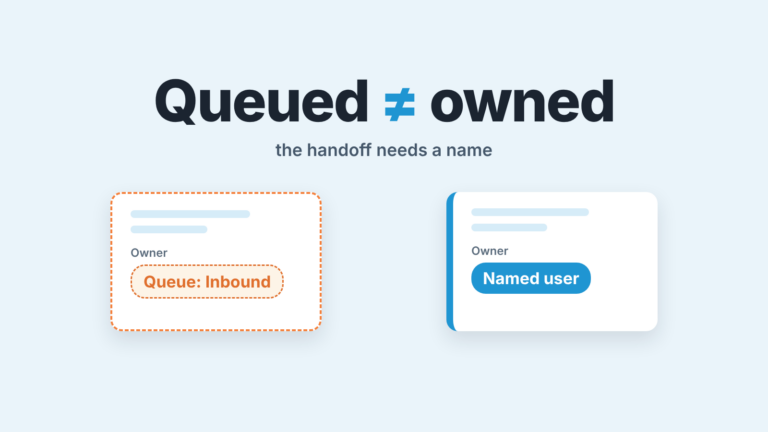
The one line you don’t skip is the sixth. If the buyer is out of time, this is the sentence: “Before you go: I’ll send a two-page summary tomorrow. Can we hold fifteen minutes next Wednesday, so you can tell me if it’s worth taking to the board?” If the answer is yes, create the activity while they are still on the line. If the answer is “I’ll come back to you”, the honest record is no next activity and no stage change. A deal with nothing scheduled should look like one. A “follow up” task that only you are responsible for hides the one fact the manager needs.
How a manager checks a call without listening to it
Open the deal. Don’t open the recording. Ask the card these questions, in this order, and stop at the first blank.
- Is there a call activity marked done on the day of the call? If not, nothing else is checkable.
- Is there a next activity, with a date, and does its title contain something the buyer agreed to do? “Follow up” is a reminder to the rep, not an agreement.
- Did the needed-by date and the expected close date change? The Changelog shows field changes by date, so a rep who skipped line four leaves a visible gap.
- Is there a second person linked to the deal? If not, does the note say the buyer was asked and gave one name?
- Does the note contain at least one sentence the buyer could actually have said? “Some IT concerns” fails. “Priya: if IT has to touch it, it waits until Q2” passes.
- If the stage moved, which of the records above justifies the move?
That check catches a different thing from listening. Listening tells you how the rep sounded; the card tells you whether the call changed anything. We’d check the card first, every time, and keep the listening for the two calls a week you score with a call review scorecard. In the pipeline review the same records answer the deal review questions without the rep narrating the call.
We build SalesBond, a sales management layer on top of the CRM a team already uses, and its Deal Health runs part of this check on every open deal: among more than 20 rules, it flags deals with no next activity and deals with no recent updates, says which rule fired, and leaves the decision to you. Check your CRM with SalesBond.
Where the script lives so reps actually open it
A script in a shared doc is read on day one and never again. The place a script survives is inside what the rep is already looking at during the call, and in Pipedrive that is the the deal’s fields.
Every custom lead or deal field can carry a description, shown when a rep clicks the info icon next to it, there to tell the team why and how to fill the field (Pipedrive: custom fields; field descriptions need the Growth plan or above). That is where the question goes. The “Needed by” field’s description reads: Ask: “When does this need to be working by, and what happens if it isn’t?” Put the date here, the consequence in the note. The lead source field’s description reads: Fill in before you dial. The rep gets the script line next to the box it fills, and nothing else.
Two settings make the fields show up at the right time. Pipeline-specific fields let you show the qualification fields only in the pipeline where inbound leads land, so the renewals team never sees them. And the quality rules on a field let you mark it “important”, which highlights it as missing in the deal detail view without blocking the save, or “required”, which blocks saving the deal until it is filled (Pipedrive: custom fields; pipeline-specific and required fields need Premium, important fields Growth). We’d mark the needed-by date as important and stop there. Required fields collect “31 December” from reps who want to close the window; the case for and against is in required fields in Pipedrive.
The last place the script lives is the activity type. Pipedrive ships call, meeting, task, deadline, email and lunch, and lets you add custom types (Pipedrive: activities). A custom type called “Qualification call” does two quiet things: teh done activity itself says which script was used, and the manager’s first check from the list above is a glance at the type rather than a guess from the subject line.
Set those three things up once and the script stops being a document anyone has to remember; it becomes the shape of the deal. Dana’s next call will still go well. This time the deal will know.