
Neither a leasing CRM nor property management software is better on its own, because they do different jobs. The property management system, the PMS, keeps the unit, the lease, rent, work orders and owner statements, and its leasing features often cover tenant inquiries and showings; AppFolio, which calls its product “property management software” and prices it per unit per month, is the typical example (AppFolio pricing). A CRM such as HubSpot, Pipedrive or Zoho CRM carries what the PMS has no record for yet, owners deciding whether to hand you units and renewals coming due, and the real work is getting the two to exchange a lease end date and a unit number without retyping.
Quick answer: which job, which system
Tenant inquiries, showings and applications belong in the PMS’s leasing features when the plan includes them, and in a CRM only when it does not. On the demo, the lead should open with the unit attached, a showing should be an activity with a date, and the application status should come back to the record.
Signing new owners, the property owners and investors handing units over to be managed, is pipeline CRM work (HubSpot, Pipedrive, Zoho CRM): a deal with a value, stages from first call to signed management agreement, a next activity on every open deal. Renewals due in the next 90 days also go in a CRM pipeline, fed by lease end dates from the PMS, with the lease end date in its own field. Rent, maintenance, accounting and owner statements are PMS work, and nobody should try to make them a CRM job.
Lists of CRMs for real estate agents answer a different question. An agent sells transactions. A property manager leases units and signs owners, and those are two different pipelines with different numbers.
Two mistakes repeat. A company buys a CRM for tenant leads while its PMS already has a leasing flow and the leasing agents type every inquiry twice. Or a company trusts the PMS to be its sales system and cannot say how many owner conversations are open this month, because a PMS has no reason to hold a deal that has no unit yet.
Property management CRM vs. PMS: what lives where
Open the pricing page of a PMS vendor and the boundary is drawn for you. AppFolio’s Core plan, “starting at $1.49 per unit per month” with a 50-unit minimum, lists “End-to-End Marketing & Leasing” among its features. “Leasing CRM” is a separate line, and it sits in the Max plan, “starting at $5.00 per unit per month”, next to “AppFolio API (read/write)”; the Plus plan in between offers the API as read only (AppFolio pricing, opened 2026-11-06). Two things follow for a buyer. The vendor itself treats leasing marketing and a CRM as different items, so the word “CRM” in a PMS brochure is not a promise that the plan you are on has one. And how much data you can move in and out depends on the plan, which decides whether a separate CRM can be kept in sync at all.
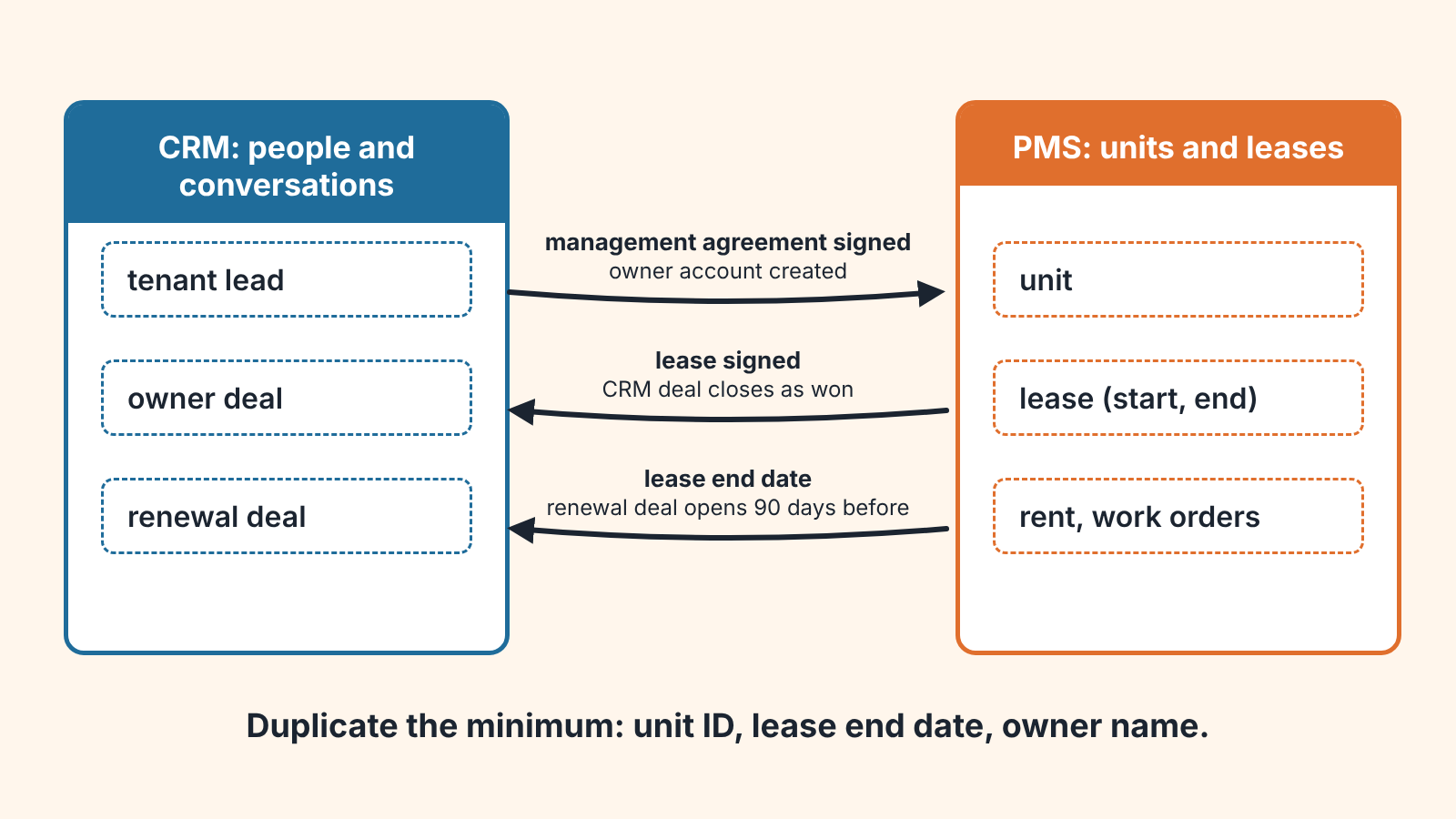
We think the clean rule is that the PMS owns the unit and the lease, the CRM owns the person and the conversation until there is a lease. The moment the lease is signed, the tenant is a PMS record and the CRM record closes as won. An owner is a CRM deal until the management agreement is signed and a PMS account after. Duplicate the minimum: unit ID, lease end date, owner name. Everything else lives in one place. What a sales CRM should hold in general is in what to keep in the CRM database for a sales team; for a property manager it comes down to the person, the unit they asked about, the source, the next step and its date.
The tenant lead pipeline
A tenant lead has a short life. Someone sees a listing, writes or calls, wants to see the unit this week and will take another one if nobody answers. The pipeline is correspondingly short: inquiry, contacted, showing booked, showed, application sent, approved, lease signed. The fields that matter are the unit, the source of the inquiry (listing site, sign, referral, walk-in), the desired move-in date and the budget.
Where this pipeline lives is the first decision, and the PMS plan answers it. If the plan includes a prospect record, showings and online applications, the tenant pipeline belongs in the PMS, because the application and the lease are PMS events and you want them on the same record as the inquiry. Build it in a CRM only if the PMS plan has no prospect tracking, or if the leasing team works across several PMS instances and needs one queue.
Either way, the manager’s numbers are three ratios per leasing agent per week: showings per inquiry, applications per showing, leases per application. A low first ratio is a response problem. A low second ratio is a unit or a price problem. A low third one is screening. Each points at a different fix, which is the reason to keep stages instead of a status field that says “in progress”.
The owner pipeline: new units under management
The owner pipeline is the one PMS leasing features are not built for, and it is the one that grows the business. The AppFolio plan page describes a “Leasing CRM”; it does not describe a pipeline for signing owners (AppFolio pricing). An owner who is deciding whether to hand you a twelve-unit building has no unit in your system yet, no lease, no tenant. He is a deal, and a deal needs a sales CRM.
Set it up as sales teams do. Deal value is the number of units times the monthly management fee, times twelve, so teh pipeline report means money. Stages: referral or inquiry, walk-through, proposal sent, management agreement signed, handed to onboarding. A lost reason as a field, with a short list: decided to self-manage, chose another manager, selling the property, fee. An expected close date on every deal and a next activity on every open one.
Any of the general CRMs does this out of the box, because this is what they are built for. HubSpot titles its CRM page “Free CRM Software for Small Businesses” (HubSpot CRM). Pipedrive calls itself “Sales CRM & Pipeline Management Software” and says it “lets you track your sales pipeline, optimize leads, manage deals” (Pipedrive). Zoho CRM’s page says its “freemium edition supports up to 3 users” (Zoho CRM), which for a company with one or two people talking to owners means the owner pipeline can live in a free edition for a long time.
Tag the source on every owner deal: referral from an existing owner, referral from an agent, inbound, outbound. After a quarter you will know whether existing owners are your main source, and if they are, keeping them is the sales job the next section is about.
Renewals are repeat sales
Lease end dates are known a year in advance. Management agreements have renewal dates written into them. And still renewals are the thing that gets missed, because nothing in the PMS opens a conversation; it just shows a date. Hotel group sales run on the same long lead times, and our comparison of the best hotel CRM for hotel sales teams is organised by job for the same reason.
Treat each renewal as a deal. A tenant renewal deal opens 90 days before the lease ends, in its own pipeline: notice sent, offer made, counter, signed, or move-out with a reason. An owner renewal deal opens before the management agreement’s renewal date: review meeting booked, report sent, renewed, or lost with a reason. Won means signed. Now you have a renewal rate per manager and per building, and a list every Monday of renewals due that nobody has touched.
That list is what we build for sales teams. In SalesBond, Repeat Sales treats every won deal of a customer as a purchase and works out the customer’s buying cycle as the median interval between purchases, which needs at least two of them. An owner whose management agreement has been renewed as a won deal each year shows a cycle of about a year, and the days since the last won deal give a status: on track, overdue once the cycle has passed, leaving once twice the cycle has passed, with both thresholds configurable. There is no prediction in it; it is arithmetic on dates you already have in the CRM. How to run account management from those statuses, with or without a tool, is in account management by customer status.
Three kinds of system, by job
The PMS with built-in leasing features fits the tenant pipeline on units you already manage, because inquiry, showing, application and lease are all PMS events. Read the plan page before assuming you have it: in AppFolio’s case leasing is in every plan and the item named “Leasing CRM” is in the top one (AppFolio pricing). Where it stops is the owner who has no unit with you yet.
The general CRM, set up with two pipelines: owners in one, renewals in the other, and a third for tenant leads only if the PMS has no prospect tracking. HubSpot, Pipedrive and Zoho CRM are the common choices; which fits the rest of the company is in CRM software by business type. Its weakness is the hand-off: a signed lease in the PMS does not close a CRM deal by itself, and someone has to decide whether that is an API job, a weekly import or a person.
The leasing CRM, sold as its own product. By leasing CRM we mean a CRM built for the renter side only: prospects, tours, applications, and sometimes residents and renewals. Knock CRM describes guiding renters “from lead to lease to retained resident” and lets prospects self-schedule tours (Knock CRM); RealPage lists Knock CRM among its own products (RealPage). Funnel calls its product a “Renter-centric® CRM”, “built around the renter, not the property” (Funnel). Buildium sits in the first group: it presents itself as property management software and lists online leasing (“manage the entire leasing process online”) and an open API among its features (Buildium). Whichever leasing CRM you look at, ask the vendor’s own page three questions: does a prospect record carry a unit, does a signed lease come back from the PMS, and can an owner be a deal with a value. Yes to the first two and no to the third means a leasing tool, and the owner pipeline still needs a home.
The demo test and the PMS hand-off
Run the demo with your own data and your own PMS, in this order, because the first failure usually decides it.
Forward a real inquiry email from a listing site to the demo address and see what the CRM makes of it. The lead should exist with the unit filled in. A blank contact with the email pasted into a note fails the test.
Book a showing for Thursday at 10:00 and look for it where the leasing agent will look on Thursday: a calendar or an activity list. A date typed into a field is a date nobody sees.
Sign a lease in the PMS sandbox, or ask the vendor to simulate it, and watch the CRM record. If it does not close, ask what would make it close, and whether that is on your PMS plan. This is where the read-only versus read/write API question from the pricing page becomes real.
Export lease end dates from the PMS and ask for the renewal deals. If the answer involves a spreadsheet, you will be doing that that spreadsheet every month.
Last, open the owner pipeline report and ask for total value by stage and the age of each deal in its stage. No value on a deal means it is a contact list, whatever it is called.
The manager’s numbers for the week
Inquiries per week is the number every management company already has and the one that tells a manager least. Review a short set instead, per person rather than per team.
For leasing: showings per inquiry, applications per showing, leases per application, and the time from inquiry to first reply. For renewals: renewals due in the next 90 days against renewals with an open deal and a next activity, and the renewal rate by building. For owners: pipeline value by stage, deals with no next activity, deals that have sat in one stage longer than the deal before them, and lost reasons for the month. Together that is about a dozen numbers and they fit on one page.
On a pipeline CRM these are the questions a CRM audit asks, and that is the part we build. SalesBond is a sales management layer on top of the CRM a team already uses. Its free CRM audit reads the last 30 days of the connected CRM and sends a PDF report: money at risk, a CRM score, the main findings, deal health by manager, the pipeline bottleneck, repeat customers and the top ten clients, with up to five fixes sorted by money. Seven days later a second PDF shows what changed. It works with Pipedrive, HubSpot, Salesforce, Zoho CRM, Microsoft Dynamics 365, Freshsales, Close, monday CRM, Copper, Zendesk Sell, Nutshell, Insightly, Attio, Bitrix24 and Kommo (amoCRM), so a management company whose owner and renewal pipelines live in any of them can check your CRM with SalesBond and read the renewals findings first.
FAQ
Is a property management CRM the same as a real estate CRM? No. An agent’s CRM is built around transactions: buyers, sellers, listings, closings. A CRM for property managers is built around leases and owners: tenant inquiries, showings, renewals, and the pipeline of owners handing over units. A general CRM can serve both with different pipelines, but a system set up for agents will ask a leasing agent for things that make no sense. Agent and broker CRMs are compared in best CRM for real estate agents and brokers, compared by job.
Can the PMS replace a CRM? For the tenant pipeline, often yes, if the plan includes prospect tracking and showings; check the plan page, because a vendor may list a “Leasing CRM” in one plan and not the others (AppFolio pricing). For the owner pipeline, no: a PMS has no deal with a value for a prospect whose units you do not manage yet.
Is there a free property management CRM? For the owner and renewal pipelines, yes: general CRMs have free entry points. HubSpot’s CRM page is titled “Free CRM Software for Small Businesses”, and Zoho CRM’s freemium edition supports up to 3 users (Zoho CRM); Pipedrive is built around the pipeline view and starts with a free trial. The renter side usually comes with the PMS plan you already pay for per unit, so check that plan before buying anything for tenant leads. Set up the owner and renewal pipelines first, run them for a month, then decide whether tenant leads belong there too.
How many pipelines do we need? Two at minimum: owners and renewals. A third for tenant leads if the PMS does not track prospects. Keep them separate, because the stages, the deal values and the cycle times have nothing in common, and a mixed pipeline makes every report a lie.
Already running owners and renewals in a pipeline CRM and want to know how many of them have no next activity this month? Start with SalesBond.