

The best real estate CRM for an agent, a realtor team or a brokerage depends on the job you cannot afford to drop. Follow Up Boss is built around portal leads, Lofty around IDX websites, Wise Agent around drip campaigns and transaction checklists, BoldTrail bundles the website, the lead engine and the CRM for a brokerage that wants one platform, and general-purpose CRMs like Pipedrive or HubSpot fit teams that want to design their own process.
Quick answer: four questions, then the table
Four questions settle most of it.
Where do your leads come from? If most of them arrive from Zillow or your IDX site, the CRM has to catch them without a person copying anything. If they come from your sphere and referrals, that matters less and follow-up discipline matters more.
Who works the lead? A solo agent needs reminders. A team needs distribution rules and a view of who picked up what. A brokerage needs both, plus a way to see each team separately.
What happens after the contract is signed? If you want the CRM to carry the transaction to closing, with a checklist and a client view, that is a different product from one that stops at “deal won”.
Do you want a process you can change yourself? Industry CRMs ship a real estate process. General CRMs ship a blank pipeline and let you decide what the stages are.
| The job you cannot lose | Where to look first | Why (from the vendor’s own page) |
|---|---|---|
| Portal leads answered fast, by the right person | Follow Up Boss | Lists Zillow Pro, IDX sites such as RealScout and 3,000+ apps via Zapier on its integrations page |
| An IDX website and ads around the CRM | Lofty | Describes itself as “Real Estate CRM, IDX Websites & AI Agents” (lofty.com) |
| Website, lead engine and CRM from one vendor | BoldTrail | Platform page lists IDX Websites, Lead Engine, Smart CRM and Transaction Integration (boldtrail.com/platform) |
| Drips plus a transaction checklist to closing | Wise Agent | Home page lists Drip Campaigns, Transaction Checklists and Transaction Portals (wiseagent.com) |
| Your own pipeline for properties, buyers and investors | Pipedrive | Real estate page: pipelines for properties, investors and buyers; notes and reminders from the phone between showings (pipedrive.com) |
| Residential and commercial under one roof, starting free | HubSpot | Real estate guide covers both; “Get free CRM” on the same page (hubspot.com) |
| A large brokerage with its own admin | Salesforce | Industry page “Real Estate CRM for better customer experiences” (salesforce.com) |
| General CRM, set up by hand | Zoho CRM | No live real estate page we could open on 2026-11-03, so we list it without an industry label |
If you want the wider picture across industries, we wrote a shortlist of CRMs by business type; this article goes deep on one industry. Next door to it, insurance agents and brokers work leads differently again, which we compared in the best insurance CRM for agents and brokers, and loan officers who share your referral partners have the best mortgage CRM for brokers and loan officers. Managers who run leases rather than sales will want the best property management CRM for managers, and financial advisors face the same build-or-buy choice, which we looked at in Redtail CRM for financial advisors.
What a real estate CRM does that a general CRM does not
A real estate CRM keeps contacts, follow-up and the deal pipeline in one place, catches leads from portals and your own website, and carries a transaction from contract to closing. Three of those are where it parts ways with a general CRM, and each one is on the vendor’s page rather than in our imagination.
Portal leads. Follow Up Boss’s integrations page has a whole section called Lead Providers, Zillow Pro among them, and its Grow plan is described as “Connect any lead source and website” (pricing page, checked 2026-11-03). In a general CRM you build that with a web form, an email parser or Zapier, and you own the breakage when a portal changes its format.
IDX websites. The home-search site is a lead source, so the industry CRMs either sell it or plug into it: BoldTrail lists IDX Websites as part of its platform, Lofty puts IDX Websites in its headline, Wise Agent sells “custom built IDX websites”, and Follow Up Boss lists IDX website providers such as RealScout and IDX Broker. Pipedrive and HubSpot have no notion of a listing site at all. They are a different kind of product.
Transactions. Wise Agent’s Transaction Checklists and Transaction Portals, and BoldTrail’s Transaction Integration, carry a deal past “under contract” to closing. A general CRM stops when the deal is marked won unless you add stages after it yourself. We have seen teams do exactly that in Pipedrive, with stages like Under contract, Inspection, Clear to close. It works. Nobody will hand you the checklist, though. Car dealers hit the same wall with a different pipeline, which we compare in the best car dealership CRM by job.
What about MLS? We are not claiming an MLS integration for anyone in this article, because we did not find a vendor statement about it that we could check. If MLS sync matters to you, ask the vendor to show it live.
Solo agent, team, brokerage: who fits where
If you are after the best CRM for a single agent, Wise Agent and Pipedrive are the two we would trial first. Wise Agent because the drip campaigns and the texting log on each contact cover the follow-up a one-person shop drops (wiseagent.com), and because the free trial is 14 days, long enough to run real leads through it. Pipedrive because its real estate page is written for the agent working alone between showings: audio notes on the phone, reminders to follow up on time, each portfolio in its own pipeline (pipedrive.com). Follow Up Boss works for solo agents too, but on its Grow plan (pricing, 2026-11-03) you are paying for team features you may not use yet.
For a team, Follow Up Boss is the obvious first trial. Its own headline is “The Real Estate Team OS” (followupboss.com), the Grow plan includes customizable lead distribution, and the Pro plan adds team inboxes and call reporting (same pricing page). Wise Agent covers similar ground with lead assignment and distribution and member-based permissions. If your team sells its own process rather than a vendor’s, HubSpot’s free CRM is where we would start, because it costs nothing to find out whether your stages survive contact with with real deals.
For a brokerage, the question is whether you want one platform or a stack. BoldTrail sells the whole platform from one vendor. Follow Up Boss’s Platform plan lists “Teams within teams”, which is the brokerage structure in three words. Salesforce fits the brokerage that already has an admin and wants to build. Lofty has a section for brokers on its home page. We would not put a brokerage on a general CRM without someone whose job is to own it.
Recruiting agents is a second pipeline for a brokerage, with candidates as deals and stages from first call to signed agreement, and a general CRM handles that pipeline well even when the listings live in an industry tool.
Lead response and follow-up: what to test in a trial
Every vendor above offers a trial or, in HubSpot’s case, a free CRM, so the question is what to do with it. Do not click through the features. Run one real lead through the system and time it.
Send a test lead from your actual portal or website form, then check how long it takes to appear in the CRM. Minutes is good. If someone has to forward an email, that is your first finding.
Check who owns it. Did the CRM assign the lead to a person by a rule, or did it land in a shared pool waiting for whoever is online? Both can be right but you should be the one who decided.
Check what the owner saw. A push notification, a text, an email, nothing? The channel decides the response time more than the software does.
Now miss the lead on purpose. Wait past your own response target and see what the system does: a reminder, an escalation, a reassignment, or silence.
Then look at it as the manager. Can you see, on one screen, every lead from the last 24 hours and who touched it? If you have to open each record, the report does not exist.
Last, test the follow-up. Put the lead into a drip or a sequence and check that the second touch actually goes out and is logged on the contact. Wise Agent says texting is logged to each contact automatically; test that on your own trial, it’s what trials are for.
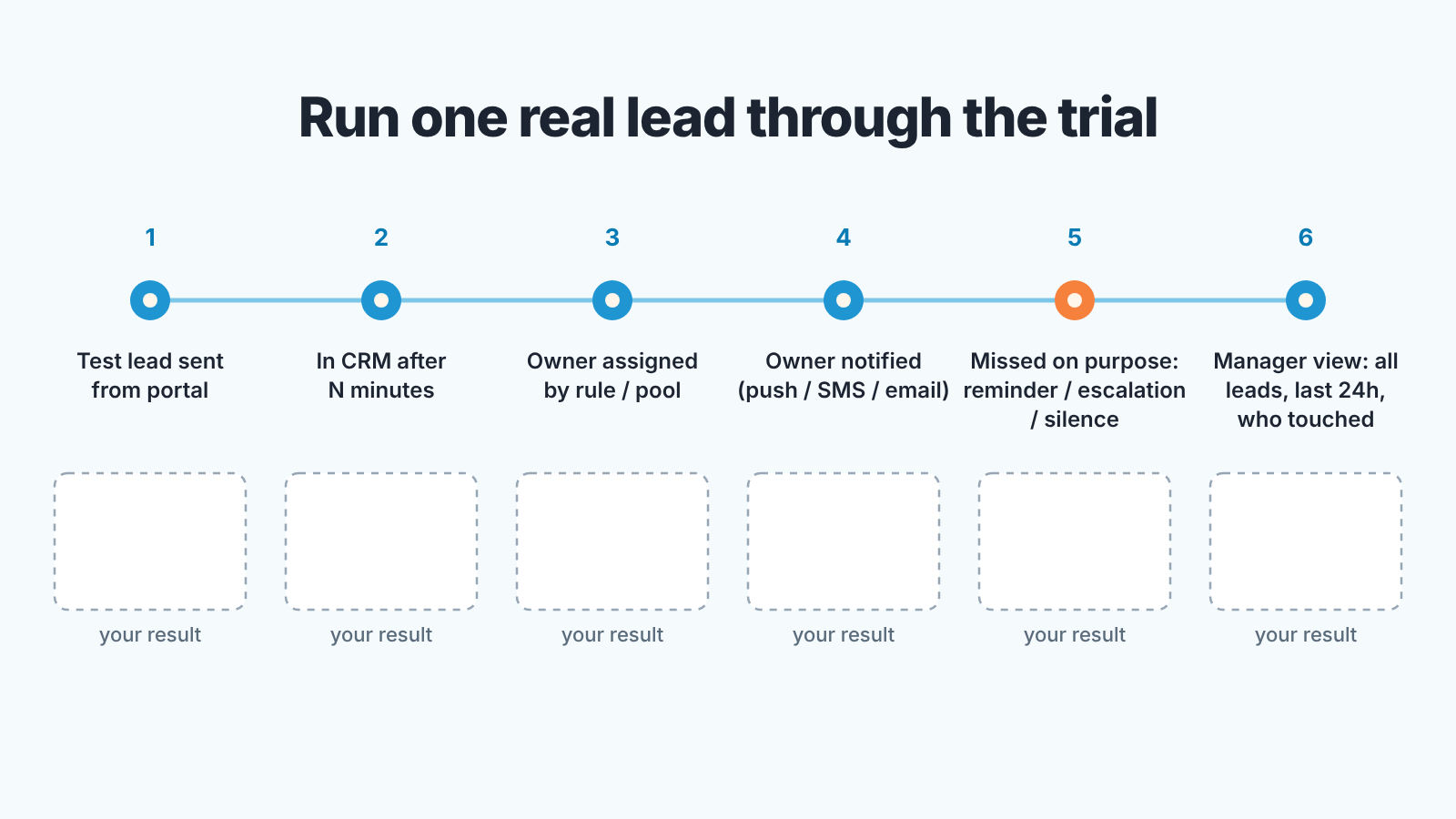
We wrote the same drill for one specific CRM in speed-to-lead in Pipedrive. The fields are Pipedrive’s; the logic transfers.
Industry CRMs: Follow Up Boss, BoldTrail, Wise Agent, Lofty
These are the CRMs built around the realtor’s own process: portal leads, IDX websites, transactions. Below we only state what each vendor says about itself, on pages we opened on 2026-11-03.
Follow Up Boss. Three plans: Grow at $69 per user per month (or $58 billed annually), Pro at $499 a month including 10 users, Platform at $1,000 a month including 30 users, with a free trial and no contracts (pricing). The integrations page lists Zillow Pro, IDX website providers including RealScout and IDX Broker, and Zapier with 3,000+ apps (integrations). This is the one to trial if the lead comes from a portal and must reach a human fast.
BoldTrail, which calls itself the next generation of kvCORE. The platform page lists IDX Websites, Lead Engine, Smart CRM and Transaction Integration (boldtrail.com/platform). The pitch is one vendor for the whole front office. The trade-off is the usual one with bundles: you take the website and the lead engine with the CRM.
Wise Agent. “Real Estate CRM for Agents, Teams & Brokerages” with a 14-day trial. The home page lists drip campaigns, bulk email, texting logged to each contact, transaction checklists, transaction portals, commission reporting, lead assignment and distribution, and team member permissions (wiseagent.com). The strongest fit we see is the agent or small team that wants the the transaction carried to closing in the same tool.
Lofty. “Real Estate CRM, IDX Websites & AI Agents”, with separate sections for agents, teams and brokers and a line of website and advertising services alongside the CRM (lofty.com). If the website and the ads are the problem you are solving, it belongs on the shortlist.
Capterra keeps a category page for this market, Best Real Estate CRM Software 2026, which is useful for names we left out. You will also see Top Producer and LionDesk on older lists; we could not open a current product page for either on 2026-11-03, so they are not here.
General-purpose CRMs set up for real estate
Pipedrive has a real estate page that reads like it was written by someone who has sat in a car between showings: “Create pipelines for properties, investors and buyers”, “Follow up and take notes on your phone between showings”, “Get reminders to follow up on time” (pipedrive.com). What it does not have is teh portal plumbing or the IDX site. You bring those.
HubSpot publishes a guide, “Understanding CRMs for Real Estate”, that covers residential and commercial and sits next to the free CRM sign-up (hubspot.com). For a team that wants to start at zero cost and grow into marketing and reporting later, that is the argument.
Salesforce has a real estate page, “Real Estate CRM for better customer experiences” (salesforce.com), written for residential and commercial firms. We would put it on a brokerage’s list, not an agent’s, for the reason we always give: it rewards a team with an admin and is hard on a team without one.
Zoho CRM is a general CRM you can set up for real estate by hand. We could not open a Zoho real estate page on 2026-11-03, so it stays on this list without an industry claim.
We’d build in Pipedrive or HubSpot when what sets a team apart is how it works a lead after the first call, and buy an industry CRM’s plumbing when the edge is being first to a Zillow lead.
How to check the pipeline after you pick
Choosing is the easy half. Three months in, the questions chnage: are leads sitting without an owner, which stage do deals stall in, how many “active” buyers have had no contact in 30 days, and whose pipeline is quietly rotting?
This is where we should say what we do. We build SalesBond, a sales management layer on top of the CRM a team already uses, and the easiest way to try it is a free CRM audit. It reads the last 30 days of your CRM and sends a PDF report: money at risk, a CRM score, the findings, managers and deal health, the pipeline bottleneck and what to fix. Seven days later a second PDF shows what changed. It runs on Pipedrive, HubSpot, Salesforce, Zoho CRM, Microsoft Dynamics 365, Freshsales, Close, monday CRM, Copper, Zendesk Sell, Nutshell, Insightly, Attio, Bitrix24 and Kommo (amoCRM). If you chose one of the industry CRMs in this article, it is not on that list, so the audit does not apply to you yet.
Check your CRM with SalesBond, or read what a 30-day CRM audit usually finds before you run one.
If you went with a general CRM, start by making the pipeline honest. Our guide to what a CRM is for a sales team has the diagrams. One pipeline per kind of deal, a required next activity on every open deal, and a stage after “under contract” so closings stop hiding in won.
FAQ
Realtor CRM, real estate agent CRM, broker CRM: are these different products?
Mostly the same products, searched with different words. The difference that matters is the role. A solo agent needs reminders and drips, a team needs lead distribution and a manager view, a brokerage needs teams inside teams and transaction tracking. Every industry vendor in this article addresses agents, teams and brokerages in some form; the plan you pay for is what changes.
Is there a free real estate CRM?
HubSpot’s free CRM is the one free plan we can point to from a page we opened (hubspot.com). The others offer trials rather than free tiers on the pages we checked: Follow Up Boss has a free trial with no contracts, Wise Agent and Pipedrive a 14-day trial each. If you are a solo agent counting every dollar, we also keep a small-business CRM shortlist that is not industry-specific.
How much does a real estate CRM cost?
Anywhere from free to four figures a month. HubSpot has a free CRM. Follow Up Boss starts at $69 per user per month on Grow ($58 billed annually), then $499 a month for 10 users on Pro and $1,000 a month for 30 users on Platform (pricing, 2026-11-03). For the other vendors here we checked product pages, not price lists, so ask for a quote for your team size before the trial ends.
Do I need an IDX website to use these CRMs?
No. The IDX site is a lead source that the industry CRMs plug into or sell; Follow Up Boss, BoldTrail, Lofty and Wise Agent all mention IDX on their pages. If your leads come from referrals and your sphere, a general CRM with good reminders may be all you need.