

Account management is the work of keeping and growing the business of customers you already have: one person owns the relationship, watches when the next purchase is due and acts before the customer drifts away. In a CRM you can see it by comparing the days since a customer’s last won deal with the customer’s usual gap between purchases.
That second sentence is the whole method, and it is the part most writing on the subject skips. Glossaries describe account management as a post-sales process of nurturing relationships with existing clients so they keep buying (Clay). Tool roundups list software for key account managers (DemandFarm). Fine as far as they go. Neither tells a head of sales with 300 repeat customers and four people which customers to call this week, and the won deals already sitting in your CRM can.
Account manager, key account manager, salesperson: who owns the reorder
Before the method, the argument that stops it in most teams. A customer bought in March. It is now July and they have gone quiet. Whose job is that ?
Three answers compete. The salesperson who closed the first deal says the the account is theirs and so is the commission on the reorder. The account manager says anything after the first invoice belongs to them. And if the company is big enough to have a key account manager, that person runs the top twenty accounts as a separate world, with plans, reviews and an executive sponsor, while the rest of the base goes to whoever has time. The roles are compared in account executive vs account manager, and the daily job is in account manager responsibilities.
Whatever the title, the test is whether every customer with repeat purchases has exactly one name responsible for the next order, and whether that person knows when it is due. In a five-person team the name is often a salesperson. In a forty-person team it is usually an account manager, with a key account manager over a handful of top accounts. Either way one customer, one owner, written in the CRM as the owner of the customer record. With two owners, each tends to assume the other called. We have never seen a quiet account won back by a committee. The same owner also handles upselling B2B customers who are ready to upgrade once the reorders are steady.
For the numbers a small team should keep in the CRM, see account management for a small sales team.
The one number to start with: a customer’s buying cycle
Open your CRM, filter won deals by one repeat customer and sort by close date. The gaps between those dates are the customer’s buying cycle. A distributor that reorders every 30 to 40 days has a cycle of roughly 35 days. A client that renews a service once a year sits at about 365. A customer with one purchase has no cycle yet.
Two decisions make the number usable.
Use the median gap. Most quick formulas take the mean interval, and one unusual order (say, a big one-off project between regular reorders) drags it around. The median ignores it. Repeat Sales, our product for repeat business, computes the cycle the same way: the median interval in days between won deals, and only once a customer has at least two purchases. RFM analysis for a B2B team starts from the same gap, comparing recency with each customer’s buying cycle.
Then attach a confidence to the number. Two purchases give you one interval, and a cycle you should not trust much. Eight purchases with gaps of 28, 31, 30, 29, 33, 30 and 31 days give you a cycle you can plan around. Repeat Sales labels each cycle high, medium or low confidence based on how many intervals there are and how much they spread; in a spreadsheet, a count and a standard deviation get you most of the way. With a cycle and a confidence label next to every customer, you can already see which accounts are due and how far to trust each date.
None of it works if reorders never reach the CRM as deals. Some teams log a reorder by editing the old won deal, others never create a deal at all because “the customer just emails the warehouse.” One won deal per order is the prerequisite, and repeat orders in Pipedrive: one new deal per order shows how to make that habit stick.
Six statuses, two thresholds, and where the thresholds come from
Once a customer has a cycle, one division turns it into a status: days since the last purchase divided by the cycle. Call it the ratio. Take an example customer with a 35-day cycle who last bought 28 days ago: the ratio is 0.8. At 50 days it is 1.4. At 80 days, 2.3.
The statuses hang on that ratio:
- on track: ratio at or below 1.0, so the next purchase is not due yet. A customer whose expected purchase date is close also gets a purchase soon flag.
- overdue means a ratio above 1.0 and up to 2.0. The usual gap has passed and no order came.
- leaving: above 2.0, twice the usual gap with nothing. Most likely they buy elsewhere now, or no longer need what you sell.
- in work covers an overdue customer who has an open deal and recent contact. Somebody is already on it.
- new: one purchase, no cycle, no ratio.
- undefined, when no cycle can be determined.
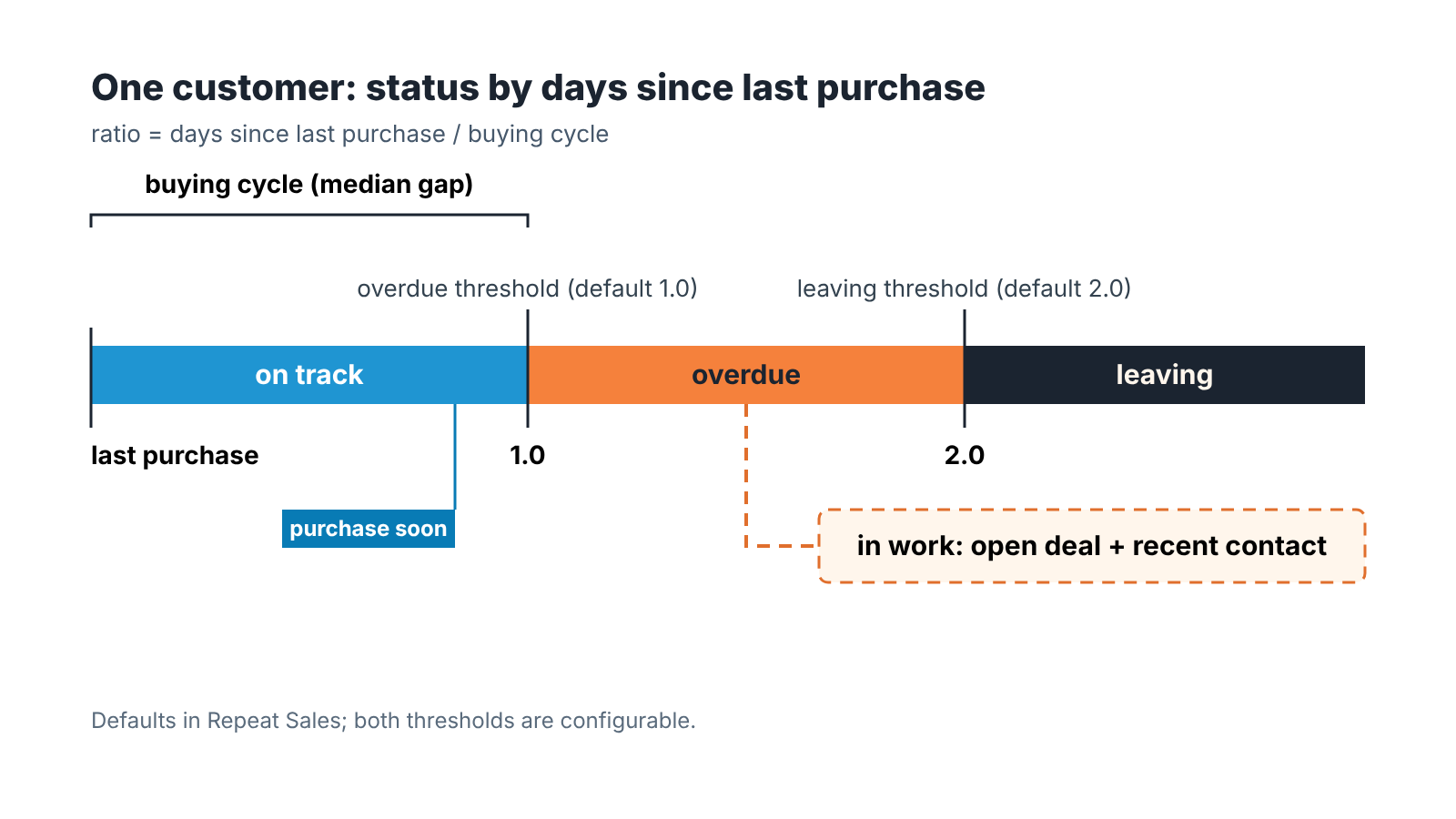
Why 1.0 and 2.0? They are not research findings, and we don’t present them as such. They are the defaults in Repeat Sales, picked because each one means something a salesperson can say out loud: “they are past their usual gap” and “they have missed a whole second cycle.” Both thresholds are configurable, and we think they should be. A team selling consumables on a 20-day cycle may want to react at 1.3. A team with annual renewals probably does not want “leaving” to mean two full years and may set it at 1.5. Setting them is a management decision, and a few weekly account reviews show quickly whether yours are too loose or too tight. If you’d rather build the same logic by hand in one CRM, customer health in Pipedrive walks through the fields and filters.
Account management by status: what to do this week
A status is useful only if it changes what somebody does on Monday. This is the mapping we use. “Owner” is the one name responsible for the customer’s next order; “manager” is the head of sales.
Purchase soon is the one status where you move first. The owner gets in touch before the expected date, confirms quantity and timing and opens the deal.
On track gets nothing proactive, and that is deliberate. A base-wide “touch every account monthly” cadence feels diligent, but mostly it spends the customer’s goodwill on check-in calls nobody asked for and gives the team busywork.
Overdue is where that time goes instead. The owner makes contact within the week with one question, “has anything changed in how you buy?”, and writes the answer on the customer record.
Leaving escalates. The owner picks up the phone and asks directly whether the customer moved to another supplier; if there is no answer within a week, the manager makes the second attempt. A customer at twice their cycle has already made a decision you were not part of. Whoever hears the reason should be senior enough to do something about it.
In work is left alone, with one check: the open deal has a next activity. The owner keeps it moving, the manager looks at the activity.
New customers have one goal, the second purchase. Agree the next order date at the first delivery.
Undefined lands on the manager once a quarter: look at the purchase history by hand and decide whether this is an irregular but real customer or not a repeat customer at all.
For the money side of the same list, see revenue at risk in the sales pipeline; retention tactics for late reorders are in customer retention strategies for late reorders.
The weekly account review: five questions for a head of sales
Next to the pipeline review, this one covers the customer base. It takes fifteen minutes and works from the status list sorted by historical value.
First: who moved into overdue this week, and does each of them have an owner with a task? A plan or an intention does not count. It has to be a dated task in the CRM.
Second: who moved from overdue to leaving? These are the misses of last month’s review. Ask what the owner did at overdue, and if the answer is “sent an email,” you have your finding.
Third: of the customers marked in work, which open deals have no next activity? Of all the statuses, in work hides neglect best, because it looks handled.
Fourth: how many new customers from last quarter made a second purchase? The first reorder is where a one-off buyer becomes a repeat customer, and the owner should be able to name a date for it.
Fifth: which of the top accounts by historical LTV sit in overdue or leaving right now? Sorting by lifetime value keeps a quiet long-term customer above a one-time big ticket. The calculation is in customer lifetime value from CRM history.
Five weeks of answers tell you more than any single one. Overdue keeps growing while leaving stays flat? Your team reacts late but does win accounts back. Leaving grows and overdue doesn’t: the thresholds are probably too loose for your cycle, or nobody is working the overdue list at all.
Two sellers, one customer
Here is a problem the status list exposes on its first run. A customer looks on track for the company and overdue for one of your sellers at the same time.
It happens when two people sell to the same account. In our example, the customer buys packaging from Anna every month and machinery from Ben twice a year. Company-wide, the account is fine. On Ben’s side, the machinery line is past its cycle and nobody has noticed, because Anna’s orders keep thier last-purchase date fresh.
The fix is to compute status per line, where a line is one customer with one seller. Repeat Sales does exactly that: status is computed per customer × seller line, then per team scope and per company, so a manager sees the account and the seller behind it at once. Its settings include an attribution mode, which is worth a look before the first run.
For splitting accounts, the line view changes the conversation. “Who owns this customer?” becomes “who owns this customer’s reorder of this kind of thing?”, and asked that way the answer is usually obvious. It also settles the argument between the salesperson and the account manager. Anna owns the packaging line, Ben owns the machinery line, and each shows up in the review when their own line goes overdue.
Where account management does not fit
Not every business has a base to manage, and the status list says so plainly. Run it on a team that sells one-off projects, or on customers who buy once every few years with no pattern, and most of the base lands in new and undefined. The data is telling you there is no repeat cycle to manage, and the time is better spent on new business and deal quality. Repeat Sales is built for renewals, reorders and recurring purchases, and on one-off sales it shows mostly new customers and undefined cycles. A head of sales who sees that has learned something about the business and can drop the idea of a cadence for customers who don’t have one.
How Repeat Sales and Sales GPS put the late customers on the daily list
Everything above can be built with filters and a spreadsheet, so a disclosure: we build SalesBond, a sales management layer on top of the CRM a team already uses; we started with Pipedrive, and SalesBond works with Pipedrive, HubSpot, Salesforce, Zoho CRM, Microsoft Dynamics 365, Freshsales, Close, monday CRM, Copper, Zendesk Sell, Nutshell, Insightly, Attio, Bitrix24 and Kommo (amoCRM). Repeat Sales reads the won deals in the connected CRM and computes the cycle, confidence, ratio and status for every customer and every customer × seller line. Its Overview, Customers, Health and New sections are the status list from this article, and the thresholds and minimum purchases are settings. Overdue, leaving and purchase-soon customers then show up in Sales GPS as customer cards, one per customer, with that customer’s deal signals attached and the reason for the priority spelled out. Accepting a card creates one task in the CRM. That is the extent of the automation: SalesBond never writes to customers itself, and there is no machine-learning churn prediction behind the statuses, only the ratio and thresholds described here. The reorder call itself stays with the owner.
FAQ
What skills does an account manager need?
For this method, three. Reading a customer’s purchase history and saying when the next order is due. Asking a direct question when an order is late, and writing the answer down. Handing a customer upward once they reach leaving, instead of hoping. Relationship skills matter, but they are what you do with the time the status list frees up.
Is account management a role or a process?
A process, which a role may own. Small teams run it through salespeople; larger teams hire account managers and, for the largest accounts, key account managers. What the customer notices is whether one person knows when they usually buy and noticed when they didn’t.
What is the difference between account management and key account management?
Key account management is the same job applied to a handful of top accounts, usually with a dedicated key account manager, account plans, regular reviews and an executive sponsor. Account management covers the whole base of repeat customers, where the status list decides who gets attention this week.
Does this work with annual contracts?
Yes, with slower statuses. A 365-day cycle means overdue starts at day 366 and leaving at day 731 on the default thresholds, which is too late for most renewal teams. Lower the leaving threshold and lean on the purchase-soon flag, which is where the renewal conversation belongs.