Account management is the ongoing work of keeping and growing the customers you already have: regular contact, renewals on time, and selling them more. Finding new customers is a separate job, and that job is sales. In a small team it’s often one person’s part-time work, so the real questions are what they own and which CRM numbers show it.
Salesforce’s guide puts it in nearly the same words. It calls account management “the ongoing process of managing and growing relationships with existing customers” and sets it against sales, “which focuses on acquiring new clients” (Salesforce: What Is Account Management?, read in November 2026). From there most guides move on to the role and its skills. DemandFarm’s long explainer, for example, covers the role, responsibilities, skills and eight challenges (DemandFarm: Account Management 101, read in November 2026). An owner with five reps needs something narrower. Who does this work on Tuesday, and how would you know from the CRM that it got done?
What account management looks like in a six-person team
Say a team has an owner, four reps and one support person. No one’s an “account manager.” The company has 140 active customers and closed $310,000 last quarter (an invented example, and every number below belongs to it, including the ones in the table).
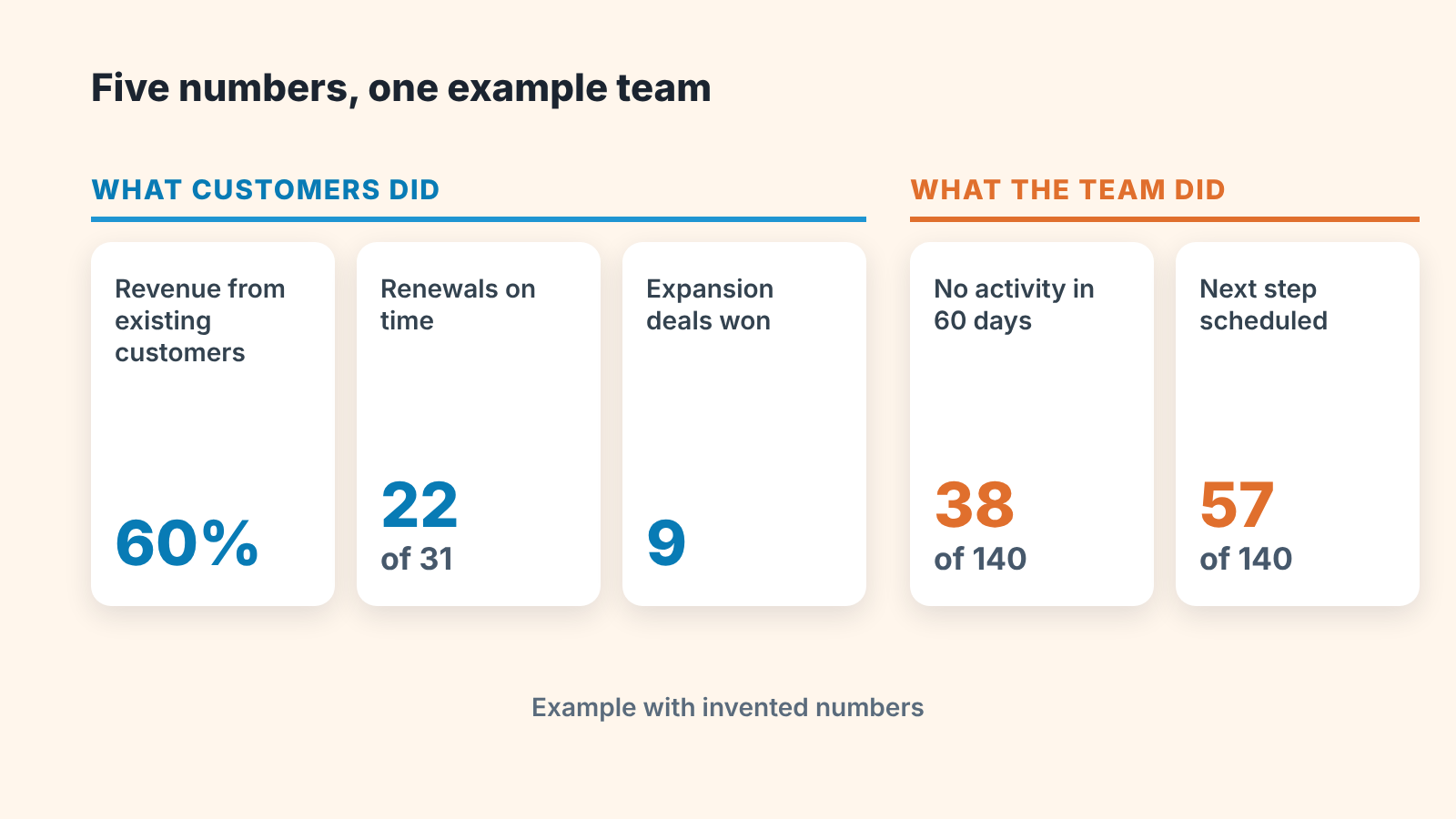
The owner pulls five figures from the CRM for that quarter.
| What the owner checks | Example result | How it was counted |
|---|---|---|
| Revenue from existing customers | $186,000 of $310,000 (60%) | Won deals where the company had at least one earlier won deal |
| Renewals closed on time | 22 of 31 due (71%) | Renewal deals won on or before the renewal date |
| Expansion deals won | 9 deals, $41,000 | Won deals marked as expansion (upsell or cross-sell) |
| Accounts with no activity in 60 days | 38 of 140 (27%) | Customers whose last logged call, email or meeting is older than 60 days |
| Accounts with a next step scheduled | 57 of 140 (41%) | Customers with an open activity dated in the future |
Read the table from the top and the team looks healthy, because 60% of the money came from people who had bought before. Now read it from the bottom. Nine renewals slipped past their date, 38 customers haven’t heard from anyone in two months, and 83 accounts have nothing planned at all.
The first three lines report what customers did. The last two report what the team did for them, and that’s where the 83 unplanned accounts sit.
Account management vs sales vs customer support
In a team of 3 to 10 people the same person often does two of these jobs, sometimes all three. The CRM should still be able to tell them apart.
Sales talks to people who haven’t bought yet. The seller starts those conversations, they turn into new-business deals in the new-business pipeline, and the count that matters at the end of the quarter is new customers won.
Account management talks to customers who have already bought. The seller starts here too, on a schedule, and the deals it creates are renewals and expansion. Look for the work on company records. It shows up as renewal deals and planned activities (a call booked for the week before the renewal date, say), and it’s measured by the revenue kept and added from existing customers.
Support starts when the customer does. Someone has a question or a problem and writes in. The work lands in tickets or a shared inbox, usually without a deal attached, and response and resolution times show whether it’s going well.
For a small team, the difference that matters most is who writes first. Support waits for the customer. Account management gets in touch before the renewal date and before the customer has anything to complain about. If the only contact your existing customers get comes after they open a ticket, then what you’re running is support, whatever the job titles say.
Splitting the sales side between two people, one who closes the first deal and one who keeps the account, is a topic of its own, covered in account executive vs account manager.
What does an account manager actually do?
An account manager owns four things for customers who have already bought: the renewal, expansion, regular contact, and an account plan for the biggest few. Most of the rest of the job serves one of those four.
Ask a rep what they owe a customer after the deal closes and you’ll often get a shrug, or “keep them happy,” which no CRM field can hold.
- The renewal. Every contract or subscription that ends has a date, and one person answers for the decision before it. In the CRM that’s a renewal deal whose close date equals the renewal date, created well ahead of it so it sits in the pipeline for months before the date arrives.
- Expansion: more seats, a bigger plan, a second product. Upsell or cross-sell? The answer changes the pitch, and upsell vs cross-sell lays out the difference.
- Regular contact, the first thing to get dropped. A call or a useful email on a rhythm that fits the account, logged as an activity, with the next one already booked.
- An account plan for five to ten of the biggest customers at most (the key account plan for a small sales team).
Cold outreach and prospecting stay outside this list. So does fixing bugs or answering how-to questions, although a good account manager hears about both and makes sure support has them.
One thing to say at tomorrow’s stand-up: “Every customer has one name next to it, and that person owns the renewal date.” It takes a minute and settles more than a job description does.
Five numbers to check in your CRM
Before the numbers, three fields have to exist. Names differ between CRMs so treat these as descriptions: a deal type on every deal (new business, renewal, expansion), an owner on every customer company, and activities logged against the company so that the CRM can show a last activity date and a next activity date. If deal type is missing, add it first as a required dropdown. Numbers 1, 2 and 3 all filter on it.
If you’ve read other guides, you’ll recognize the first two under their usual names. Number 1 is a close cousin of revenue retention, and number 2 of customer retention rate; the renewals that never close are your churn. Subscription businesses roll the same data up into net revenue retention.
1. Revenue from existing customers
Filter won deals for the period by deal type: renewal plus expansion. If you never tagged deal types, fall back to won deals for companies that already had an earlier won deal. Divide by all won revenue. In the example that was $186,000 of $310,000.
The trend tells you more than the level. A share that rises while total revenue stays flat can mean new business is drying up.
2. Renewals closed on time
Count renewal deals whose renewal date fell in the period, then count how many were won on or before that date. The example team got 22 of 31. Open the nine late ones one by one. Was the deal created late, or was it created on time and left alone?
3. Expansion deals won
Number and value of won deals with type “expansion”. Nine deals and $41,000 in the example. If this sits at zero for two quarters, check whether reps log expansion as edits to the old deal. That habit hides the the work and overwrites the original amount.
4. Accounts with no activity in N days
Filter customer companies by last activity date older than N days. N comes from your own rhythm. A team that sells annual contracts might use 60 or 90, and a team with monthly reorders might use 30. The example used 60 and found 38 accounts.
This list is the best early warning you have. It pairs with the pattern described in customer churn in B2B: what closed-won hides.
5. Share of accounts with a next step scheduled
Customer companies with at least one open activity dated in the future, divided by all active customers. In the example, 57 of 140. We’d check this one weekly and the other four monthly, because it’s the only number of the five that the team can change by Friday.
Building these five as saved filters takes an afternoon in most CRMs. If you’d like a second opinion on the same data, SalesBond’s free CRM audit reads the last 30 days of your CRM and sends a PDF report that includes sections on repeat customers and your top-10 clients; a second PDF arrives seven days later and shows what changed. Check your CRM with SalesBond. For teams whose customers buy again and again, the Repeat Sales product works out each customer’s buying cycle from their past purchases (it needs at least two) and labels the customer on track, overdue or leaving. How to act on those labels is the subject of account management by customer status.
When a small team needs a dedicated account manager
You’ve got customers worth protecting, so you hire an account manager. That’s the usual advice, and we disagree with it for teams under ten people. A new hire inherits accounts with no owner, no renewal dates and no contact history, and spends the first quarter rebuilding what the CRM should already hold. Assign owners and get the five numbers running first. Then let the numbers tell you whether the workload fits inside someone’s week.
Start with hours. Decide how often each account should hear from you and roughly how long one contact takes with preparation. In the example, 140 accounts at one contact a quarter and 45 minutes each comes to 105 hours a quarter, or about eight hours a week. A rep can hold that as a fixed block in their calendar. Double the account count or the frequency and it stops fitting.
Then look at where the revenue comes from. When existing customers bring in most of the money and the person responsible for them spends most of their time prospecting, the calendar and the revenue disagree.
Give it a full quarter with named owners, then check numbers 4 and 5 again. Accounts that still go silent, even with an owner and a weekly block each, point to a capacity problem, and that’s when a dedicated role pays for itself.
We don’t give a customer count at which to hire, because we have no sourced figure for one and the answer depends on contract size and contact rhythm. What does the hours estimate come to with your account count?
A middle step exists, too. Before you write a job ad, one rep can take account management as a named part of the job (say, two fixed mornings a week), with a small part of their target tied to renewals. Their name then goes in the owner field of every customer they cover.
Two mistakes that cost renewals
The first is the account with no owner. A rep leaves, their deals get reassigned, and their customers stay under a deactivated user for months. Nobody decided to ignore those customers, the CRM simply had no one to remind. You’d find them in a minute with a filter on customer companies where the owner field is empty or points to an inactive user. Put that filter into your quarterly review, next to the agenda in the sales QBR for a small team.
The second is the rep who drops the customer the day the deal closes. It’s rational behavior if the commission plan pays only for new business and nothing in the CRM asks for a follow-up. Make “create the next activity” a condition for marking a deal won, and create the renewal deal on the same day (the renewal date becomes its close date). The customer then shows up in number 5 from day one.
FAQ
What’s the difference between an account manager and an account executive?
An account executive closes the first deal with a new customer. Once it’s signed, an account manager takes over and owns the renewal and the growth of that account. In small teams it’s often the same person; the handoff and the split of targets are covered in account executive vs account manager.
Is account management sales?
Its part of the sales function and it should carry a revenue target, measured on renewals and expansion. The daily work differs from new-business selling: fewer first conversations, more scheduled ones with people who already know you.
How much does an account manager earn?
Pay varies a lot by country, industry and whether the role carries a quota. We haven’t found a dated open source we’d quote a range from, so check current job postings for your region and deal size before you write an offer.
What is key account management?
It’s account management for the handful of customers big enough to get their own written plan, with named contacts on both sides and a review schedule. How to build one with a small team is in the key account plan for a small sales team.