Competitive analysis is the process of finding out who you compete with and how you compare. For a sales team the fastest start is your own deals: record the competitor on every won and lost deal, then check how often each one appears, your win rate against it and why you lose. Add outside frameworks after that. Most guides do it the other way round, starting from the competitor’s website and pricing page, and we think that order is backwards for a team of four or six reps, because the website tells you what the competitor says, while your closed deals show where you actually meet them and how it goes.
Competitive analysis in one paragraph
The marketing definition is fine. Dun & Bradstreet describes competitive analysis as using data and research to understand the strengths and weaknesses of your competitors, and lists the key elements worth collecting (D&B: What is a competitive analysis). Slideworks turns it into six steps and a template (Slideworks: Competitive analysis framework and template), and Cascade lists six frameworks you can run it through, SWOT and Porter’s five forces among them (Cascade: Competitive analysis frameworks). You will also see it called competitor analysis; for our purposes it’s the same job. All of that is outside-in, comparing what is public about the competitor with what is public about you, and it cannot answer the question the owner of a small sales team asks on a Monday: who are we losing to, how often, and in which deals? Only your own pipeline has that, so the version here has one data source, the deals you already closed, and one output, a short card per competitor that a rep can read in a minute.
Start inside: the competitor field on your deals
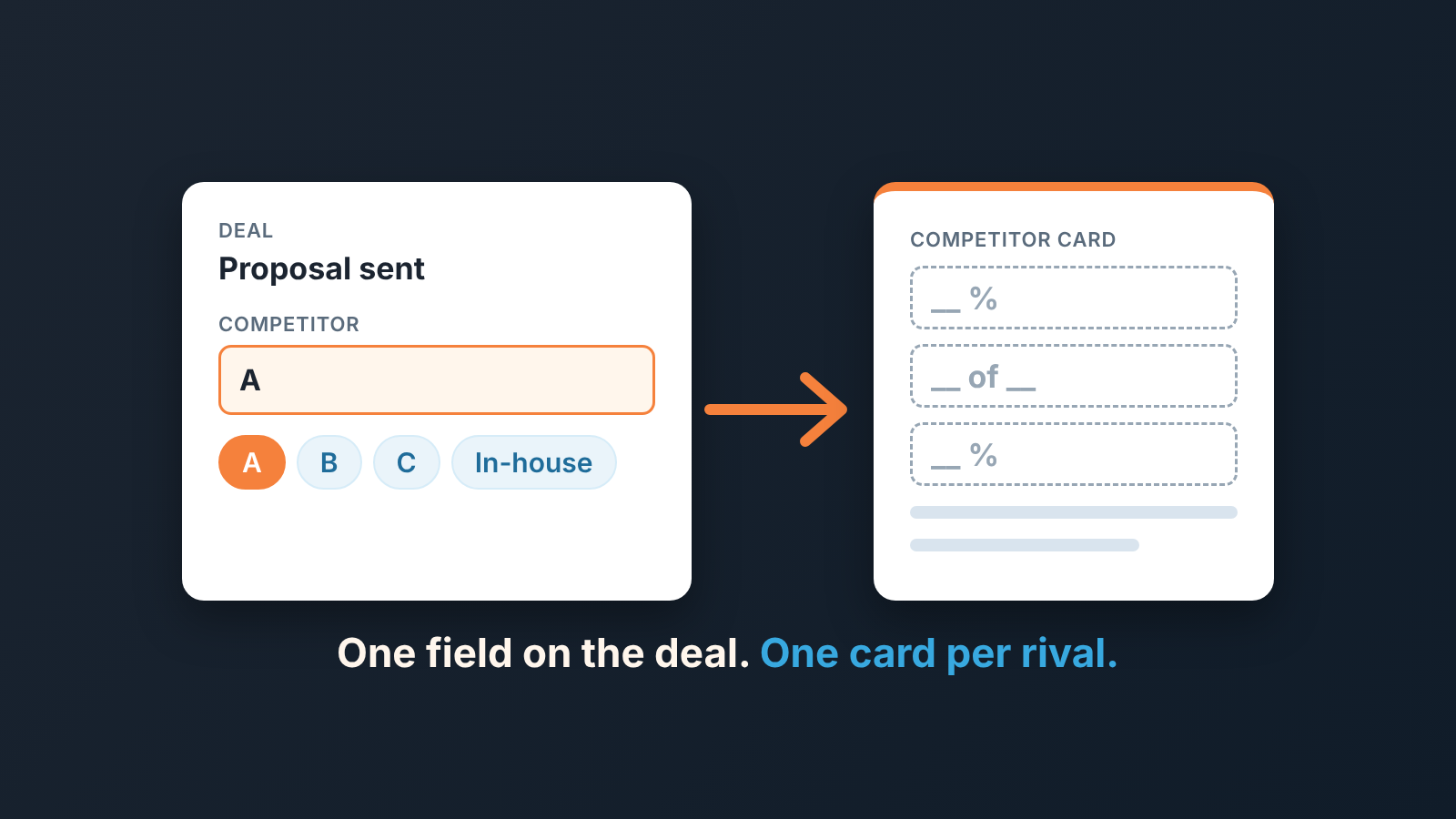
Everything below depends on one custom deal field called Competitor, a dropdown with your three to five named rivals. How to set it up, why a fixed list beats free text and whether to make it important or required is in sales battlecards for a small team, so here are only the three things competitive analysis needs on top.
Add “In-house / spreadsheet”, “None” and “Unknown” as separate options. None means the buyer told you there was no alternative. Unknown means nobody asked. Merge them and you hide the most common problem with this field.
Ask for it by the proposal stage. On day one a rep rarely knows who else the buyer is talking to; by the time a proposal goes out they usually do.
And backfill before you read a single report. Pull the closed deals from the last two quarters, sit with the reps for half an hour and fill Competitor from memory and deal notes. The history filled from memory is rougher, and you can read it next week instead of waiting until spring.
Report 1: how often each competitor appears
The first report is just a count. Take all closed deals, won and lost, from the last two quarters and group them by Competitor. What you get is a list of who you really meet, and it is often not the the list the team talks about.
Numbers in this article are made up to show the shape. Say you closed 60 deals: Competitor A on 18 of them, In-house on 12, None on 11, Unknown on 10, Competitor B on 9. Two things jump out before any win rate is calculated. The spreadsheet is your second biggest competitor, and nobody has a plan for it. And a sixth of your deals have no answer at all. Our rule: if Unknown is the largest or second largest group, stop and fix the field first, because every rate on the rest is a rate on the deals reps happened to remember.
If you have one more field that describes the customer, deal size band, industry or lead source, split the count by it. This is where “where we meet them” comes from. A competitor who shows up only above a certain deal size, or only in inbound leads, is a different problem from one who is everywhere.
Report 2: win rate against each one
Win rate against a competitor is won deals divided by all closed deals where that competitor is on the field. Use the same definition you use for the team’s overall win rate, otherwise the two numbers are not comparable; we wrote down the version we trust, with the traps, in sales win rate in Pipedrive, and the definition carries over to any CRM.
Then put each competitor’s rate next to the overall one. Continuing the invented example: overall 40% (24 of 60), against A 28% (5 of 18), against In-house 33% (4 of 12). The gap is the finding. Against A you lose almost three deals out of four, and that is where the next report earns it’s place.
And B? On paper 5 of 9 is 56%, above your average. But with nine closed deals a single result moves the rate by about 11 points. We do not read a win rate from fewer than ten closed deals, so the card says “5 of 9, too few to call” instead of a percentage that looks precise. The smaller competitors stay as counts until they accumulate.
Report 3: stage and reason when you lose
Two more columns, both only on lost deals: the stage the deal was in when it was marked lost, and the lost reason.
Stage first, because it is the column most teams skip. Losing to A at qualification and losing to A after the proposal are different problems. The first usually means the buyer had already chosen and you were the comparison quote; the second means you were in it and something in the proposal tipped it. In the example A beat you 13 times; say 7 of those 13 losses came after the proposal. That is a late loss pattern, and it points at the offer.
For the reason, the card needs one thing: the reason that comes up most often against this competitor, and whether it holds at every stage. “Price, after proposal, against A” is a sentence a rep can act on. How to get the buyer’s own words instead of the rep’s guess is in win-loss analysis for a small team, and what to do when the answer keeps being “price” is in our piece on the unique selling proposition tested against lost deals.
A one-page competitive analysis template for each competitor
The three reports collapse into one card per named competitor. Seven lines, and nothing else; the moment it grows a second page nobody updates it.
- Deals where named in the last two quarters, and the share of all closed deals (Report 1).
- Where we meet them: size band, industry or lead source (Report 1, split).
- Win rate against them, always with the count (Report 2).
- The stage where we usually lose to them (Report 3).
- The most common lost reason against them (Report 3).
- One sentence on when we win and when we lose, written by the owner of the card.
- Owner and last updated.
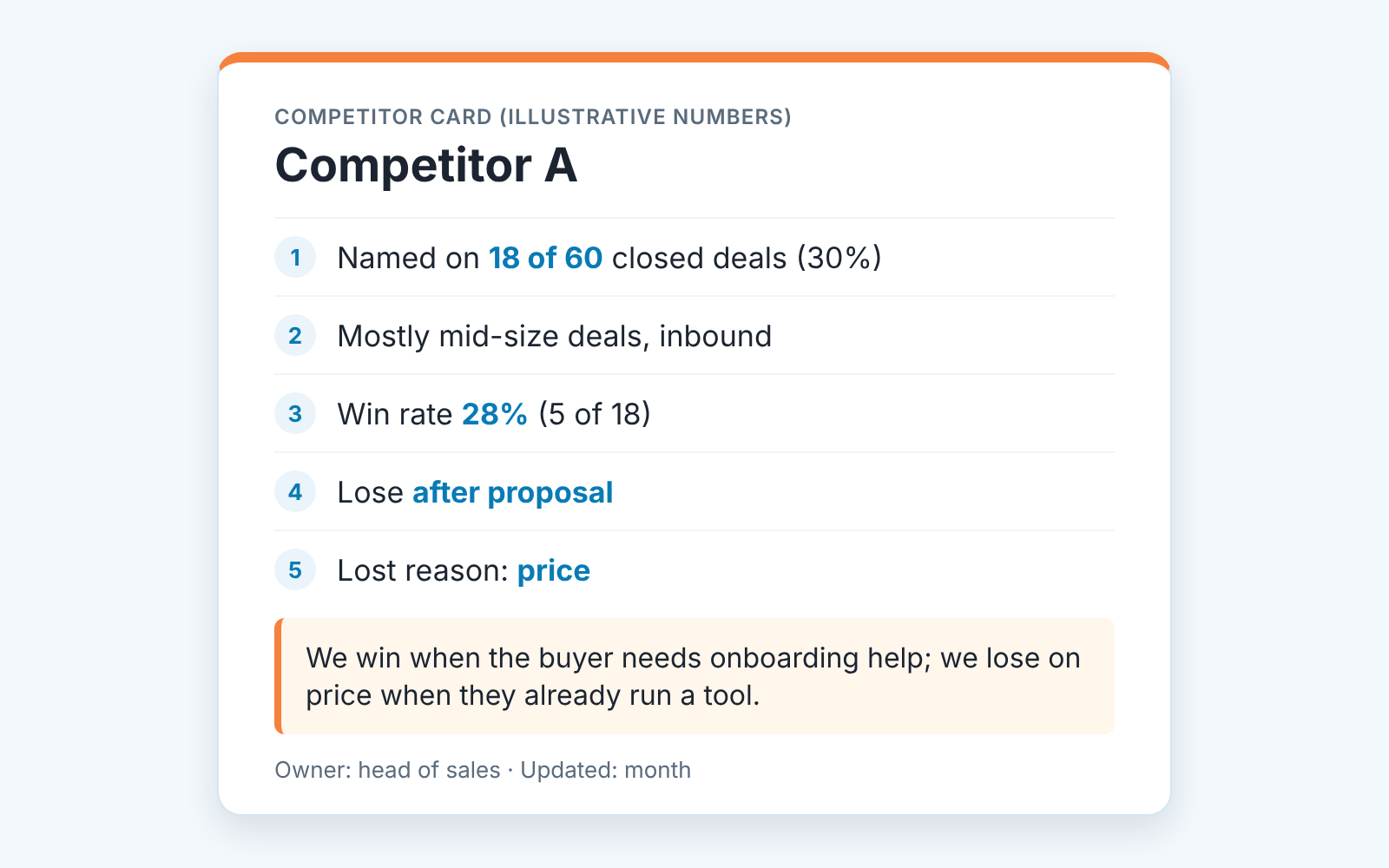
Line six is the point of the card and the hardest part to write. It names the pattern, for example “We win against A when the buyer has no one to run onboarding; we lose on price when they already have a tool and are switching.” If you cannot write it yet, leave the line blank and say so.
A battlecard is the rep-facing page on how to sell against a competitor; this card is the evidence it’s built on, and it changes less often. A bake-off record is separate too. When a competitor shows up as a formal head-to-head evaluation, the deal gets its own write-up, covered in the sales bake-off, and the card only needs the outcome.
We build SalesBond, a sales management layer on top of the CRM a team already uses; we started with Pipedrive. It works from the deal data a team already keeps, which is why we care about a field like Competitor being filled, since an empty field is a blind spot for any report, ours included. Its free CRM audit reads the last 30 days of the connected CRM and sends a PDF report with the top findings and up to five things to fix, then a second PDF a week later. If you want a second pair of eyes on that data, check your CRM with SalesBond. The cards themselves can live in a shared document; they do not need software.
Where outside frameworks add to the CRM view (SWOT, five forces, feature comparison)
Outside frameworks fill in what your deals cannot: the competitor’s published price, features, positioning and reviews. The six steps Slideworks lays out and the six frameworks Cascade walks through all collect that public side. Your deals tell you that you lose to A on price after the proposal; they do not tell you what A charges or which feature the buyer saw in A’s demo.
Run them for one competitor, the one whose card worries you most and only after the card exists. A feature comparison against A built from A’s website and your lost-deal notes is useful, because you know which features to compare: the ones that showed up as reasons. Built in a vacuum for five competitors, the same comparison rarely gets opened a second time.
SWOT we do once a year, for the company, with the cards on the table, otherwise the “threats” quadrant fills up with fears, and the competitors who are winning deals never make it in. Porter’s five forces looks at the pressure on a whole industry: the threat of new entrants, supplier power, buyer power, the threat of substitutes and rivalry among existing competitors. That makes it an owner’s exercise for the planning offsite. The sales meeting has no use for it. If a framework does not change a line on a card, we skip it.
Keeping the field honest
The whole thing rests on reps filling one dropdown truthfully. The owner of the cards and the fifteen-minute monthly pass to clear last month’s Unknowns work exactly as for battlecards. Two rules are specific to this analysis:
- Unknown is an allowed answer, and a guess dressed up as an answer goes back to the rep.
- Win rate against a competitor describes the offer and the market and stays out of every rep’s scorecard.
The second one is the rule we would keep if we had to drop the rest. The moment a rep believes the number is about them, Competitor A quietly becomes “None”, and thier next quarter of data is worth nothing.