

Laissez-faire leadership is a hands-off style in which the manager sets the goal and leaves the decisions about how to reach it to the people doing the work. It suits seasoned reps. On a sales team, a laissez-faire leadership style works when those reps keep clean CRM records, and it breaks when deals sit without a next step (no call logged, no meeting booked) and the manager only finds out at the end of the quarter.
The style has a long paper trail. According to Wikipedia’s article on leadership styles, which cites Kevin Wren’s Social Influences, it was first described by Lewin, Lippitt and White in 1939, alongside the autocratic and democratic styles.
What laissez-faire leadership means, and what the leader still owns
The name comes from French, where laissez faire translates literally as “let do” (Wikipedia’s article on laissez-faire gives that gloss). So does laissez-faire mean hands-off? Yes, for daily decisions such as who to call, when to follow up and how to run the meeting.
Picture a rep with six years in the same territory. She knows which accounts answer the phone on Friday, which buyer needs a second demo and how long to wait before the follow-up. Telling her how to run Tuesday adds nothing. Under a laissez-faire manager she decides all of that herself.
A laissez-faire leader sets the target, makes sure the team has what it needs, and steps in when a rep asks or when results start to slip. The same Wikipedia article on leadership styles says the leader offers “guidance and support when requested”, and it adds that the style should stay off the table when the leader cannot or will not give regular feedback. Feedback needs something to be based on. For a sales manager that something is the deal record, with its last activity date, stage and expected close date.
So the manager keeps the target, the pricing rules and the definition of each pipeline stage, and still reads the records every week.
A lot of leadership advice says to trust your team and stop checking. We disagree with the second half. A rep’s decisions and a rep’s records are two separate things. We’d hand over the decisions and keep reading the records once a week, because a manager who reads nothing has no way to notice the week a strong rep starts to need help.
When it works in a sales team: examples by rep, deal size and cycle
Say a buyer asks for a discount that’s within your pricing rules. A rep who’s trusted agrees it on the call instead of waiting for Monday’s meeting. That speed is the main advantage of hands-off, and the second one is time, since a strong rep spends the hours that used to go to status updates with buyers.
Most guides pick one style for the whole team. We’d assign it per rep, and then adjust per deal, because a five-person team almost never has five people at the same level.
The thresholds in this example grid are illustrative, so set your own from your cycle length and your own closed-won history.
| Rep profile (example) | What the CRM shows | Style that fits |
|---|---|---|
| 12+ months on the team, hit target in 3 of the last 4 quarters | Every open deal has a next activity; forecast lands close to actual | Laissez-faire: goal and weekly report only |
| Experienced hire, first 90 days | Good activity, but stages used differently from the rest of the team | Democratic: agree the process together, then let go |
| Under 6 months in sales | Deals without next steps, close dates pushed | Directive coaching: weekly deal-by-deal review |
| Veteran in a slump (two missed months) | Activity dropping, forecast far above closed | Temporary close review, with a stated exit condition |
Deal size changes the answer even for the best rep. Say your typical deal is $4,000 and closes in three weeks. A mistake costs little and shows up fast, so freedom is cheap. Now say one deal in the pipeline is worth $60,000, a third of the quarter’s number. That deal gets a joint review no matter who owns it. Tell the rep the reason up front (the size of the deal) so the review doesn’t sound like a verdict on them.
Cycle length works the the same way. In a 20-day cycle a quiet week is visible in the closed numbers by month end. In a 6-month cycle a rep can go quiet for five weeks and the revenue report won’t show a thing until it’s too late to recover the quarter. The longer the cycle, the more the weekly check below matters.
When hands-off costs deals: the disadvantages that show up in the CRM
Hands-off fails quietly. The rep sounds confident in the hallway (nobody has complained, and the pipeline total looks fine), so the problem only surfaces in the deal records, in three places.
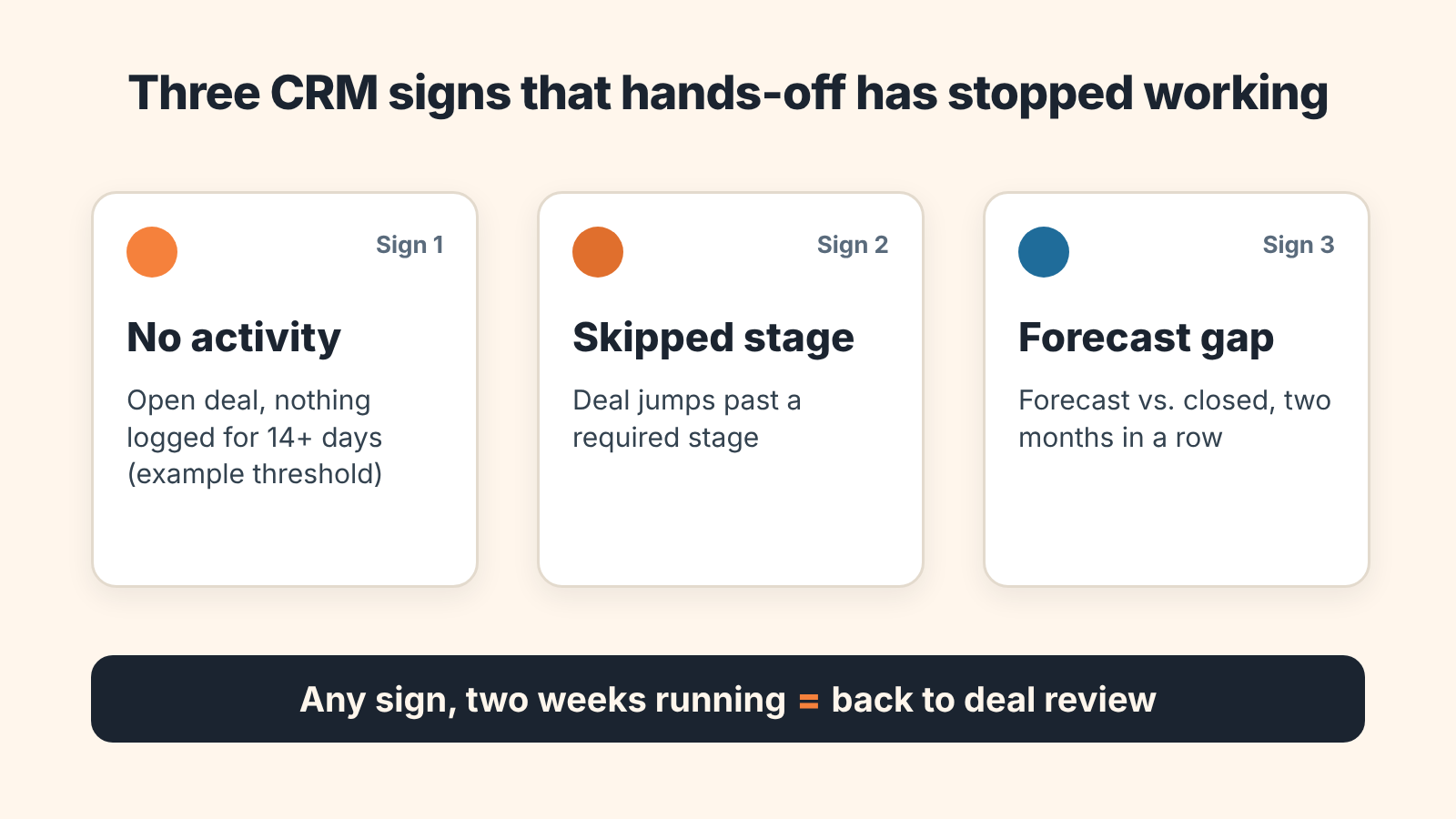
Open deals with no recent activity
Filter open deals by last activity date. As an example threshold take a third of your average cycle: with a 45-day cycle that’s roughly 14 days. One stale deal is a question for the rep. Five stale deals out of sixteen means nearly a third of the pipeline is unattended. Some of those may be stalled and still winnable, others already dead, and telling stalled deals from dead ones is the rep’s first job once the list is in front of them.
Deals that skip a stage
Stage history shows the path a deal took. A deal that goes from Qualified straight to Proposal Sent, with no Demo in between, either had an unusual buyer or a rep who is tidying the board to match what he hopes is true. Count the skips per rep over the last 30 days. And when the same stage gets skipped by everyone? Then the stage probably doesn’t match how you sell, and you fix it in the pipeline settings.
Forecast that doesn’t match the result
Compare what the rep forecast at the start of the month with what closed. In the example below, a rep who called $70,000 and closed $44,000 hit 63% of her own number. One miss happens to everybody. Two in a row means the rep has lost track of where her deals stand, and hands-off was a bet on exactly that judgment.
The 10-minute weekly check that keeps hands-off safe
Build three saved views in your CRM once. The first lists open deals sorted by last activity date. The second shows deals whose stage changed in the last 30 days, with their stage history. The third puts forecast against closed-won by rep for the previous month.
Pipedrive, HubSpot, Salesforce and Zoho CRM each name these fields a little differently, so look up the exact labels in your own account. In HubSpot, for example, the default deal properties include Deal stage, Amount, Close date and Last activity date (HubSpot’s list of default deal properties, checked November 2026).
Then open them every Monday. That’s the whole routine. It replaces the daily “any news on Acme?” messages that experienced reps hate, and it’s the same idea as the weekly rhythm we suggest in place of micromanagement.
Here is a laissez-faire leadership example with a five-rep team, numbers invented for the example.
| Rep | Open deals | No activity 14+ days | Stage skips, last 30 days | Last month: forecast / closed | Decision |
|---|---|---|---|---|---|
| Ana | 14 | 0 | 0 | $60,000 / $57,000 (95%) | Leave alone |
| Ben | 11 | 1 | 0 | $45,000 / $41,000 (91%) | Leave alone; ask about the one deal |
| Carla | 16 | 5 | 1 | $70,000 / $44,000 (63%) | Back to weekly deal review |
| Dev (4 months in) | 9 | 2 | 3 | $30,000 / $21,000 (70%) | Was never hands-off; keep coaching |
| Eli | 12 | 0 | 2 | $50,000 / $49,000 (98%) | Leave alone; ask why Demo gets skipped |
Ana is what laissez-faire looks like when it works. She has 14 open deals, none stale, no skipped stages, and a forecast that landed at 95% of what she closed. Her manager sets the quarterly number, reads the report on Monday and otherwise stays out of her way.
Three reps out of five need nothing from you this week. Reading the table took a couple of minutes, and the two conversations it points to are about Carla’s five quiet deals and Dev’s three skipped stages.
If you’d rather not maintain the views by hand, SalesBond can run this check for you. It’s a sales management layer on top of the CRM a team already uses, and its Deal Health product checks every deal against more than 20 rules (as of November 2026) in categories that include Activity, Progression and Forecast. The quickest way to see where your team stands is the free CRM audit: SalesBond looks at the last 30 days of your CRM and sends a PDF report, then a second PDF seven days later with what changed. Check your CRM with SalesBond.
How it differs from autocratic, democratic and transformational styles
The difference comes down to who makes the call on a deal. An autocratic manager decides and the rep executes, which suits a crisis or a brand-new hire; we covered the owner’s version of that in when to decide alone as a small business owner. A democratic manager decides together with the team. That’s slower, and it works well when you’re designing a process everyone has to live with, such as stage definitions.
Transformational leadership aims at something else. It gets reps to want a bigger goal and says little about who chooses the next step on a given deal, so it combines easily with a hands-off approach to daily work (more in our piece on transformational leadership for sales managers).
Laissez-faire sits at the far end, where the rep decides and the manager supplies resources and reads the results. If you want all the styles side by side, the overview of leadership styles for a sales manager has them.
How to move a rep in and out of hands-off
Say it out loud. A rep who gets left alone without a conversation may read it as neglect, and a rep who gets pulled back without one will read it as punishment.
Moving in, the conversation can be three sentences. “You’ve hit the number three quarters out of four and your pipeline is clean. From Monday I’m dropping our deal-by-deal review. I’ll still read the weekly report, and I’ll come to you only if something in it looks off.” Then name the conditions, the same three signs from above, so the rep knows what would change the arrangement. Its ordinary delegation, applied to a sales manager’s week, where you hand over the decisions and keep the outcome.
Moving out is harder. Do it on data and put a time limit on it. With Carla from the example it could sound like this. “Five of your open deals have had nothing logged for two weeks, and last month closed at 63% of your forecast. For the next four weeks we go through your pipeline together on Mondays. When the stale list is empty and the forecast lands within 15%, we go back to how it was.” The numbers in that script are examples, so pick thresholds you’d be comfortable applying to your best rep too.
A brand-new team is a different case. Reps without a track record or CRM habits start with closer coaching and earn hands-off one at a time, as their records show they’re ready.
Then there’s the new hire with ten years of experience elsewhere. It’s tempting to grant full freedom on day one. Wait until you have a full cycle of their records in your CRM, since their track record so far lives in someone else’s system.
Pick one rep this week who you think has earned hands-off, build the three views, and read their numbers next Monday before you say anything to them.