

A leadership style is the pattern in which a manager makes decisions and directs people: how much they decide alone, how much they hand over, and how they treat the people doing the work. A sales manager should pick the style by situation (more direct with new reps, more delegating with senior ones) and then confirm it with data. If deals are not updated and next steps are missing six weeks after you chose a style, the style is not working, however good it felt in the room.
Leadership styles in one paragraph (and why a sales manager needs more than one)
The lists online (HR material calls them “management styles”) describe six to twelve, each with pros, cons and a quiz. The common set is autocratic, democratic, transformational, servant, laissez-faire and transactional, and longer lists add bureaucratic and charismatic (Business Leadership Today: the 8 types of leadership). An owner who runs the whole business meets the same list from another angle, covered in management styles for an owner of a small business.
A list of styles is not enough for a sales manager with six reps. On the same Monday you have a rep in week three who does not know which fields matter, a senior rep whose number is slipping for the first time, and a quarter that ends in nineteen days. One style cannot serve all three. Knowing your default style matters for one reason: it is the one you will reach for under pressure, whether or not the situation calls for it.
So we treat a style as a hypothesis. The CRM is where it gets tested.
Six styles a small sales team actually sees
We drop two of the eight for a small team. Bureaucratic leadership runs on rules, fixed duties and a clear hierarchy, which a team of six does not have and should not build. Charismatic is a personality, and a manager cannot pick it. That leaves six.
Autocratic, or directive. The manager holds the decisions, with the emphasis on rule enforcement and a clear chain of command. It is fast; the cost is that it can stifle initiative and demoralize people (Business Leadership Today). In a sales team it sounds like “call these twelve accounts this week, log every call, next activity on every deal by Friday”. Owners who still sell face the same choice, and autocratic leadership for a small business owner lists the few cases where deciding alone is the right call.
Democratic. The team weighs in before the decision. Slower, and it buys ownership. We use it for process decisions like a new stage or a required field. Nobody should vote on whether to discount.
Transformational. Transformational leadership gets a team to buy into a shared vision and pushes people past what they think is their ceiling. The same source warns it can neglect the short term and lead to burnout. We reach for it when a team has hit plan three quarters running and started to coast, and transformational leadership for a sales manager covers it in full.
Servant. Built on the growth of the people: listening, empathy, stewardship (Business Leadership Today). In practice this is coaching. You ask before you tell, and you remove what is in the rep’s way.
Laissez-faire. Hands off. The rep runs thier own book and reports results. It suits an experienced rep who keeps the CRM current without being asked; with anyone else, problems show up only when the number is missed.
Transactional. Hit the number, get the reward; miss it, get the consequence. Everyone knows the terms, and the terms cover only the number, so use it for a set period such as a quarter-end push.
Only two of these ask the rep what they think, and that is fine. A new rep in week two does not want a development conversation, they want to know which fields to fill.
Match style to situation: new rep, senior rep, slump, quarter-end
This is the matching we start from, and each pairing stays a first guess until the CRM confirms it.
A new rep in their first 60 to 90 days gets directive, with a servant underside. They need rules before they need autonomy, so you name the accounts, the cadence and the fields. You also ask every week what is confusing.
A senior rep with steady numbers gets laissez-faire inside a transactional frame: a monthly number agreed, the weekly pipeline review kept, nothing else. The rep decides how to work, and the agreed number and the weekly review show you early if that stops working.
The same senior rep in a first slump is a different case. A good rep who slips usually has a reason, and telling them harder will not find it. Go servant: read their stalled stage in the CRM first, then ask what changed. Which signal calls for which conversation covers how to pick the talk.
Quarter-end with the team behind plan? Transactional plus directive, for the last weeks of the quarter only: a named list of deals, a daily touch on each, a scoreboard everyone can see.
A team on plan and coasting is where transformational earns its place. And when you change stages, fields or meeting cadence, go democratic. The people who log the data have to believe the field matters. Hold one meeting on the change and write the decision down.
Two caveats. In a small company the owner often sells too; who decides what is in the four jobs of sales management and in the sales manager job description. And quarter-end is a style you borrow for a few weeks. Twelve months of it demoralizes a team.
What each style should change in your CRM within six weeks
Pick one signal per style before you start, write it down with today’s value, and read it again in six weeks.
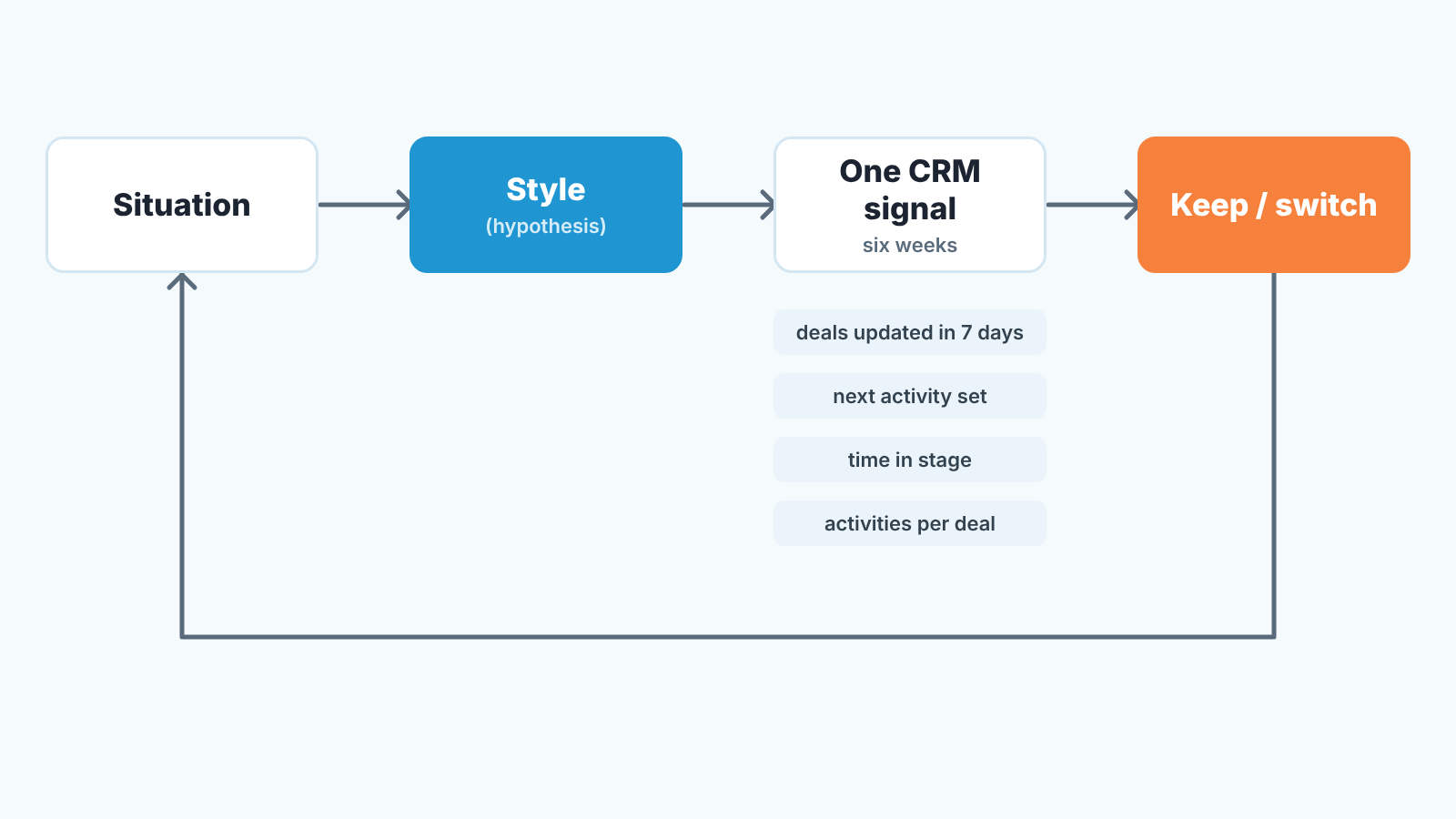
- Directive with a new rep: the share of their open deals with a next activity scheduled. If the field stays empty, the instruction was too vague.
- Laissez-faire with a senior rep: nothing should move. The share of deals updated in the last seven days stays where it was when you stepped back.
- Servant in a slump: time in the stage where that rep’s deals pile up. Coaching that works shortens the stall.
- Transactional at quarter-end: activities per open deal on the named list go up, and expected close dates on those deals stop moving. A close date pushed twice in a four-week sprint was never landing this quarter.
- Transformational: new deals created per rep from their own prospecting.
- Democratic: the fill rate of the field the team asked for.
An example, with invented numbers so the shape is clear. A rep joins on the first of September and you go directive: ten named accounts, next activity on every deal by Friday. On day one, 4 of her 11 open deals have a next activity. In mid-October you read the same number. At 10 of 13 the style did its job and you can start loosening. At 5 of 14 the deals grew and the discipline did not.
When the CRM says the style is wrong
You expected the data to move one way, and it moved the other way or not at all. Each style tends to fail in its own recognisable way.
With a new rep under directive leadership, the miss looks like compliance. Next activities do get set, all on Friday afternoon, all for “next week”, and by Wednesday they are overdue. Repeating the rule will not help. Sit with them on three real deals.
Laissez-faire goes wrong more quietly. The senior rep’s updates thin out, then stage changes arrive in a burst the day before the pipeline review. The rep is updating for the review, and between reviews nobody looks at the deals. Go back to a weekly look at the deals.
Servant leadership fails when the stall stays the same length and the CRM fills up with notes. You listened and nothing changed. Pick one thing to do differently on the next five deals.
Under quarter-end pressure we have seen activity go up on every deal except the big ones. Reps avoid the hard calls when the clock is loud. Name the three deals that matter and take one call with them yourself.
Transformational misses are easy to spot: meetings about the vision are well attended, and pipeline is flat. The vision has no weekly activity attached to it. Change the prospecting block in the week and leave the target alone.
And democratic? The agreed field sits empty and people say they forgot. Usually the decision was yours and they nodded. Ask again, and this time be ready to accept “no”.
One case that does not belong here: the number is fine and the data looks bad. When a rep hits target and the CRM is empty, the problem is data hygiene, and changing your style will not fix it. That is performance management, a different conversation.
Switching styles without whiplash
Reps do not mind a manager who changes approach. They mind one who changes it silently, because then every change reads as a mood.
Say it out loud and tie it to the situation. “For the next four weeks I’ll be in your pipeline every Tuesday, because we’re behind and I want us to land the quarter” is a switch a rep can accept. “I feel like I need to keep a closer eye on you” is the same switch, and it lands as a verdict. Give it an end date too. Four to six weeks gives the CRM signal time to move, and the rep knows when the closer look ends.
Switch one person at a time where you can. Going directive on the whole team because one rep is drifting penalizes the five who were fine, and it hides the the signal you wanted, because now everybody’s data moves at once.
Decide when to switch back from the CRM signal. Going hands-off on a senior rep will feel like neglect for a week. Check the seven-day update share before you trust it. Put the read in the monthly slot of a small-team meeting cadence. Most teams this size have no sales ops person to keep the numbers (when a team of 8 to 20 needs one), so the manager keeps them.
A monthly check: three numbers and one conversation
Once a month, per rep, three numbers from the CRM and one question.
The numbers: the share of open deals updated in the last seven days, the share with a next activity scheduled, and the count of deals past their expected close date. A filtered pipeline view in any CRM gives you all three in minutes. Write them next to last month’s. For a first reading without building the view, SalesBond’s free CRM audit looks at the last 30 days of your CRM and sends a PDF report with sections on managers and deal health, then a second PDF seven days later with what changed.
The question stays the same every month: “What did I do this month that helped, and what got in the way?” A senior rep who says “the Tuesday reviews are fine, the daily check-in is not” has just told you transactional is over and laissez-faire can come back. A new rep who says “I still don’t know what counts as a next step” has told you directive needs to get more specific.
Start this week with one rep. Write down the style you are using with them, the one signal you will read, and today’s value, then put a reminder in your calendar six weeks out.