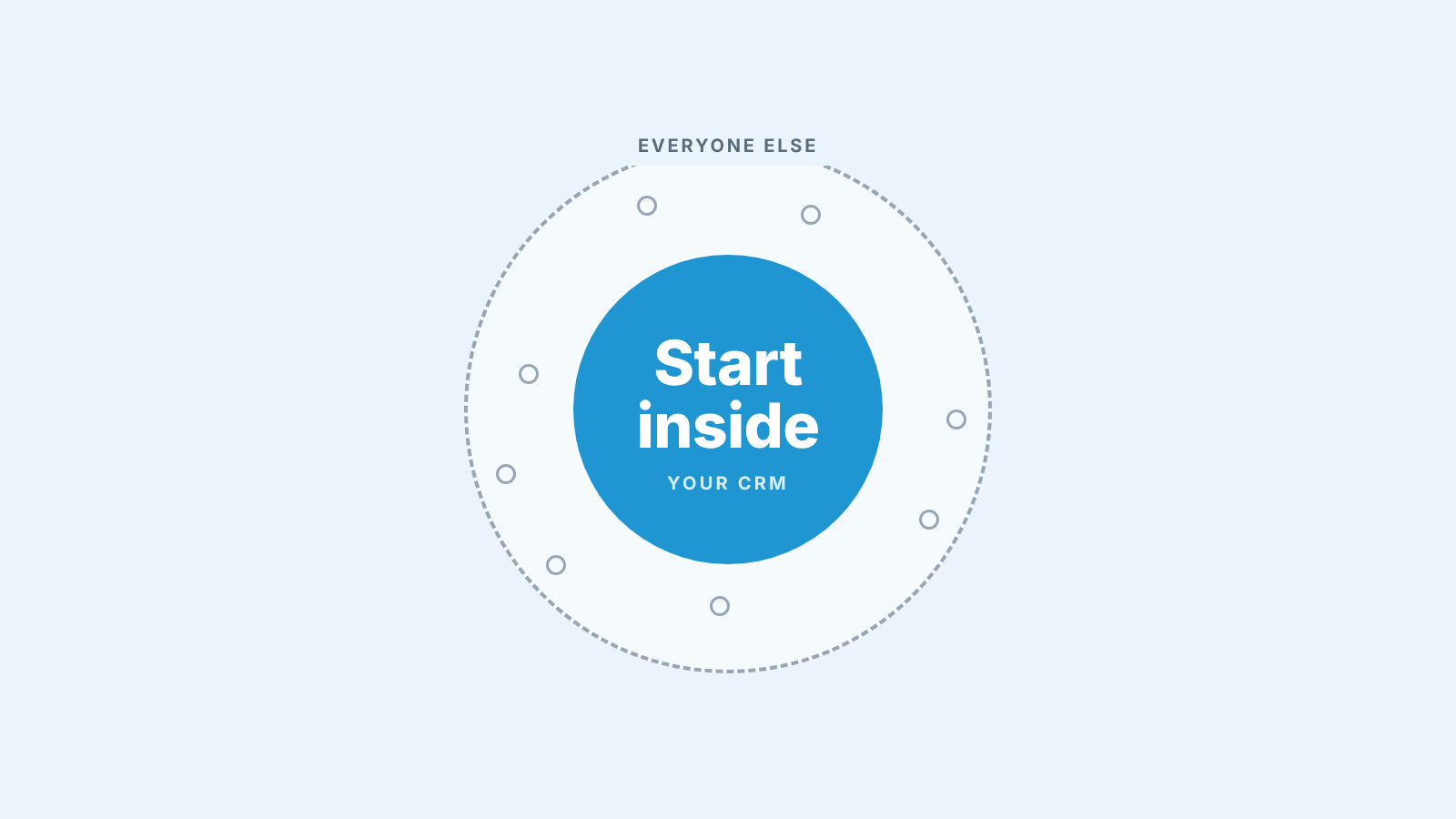
Market research for a small business is collecting and reading information about customers, competitors and demand so that you decide with data instead of a hunch. For a small business (or a small sales team) the cheapest place to start is the CRM you already pay for: it shows which segments you win, which you lose and why, and how long each kind of deal takes. Outside research, a survey or a bought report, is for the questions the CRM cannot answer: how big the market is, what people who never became leads think, and what the going price is. Start inside, then pay only for what is missing.
Market research in one paragraph
Primary research means asking people directly, and secondary research means reading what others have already published. Most guides on this topic are long. Appinio’s walks through objectives, tools, primary and secondary methods, use cases and how to interpret the findings (Appinio: understanding market research). Semrush splits its guide into types, methods and a step-by-step “How to Do Market Research” (Semrush: market research guide). Both come from vendors of survey or SEO tooling, and both assume you will go out and collect new data. That is one way to do it. We disagree with the order.
For a small business, the work comes down to six questions, each answered from the cheapest source that can answer it. Three of them can be answered from won and lost deals already in your CRM, the source most guides skip; the other three need primary and secondary research, the two outside sources every guide covers. Picture a team of three reps with two years in a CRM: that is likely hundreds of conversations, each with an outcome attached.
Market research for small business starts in your CRM: what it can tell you, and what it can’t
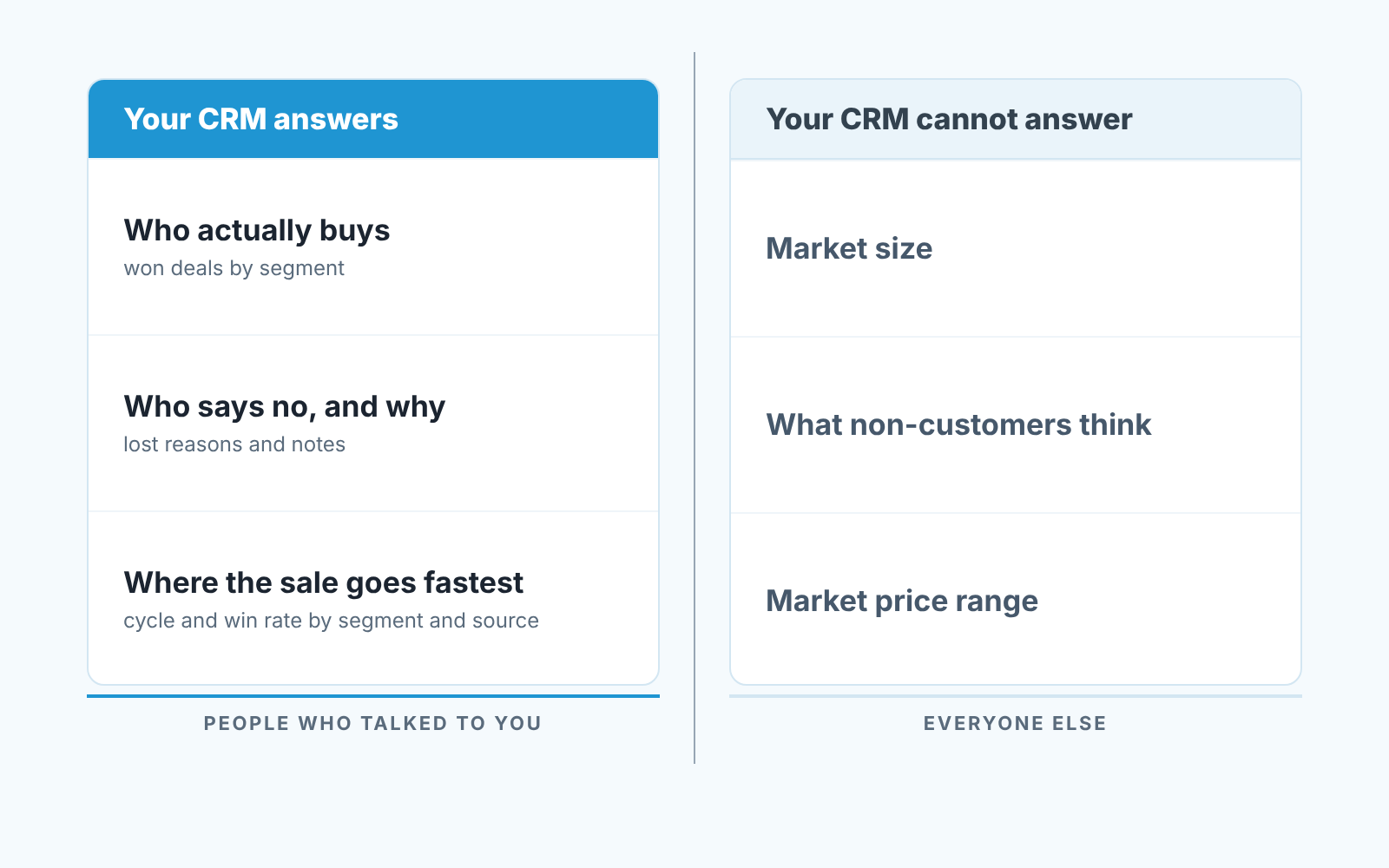
A CRM only knows about people who talked to you, and that limit decides which market questions it can answer.
Inside that line the CRM is good. Every closed deal carries a company, usually an industry and a size, a source, a created date, a close date, an amount and an outcome. Lost deals carry a reason, or at least a note. Activities and emails carry what the customer asked for. From those fields you can answer three market questions without asking anyone anything: who actually buys from you, who says no and why, and where the sale moves fastest.
Before you run a single report, spend half an hour on the fields themselves. Is the industry written the same way everywhere, or do “Healthcare”, “health care” and “Clinics” split one segment into three? Is company size filled in, and is the lost reason filled in on most lost deals or only on some? Are there duplicate companies that will count one customer twice? Fix what you can, and note what you can’t so you remember it when you read the numbers. SalesBond’s free CRM audit reads the last 30 days of a connected CRM and sends a PDF report with a CRM score and your top-10 clients, a quick outside look at how far this data can be trusted.
Question 1: who actually buys?
Open your won deals for the last twelve months and group them by one attribute at a time: industry, company size, region, source. Do it once by count and once by revenue, because the two lists often disagree. A hypothetical to make it concrete: a team sells scheduling software, and the count list says “small clinics” while the revenue list says “regional clinic groups”. The market has just told that team it serves two segments with different economics, and its website has probably been talking to only one of them.
This is the market research version of “who is our customer”, and most small companies answer it from memory. Memory favours the loudest customer and the most recent one, while the won-deals list gives every customer one row.
Two cautions. A segment with three won deals is an anecdote; write it down as a hunch to test. And the won list describes your past selling, accidents included: if the founder knows alot of dentists, dentists will top the list whether or not they are the best market. Turning the list into a profile is covered in building an ideal customer profile from won deals, and cutting the base into segments in B2B customer segmentation. For the market note you need one sentence: “Last year we won most often in X, and most of the revenue came from Y.” Once a segment holds up, TAM, SAM and SOM for a small company puts a size on it.
Question 2: who says no, and why?
The lost reason field is the closest thing a small team has to a competitor survey. It is also one of the least trusted fields in the CRM, because reps fill it in the thirty seconds after a deal dies, so “budget” and “timing” come back quarter after quarter. Read it anyway with the notes next to it.
You are looking for a pattern by segment; the overall pie chart hides it. Another hypothetical: mid-size manufacturers lose on “chose competitor”, and small shops lose on “no decision”. Those are two different market facts. The first says a named competitor is winning a segment you want, so go and read their pricing page, their case studies and the features they lead with (competitive analysis for a sales team walks through how). That is secondary research, it is free, and it took an afternoon because the CRM told you where to look. The second says the segment may not feel the problem badly enough to pay anyone. That’s a demand finding, and a reason to stop spending there.
Treat the field as a pointer. When a reason cluster looks important, pull five of those lost deals and read the email threads. The thread shows what the buyer actually said, which a reason code can’t. Calling those buyers is the next step up, primary research in the textbook sense, and we described the small-team version in win-loss analysis: ten deals, five questions, and the buyers behind the five lost deals you just read are the first calls to make.
Question 3: where does the sale go fastest?
Market research usually stops at who and why. A sales team has a third question that bought reports never answer: where is the path of least resistance? Your CRM holds the answer in two dates per deal, created and closed.
Take the days between them for won deals and group by the same attributes as in Question 1. Then do the same for win rate (won divided by won plus lost) per segment and per source, and put the two side by side. A segment that closes in weeks with a high rate is a market that already understands the problem and has budget for it. A segment that takes months and rarely closes may still be worth it for the deal size. But it is a different market, with different content, different qualification and probably a different rep.
Source matters as much as segment here. Suppose, hypothetically, that referrals show both a shorter cycle and a higher rate than paid ads: that tells you where the market is already warm. If you are unsure how to compute the rate without fooling yourself, sales win rate: what to count and what not to goes through the stage and date pitfalls. The market reading only needs the comparison.
One honest limit. Cycle time measures your process as much as the market. A slow segment may be slow because your proposal template is wrong for it, and the buyers may move as fast as anyone. Note the number, then ask the the rep who sells there before you write the conclusion.
Three things the CRM will never tell you
Outside the CRM’s line, the survey guides are right.
Market size. Your CRM shows how many companies in a segment came to you, which says nothing about how many exist. If you won twelve clinics, there may be two hundred in your region or twenty thousand. The gap between those two numbers decides whether you hire a second rep for that segment, and no amount of filtering will produce it. (How a small company can estimate its share once it has that outside number is in market share for a small company.)
Non-customers. Everyone in the CRM, won or lost, knew you existed and had a reason to talk. The people who matter most for growth solved the problem some other way, or never saw it as a problem. They do not appear in any report you can run. Lost deals are a biased proxy at best since they got far enough to be logged.
Price range. Your deals show what people paid you, after your discounts, in your negotiation style. That is one point on the market’s price line. Whether you are cheap, expensive or somewhere in the middle for the segment you want is not in your data. A rep’s “we lost on price” is a guess about the competitor’s quote. Nobody on your side has seen the quote itself.
The CRM still decides which segment these outside questions are about.
Cheap ways to fill the gaps
The market research methods for a small business that fill these gaps are customer interviews, secondary research and a short market research survey, roughly in that order. Starting inside makes the outside work small. You are no longer researching “the market”; you are researching two segments and three questions, and that is a week rather than a quarter.
Customer calls come first, because they are the cheapest and the most honest. Ten won customers and ten lost ones from the segment in question, twenty minutes each. Ask what else they considered, what they expected to pay before they saw your price, and who else they know with the same problem. The last question is your first market-size data point; the price question gives you the range the CRM could not.
Public data covers size and price. Company registries and industry association member lists give you a count of companies in a segment and region. Job boards show who is hiring for the role your product helps, a sign that the pain is being funded. Competitors’ pricing pages, where they publish them, and review sites where buyers complain about price bracket the market range. All of it is free and takes one person a day with a spreadsheet.
A short survey comes last, and only when the first two leave a question open. Five questions at most, sent to a list built from the public data above, in a segment the CRM already told you is worth the effort. Ask about the problem they have. If you would rather have someone else run it, the search results for this topic are full of research firms and rankings of them (GWI’s list of US market research companies, for one). How much that costs depends mostly on scope, and a narrow scope is the cheapest kind. That makes it a reasonable purchase once you can hand them a one-page brief with a segment and a question. Before that brief exists, we would not buy one, because the firm would have to guess the question as well.
The one-page market note
Everything above should fit on one page for the owner. The owner will read one page to the end. Ours looks like this:
- The question we set out to answer, in one line.
- Where we win: top segments by count and by revenue, with the won-deal counts next to them so nobody mistakes an anecdote for a trend.
- Where we lose and why, by segment, and the one competitor or demand finding that follows from it.
- Where it is fast: the segment and source with the shortest cycle and best rate, and the one with the worst.
- What the CRM could not tell us, and what we did about each gap: calls made, sources read, survey sent or not.
- One decision we propose, and what we would need to see to reverse it.
Start with line six. Write the decision, note what would change your mind, and put the next look at the won list on the calendar for six months from now. By then the CRM will have new answers, and you will know which outside questions were worth asking.