

A management style is the repeatable way you set tasks, make decisions and check the work. There is no best one, because the style that gets a new hire through their first month will suffocate someone who has done the job for ten years. So the useful skill for a small-business owner is owning three or four styles and knowing which one the situation in front of you calls for.
Management style is not leadership style
People use the two words as if they were one thing, and the search results do too. They are not. Management is the process half: who does what, by when, how you find out it got done, and what happens when it did not. Leadership is the direction half: where we are going and why anyone should come along. An owner of a twelve-person company does both, often inside the same hour, which is why the confusion is so easy.
This article is about the management half. If what you are really asking is how to motivate a team or set a direction, the article on leadership styles for a small sales team is the better read. Transformational leadership, which people often file under management, has an article of its own.
Why bother with the distinction? Because management is the part that touches every working day, and that shows in the data. Gallup’s 2024 trends piece puts it bluntly: how employees are managed has about four times as much influence on their engagement and wellbeing as their work location (Gallup, 6 Workplace Trends Leaders Should Watch in 2024). Owners spend a lot of energy on the office-versus-home question. The check-in on Tuesday matters more.
Six management styles, and what each one costs
Most lists you will find run to ten styles or more. BambooHR’s version has ten, ranked from best to worst: visionary, transformational, coaching, democratic, persuasive, servant, transactional, laissez-faire, bureaucratic and autocratic (BambooHR). The ranking is the author’s opinion; the piece does not say how it was produced, and we think ranking is the wrong question anyway. A style is a tool you pick for the job in front of you.
Underneath those ten sit three base styles, and ProjectManager describes the classic three: autocratic, where the manager makes every decision; democratic, where the team brings ideas and the manager still decides; and laissez-faire, which suits highly skilled people who need little direction (ProjectManager). We find six is the number a small-business owner can actually keep in their head and use.
Directive (autocratic)
You decide, you assign, you check. Instructions are specific and the person is not asked for an opinion. It works when the person cannot yet judge the work themselves, when the cost of a mistake is high, or when there is no time to discuss. The cost is that nobody learns to decide, and the moment you are away, work stops. Used past it’s moment, it turns into the micromanagement we describe below.
Democratic
You put the question to the people who will live with the answer, listen, and then decide. Note the last part. Democratic management is not a vote; the owner still owns the decision. It works for choices the team has to carry every day (a new schedule, a new tool, how the shop floor is laid out) , because people keep a rule they helped write. The cost is time, and the risk is that it slides into meetings where nothing is ever settled.
Coaching
You treat each piece of work as a chance to make the person better at it. Instead of fixing the quote yourself, you ask what they would change and why. It works with people who are capable and still growing, which in a small business is most of them. The cost is that it is slow, and it is useless in a real emergency, when the quote has to go out in ten minutes.
Laissez-faire (hands-off)
You set the outcome and get out of the way. It works with experienced people who know teh job in more detail than you do, and that is a bigger group than most owners admit. The cost shows up late: when a hands-off style is applied to someone who was not ready, you find out from a customer before the person tells you.
Transactional
Clear targets, clear rewards, clear consequences. Hit the number, get the bonus. It works for work that can be counted honestly: deliveries made, calls completed, tickets closed. It fails on work that cannot, and it fails on people who want more from the job than the number. BambooHR cites a Gartner finding that 82% of employees want their organization to see them as a person, not only as an employee (BambooHR, citing Gartner). A purely transactional owner is the one who does not.
Visionary
You explain where the company is going and let people work out their own part of the route. It is the owner’s natural style, because you are the one who can see the destination. It works when something new is starting and people are unsure why. The cost is that a vision does not tell anyone what to do on Thursday, so used alone it leaves a team inspired and idle.
Four of BambooHR’s ten are missing here on purpose. Transformational is more leadership than management. Persuasive and servant are, in our experience, variants of directive and coaching. Bureaucratic is a style that a company of fifteen people rarely needs and should not want.
Situation, then style
Pick the row that looks like your week, even if another style sounds more like you. Several rows (the late invoice, the honest count) turn on numbers, and a manager needs enough business acumen to read those numbers in the CRM; we list what to check in a separate piece.
| Situation | Reach for | What it looks like on Monday |
|---|---|---|
| New hire, first weeks | Directive | A written list of what done looks like, and a check at the end of each day |
| Someone who has done the job longer than you have | Laissez-faire | One agreed outcome, one agreed date, no check-ins between |
| A capable person repeating the same mistake | Coaching | You review the work together before it goes out, and they say what they would change |
| A decision the whole team has to live with | Democratic | A short meeting, everyone speaks once, you decide by Friday |
| Late invoice, safety incident, deadline tomorrow | Directive | You assign, you check, and you say when normal service returns |
| Repetitive work with an honest count | Transactional | The number is on the wall and the reward is written down |
| Launching something nobody asked for yet | Visionary | You explain the why in one page, then switch to one of the above |
| Every decision in the company waits on you | Laissez-faire, in stages | You hand over one class of decision at a time, with a checkpoint |
The last row is the one most owners end up in. If that is you, the piece on what to delegate and what to keep goes through it in more detail than fits here.
How to tell which management style you actually use, and how to switch
Most owners describe themselves as coaching or democratic. Most of their staff would say directive. Skip the online quiz. Take the last ten decisions that mattered in the business and write down who made each one. If your name is on eight of them, your style is directive, whatever you call it. Then open your calendar and count the check-ins you started last week versus the ones someone brought to you. Then ask two people, separately, “When I hand you work, what do you expect to happen next?” Their answer is your style.
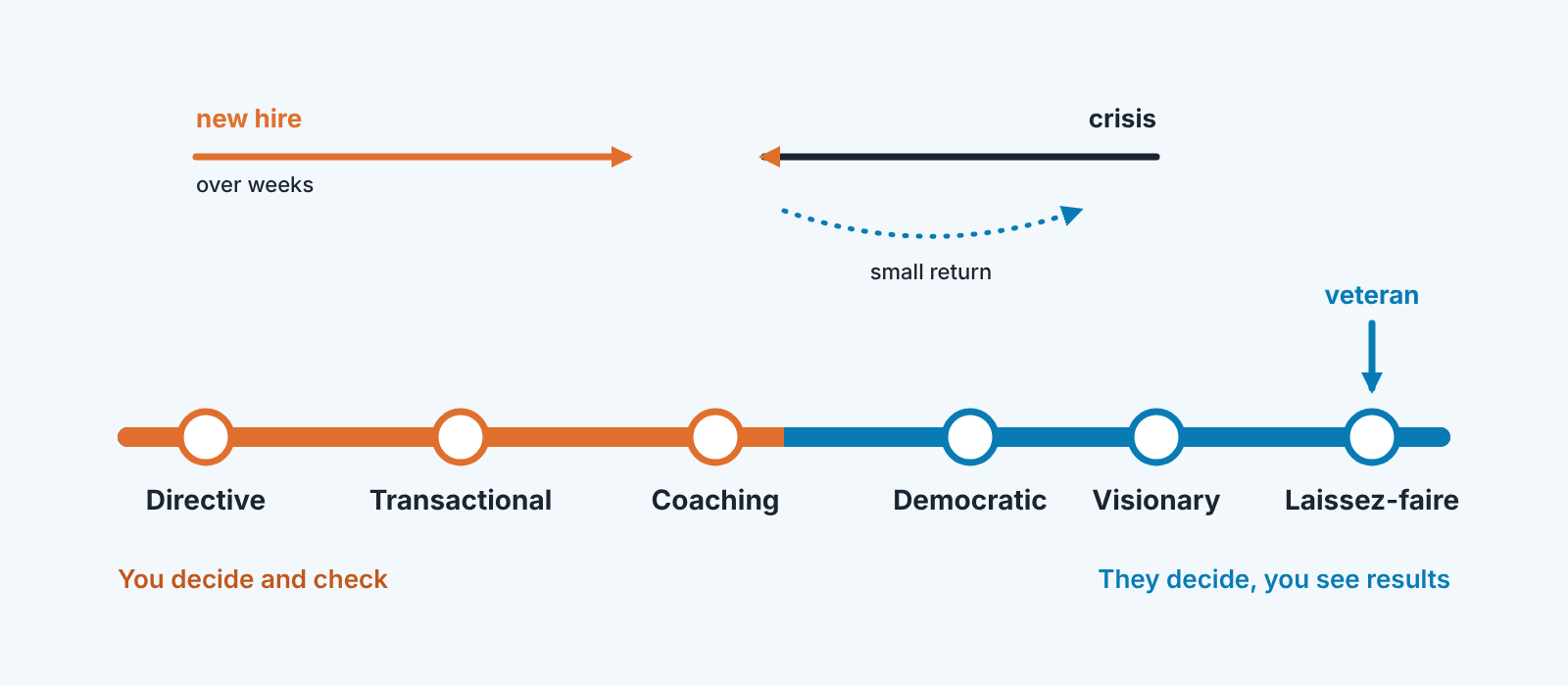
Switching is where the actual skill lives, and it comes down to three cases that every small business runs into.
A new person. Start directive, and say so: “For the first month I will be specific and I will check daily. That is not about you, it is how we start everyone.” Then loosen on a schedule you set in advance. Week one, you check daily. Week three, you check only the output. Month two, they bring you the problem cases and nothing else. The mistake is to loosen because they seem fine, then tighten again after one error, which teaches them that the the rules are moods.
A veteran. Here the switch is mostly about what you stop doing, and it only counts if you say it out loud. “I am not going to review your quotes anymore. If one goes over the limit, you tell me; otherwise it is yours.” Hands-off applied silently just looks like neglect.
A crisis. Switch to directive, announce the switch, and announce the end date. “For the next two weeks I am making the calls on spending, and on the first of the month it goes back to normal.” The end date is the part people forget. A crisis style with no end date is how a democratic company becomes an autocratic one without anyone deciding it should.
ProjectManager’s advice is to start from your own personality and then adjust for the skills and motivation of the team, the culture and outside pressure (ProjectManager). We would put it more sharply: your personality is the default you fall back to when tired. Know what it is so you can catch yourself.
Signs the style has stopped working
Styles do not fail loudly. They fail in small habits that are easy to explain away, so it helps to know what each failure looks like from the outside.
Directive gone wrong is micromanagement. People wait for you before starting anything. Nobody brings you a problem, because problems bring questions. You are copied on every email and reading all of them. The people who could leave, do. If that sounds familiar, the article on reading the work instead of checking in is written for a sales team but the mechanism is the same in any department.
Laissez-faire gone wrong is emptiness. Deadlines slip and nobody mentions it. You hear about a problem from a customer. Each person has quietly invented their own standard for what good looks like, and the standards disagree. The owner usually notices this one last because from a distance a quiet team and a drifting team look the same.
Democratic gone wrong is a company that meets instead of ships. Decisions get reopened. The same question is discussed in three meetings and settled in none. The fix is to keep the discussion and put a date on the decision.
Transactional gone wrong is a team that hits the number and nothing else, and a steady leak of the people who wanted more from the job than the number.
One practical check if any of the people you manage are themselves managers: look at what their team leaves behind rather than at what they tell you. For a sales manager that record is the CRM, and it is one honest place to see whether a style is working or only being described. We build SalesBond, a sales management layer on top of the CRM a team already uses, and its free CRM audit reads the last 30 days of a connected CRM and sends a PDF with a section on managers and how their deals are moving, then a second PDF a week later with what changed. If you run a sales team through a manager, check your CRM with SalesBond; if you don’t, the same idea applies to whatever record your department keeps.
FAQ
Which management style is best for a small business?
None of them, on its own. A small business has new people and veterans, calm months and crunches, and no layer of middle managers to absorb the difference. An owner who can run directive with a new hire in the morning and hands-off with a veteran in the afternoon beats an owner who is excellent at one style.
Can I use different styles with different people on the same team?
Yes, and you should, because the people on one team are rarely at the same stage. What you have to do is say why, out loud. “I check Sam’s work daily because he started in March, and I don’t check Priya’s because she has run this for four years” is fair. The same difference, unexplained, reads as favoritism.
What is the difference between a directive style and micromanagement?
Time and a reason. Directive management is specific instructions plus checks, applied to someone who needs them, for a period you have named. Micromanagement is the same behaviour with no reason the person can see and no end in sight. Left that way, it produces an employee who waits for instructions.
How many types of management styles are there?
Lists run from three to ten. Most build on three base styles: autocratic, democratic and laissez-faire. We use six because that is how many a small-business owner can keep in mind and actually switch between.