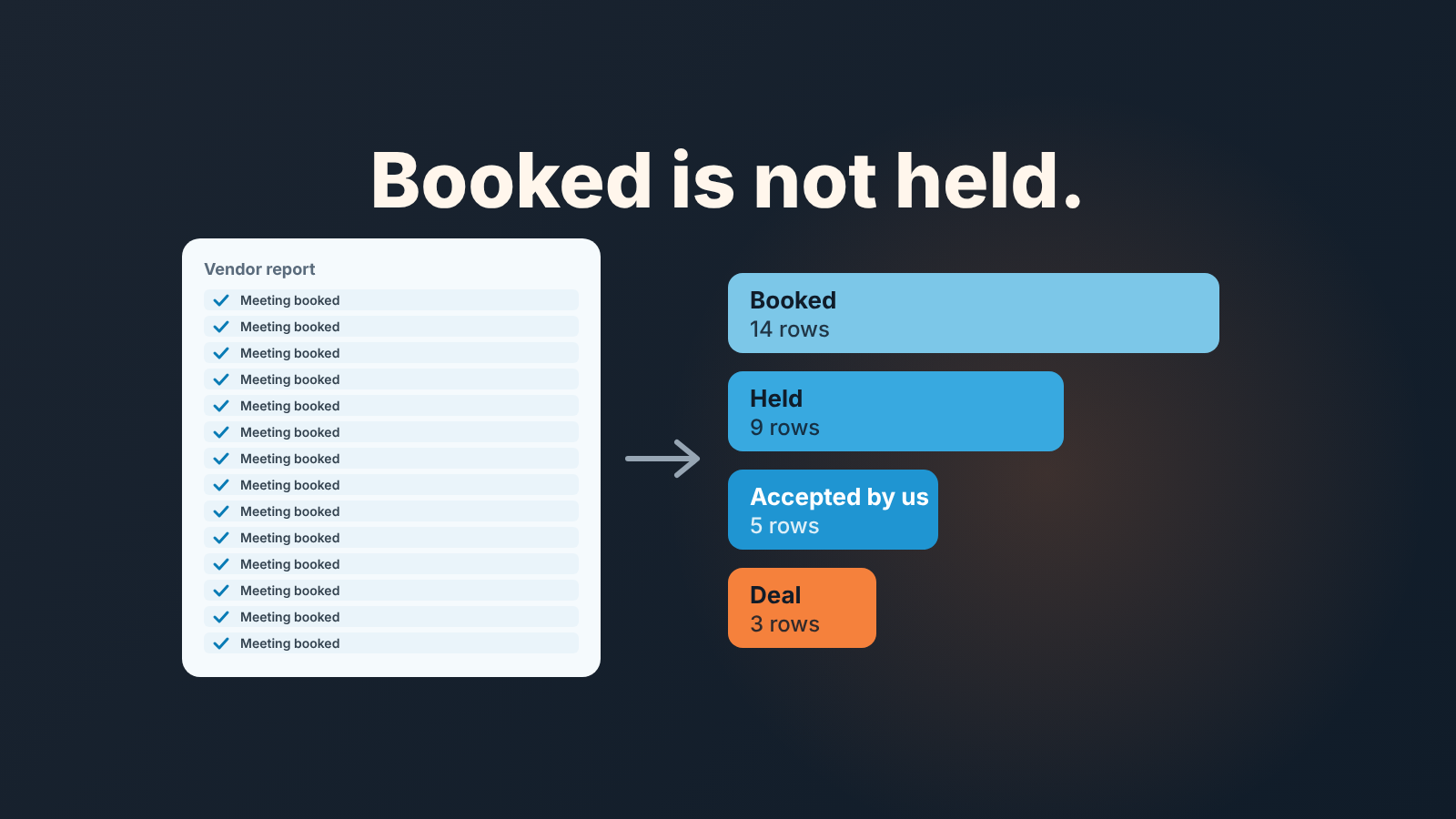
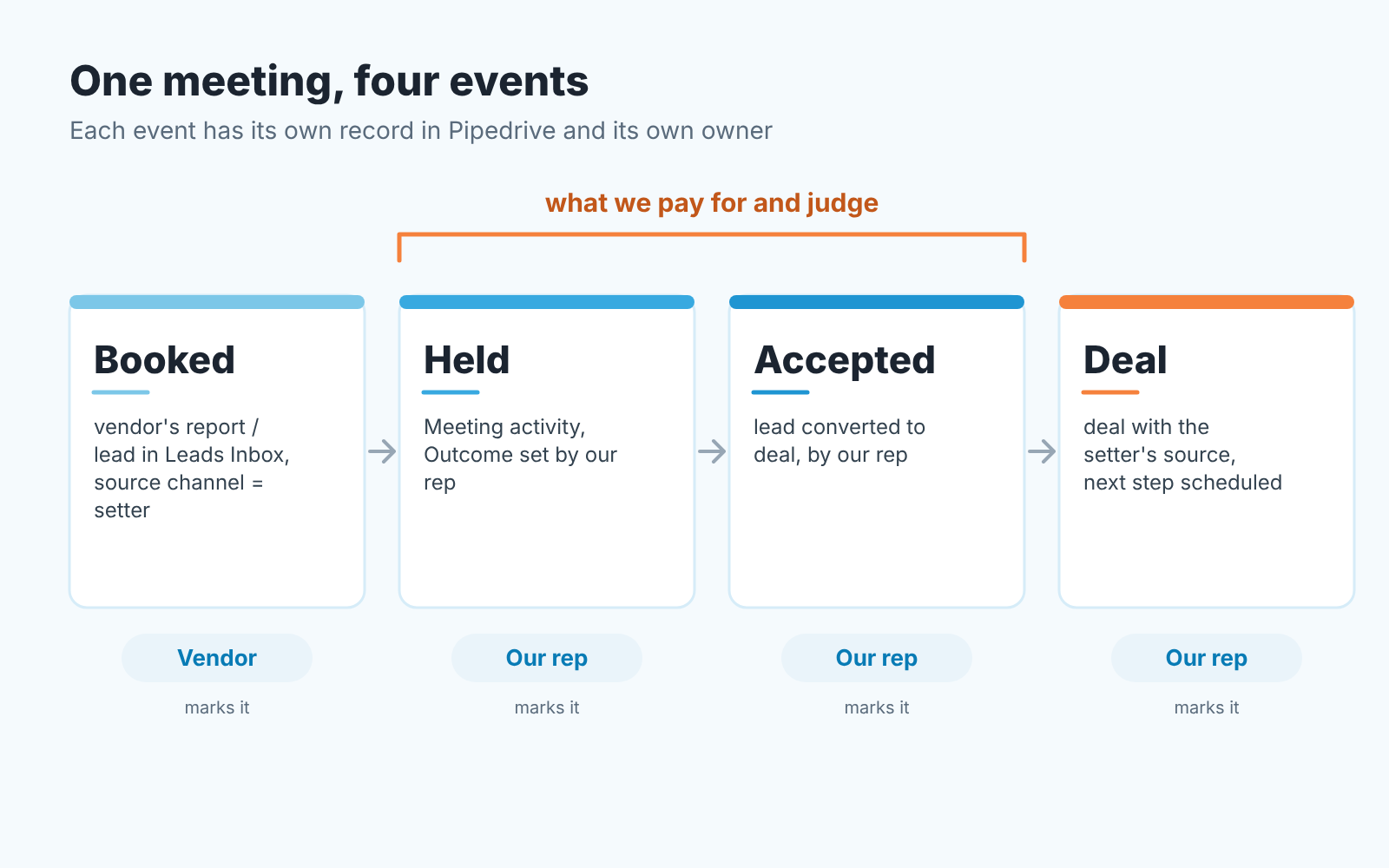
With outsourced appointment setting, treat every meeting the setter sends you as four separate events, not one: booked, held, accepted by your team, turned into a deal. In Pipedrive that means the setter’s lead carries their source, the meeting activity carries an outcome your rep chose, and the decision to accept lives with your team, not with the vendor. Pay for and judge the engagement on held and accepted meetings. The one figure you cannot use is the number of rows in the provider’s monthly report.
Fourteen meetings on the invoice, three deals in Pipedrive
Perrin runs sales at Stonefly Dray, a team of eight on Pipedrive; the people, the company and every number here are illustrative. In March they hired an outside setter. On the first of April the setter’s report arrives: 14 meetings booked. Perrin filters deals in Pipedrive by that source and finds three.
Calla, the founder, asks the obvious question. Where did the other eleven go?
Perrin can half answer it. Two were no-shows. One turned out to be a student doing a project. Two were rebooked, and he is not sure whether the report counts them once or twice. The report and the CRM count different things, and nobody wrote down which thing the invoice is for.
Booked, held, accepted, deal: four events, not one
The setter counts booked meetings because booking is the part they control. An invite went out and was accepted, and from their side the job is done. Your side starts when the invite fires.
Held is the second event: someone from the prospect’s company showed up and stayed. Accepted is the third: your rep, after the call, says this is a company we can sell to, at a title that can buy. Deal is the fourth, and it can take weeks.
The vendors themselves price on the second event, not the first. Key Outreach puts pay-per-meeting pricing at “$150–$500+ per held meeting” and budgets $5,000–$15,000/month for a serious managed program (Key Outreach buyer’s guide). Those are one vendor’s figures, not a market standard, but notice the word: held.
We judge the engagement on the third event, because a held meeting with a student is still a held meeting. Instantly, another vendor, says it about metrics in general: “Measuring outcomes (pipeline value, closed revenue) rather than just activity (dials made, emails sent) ensures alignment with business goals” (Instantly). Bookings are activity. Accepted meetings and deals are outcomes.
Define a qualified meeting before you sign the setter’s contract
Most of the pain in Perrin’s story comes from one missing paragraph in the contract. Key Outreach puts it plainly: “Write the definition into the contract — specific title, company size, confirmed interest, and meeting held (not just scheduled)” (Key Outreach).
Our version adds a fifth line, and it is the one that makes the other four checkable: the meeting counts when our rep marks it accepted in our CRM within two business days of the call. Not when the setter says it went well. When our person, who was on the call, puts the mark in Pipedrive. That turns “you counted 14” into “we accepted five, here is the list, let’s look at the nine”.
What this looks like in Pipedrive
The setter’s prospects enter as leads in the Leads Inbox, not as deals. Pipedrive lets you add leads by hand or import them from a spreadsheet, and every lead must be linked to a person or an organization (Pipedrive: adding leads to my Leads Inbox).
Each of those leads gets the vendor as its source channel. That is the team-managed source field: an admin edits its list of values in Company Settings > Data fields, and any user can set the value on a record. We wrote up the setup in how to capture lead source in Pipedrive. Add one value, the setter’s name, and nothing else. That value is what makes everything below a single filter.
The meeting itself is an activity of type Meeting, owned by your rep, not by the setter. When the call ends, the rep marks it done and fills in the Outcome. Since July 2026 an admin can require the Outcome field before an activity is marked done, per activity type, in the Activities tab under Settings (Pipedrive product updates, July 2026). What matters is the meaning your team agrees on: held with a next step, held with no next step, no-show, rescheduled. We covered why “done” is not an answer separately.
Accepting is the last mark, and the vendor never sees it. If the rep accepts, they convert the lead into a deal; Pipedrive carries over the person, organization, notes and activities, and the rep sets the setter as the deal’s source channel in the same minute. If not, the lead stays a lead and the rep writes one line in the note saying why: wrong title, no budget this year, already a customer. That line is what you read back to the setter on Friday. Our piece on leads versus deals in Pipedrive explains why the lead should not become a deal before this point.
No-shows and reschedules: one meeting, one record
A no-show is marked by the person who sat in the empty room. That is your rep, so the outcome is theirs to set, the same day, not three weeks later when the vendor’s report arrives.
Reschedules are where double counting starts. The setter rebooks, a second invite goes out, and now there are two meeting activities for one conversation. Don’t create the second one. Move the date on the the existing activity and keep it open. One prospect, one meeting activity, one outcome, and the booked count stays at the number of people, not the number of calendar invites.
Cutting no-shows is a separate job: demo no-shows in Pipedrive. Here we only make sure each one is written down.
Fifteen minutes on Friday with the source filter on
Once the source channel is in place the weekly check is short. Filter leads and deals where source channel is the setter and the record was created in the last seven days, then count four things: leads added, meetings held, leads converted to deals, deals with a next activity scheduled.
Put those next to the vendor’s report for the same week, and send any gap to the setter the same day as a list of names.
The last count matters most. A deal your rep accepted with no next activity is a meeting you paid for that is now quietly dying in the pipeline. We build SalesBond, a sales management layer that works with Pipedrive, HubSpot, Salesforce and Zoho CRM; if you want a second pair of eyes on those deals, Check your CRM with SalesBond. The filter and the four counts work without it.
When to end it
Our rule of practice, not a benchmark: two months in a row where fewer than half of the booked meetings were held, or where accepted meetings produced zero deals, and we end the engagement. The first failure is the vendor’s booking quality. The second might be ours, so before ending it we read the rep’s “not accepted” notes for those two months. “Wrong title” twenty times means the setter is not following the definition. “Good fit, no urgency” means the problem is our offer, and a new setter will book the same people.
One row per event, one person per mark
The whole system fits in one table.
| Event | Where it is recorded in Pipedrive | Who marks it |
|---|---|---|
| Booked | Lead in the Leads Inbox, source channel = the setter | Imported from the vendor’s list |
| Held or no-show | Outcome on the Meeting activity | Your rep, same day |
| Accepted | Lead converted to a deal, or a one-line reason in the note | Your rep, within two business days |
| Deal | Deal with the setter’s source and a next activity scheduled | Your rep |
The vendor owns teh first row. You own the other three, and the invoice should be about the second and third. Perrin’s next report will still say 14. His Pipedrive will say nine held, five accepted, three deals, and for the first time he will know which number to argue about.