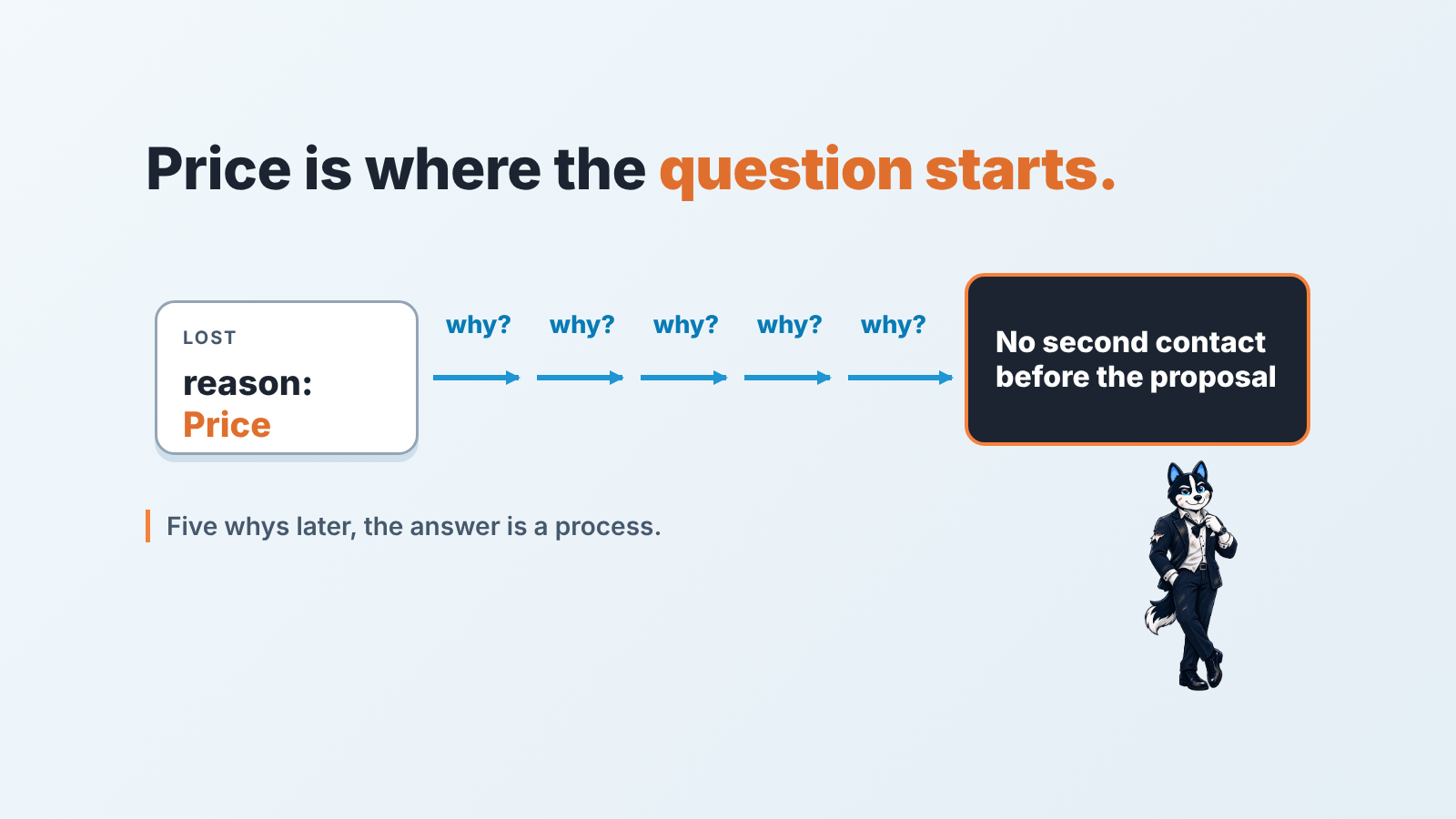
Root cause analysis is a method that looks for the cause of a problem rather than its symptom: you keep asking “why” (the 5 whys) until the answer is a process you can change. In sales, that is how you take apart lost deals. “Lost to price” is the symptom. “We sent a proposal to a single contact who had never seen the product and had no budget authority” is a cause, and a cause has an owner and a fix.
This is for the owner or head of sales of a small team who opens the lost-deals report once a quarter, sees “price” at the top, and suspects that is not the whole story. Start with one lost deal and the rep who worked it, then widen to 10 to 20 deals and end with a table of cause, process, owner and date. The method was built on factory floors, and it carries over to a pipeline because a lost deal leaves dates, stage changes and a record of who was involved.
What root cause analysis is, and where it came from
Root cause analysis (RCA) is a systematic process for finding the underlying causes of problems, and its goal is to stop the problem from coming back rather than to treat the symptoms (ASQ, Root Cause Analysis). The best-known tool inside it is the five whys: you repeat the question “why” to trace the visible symptom back to its cause. The technique was developed by Sakichi Toyoda and became part of the Toyota Production System (ASQ, What are the Five Whys?). It took shape in manufacturing in the 1950s, and like any method it has limits (RZ Software, A Guide to the 5 Whys).
Most of what is written about RCA is about manufacturing, IT incidents and patient safety. One health authority describes it as a series of five or more sequential “why” questions to find the root cause of an incident (Saskatchewan Health Authority). A lost deal is an incident too. It has a timestamp, a sequence of events before it, and a person who marked it lost. Nobody in sales is used to treating it that way, though. The deal gets a reason from a dropdown, the report counts the reasons, and the count is mistaken for an analysis.
We think the method suits sales more than the engineering examples suggest. A lost deal almost always has a process behind it that the CRM already recorded: stages, dates, activities, who was on the deal. The evidence is there. What’s missing is the habit of asking why more than once.
A 5 whys example: one lost deal, end to end
Pick a deal that hurts a little. Not the biggest loss of the quarter, because that one has politics around it, and not one that was dead on arrival. A mid-sized deal that reached the proposal stage and then went quiet is ideal. Open it in the CRM with the rep who worked it and start from the recorded reason.
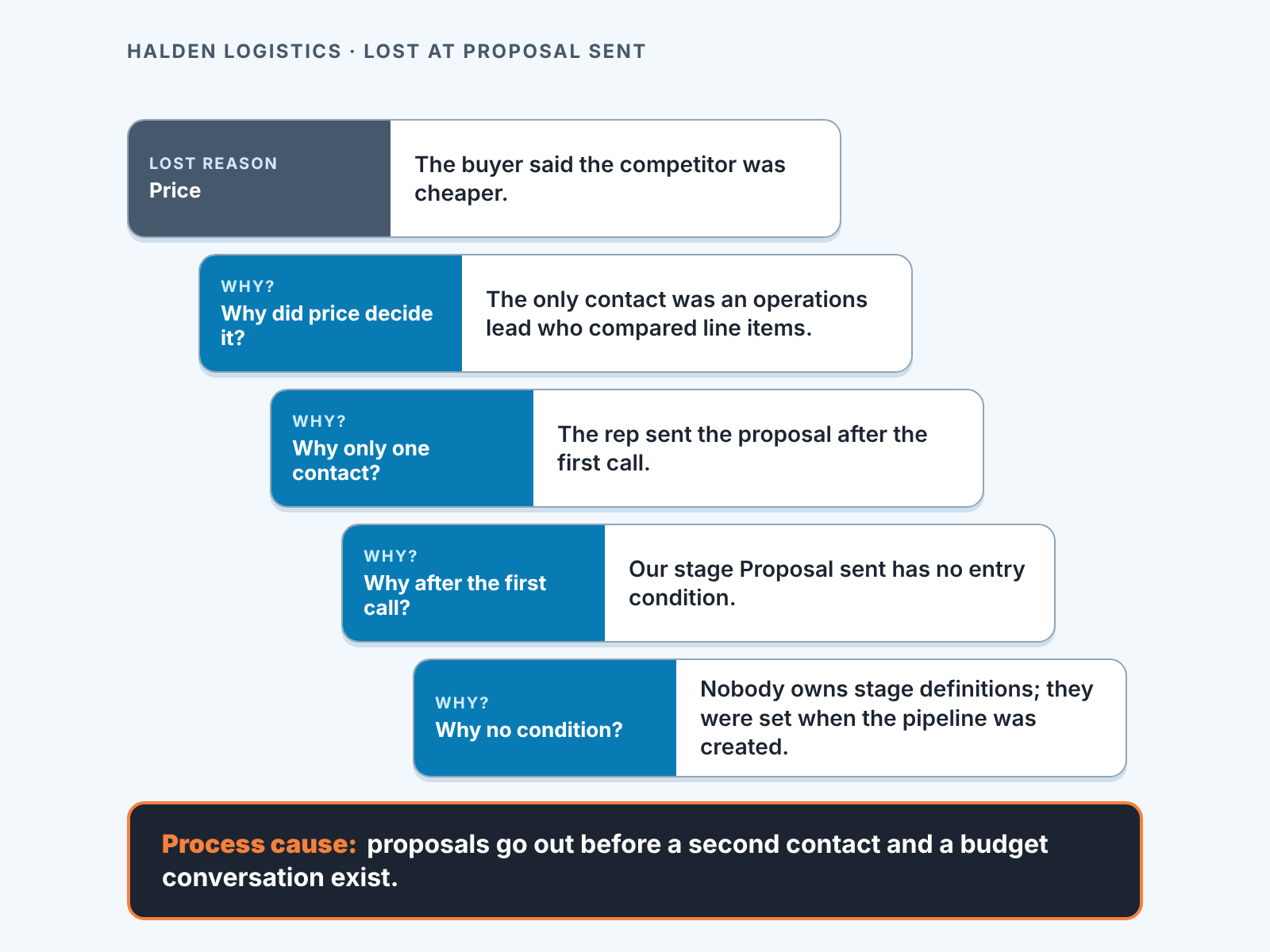
Here is how the conversation went on a hypothetical deal, Halden Logistics, marked lost at the stage “Proposal sent” with the reason “Price”.
Why did we lose it? The buyer said a competitor was cheaper.
Why did price decide it? Because the only person we were talking to was the operations lead, and he compared two proposals line by line. He had no reason to weigh anything else.
Why were we only talking to the operations lead? Because the rep sent the proposal right after the first call. There was no second meeting where the finance director or managing director could have joined.
Why did the proposal go out after one call? Because our “Proposal sent” stage has no entry condition. A rep can move a deal there whenever the buyer asks for numbers, and buyers ask for numbers early.
Why does the stage have no condition? Because nobody owns the stage definitions. They were set when the pipeline was created and nobody has touched them since.
Five questions, and the answer stopped being about the buyer or the rep at question four. That’s the signal to stop: the answer is a process, it is ours, and someone can change it next week. Sometimes four whys are enough and sometimes you need seven. AWS’s guidance on the method says you may need more than five, and that “human error” as a root cause may point to a missing check, so the next question is why the error was possible at all (AWS Well-Architected, Five whys). “The rep should have asked for a second contact” is a human-error answer. “The stage lets a proposal go out without one” is the cause.
The same page adds one more rule, and it matters more in sales than anywhere: run it blame-free. The rep is sitting next to you. If the exercise turns into a review of her judgement, you will get the chain she thinks you want to hear, and you will never get question four. That is also the line between this and a lost-deal debrief with the rep, which is a coaching conversation about one deal; RCA looks for the process cause behind many.
How to run a root cause analysis on lost deals
One chain is a hypothesis. The routine we use once a quarter looks like this:
- Pull 10 to 20 deals lost in the last quarter that reached at least the proposal stage. Deals lost at the first call rarely have enough history to question. Fewer than ten and one odd deal dominates; more than twenty and the session runs out of time before the chains are finished.
- Run the five whys on two or three of them with the reps who worked them, until each chain ends in a stage, a field or a rule.
- If the problem is a trend rather than one deal, sort the candidate causes on a fishbone.
- Test the two or three strongest candidates on every deal in the set and count how often each one shows up.
- Put the causes that hold into a table with a process change, one owner and a date.
- Four weeks later, open the deals lost since the change and look for the pattern again.
A fishbone for a falling win rate
The five whys are built for one deal with one cause. Say the win rate (deals won as a share of all closed deals) has slipped two quarters in a row and the lost-reason report shows nothing new. A single chain won’t hold that. The ASQ glossary says as much: the five whys work best for problems with a single root cause (ASQ). For a trend we use a fishbone (Ishikawa) diagram, which sorts candidate causes into categories before you test any of them.
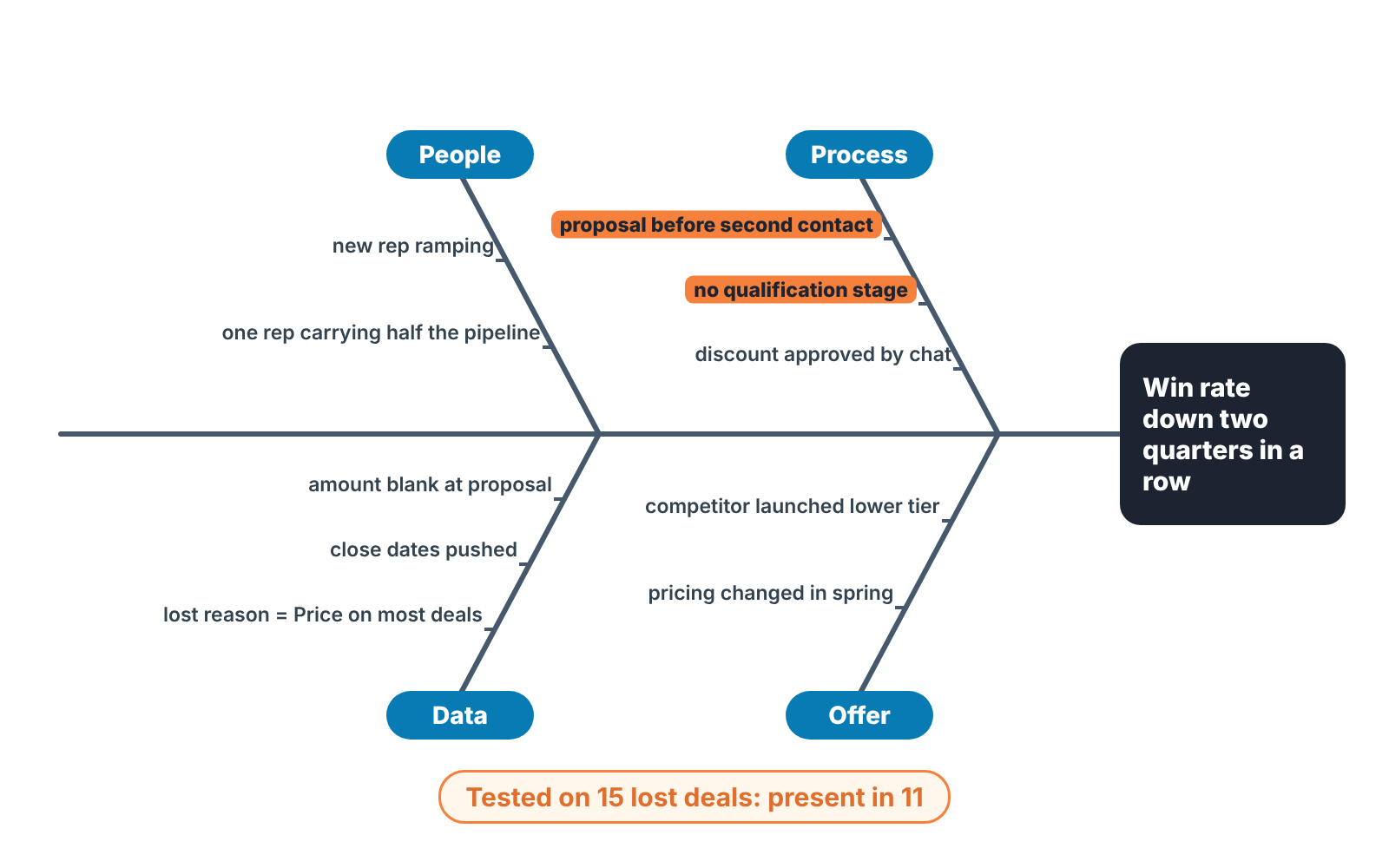
For a sales team the four bones we use are people, process, data and offer. People: who is on the team, who is new, who carries what share of the pipeline. Process covers stages, entry conditions, qualification and how a discount gets approved. On the data bone goes what the CRM says and what it fails to say, including the suspicious case where most deals are lost to one reason. Offer is pricing, packaging, and what competitors changed.
Fill the bones in a thirty-minute session with the team, then take the lost deals from the period and test the candidates that look most likely. Open each deal and tick: did the proposal go out before a second contact existed? Was there a qualification stage at all? Was the amount blank when the deal reached proposal? A candidate that shows up in most of the deals deserves a five-whys chain of its own. One that shows up in two deals out of fifteen is a story someone told in the meeting.
The fishbone also protects you from the obvious. “Pricing changed in spring” will sit on the offer bone, and it may well be real. But if eleven of fifteen lost deals went to proposal after a single call, pricing is not the first thing to fix.
The CRM fields that feed the analysis
You can’t run five whys on a deal the CRM barely remembers. The quality of the analysis is set months earlier, by what the team records, and three groups of fields do the work.
The lost reason itself. In Pipedrive it’s the lost reason a user gives when marking a deal as lost, freeform by default with an option to switch to a predefined list (Pipedrive, Lost reasons); in HubSpot it is the default deal property “Closed lost reason” (HubSpot, default deal properties). The value is the starting symptom, nothing more. A short fixed list sorts more cleanly than free text, because “Price” written five different ways won’t group in a report. If your list has grown to twenty options or “Other” tops the report start with the list itself; we’ve written about how to set up lost reasons in Pipedrive and how to make the closed-lost reason required in HubSpot.
The stage at which the deal was lost, and the dates. The stage tells you where in the process the deal died, and that alone changes the question. A deal lost at “Qualified” and a deal lost at “Proposal sent” with the same reason “Price” are two different incidents. The date of each stage change tells you how long the deal sat there and whether the proposal went out a day after the first call.
The activity record: calls, meetings and emails logged against the deal, with who attended. This is how you answer “were we talking to one person or three?” without relying on memory. One logged call followed by a proposal is the pattern from our example, and you’ll start spotting it fast.
If the deals you open have an empty lost reason, no activities and a stage history that jumps straight from new to lost, the analysis has found its first cause before you asked a single why: the CRM is not recording the process. We build SalesBond, a sales management layer on top of the CRM a team already uses, and this is exactly what its free CRM audit looks at. It reads the last 30 days of the connected CRM and sends a PDF with deal health, the pipeline bottleneck and what to fix, then a second PDF a week later with what changed. If you want to know whether your data can carry an analysis before you book the session, check your CRM with SalesBond.
From cause to action: an owner and a date
The last step is a table with four columns, because a cause without an owner rarely gets fixed. We think the table matters more than the method that produced it, because it’s the the thing people will look at in a month.
| Cause (from the chain) | Process to change | Owner | Date |
|---|---|---|---|
| Proposals go out after one call with a single contact | “Proposal sent” stage gets two entry conditions: a second contact on the deal, and a budget conversation logged as an activity | Head of sales | Pipeline settings changed by Friday; first review in four weeks |
| Discounts approved in chat, with no record on the deal | Discount request becomes a field on the deal; approval is a note from the approver, not a message | Owner | Field added this week; reps briefed Monday |
| “Price” is selected when the real reason is unknown | Lost reason list gets a value “No decision / went silent”; “Price” requires a competitor name in the note | Sales ops or the senior rep | Two weeks |
Copy the cause column from the chain, in the words it was found in, without polishing them. The process column names a thing that exists in the CRM: a stage condition, a field, a list value. “Reps should qualify better” does not belong there, because it is not a process. The owner is one person. The date has two parts where it needs them: when the change goes in, and when you check whether it worked.
Checking is where the loop closes. In four weeks, open the deals lost since the change and look for the pattern again. If proposals still go out after one call, the stage condition is being bypassed and you have a new why to ask.
Do you need a tool for any of this? No. A spreadsheet with four columns and the CRM’s deal pages are enough for the analysis, and a manager with a saved filter and a calendar reminder can do the four-week check by hand. It’s worth doing by hand at least the first time. A tool earns it’s place in the step after, when you want to know every week whether the pattern has come back. In SalesBond that check runs on its own: Deal Health tests every deal against more than 20 rules and shows each violation with a recommended action.
Where the method goes wrong
The most common failure is stopping too early. The Zoho Workplace guide on the five whys names it first, and adds that the true root cause often sits in a system, process or policy rather than in an individual mistake (Zoho Workplace, A guide to 5 Whys analysis). In sales, stopping early has a specific shape: the chain ends at “the rep did not ask for a second contact”. That feels like a cause because it names a behaviour. It isn’t one, because nothing in the process changes if you accept it. Ask one more time .
The second failure is “price” as the final answer. In a deal that reached proposal, price is rarely the root cause; it is the reason the buyer gave, which is a different thing. A buyer who says “too expensive” is telling you what was easiest to say. When a chain stalls at the competitor’s price, ask why price was the deciding factor in this deal. Usually only one contact was weighing the decision, or value was never established before the proposal. If the honest answer is that the buyer needed the cheapest option and would always have taken it, mark it as not winnable (we’ve written about when to close a deal as lost) and spend the time on a different deal.
Third, treating one case as the rule. We have seen teams rebuild thier stages after a single painful loss, and the new stages fit that one deal and nobody else.
The fourth is the blame problem again, and it decides whether the rep should be in the room. She should, for the deals she worked, because the chain needs facts only she has: who was on the call, what the buyer actually said. The condition is that the session is about the process, and that she hears this before it starts. If a manager who is already unhappy with a rep runs it on that rep’s deals, every chain will end at the rep and the process causes will stay where they are. Run it on a mix of reps’ deals, or let the senior rep run it instead of you.
RCA is not win-loss analysis
The two get confused, and the confusion costs a team the better use of both. Win-loss analysis asks the buyer. You call the people who chose someone else, ask why they chose what they chose, and put their answer next to the reason the rep logged. It’s a view from outside, and we describe the small-team version in win-loss analysis for a small team.
Root cause analysis goes the other way. It starts from the CRM and goes inward, into our own process, and it ends with a change to a stage, a field or a list. The buyer may tell you “price”; the RCA finds that “Price” is what reps select when a deal went silent after a one-call proposal. When the same reason keeps coming back in the win-loss calls, that’s the moment to run an RCA on those deals.
A practical rhythm: keep the lost-reason count on the manager dashboard with the other numbers you watch weekly and run the RCA once a quarter, on 10 to 20 deals, with the table above as the output. If the same cause shows up in two quarters’ tables, the process change did not take, and the next chain starts with the question of why the fix didn’t stick.