Active listening is listening to understand rather than to reply: you take in what the other person means, say it back in your own words, ask about the part you did not get, leave a pause instead of filling it, and write down the result. In sales it is the skill every first conversation with a buyer runs on, and a manager can check it in two places, the call recording (did the rep paraphrase and ask a follow-up?) and the deal in the CRM (did the buyer’s words make it into a field?).
The example buyers, deals and names below are invented. The habits are the ones we see in recordings every week.
What active listening is
UC Berkeley Executive Education describes active listening as being fully present in the conversation: absorbing the meaning and the context of what is said, and quieting the inner voice that is already drafting what to say next (UC Berkeley Executive Education). The same piece draws the line with passive listening. Passive hearing is automatic; active listening is something you choose to do. That is the general definition and it holds up in sales with one addition. On a discovery call the buyer is often saying something out loud for the first time, so it comes out half-formed. Listening to understand means helping them finish the thought before you compare it with your pitch.
On a call the difference is easy to hear. Does the buyer ever get to correct you?
One warning before the techniques. Leadership Global makes the point that active listening is easily reduced to a checklist, and that a person can do every item on it and still listen badly (Leadership Global). We agree, and we still give managers a checklist later in this article. The difference is who the list is for. A rep who runs through “paraphrase, ask, pause” like a script sounds like a script. A manager who uses the same list to find moments in a recording is doing something else: looking for evidence, so the feedback can point at a minute mark and a sentence rather than at a personality.
Five techniques, and what each one sounds like
The five active listening techniques we coach are paraphrasing, the clarifying question, the pause, naming what you heard behind the words, and the summary at the end. Longer lists exist. These five are the ones that show up in good calls and go missing from bad ones, so their absence is something you can hear in a recording.
Paraphrase
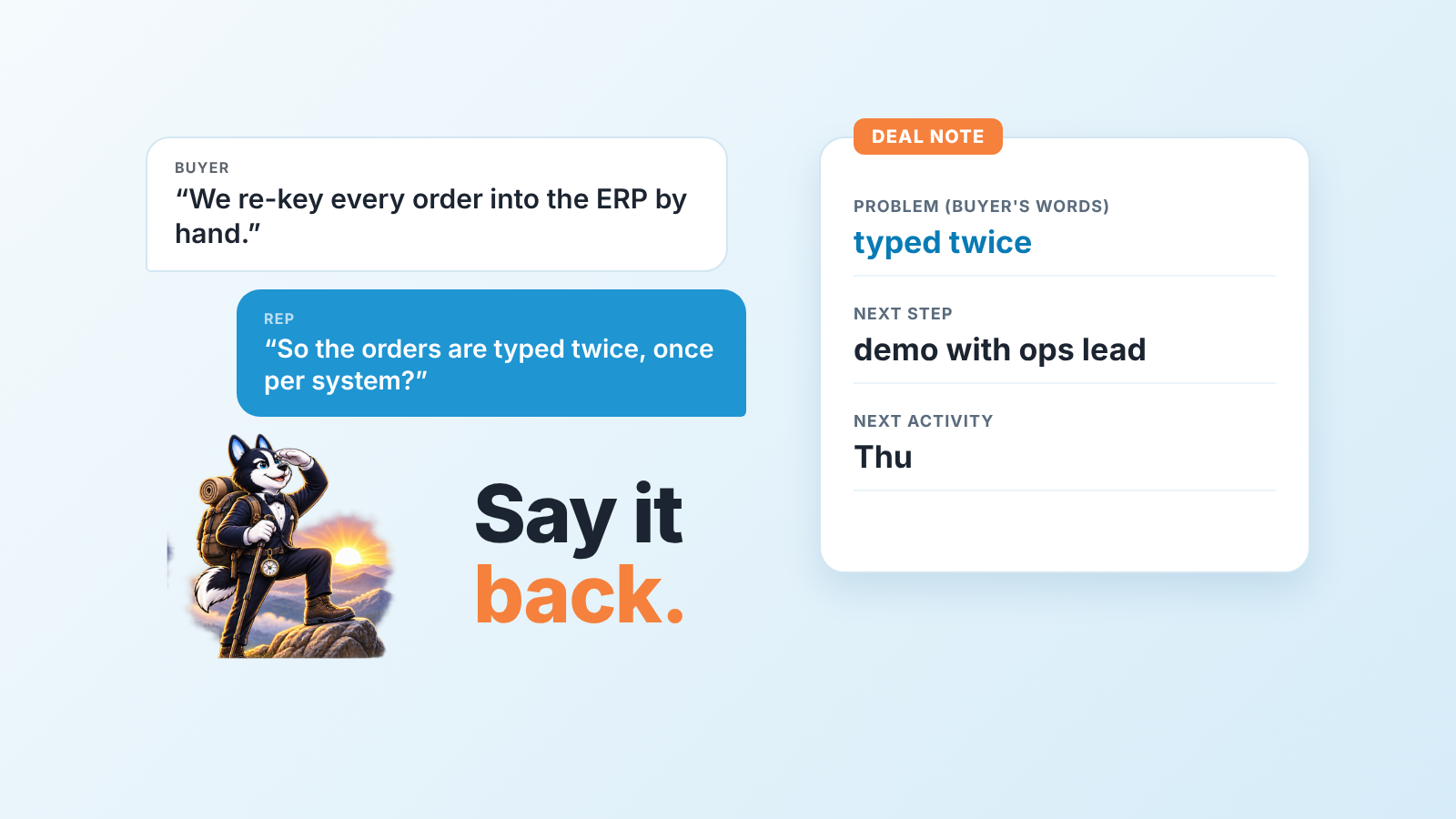
Say back what you heard, shorter, in your own words, and let the buyer correct you. “So the orders get typed twice, once into your web shop and once into the ERP?” It tests whether you understood, and the buyer’s “no, actually” is the most useful phrase on the call.
How often? After the buyer’s longer answers and once more at the summary. Not after every sentence. If the buyer has corrected or added to something at least once, the rep is paraphrasing enough; if it starts to sound like a script, too much. And a paraphrase that repeats the buyer’s sentence word for word is just an echo, and buyers notice.
Clarifying questions
A clarifying question goes one level down from what was said. The buyer says “it’s a mess at month end”. The clarifying question is “what does the mess look like, who is staying late?” rather than “how much is that costing you?” The second one is a sales question in disguise, and it comes too early. Ask it after you understand the mess. We wrote about the other half of this, getting the answer into the deal, in probing questions on sales calls and the CRM line they fill.
The pause
After the buyer answers, wait. Two or three seconds feels long on a call, and it is where the second half of the answer comes from: “…and honestly the bigger problem is that nobody trusts the stock numbers.” Reps who fill every silence never hear that sentence. This is the easiest technique to check in a recording and the hardest to coach, because the urge to fill the silence is physical.
Naming what you heard behind the words
Sometimes the content is a process problem and the tone is frustration, or fatigue, or embarrassment that the problem has lasted this long. Naming it takes one short sentence: “Sounds like you’ve raised this before and it went nowhere.” You may see this called labeling, and its cousin mirroring, which is repeating the buyer’s key word back as a question (“Guessing?”). Do it once, when it is true, and move on. More than once per call it turns into a therapy voice and the buyer backs away.
The summary at the end
Before the next-steps part of the call, the rep states what they understood in three or four sentences: the problem in the buyer’s words, who is affected, what has been tried, what would need to be true for a change to happen. Then they ask “did I get that right?” This is the technique that feeds the CRM, because a summary the buyer has confirmed is exactly what belongs in the deal note. We will come back to that.
Active listening examples from a discovery call
We described the call itself, its structure and the fields it should fill, in how a small team runs a discovery call in Pipedrive. Here the question is narrower: what the listening half sounds like.
The buyer is an operations lead at a distributor. She says: “We’ve got three warehouses and each one keeps its own spreadsheet, so when sales promises a delivery date they’re guessing.”
The version where the rep is not listening: “Right, so visibility across locations. Our platform gives you a single view of inventory in real time. Let me show you.” The rep has heard a category, matched it to a slide, and moved on. Nothing the buyer said has been checked.
The version with active listening, over the next two minutes:
“So the spreadsheets are per warehouse, and sales can’t see any of them when they’re on the phone with a customer?” (paraphrase; the buyer says “they can see them, they just don’t trust them, they’re a day old”).
“A day old because someone updates them at the end of the shift?” (clarifying question, one level down).
Silence. The buyer adds: “And when the numbers are wrong we eat the shipping cost on the re-delivery. Finance brought it up last quarter.” (the pause did its work: now there is a cost, a second stakeholder, and a reason this is on her list now).
“Sounds like you’ve been the one explaining the re-deliveries.” (naming it, once).
Near the end: “Let me check I have this. Three warehouses, each on its own spreadsheet updated end of shift. Sales quotes dates off stale numbers, wrong dates turn into re-deliveries you pay for, and finance noticed last quarter. Is that right, and is there anything I’m missing?”
Notice what the rep did not do in those two minutes. No product, no budget question, no “what would it mean for your business if we solved this”. Those questions have a place later in the call. Here they would have ended the buyer’s story early, and the story is the deal.
What a manager listens for in a recording
Most managers who review calls listen for the pitch. Was the value proposition clear, did the rep handle the objection, did they ask for the next step. Those matter, and we cover them in the call review scorecard. For listening the review is different: you are listening to the buyer’s half of the call and checking what the rep did with it.
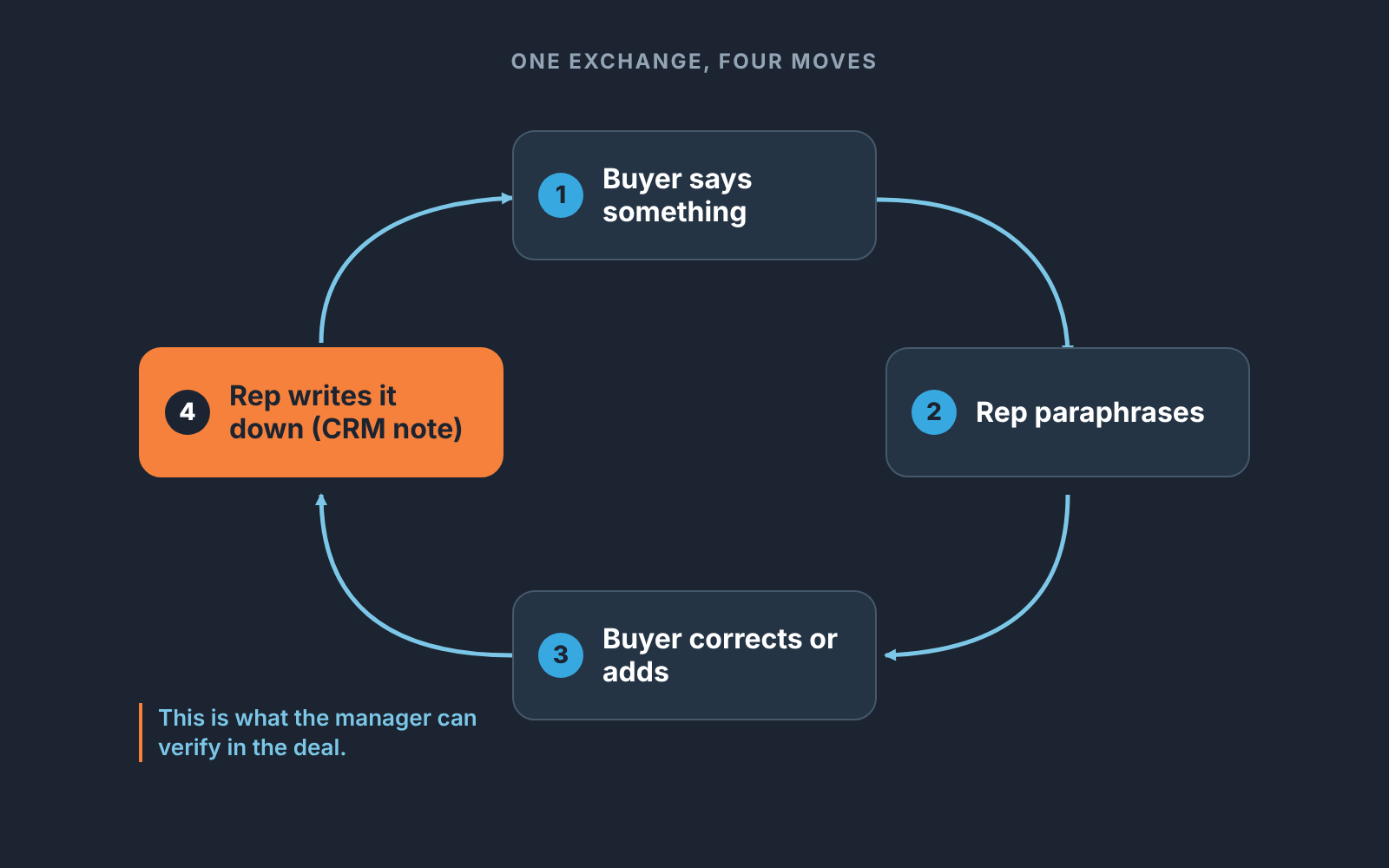
Our checklist for a recording. We do not score it; we timestamp it.
- Did the buyer say anything the rep later paraphrased? Find one instance and note the minute mark. If there is none in the first ten minutes, that is the feedback.
- After the buyer’s longest answer, how long before the rep spoke? Count it.
- Did the buyer ever say “no, actually” or “not quite”? A call with zero corrections usually means the rep never checked.
- One question that went a level down from something the buyer said, rather than sideways to the next topic on the rep’s list: is it there?
- Who named the cost, the second stakeholder, the deadline? The buyer unprompted, or the rep by leading?
- Was there a summary before next steps, and did the buyer confirm or add to it?
- Does the deal note match the summary?
That last item turns a soft skill into something a manager can check without the recording.
From the call to the CRM note: the minimum fields
A discovery call that lived only in the rep’s head is a call the manager cannot coach and the team cannot continue if the rep is out. So the test of whether the rep listened goes past the recording: it is whether the buyer’s confirmed summary made it into the deal, in the buyer’s words, in fields someone else can read in thirty seconds.
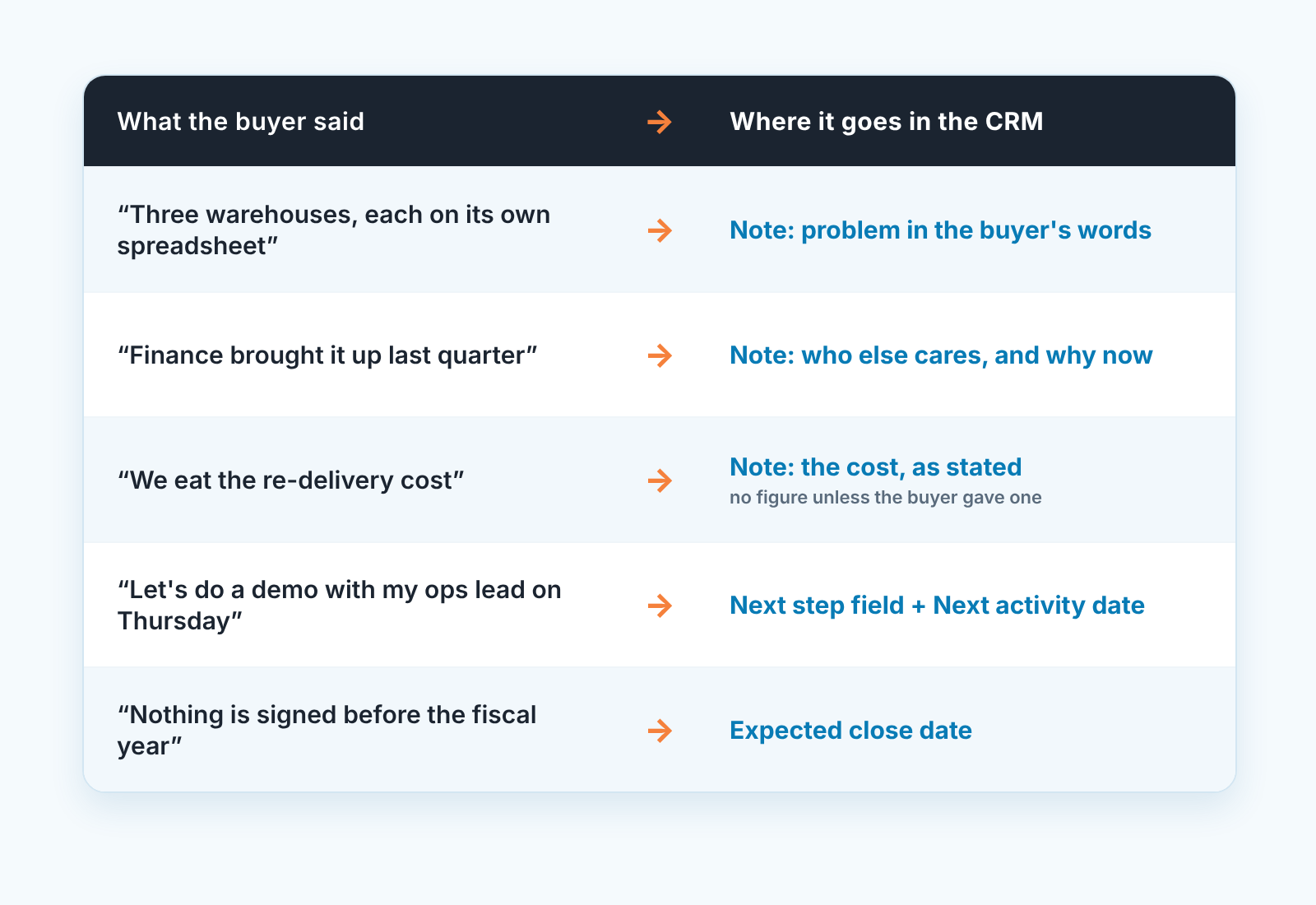
Every mainstream CRM has the three places this needs: a note on the deal, a next activity and a close date. In Pipedrive, HubSpot, Salesforce and Zoho CRM the names differ slightly. The minimum we ask for:
The problem in the buyer’s words, in the note. Not “visibility issues” but “three warehouses, each on its own spreadsheet, sales quotes off stale numbers”. If the note contains the product’s vocabulary and not the buyer’s, the rep wrote down the pitch and lost the call.
Who else is involved and why now, in the same note. “Finance raised re-delivery costs last quarter” is two facts in one line: a second stakeholder and a trigger. Those two facts decide whether the deal is real.
The next step as its own field with a date. “Demo with ops lead, Thursday” goes into the next activity with the day on it. A next step that lives in the note does not show up in any pipeline view, which means nobody notices when it slips.
The close date, if the buyer said anything about timing. “Nothing is signed before the fiscal year” is a close date. Leaving the default because the buyer did not give an exact day is how a forecast nobody believes gets started.
That’s it. Four things, two of them in the note. A note with those four things, in the buyer’s language, is proof that listening happened. A note that says “good call, interested, follow up next week” is proof that it did not, however warm the call felt.
A disclosure, since this is where the CRM check comes in. We build SalesBond, a sales management layer on top of the CRM a team already uses; we started with Pipedrive. Deal Health, the part that checks every deal against more than 20 rules, looks at the CRM half of this on its own and shows each violation with a recommended action. What it cannot do is tell you whether the rep listened. No tool reads a note and judges whether those are the buyer’s words; that stays with you and the recording. If you want to see the CRM half across your open deals right now, the free CRM audit looks at the last 30 days of your CRM and sends a PDF report, then a second one a week later with what changed. Check your CRM with SalesBond, and take the deal health section of the report into your next call review.
Coaching feedback from evidence, not from impression
“You need to listen more” is a verdict, and a rep cannot act on it. The feedback that works has the shape we described in how a sales manager gives feedback from CRM evidence: a situation, the evidence, a next step. For listening, the evidence is a minute mark and a field.
Here is what that sounds like in a 1:1, using the recording and the deal from above.
Situation: “The call with the distributor on Tuesday, around minute eight.”
Evidence: “She said sales quotes off numbers that are a day old, and you went straight to the real-time inventory slide. Then at minute twelve she mentioned finance and re-delivery costs, and that’s not in the deal note. The note says ‘inventory visibility, demo next week’, and there’s no next activity on the deal.”
Next step: “On the next discovery call, one thing: after her longest answer, paraphrase it before you say anything else. And put the next step in the activity, not the note. We’ll listen to that call together Friday.”
Then stop talking. Yoh lists listening to the recipient’s response as a key part of delivering constructive feedback (Yoh), and the rep’s response usually tells you something. “I jumped to the slide because the last three buyers in that segment wanted to see it first” is a real reason, and it changes what you coach. Maybe the fix is to show the slide and then come back to her sentence.
The exercise we use most on a 1:1 takes ten minutes. Play the weak moment from the recording, stop it right after the buyer’s line, and play the buyer yourself. Say her sentence again; the rep answers with a paraphrase instead of the slide. Then add the line she said next, so the rep has to pause and let it land. Two or three rounds are enough. It feels awkward the first time, and it is still the fastest active listening exercise we know, because the rep practises on a sentence a real buyer said last week rather than on a made-up scenario.
There is a second reason the manager’s own listening matters, and it is bigger than one call. UC Berkeley’s piece notes that when team members feel genuinely heard, they are more likely to share ideas and admit challenges, and ties that to the psychological safety a leader builds by listening (UC Berkeley Executive Education). LeadDev makes a related observation: when people feel heard, they are more willing to listen to others in the group (LeadDev). In a sales team that cashes out simply. A rep who gets interrupted in every 1:1 learns to interrupt buyers. A manager who paraphrases the rep’s account of a lost deal before reacting to it is running the technique in front of the person they want to adopt it.
One pattern across several calls belongs in a coaching plan rather than in a single remark; which CRM signals call for which coaching conversation covers that cycle. Listening is one of teh few skills where the signal is partly in the CRM (empty next steps, notes in product language) and partly in the recordings, so the plan needs both.
Where it goes wrong, on the call and in the review
Interrupting is the obvious one, and it is more often enthusiasm than rudeness. The rep hears the problem they can solve and cannot wait. The fix is mechanical: paraphrase before responding, every time, for a month, until the the urge passes.
Solving early is the quieter version of the same mistake. The rep lets the buyer finish, yet the first question after the buyer’s answer is “how much is that costing you?” or “who would need to sign off?” Both are good questions. Asked before the problem is understood, they tell the buyer the rep is filling in a form.
Leading questions are a listening problem dressed as a discovery technique. “So the real issue is that you don’t have a single source of truth, right?” hands the buyer the rep’s answer to agree with. Most buyers agree to be polite, and the note then contains the rep’s framing. The clean version is open: “what happens when the numbers are wrong?”
Transcribing instead of listening. A rep who types every word hears none of them. Write the note from the confirmed summary at the end of the call; that is what the summary is for.
Performing the techniques: paraphrasing every sentence, naming a feeling every two minutes, pausing for effect. Its the checklist problem from the first section. The cure is fewer techniques, used when they are true, and a manager who points out the performed ones with the same minute mark they use for the missing ones.
And the manager’s own mistake is listening to the recording only for what went wrong.
Pick one discovery call from the last few days, open the deal next to the recording, and look for two things only: one moment where the rep paraphrased, and whether the buyer’s words made it into the note. If the paraphrase is there, timestamp it and tell the rep; a call where they paused at the right moment and got the finance sentence out of the buyer deserves a minute mark too, and that’s the one they will remember. If it is missing, you already have your next 1:1.