A probing question is a follow-up that digs into the buyer’s first answer to learn the context or the cause behind it. Ask one after every answer that sounds vague, and write the new fact into the deal in a single line. If nothing new lands in the CRM, the question was conversation, not probing.
That last test is the part most lists of probing questions in sales leave out. Copper’s guide describes probing questions as follow-ups that go further into a person’s first answer, and sorts its examples into three groups: establishing the origin story, finding the root of the pain point, and anticipating roadblocks (Copper). We use the same three jobs below. What the guide stops short of is where the answer goes: its closest advice is to take detailed notes, which we think is too loose to survive a week.
A probing question starts where the script’s answer ends
Every call has questions you wrote before it started, like “What are you using today?” Those are script questions, and they are fine. The buyer answers them the way buyers answer anything asked cold: short, polite and general. “We’re looking to be more efficient.” “We’ve outgrown spreadsheets.”
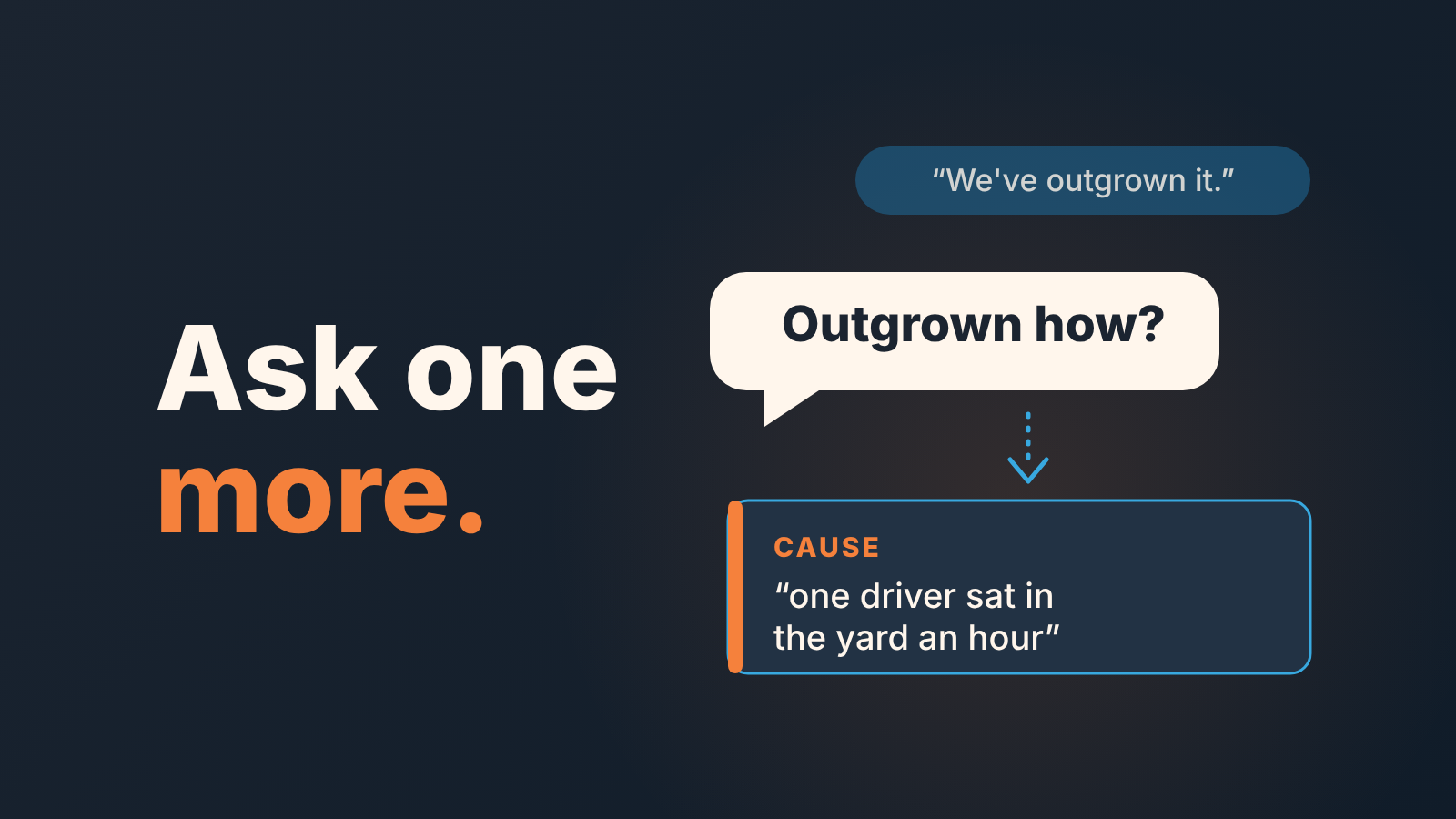
The probing question comes next, and it is made out of the buyer’s own words. You could not have written it down before the call, because you did not know the buyer would say “outgrown”. That is the simplest test we know: if you could have asked it before the call, it was a script question.
Don’t confuse it with a clarifying question, which pins down a fact you half heard: “Which spreadsheet?” A probing question asks what sits behind the fact. “Outgrown how?” Both are useful. Only the second changes what you know about the deal.
The second test is about the deal record. After a probing question lands, the deal holds a fact it did not have before: a name, a number, a reason, a sentence only this buyer would say. After a script question there is usually a category (“pain: efficiency”), which is what the rep had in mind before the call anyway.
Three jobs for a follow-up: context, cause, obstacle
A follow-up has one of three jobs: fill in the context, find the cause, or surface the obstacle. The exchanges below are made-up examples, not real calls. The rep sells scheduling software to small logistics firms; the buyer runs dispatch at one of them.
Context asks what the first answer sits inside.
Buyer: “We’re comparing a few tools right now.”
Rep: “What are you doing it with today, and who besides you touches it in a normal week?”
Buyer: “A shared spreadsheet. Me, the night dispatcher, and the owner checks it on Mondays.”
What goes in the deal: Context: spreadsheet; three people touch it, owner reviews Mondays. Three facts, none of them in the first answer. One of them, the owner on Mondays, tells you who else will have an opinion.
Cause asks why the first answer is a problem now.
Buyer: “It’s just slow.”
Rep: “Slow where? Tell me about the last time it cost you something.”
Buyer: “Last Thursday. Two drivers got the same route and one of them sat in the yard for an hour before anyone noticed.”
What goes in the deal: Cause: "two drivers got the same route, one sat in the yard an hour" (Thursday before our call). Written in the buyer’s words, not yours. “Scheduling conflicts” is your phrase. The idle driver in the yard is theirs, and its the sentence you will reuse in the proposal.
Obstacle asks what will stop the deal that the buyer has not said yet.
Buyer: “I’ll take it to the team.”
Rep: “Who on the team has said no to a tool like this before, and what was their reason?”
Buyer: “The owner. He bought a routing app two years ago and nobody used it.”
What goes in the deal: Obstacle: owner; a routing app bought ~2 years ago went unused. Now the deal says why the demo should be about adoption rather than features, and who needs to be in the room.
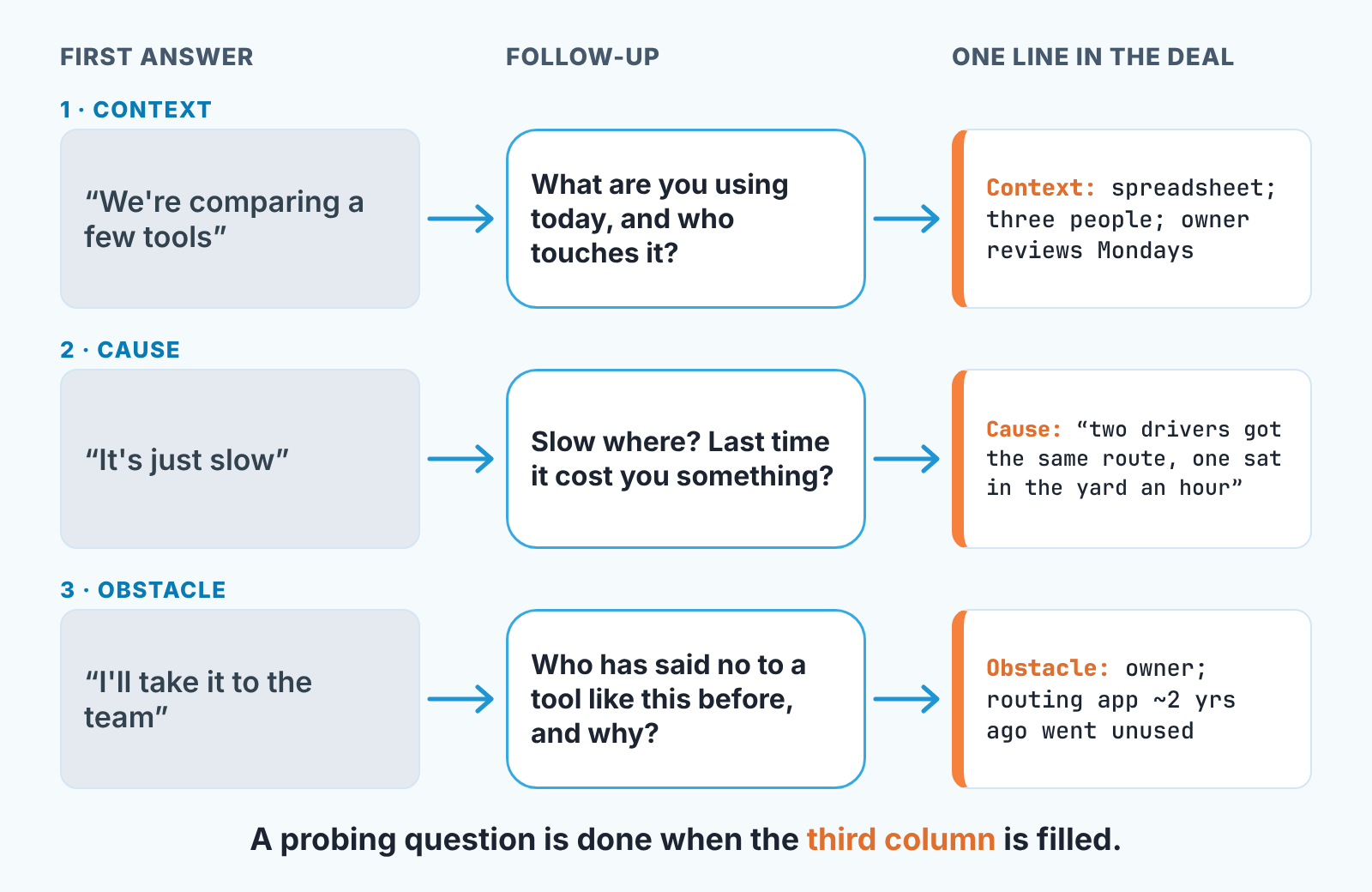
A manager who was not on the call can read each of those lines and understand the deal. That is the bar.
Seven probing questions worth keeping in your head, and what each one adds to the deal:
- “Slow where?” → the cause, not the symptom
- “Tell me about the last time it cost you something.” → a dated incident
- “Who besides you touches it in a normal week?” → the other people involved
- “You said ‘outgrown’. Outgrown how?” → context in their word
- “What did you try before this?” → the fix that failed
- “Who has said no to a tool like this before?” → the obstacle, by name
- “What led to doing it that way?” → the history, without defensiveness
Questions that sound deep but add nothing
Some follow-ups have the shape of a probing question and none of the effect. Four of them come up often enough to name.
The “why” under pressure. Copper’s guide advises avoiding “why” unless it is a clarifying question, because people tend to hear it as an accusation and get defensive (Copper). We agree. Asked flat, “why do you do it that way?” makes the buyer defend the current setup instead of describing it. Swap in “what led to doing it that way?” and the same person tells you the history.
The leading follow-up. “So the real issue is visibility, right?” The buyer nods, the rep writes “visibility” in the note, and the deal now contains the rep’s word with the buyer’s name on it. A probing question gives the buyer room to say something you did not expect. This one leaves room for yes.
The stacked question. “How many drivers do you have and how do you handle changes and what happens when someone calls in sick?” The buyer answers the easiest third. You record a headcount.
The one you already know the answer to. It shows you did your homework and adds nothing to the deal.
Yes-or-no questions are not on this list. A closed question that produces a fact (“Is the owner the one who signs?”) earns its line like any other. What matters is whether the answer was new.
Where the answer goes: one line in the buyer’s words
The rule we hold reps to is plain: one probing question, one line in the deal, written by the person who heard the answer, before the next call starts. Not a tidy summary at the end of the day, when the yard and the hour and Thursday have already blurred into “scheduling issues”.
The line has three parts, in a fixed order so a reader can scan a column of them.
Job: the fact or the buyer's sentence (who said it, when)
Using the invented call above, Cause: "one driver sat in the yard an hour" (dispatch lead, 23 Oct call) is a line. Discussed pain points around scheduling is not, because it would be true of every call the rep ever made. If what the buyer said was a number, write the number with its unit. If it was a reason, quote it. If it was a name, write the role next to it.
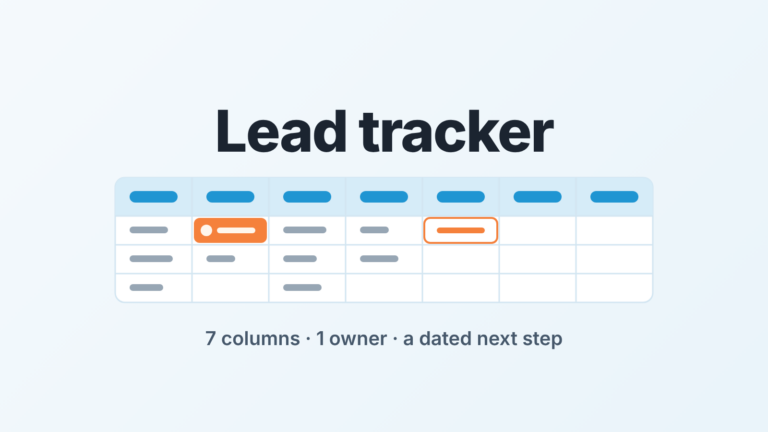
A note on the deal works. A dedicated long-text field works better once a manager wants to scan many deals at once. If you want fields, question-based selling: one deal field per question type maps probing to a single “Current situation” field among the others; this post is about the follow-up that fills it. If your team keeps a call note instead the cause line fits the first line of the five-line call note and the obstacle fits its objection line, without changing anything else.
Three deals, one buyer sentence each
The manager’s half: on Friday, pick three deals that moved stage this week. Open each one and look for a single sentence about the cause that only this buyer could have said. “Two drivers got the same route” passes. “Pain: efficiency” fails, and so does an empty note.
The empty-field review in the question-based selling post looks for the first blank. This one reads a field that is already filled and asks whose words are in it: the buyer’s or the rep’s.
A fail means one of two things. Either the probing question was never asked, which is a coaching conversation about the call, or it was asked and never written down, which is a conversation about the ten seconds after it.
Either way, the next activity on that deal is not the demo that is already booked. It is one follow-up call with one job, and its subject says which: context, cause or obstacle.
We build SalesBond, a sales management layer on top of the CRM a team already uses; we started with Pipedrive. Deal Health checks every deal against more than 20 rules and flags routine signals such as no next activity scheduled or a close date that has passed, so your Friday goes to reading the three sentences. Check your CRM with SalesBond.
Every method has its own question sequence (SPIN selling in Pipedrive, Gap selling in Pipedrive, and the thirty-minute discovery call: six questions and one of three outcomes), and none of them disagree about the follow-up. So on your next call, wait for the first vague answer, ask what is underneath it, and write the the line before you dial the next number.