
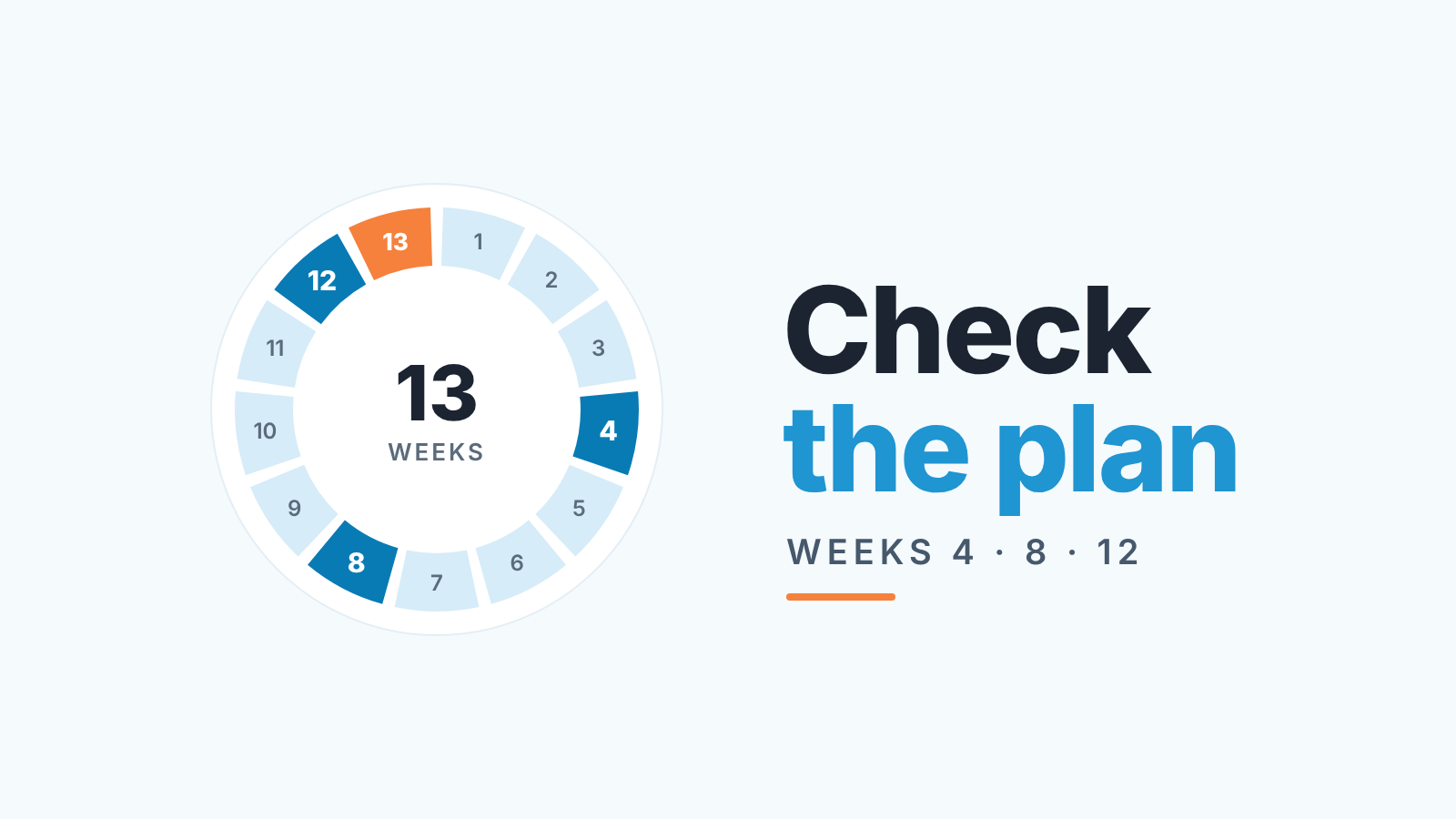
Sales planning is not finished when the plan is written. Compare the plan to your CRM at weeks 4, 8 and 12 using one number each: open pipeline against what the target needs, deals in the closing stages, and what slipped. At each checkpoint decide one thing, whether the plan is off or the quarter is, and change the part that is actually wrong.
A plan is only useful if it is checked
Sales planning means setting the quarter’s target and working out the numbers underneath it: how many deals the team has to win, at what size, and how many have to enter the pipeline for that to happen. Most teams do that part. The step that gets skipped is the check.
Plenty of plans live until Wednesday of week one: the kickoff slide goes out, and nobody opens the document again until the quarter is over.
The pages that rank for “sales planning” mention the check and stop there. In IBM’s twelve-step process, step eleven is “Monitor and adjust”: “track progress regularly against the established sales metrics and KPIs” (IBM: Sales planning). Salesforce says startups and new companies “should review their plan at least every quarter” (Salesforce: What is a sales plan?). Neither says which number to look at in week four or what to do when it is wrong.
Our position: for a team of two to ten reps, a one-page plan checked three times a quarter against the CRM beats a long plan checked once. Checking is cheap. One number, one filter, fifteen minutes. The expensive part is finding out in week thirteen.
What the plan has to say in numbers
Before a plan can be checked it has to contain four numbers. If yours is a page of prose and a revenue figure, pull them out first.
- The target for the quarter, in revenue or won deals. Where it comes from is covered in how to set sales quotas and sales capacity planning for a small team.
- Average won deal size = won deal value over the last two or three quarters ÷ number of won deals.
- Win rate = won ÷ (won + lost) over the same period, counting only deals that reached a qualified stage, so leads nobody worked don’t drag it down.
- The pool the target needs: wins needed = target ÷ average won deal size (skip this if the target is already in won deals), and pool = wins needed ÷ win rate. The working is in pipeline generation target per rep.
The checkpoints measure against the pool, not the revenue figure. Put the four numbers at the top of the plan, dated; a one-page pipeline plan already has most of them.
Checkpoint one: week 4, is pipeline coverage enough
In week four you cannot know whether you will hit the number. You can know whether it is still possible.
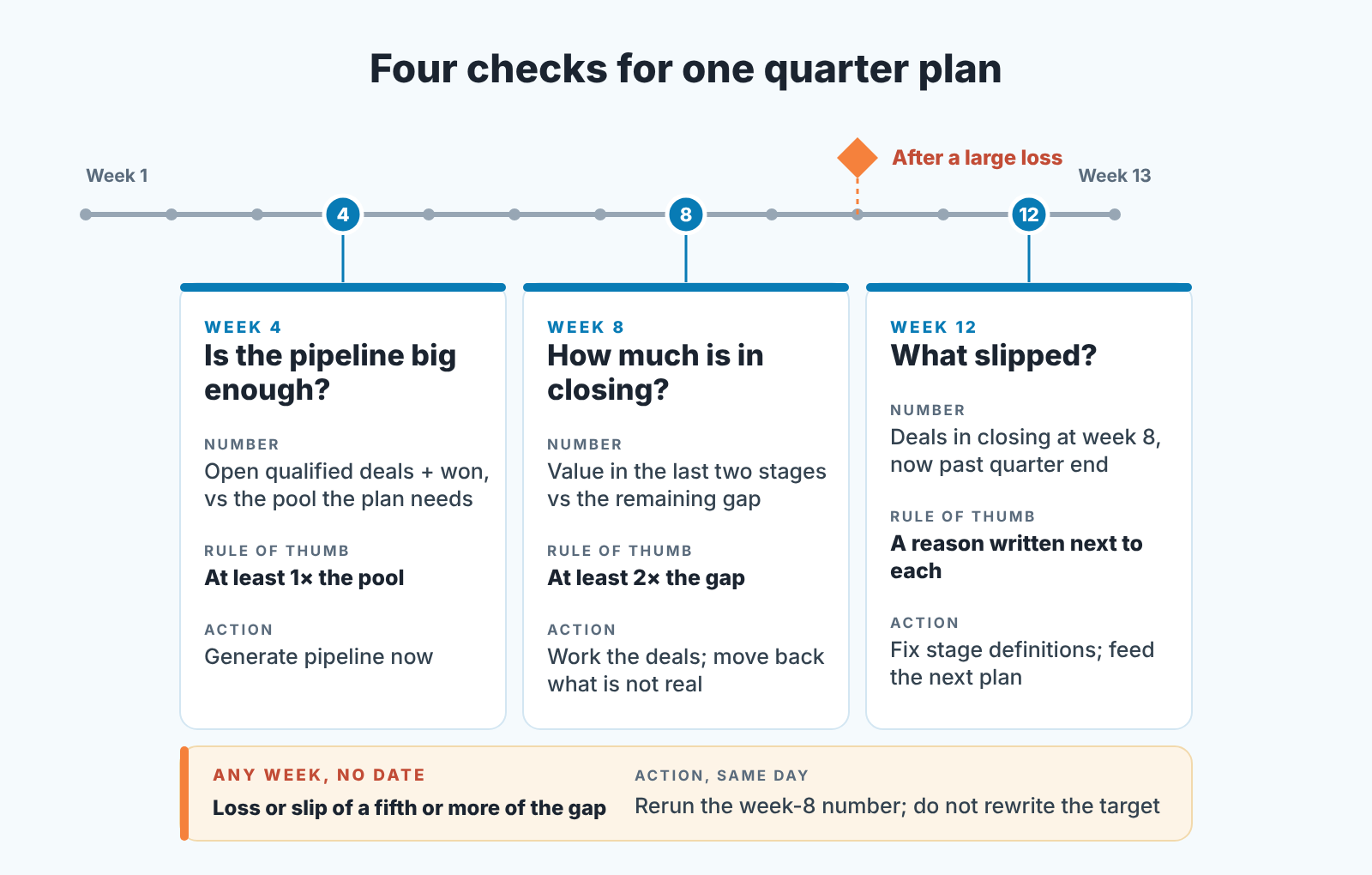
The number is pipeline coverage: open qualified deals plus deals already won this quarter, divided by the pool the plan needs. The usual pipeline coverage ratio divides open pipeline value by quota instead, so the two sit on different scales. Our 1× of the pool comes out at roughly 1 ÷ win rate on the usual ratio, which is 4× for a team winning 25% of qualified deals.
In Pipedrive that is a filter on stage and open status; in HubSpot, deal stage and the amount property; in Salesforce, stage and amount on open opportunities. Leave out the first stage if your team logs every inbound form into it. You want deals a rep has actually spoken to.
Our rule of thumb, not an industry figure: at week four, coverage should be at least 1×. The whole pool, not a third of it. The reason is the calendar. Nine of the thirteen weeks are left, and if your usual cycle from qualified to won is longer than that, a deal that enters the pipeline after week four will close next quarter. The pipeline you have in week four is close to the pipeline you will finish with.
Under the line, the action is pipeline generation, now: per-rep new-deal counts for the next four weeks, reviewed weekly. Pushing harder on the deals you already have does not fix a pool that is too small. If the gap is wide, we wrote separately about an empty pipeline at the start of the quarter. Far over the line check the stage definitions before you celebrate. A pipeline at 2× the pool or above often means deals sitting in a qualified stage that nobody has qualified.
Checkpoint two: week 8, how much is actually in closing
Week eight is the midpoint, and the question changes from “is there enough” to “is enough of it moving”.
The number: value of open deals in the last two stages before won, with a close date inside the quarter, against the remaining gap (target minus what is already won). Pipedrive calls the date expected close date, HubSpot calls it close date, and Salesforce opportunities carry a close date too.
Our rule of thumb: the value in those two stages should be at least double the remaining gap. Double, because late-stage deals do go quiet, and others slip into next quarter whatever the close date says; 2× assumes about half of what is in closing comes in. If you have measured your late-stage win rate from the CRM, use it instead of our factor: remaining gap ÷ late-stage win rate is the amount you need in closing.
Two more questions. Which closing-stage deals have no next activity scheduled? A proposal with no next step is not in closing, whatever stage it sits in. And which have had the close date moved since the quarter began? A deal pushed twice is telling you something the stage is not.
Under the line in week eight, work the deals, not the pool; new deals added now will mostly land next quarter. Go down the list: which deals in closing can be confirmed this week, which need a decision-maker you have not met, which should move back a stage so the report stops lying. Moving a deal back feels harsh. It is also the cheapest moment to find out.
Checkpoint three: week 12, what slipped and why
With a week left, this checkpoint is about lessons, not the forecast.
The number: deals that were in closing stages at week eight and are still open with a close date now past quarter end. That is the slipped list. Freeze the week-eight report when you run it; that is easier than rebuilding the list from the close date’s change history.
Go through the the slipped deals one by one and write a reason next to each, in the plan document rather than in CRM notes nobody rereads. The reasons tend to be few: no decision-maker in the conversation, budget moved to the next fiscal period, a competitor you found out about late, a proposal followed by silence, or a deal that was never really at that stage.
The last one matters most for the plan, because it means your week-eight number was wrong, not your week-eight action. If a third of the slipped list “was never really at that stage”, the fix is stage definitions and a required field at the entry to the closing stage. Next quarter’s week-eight line should be stricter.
This quarter’s won deal size and win rate then go into the next plan. Our sales forecast template keeps both quarters side by side for that.
The fourth checkpoint has no date
The dated checkpoints assume an even quarter. When a deal that was a large share of the remaining gap is lost, the plan is wrong that afternoon, not at the next checkpoint.
So the fourth check is triggered, not scheduled. After any single loss or slip worth a fifth or more of the remaining gap (our rule of thumb again), rerun the week-eight number the same day. Usually the choice is then between pulling one or two next-quarter deals forward and accepting the miss early; either beats a surprise at the end. What you should not do is rewrite the target. It was set from capacity and history, and one lost deal changes neither.
When the plan is wrong, and when the quarter is
The quarter is off when the plan’s numbers still hold but execution is behind them. Win rate and deal size match the plan; there are simply fewer deals, or they are moving slowly. The fix is activity: generation in week four, closing work in week eight. The plan stays as written.
The plan is off when the numbers themselves have moved. Win rate is running well under the figure at the top of the page, deal size has dropped, or a rep left in week three and capacity is lower than the plan assumed. More activity against the wrong numbers just produces a bigger miss. Recalculate the pool with the new win rate and deal size, and if the target rested on capacity that no longer exists, say so in writing to whoever owns it. We think an honest downward revision in week eight is a management act. The same revision in week thirteen is an excuse.
A disclosure: we build SalesBond, a sales management layer on top of the CRM a team already uses; we started with Pipedrive. Its Sales Plan keeps the target, current attainment and the gap to target in one place. The filters above do the job too. What matters is that someone opens them on the dates in the plan. Check your CRM with SalesBond.
Put the dates in the calendar, not the plan
Put three recurring events in teh team calendar now (end of week four, end of week eight, end of week twelve), each with the one number to read and the filter that produces it. Add the fourth as a standing rule: large loss, same-day recheck. Four short meetings a quarter is the entire cost of knowing in week four what would otherwise surface in week thirteen.