An elevator pitch in B2B sales is the 20 to 60 seconds in which you say who you help, what problem you take off their hands and what changes once you do, and then you end with a question instead of a list of features. On an expo stand it can be as short as “We work with service companies that run ten to fifty technicians and still plan tomorrow’s jobs by phone the evening before. How does your team get tomorrow’s jobs today?” The pitch has done its job when the person across the table says “tell me more”. Everything here is about introducing your company to a future customer at a first meeting, a first call, an expo stand or an event; a pitch for a job interview follows different rules.
What a B2B elevator pitch is (and what this article is not about)
Wikipedia defines an elevator pitch as a short description of an idea, product or company that explains the concept so that any listener can understand it in a short period of time. The name comes from the length of an elevator ride, which the entry puts at roughly thirty seconds to two minutes (Wikipedia: Elevator pitch). The same entry quotes business growth strategist Wendy Shore on the point that matters most to a seller: the goal is not to make a sale but to generate enough interest to earn a continuation of the conversation.
That is the whole job. A B2B elevator pitch is the sentence or four that gets you the next ten minutes with someone who did not plan to spend them on you.
The career version of the pitch is about you: your skills, your goals, why a team would want you. Ours is about the listener’s problem, and the seller shows up only as the one who works on it. If a draft of your pitch has your name in the first sentence and the buyer’s problem in the third it is a career pitch wearing a company badge.
Elevator pitch vs sales pitch: the first 40 seconds vs the first two minutes
We wrote about the sales pitch separately, and the difference is practical. There, the pitch is the first two minutes of a first conversation, built from the words buyers already used in your CRM and versioned so you can compare win rate later. The elevator pitch is what happens before those two minutes. It earns them.
So it leaves out things that the the sales pitch includes. No features. No price range. One proof. And it ends with a question rather than a proposed next step, because at second forty nobody has given you permission to propose anything yet.
You can hear the switch in a live conversation. The moment the listener asks a question back (“how does that work with our ERP?”), the elevator pitch is over and you are in the sales pitch. Stop reciting and answer. A rep who keeps delivering the prepared sixty seconds through a buyer’s question has lost the one thing the pitch was for.
The formula: who, problem, change, proof, question
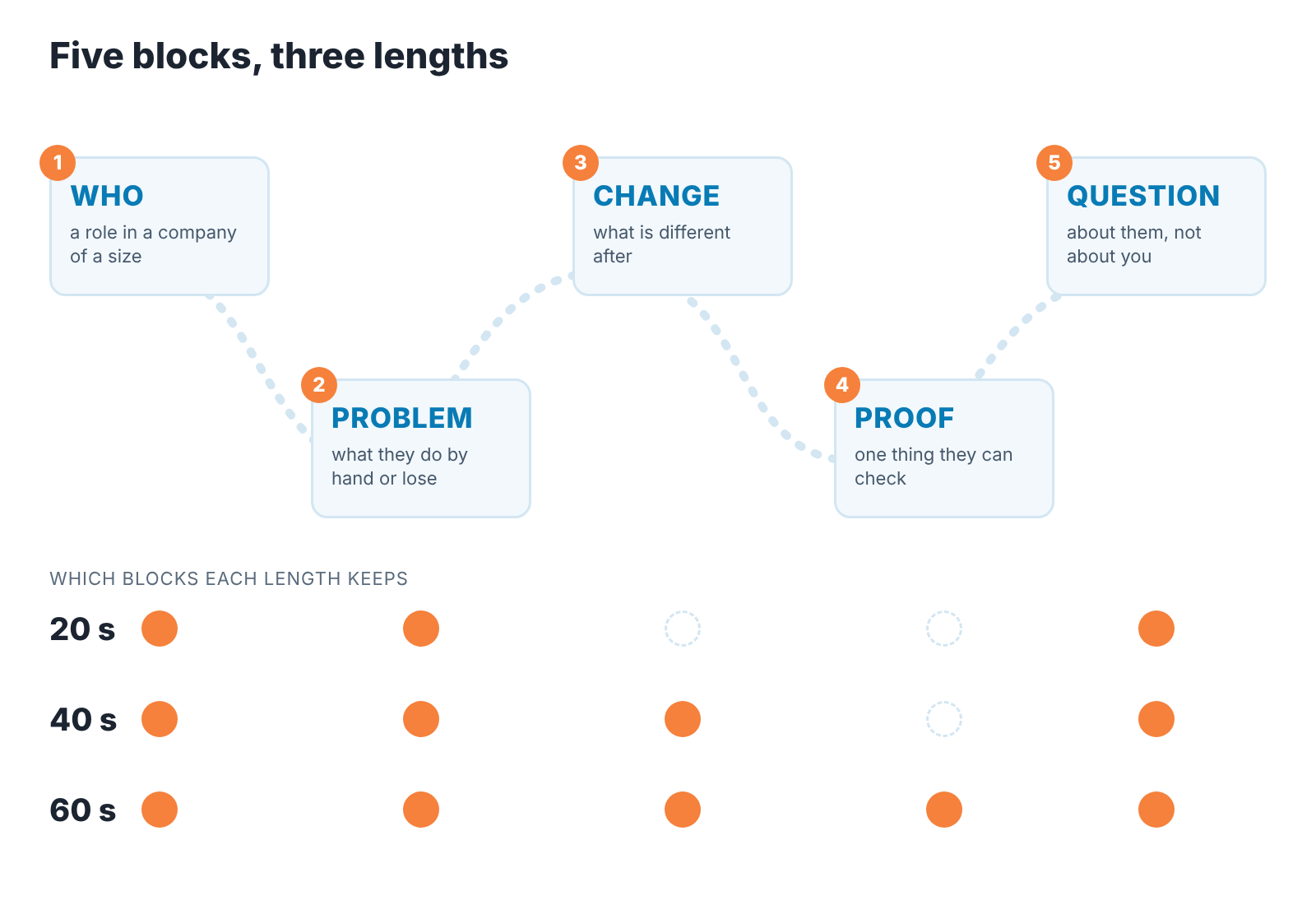
Five blocks, in this order. The order is most of the work.
Who. A role in a type of company of a size. Words like “businesses” or “companies like yours” are too broad. “Owners of regional logistics firms with twenty to a hundred trucks” tells the listener in two seconds whether to keep listening. “Businesses that want to grow” tells them nothing and costs the same two seconds.
Problem. The thing they do by hand, do twice, or lose money on, in the words they would use at their own Monday meeting. Not your category name. A buyer does not have a “workflow automation problem”. They have a dispatcher who rebuilds the same spreadsheet every morning.
Change. What is different after you, stated as a state and not as a promise. “The morning plan is ready before the dispatcher arrives” is a state. “You will save hours every week” is a promise, and a listener who has heard that promise from four vendors this year stops listening at the word “save”.
Proof. One, and checkable. A named type of customer, how long you have been doing this, or a number you can show on the next call. If you have no number yet, do not invent one; “we have run this for three cold-storage operators since spring” is a proof. “Clients see significant improvement” is not, and a procurement manager will ask you to show it, which is the wrong first question to get.
Question. Open, about them, and aimed at the problem block. “How does your dispatcher build the morning plan today?” If the answer is “we don’t have a dispatcher”, you have learned in ten seconds that this is not your buyer. That is also a result.
What we see in draft pitches is almost always the same defect: the who is at the end. “We are a software company founded in 2019 that builds planning tools, and we work mostly with logistics firms.” By the time the buyer hears “logistics”, they have been listening to your biography for fifteen seconds. Flip it.
If you have met the “3 C’s” (clear, concise and compelling, as Asana’s elevator pitch guide lists them), the five blocks are one way to get there. Who and problem make it clear. Cutting to one proof makes it concise. The question is what makes it compelling, because it gives the listener something to do.
Three lengths for three places
The same five blocks, cut differently. We use 20, 40 and 60 seconds as working lengths. They are our habit, not a rule from a book, and your own clock may differ by a few seconds.
On an expo floor you get about 20 seconds before the person’s eyes move to the next stand. That is who, problem, question. Nothing else. “We work with owners of regional logistics firms who still plan the day in a spreadsheet. Does your dispatcher do that, or have you moved off it?” The proof waits until they stop walking. If someone stops and asks for 30 seconds, stretch this version with the change in one sentence and still leave the proof out; if it runs long, shorten the problem sentence, because that is the one people pad with adjectives.
On a cold call, around 40 seconds after the opener is what you can hold before the person decides whether this call continues. That is who, problem, change, question. Skip the proof; on a cold call an unprompted proof sounds like a script, and the listener has a hand on the hang-up button. The pitch is one part of the call. Which outcomes to log in the CRM when it ends, and what the manager reads from them, is in our piece on cold calling for a small team.
At a first meeting you have the full 60 seconds and should use all five blocks, then stop talking. The meeting was agreed so the listener owes you a minute, and the proof belongs here because they have the time to weigh it. After the question, the discovery call starts and the pitch is over. The worst first meetings we have sat in were ones where the seller’s “introduction” ran nine minutes and the buyer’s problem never came up.
B2B elevator pitch examples for sellers and founders
Every example below is invented to show the structure. None is a customer case, and the companies do not exist.
A SaaS seller, scheduling software for field service teams. Before:
Hi, I’m with FieldPlan. We’re a cloud-based platform for field service management with real-time scheduling, mobile apps for technicians, and integrations with all major accounting tools. We’d love to show you a demo.
After:
We work with service companies that run ten to fifty technicians and still plan tomorrow’s jobs by phone the evening before. With us the plan is built by three in the afternoon and the technicians see it on their phones. We’ve been running this with HVAC contractors for two years. How does your team get tomorrow’s jobs today?
The features went away. The who moved to the first word. The proof became something the listener can verify by asking for a reference.
A service company, outsourced bookkeeping for restaurants. Before:
We provide full-service accounting and bookkeeping solutions tailored to the hospitality industry, with a dedicated team and transparent pricing.
After:
We do the books for restaurant groups with three to ten locations, the ones where the owner finds out in March what January cost. Our clients get each location’s numbers by the tenth of the next month. We’ve done this for restaurant groups for six years. When do you see last month’s numbers now?
A manufacturer, corrugated packaging for food producers. Before:
We’re a family-owned packaging manufacturer with forty years of experience and a modern production facility.
After:
We make shipping boxes for mid-size food producers who are tired of a six-week lead time from the big suppliers. Our standard run ships in ten working days. Two of the regional dairies in this state have moved to us this year. What’s your lead time on boxes right now?
Forty years of history is a fine thing. It is not a problem the buyer has.
A consultant, sales process for founder-led companies. Before:
I help businesses optimise their sales processes and drive growth through proven methodologies.
After:
I work with founders who still close most of the deals themselves and have hired two or three salespeople who aren’t closing yet. After three months the founder is out of the first call. I’ve done this with eleven software companies. Who runs the first call with a new lead at your company today?
A founder on an expo floor, route planning for last-mile delivery. The 20-second version:
We work with delivery companies that run twenty to a hundred vans, on route planning. Are your routes still planned by the dispatcher in the morning, or is that automated already?
That is the whole thing. If they stop, the founder adds the change and the proof. If they keep walking, nothing was wasted.
So what is a good elevator pitch example? One that names the listener’s type of company in the first sentence and their problem in the second, and ends with a question. “Good” only means something relative to who hears it: the packaging pitch would be a poor one for a software buyer.
Adapting the pitch to who is listening
Keep who and problem fixed. Swap change and proof for the person in front of you, and aim the question at what they personally own.
A procurement manager owns risk and comparability. The change they want to hear is that the purchase is safe and easy to justify; the proof they trust is a reference in their industry and a clear answer on compliance and contract terms. Ask about their process: “How are you comparing options on this right now?”
A finance director owns cost and cash. The change is what they stop paying for, or how much sooner the cash comes in. The proof is a number you can show on paper on the next call, with its period. Ask where the cost sits today: “Which line does this show up on for you now?”
A technical owner, a CTO or a head of operations, owns the things that break. For them the change is what your product touches and what it leaves alone. The proof is an integration they can name. A line like “we integrate with everything” proves nothing to them. Ask about the current stack and who maintains it.
A business owner owns the whole thing and thier own evenings. The change is a task they personally stop doing. The proof can be a peer: another owner of a company like theirs. Ask what they still do by hand that they shouldn’t have to.
This is the same logic as consultative selling, squeezed into one minute: the pitch is a question with an introduction attached, and the question changes with the chair. We would rather a rep carried four pitches of forty seconds than one of two minutes that tries to cover all four listeners.
Five mistakes that kill the pitch
The first is starting with the company. Founding year, headquarters, team size. Nobody has ever said “tell me more” to a founding year.
The second is a feature list where the problem should be. Features are answers, and at second ten the buyer has not asked a question yet.
The third is the verb “help” with no object. “We help businesses grow” fits a bank, a gym and a printing shop equally well. If you can swap your company name for a competitor’s and the pitch still works, its not a pitch.
The fourth is stacking proof. Three numbers, two logos and an award in one breath. Each one dilutes the others, and the listener remembers none. Pick one and keep the rest for the follow-up call.
The fifth is ending on a statement. “So that’s what we do.” A full stop hands the next move to the listener, and the polite move is “great, thanks” and a step toward the coffee. A question gives them a reason to stay.
A test: how to know the pitch works
“I like it” is not a test. Neither is “the sales trainer liked it”. The only honest measure of an elevator pitch is whether first conversations turn into second ones, and your CRM can count that if you let it.
Two measurements, both cheap.
The first is the share of first contacts that led to a second conversation within a window you choose, say fourteen days. A first contact is any conversation where the pitch was delivered: expo, cold call, intro meeting. A second conversation is a scheduled call or meeting that actually happened. Pull the ratio by month. We are not going to give you a benchmark because we do not have one, and neither does anyone who quotes you a percentage without showing the data. Compare your own months against each other, and the pitch versions within them.
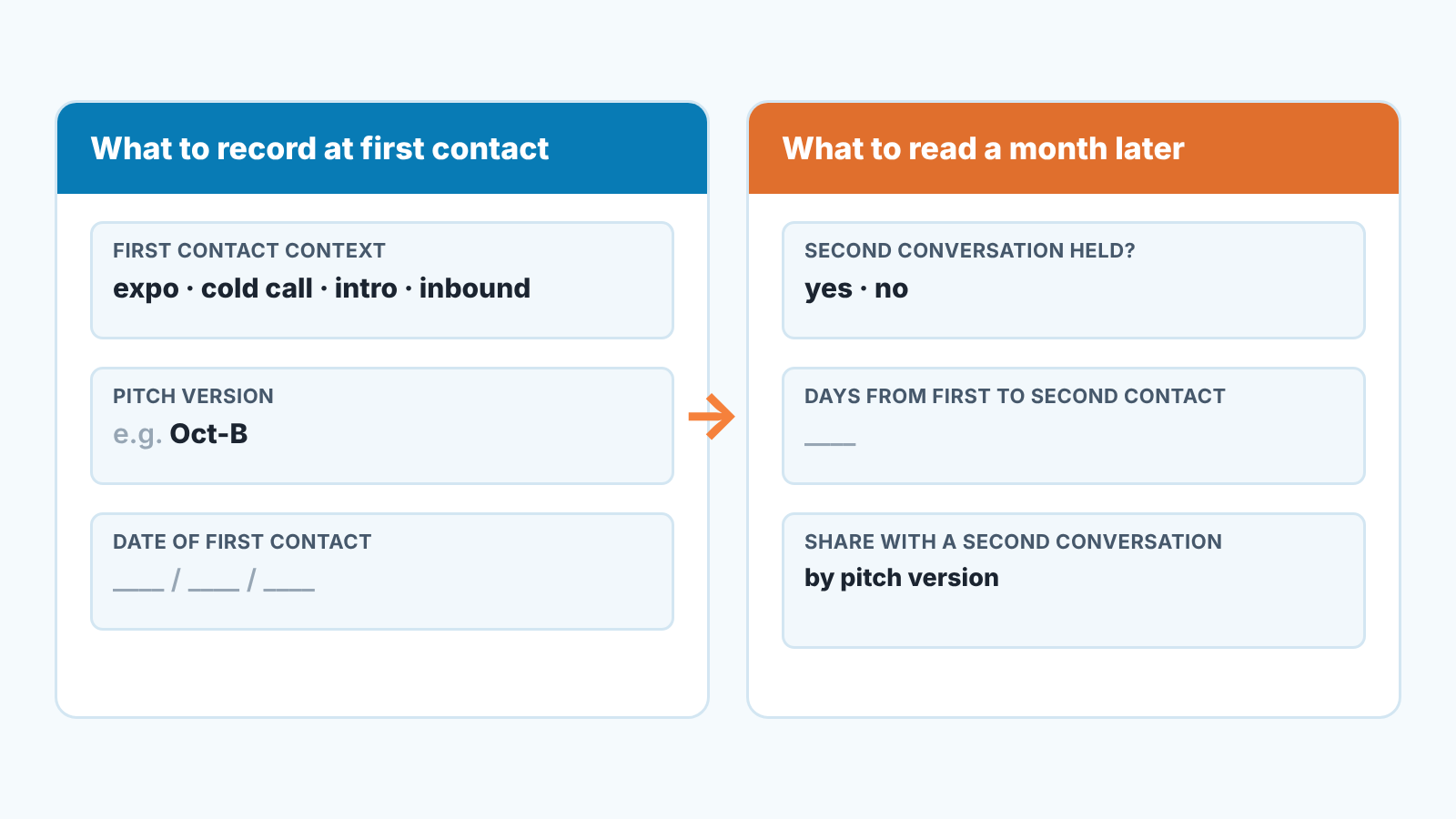
The second is a record of which version of the pitch each contact heard. That needs two fields on the contact or the deal, whichever your CRM creates at first contact: a dropdown for the first contact context (expo, cold call, intro, inbound) and a short field for the pitch version, which can be a date or a letter. Then the second contact date, which most CRMs already hold as the next completed activity. With these three things you can answer “did version B from October get more second meetings than version A from September?” in a filtered list, no spreadsheet needed. When those second meetings become deals, the habit carries further down the funnel: comparing pitch versions by win rate is the same idea with a longer wait.
Where does the pitch sit in the larger process? It is the first minute of the first stage, before qualification, before discovery, before anyone has said the word “proposal”. If you are mapping the whole thing, our guide to the B2B sales process from first contact to repeat purchase shows where the pitch stands relative to everything that follows.
A note on the tool we build, since it reads the same data. The free CRM audit from SalesBond looks at the last 30 days of the connected CRM and sends a PDF with money at risk, deal health and the pipeline bottleneck, then a second PDF a week later with what changed. It will not grade your pitch. It will show whether the deals that came out of those first conversations are moving or sitting, and that is the question the pitch was supposed to set up.
An elevator pitch template you can copy
Three lines. Fill them in, read them aloud with a stopwatch, and cut until the 60-second version fits.
We work with [role] at [type of company, size] who [problem, in their words].
With us, [what is different after], and [one proof they can check].
[Open question about how they handle the problem today]?
For the 20-second version keep line one and the question. For the 40-second version add the first half of line two.
Then pick the next place you will actually use it, an expo next month or tomorrow’s call block, and add the pitch version field before you go. After four weeks, compare the share of second meetings for each version and keep the stronger one.