Cold calling is phoning a potential customer who has had no prior contact with you, usually to start a conversation and book a meeting rather than to sell on the spot. It still works for some teams and not for others, and published success rates of about 2–6% are not comparable because vendors count different things. This guide covers how a cold call goes, how to handle the usual brush-offs, whether it is legal, and how to count your own dials, conversations and meetings in the CRM.
That last part is the one most guides skip. If the rep picks the call outcome from a list instead of typing a note, the funnel builds itself and the manager can read it on Monday.
What is cold calling?
A cold call is a call to someone who has had no prior contact with the salesperson. Merriam-Webster defines it as a telephone call soliciting business made directly to a potential customer without prior contact (Merriam-Webster). The person did not fill in a form, did not download anything, did not reply to an email. You have a name and a number, and you call.
Cold calling meaning, in plain sales terms: it is the outbound half of prospecting, where the rep starts the relationship instead of waiting for the buyer to start it. Kaspr describes it as a technique that helps reps spark a conversation, gauge interest or qualify a lead, and the difference from a warm call is exactly that lack of prior contact (Kaspr). A warm call follows some earlier touch: an inbound request, a referral, a reply to an email. A cold call follows nothing.
The purpose is narrower than people expect: in Call Center Studio’s words, to create interest and then schedule a follow-up meeting (Call Center Studio), so a rep who comes back with “we had a great chat” instead of a date has not had a good call.
Two things get mislabelled as cold calling in small teams, and the mislabelling ruins the numbers.
The first is calling inbound leads late. Someone requested a quote two weeks ago, nobody called, and now a rep is “cold calling” them. That is a slow follow-up, and it converts very differently from a true cold list. Keep it out of the cold-call funnel or your meeting rate will flatter you for the wrong reason (we wrote about the split in inbound versus outbound for a small team).
The second is the referral. A referral consultant put it bluntly in 2012: if you just get a name, you’re cold calling (No More Cold Calling). The reverse holds too. If a customer introduced you, the call is warm, and logging it as cold inflates the cold number. One honest tag on the lead before the dial; for Pipedrive teams we described a workable hot, warm and cold labelling rule.
Is cold calling still worth it?
It depends on the list and on how you count, and nobody can answer it for your team from the outside.
The “cold calling is dead” argument is usually made by someone selling the alternative, and the “it still works” argument by someone selling dialers or data. Both sides quote percentages, and the percentages do not share a denominator, which we take apart in the section on success rates below.
What we will say is where it tends to fail. Kaspr makes the point that cold calls turn into spam when you target the wrong audience repeatedly (Kaspr), and in our experience a dead list is mistaken for a dead channel far more often then the other way round. A team that dials the same 300 companies every quarter with the same opener will conclude the phone does not work. A team that builds a fresh segment, dials it for four weeks and reads its own connect rate and meeting rate will know whether it works for them. That is the only test that counts, and it costs four weeks.
If the phone is not the channel for a segment, that is a useful finding; the section on when to stop covers how to read that in the numbers. For a segment that reads better in writing, the same lead list can go into cold email instead.
How to cold call, step by step
A cold call that works has four parts, and they come in a fixed order: preparation, the opening, one question, and an agreement on the next step. Each part has something to put in the CRM, which is why we lay it out this way rather than as a script.
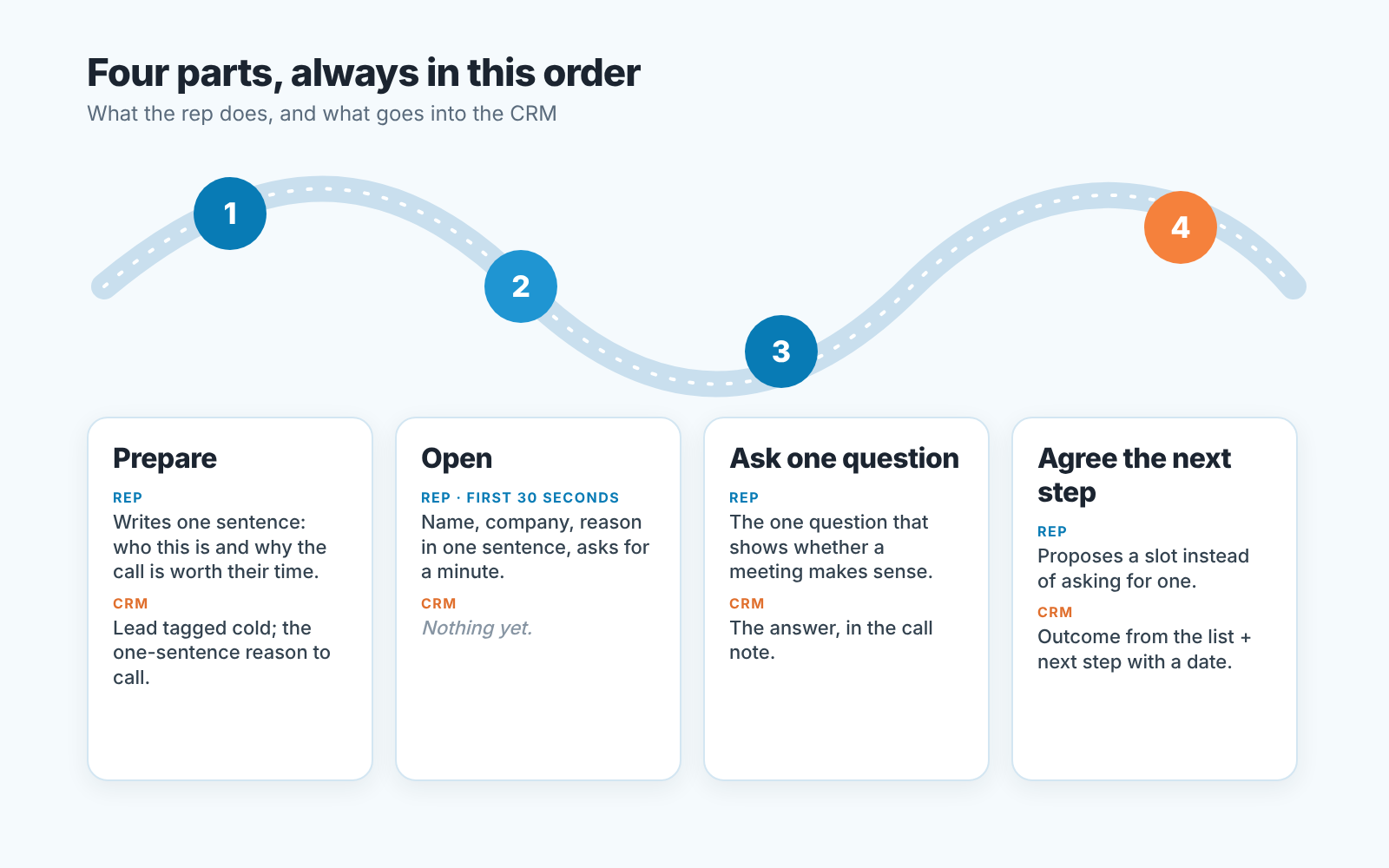
It starts before the dial. The rep should be able to say in one sentence who this is and why the call is worth their time. That should be a reason tied to the company: a job post, a new office, a product they sell that usually comes with the problem you solve. If the rep cannot write that sentence, the lead goes back to whoever built the list.
Then the opening. The first thirty seconds decide whether there is a call at all. Say your name and company, say why you are calling in one sentence, and ask for a minute. An example opener (our wording): “Hi, this is Anna from Example. I’m calling because you’re hiring two field sales reps, and that usually means someone is about to be asked how many visits the team made last week. Do you have a minute?” The words matter less than two things: the reason is about the prospect, and the ask is small.
Third, one question. A cold call is not a discovery call. One question is enough, and it should be the question that tells you whether a meeting makes sense: “How do you know today whether the reps are on plan before the month ends?” (example, ours). Listen to the answer and write it down in the the call note in the prospect’s words. A full discovery call for a small team is a separate conversation with its own structure; do not try to have it in minute two of a cold call.
And last, the next step. The call ends with a meeting on a date, or with a clear no. Propose a slot rather than asking for one: “Would Tuesday at ten or Wednesday at two work for a twenty-minute call?” Then log the outcome from the fixed list and set the next activity with a date. The outcome list and the next-step rule are further down.
This is the skeleton. A full written script, with the fields a rep fills in Pipedrive while on the call, is in our cold call script guide for Pipedrive; we are not repeating it here. Reviewing a recorded call against the four parts is a scorecard question, also covered separately.
Handling the common brush-offs
Most cold calls that reach the right person end in one of five replies. Each deserves a question back rather than a counter-argument, and a note the manager can count.
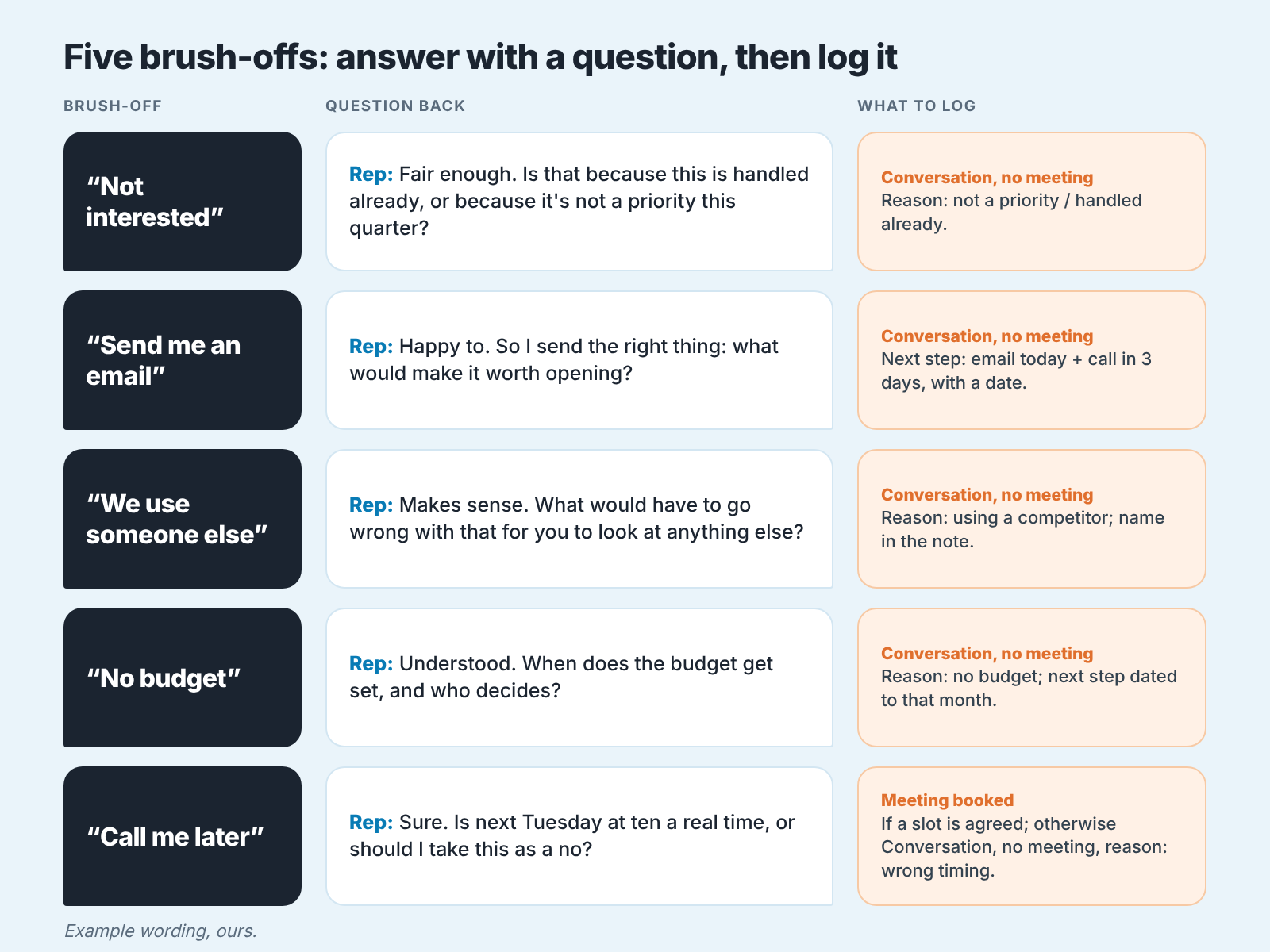
“Not interested” usually means “I don’t know who you are and I’m busy”. It is rarely a considered rejection, so the outcome is “Conversation, no meeting” with a reason picked from the list. “Send me an email” is a polite hang-up unless the email goes out the same day with a dated call three days later.
“We use someone else” is good news for the list: the company has the problem and pays to solve it. Write the competitor’s name in the note, because six months later that note is the reason to call again. “No budget” needs two facts, when the budget gets set and who sets it, and a next step dated to that month.
“Call me later” is either a meeting or a no, and the rep should find out which on the spot. Never “call back sometime”.
How to log objections so they become a coaching loop, and what the manager does with the report, is the subject of our objection handling article for Pipedrive.
Voicemail and gatekeepers
Most dials do not reach the target at all, and the two usual stops are a voicemail box and a person whose job is to keep you out.
Leave a voicemail only if you intend to follow it up and keep it to the reason for the call plus your name and number. Log it as “Voicemail”, not as a conversation; it tells you nothing about the prospect. The sequence that follows a voicemail is in our voicemail follow-up guide for Pipedrive.
A gatekeeper is not an enemy and not a target. Be direct about who you want and why, ask when that person is usually reachable, and thank them. Log the dial as “Gatekeeper”, which counts as a dial and nothing else in the funnel. If the gatekeeper gives you a time or a direct line, that goes into the note, and the next step gets that time.
The best time to cold call
The honest answer to “what is the best time to cold call” is: the hour at which your connect rate is highest, and you only learn that by logging the dial time.
Amplemarket’s data says calls between 4 and 5 pm were 71% more successful than morning calls; the primary source is not named, so treat it as a hypothesis to test on your own list (Amplemarket). Decision-makers in a factory and in a design agency are reachable at different hours, and a vendors average blends both. Two weeks of dials split into morning, midday and late afternoon, with connect rate per block, beat any published chart. How to pull that from the activity report, by day of the week as well, is in best days to call, by your own Pipedrive data.
What percentage of cold calls are successful? Three vendor numbers, three definitions
Published cold call success rates range from 2% to about 6%, depending on who is counting and what they count.
Cognism’s 2024 report puts the average success rate at 4.82%: 254 meetings booked from 5,265 conversations, double the 2% it measured in 2023. The data is Cognism’s own calls (Cognism: State of Cold Calling). Amplemarket quotes “industry data” at 6.3% without naming the primary source (Amplemarket). Cleverly’s statistics roundup leans on secondary sources and adds that it takes about eight attempts on average to reach a decision-maker (Cleverly).
Look at the denominators before you compare. Cognism’s 4.82% is meetings per conversation, meaning the prospect picked up and talked. Divide meetings by dials instead and the same team shows a much smaller number, because most dials never become a conversation (Cleverly’s eight attempts per decision-maker is the same point from the other side). The 6.3% figure does not say what its denominator is. And Cognism’s own number more than doubled between two reports, so even one vendor does not hold still.
Our position: use these numbers as a sanity check and nothing more. A team far below them probably has a list or pitch problem. A team far above them almost certainly has a definition problem in how “conversation” and “meeting” get logged. Between those edges the benchmark says little about your reps, and your own weekly funnel is the number to read.
The only funnel you need: dials, conversations, meetings
Three counts, per rep, per week. Nothing else goes on the manager’s page.
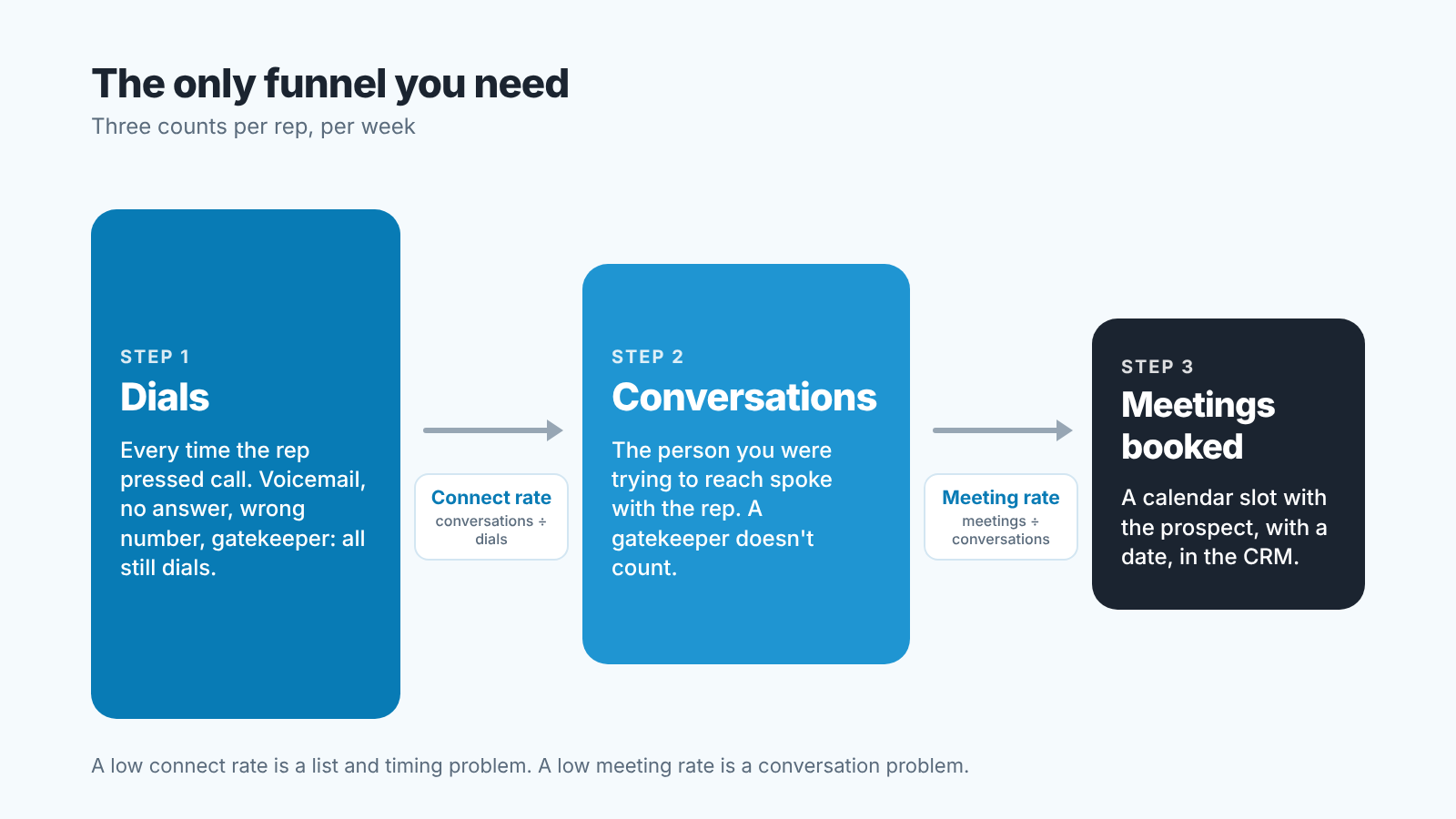
- A dial is every time the rep pressed call. Voicemail, no answer, wrong number, gatekeeper: all still dials.
- A conversation means the person you were trying to reach spoke with the rep. A gatekeeper doesn’t count. A ten-second “not interested, bye” does, because it tells you the list reached the right person and the opener did not land.
- A meeting booked is a calendar slot with the prospect, with a date, in the CRM. “Send me something and we’ll see” is not one.
Two ratios fall out of this: conversations divided by dials (your connect rate) and meetings divided by conversations (your meeting rate). Keep them separate, they diagnose different problems. A low connect rate is a list and timing problem. A low meeting rate is a conversation problem, and that is where coaching goes.
The definitions matter more than the tooling. If one rep counts a gatekeeper as a conversation and another does not, the team comparison is garbage, and the rep with the stricter definition looks worse. Write the three definitions down and apply them for a month before you judge anyone by the ratios. The broader set of activity metrics for a small team follows the same approach: few counts, hard definitions.
Cold call outcomes to log in the CRM (a fixed list) and the next-step rule
A dial should be able to end in only a handful of ways, and the rep should pick from a list, never type. Free-text outcomes (“left vm, try again”, “LVM”, “voicemail”) cannot be counted, and the manager ends up reading notes instead of reading a funnel.
Here is the list we use. Six outcomes, no more.
- No answer: rang out, no voicemail left.
- Voicemail: message left.
- Gatekeeper: spoke with someone other than the target; target not reached.
- Conversation, no meeting: target reached, declined or deferred.
- Meeting booked: calendar slot created.
- Bad data: wrong number, person has left, company closed.
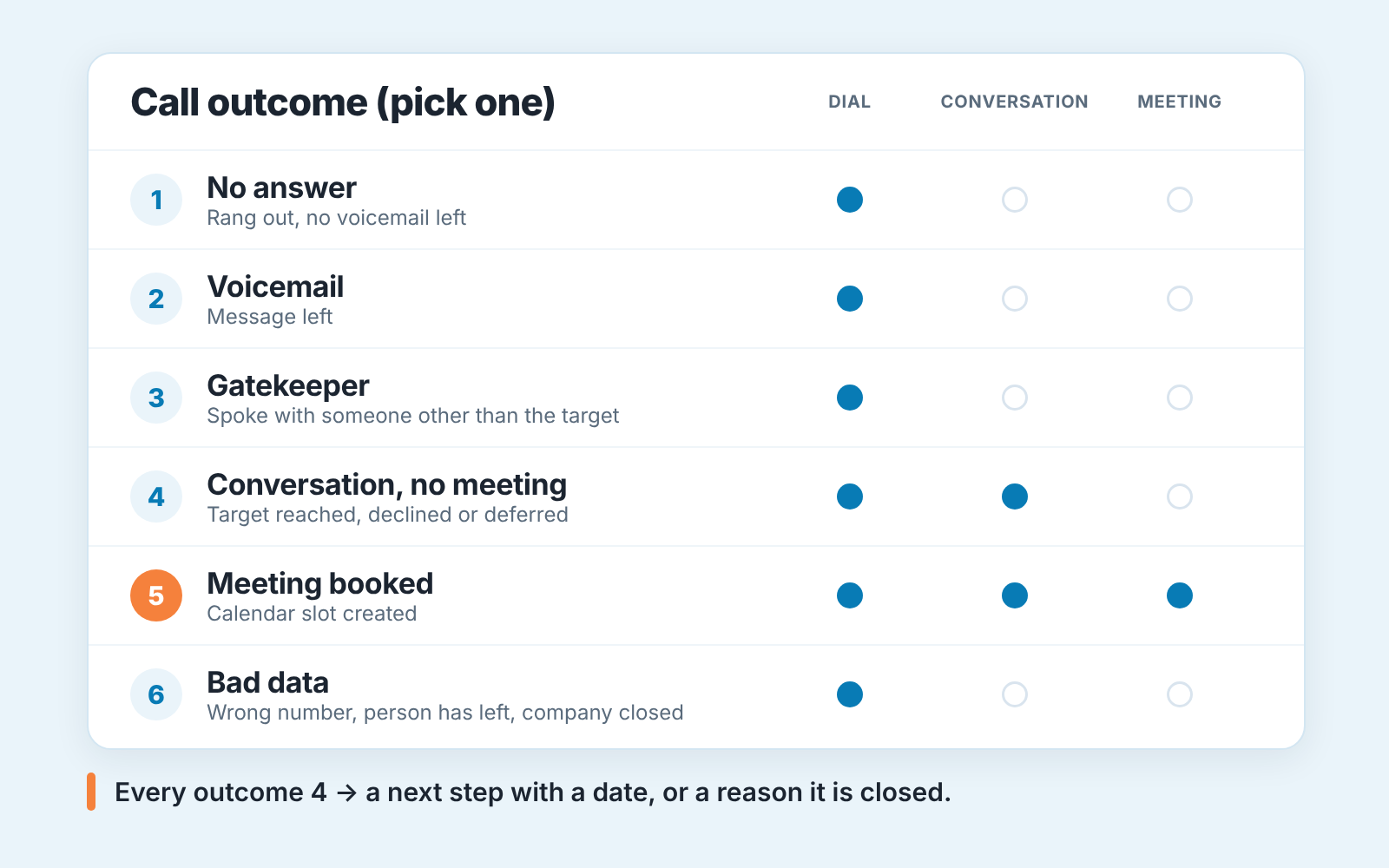
The mapping to the funnel is mechanical. Outcomes 1, 2, 3 and 6 are dials and nothing else. Outcome 4 is a dial and a conversation. Outcome 5 is all three. With this list the funnel builds itself from a filter on the activity report; nobody tallies anything by hand on Friday.
Then the one rule that keeps the pipeline honest: every conversation gets a next step with a date, or a reason it is closed. Outcome 4 is the dangerous one. A rep had the target on the phone, got a “call me next quarter” and moved on. Without the rule that lead sits in the CRM looking alive forever. With it, the rep either schedules the call now or marks the lead lost with a reason. Both are fine; a conversation left with no next step is the one outcome the rule forbids.
Two details from practice. “Conversation, no meeting” should carry a reason picked from a short list too (no budget, wrong timing, using a competitor, not the right person, not a priority); the reasons become your objection report, and they are the same reasons the brush-off section above tells the rep to log. “Bad data” measures the list, and the fix is upstream, with whoever builds the lists.
How the outcome field and the next-step requirement are set up depends on your CRM, and we have written those guides already, so this article does not repeat them: the HubSpot call outcome and next-step setup and, for teams dialing in volume, the power dialer call logging check a manager should run.
What the head of sales reads every Monday
One table per rep for last week: dials, conversations, meetings, connect rate, meeting rate. Then the count of conversations with no next step. That is the entire Monday read, and it fits on one screen.
Read it in a fixed order, because the order tells you where the problem is.
Start with dials, the only number a rep fully controls. If dials are low nothing downstream means anything, and the Monday conversation is about calendar and discipline. Pitch can wait.
Then connect rate. If one rep connects at half the team’s rate on the same list, the difference is usually timing or list segment, rarely skill. Ask what hours they dial (the section on the best time to cold call above is the test to run). If connect rate is low for everyone, the list is the problem and coaching will not fix it.
Then meeting rate. This is the skill number. Two reps with similar connect rates and very different meeting rates are having different conversations, and that is where the manager listens to a few calls and coaches teh opener and the ask. Do not coach meeting rate on a week with a handful of conversations; one lucky call moves it too much. Four weeks, then an opinion.
Last, conversations with no next step. This count should be zero every Monday, and it is the one number we would discuss in front of the whole team, because it is a hygiene rule and says nothing about performance. A rep with ten open conversations and no dates is leaking the leads that cost the most to produce.
A disclosure, since this is the part a manager would want automated: we build SalesBond, a sales management layer on top of the CRM a team already uses; we started with Pipedrive. Its Deal Health checks flag a deal with no next activity scheduled, so once a conversation has turned into a deal, the manager does not have to build that filter. Calls logged against leads that never became deals are still yours to filter. The harder work is the six-outcome list and the definitions, and no tool writes those for you.
If you want an outside read of your own data first, that is what the free CRM audit is for: SalesBond looks at the last 30 days of the connected CRM and sends a PDF report, and seven days later a second PDF with what changed. Check your CRM with SalesBond.
Is cold calling legal? Do Not Call lists and where to check
Yes, cold calling is legal in the US, and it is regulated. This is not legal advice; it is the short list of what a small team needs to know exists, with the official page to read.
The federal rule for sales calls is the FTC’s Telemarketing Sales Rule. The FTC’s own compliance guide says it is a violation to make covered calls without having accessed the National Do Not Call Registry, that call lists must be scrubbed against the Registry at least every 31 days, and that, absent prior consent, sales calls to a person’s home are limited to 8 a.m. to 9 p.m. local time at the location called (FTC: Complying with the Telemarketing Sales Rule). Violations carry civil penalties per call; the guide states the current amount, so take it from there rather than from this article.
For a B2B team the key line in that guide is this: the FTC states that most phone calls between a telemarketer and a business are exempt from the Rule, with exceptions: calls to a business to sell nondurable office or cleaning supplies, for example, are not exempt. Whether a given number on your list is a business line or a person’s is for you and your lawyer to decide.
The FTC guide also describes an “established business relationship” exemption with time limits (18 months after a purchase, three months after an inquiry) and the requirement to keep your own entity-specific do-not-call list: anyone who asks you not to call again must not be called again, Registry or not. Calls to mobile numbers are regulated by the FCC under the Telephone Consumer Protection Act (TCPA); check those rules at fcc.gov. Outside the US the rules differ by country and often by number type; check the official registry for your country or ask a lawyer.
The practical consequence for the CRM: a list scrubbed in January is not scrubbed in March. Put the scrub date on the list record and make “asked not to be called” a flag that removes the number from every future list as well as this one. That flag is your entity-specific list.
When to stop cold calling a segment
There is a point where the Monday table says the list is dead, and the honest move is to stop dialing it rather than push the reps harder.
The signal is in the two ratios together. Connect rate falls week after week while dials hold steady, and the meeting rate on the conversations you do get sits well below your other lists. You are reaching fewer people, and the ones you reach do not want the meeting. Rotating reps will not change that. Switching the list, the offer or the channel will.
Before you drop the segment check the “Bad data” share. If a large part of the outcomes are wrong numbers and departed contacts, the problem sits in the data, and a fresh list may behave completely differently. Cleverly’s roundup notes that 50 to 60% of B2B buyers prefer phone contact (secondary sources, so hold it loosely), which is one more reason to fix the list before abandoning the phone for that segment (Cleverly).
If the segment realy is dead on the phone, the leads still exist. Move them into a different prospecting motion and keep the cold-call funnel clean for the lists that respond; how a small team spreads its effort across channels is the subject of our guide to prospecting for a small sales team.
Where to start this week: put the six outcomes into the call outcome field as a dropdown, write the three funnel definitions into the team’s playbook, and next Monday read the table in the order above. Give it four Mondays before you compare anyone to anyone, including to Cognism.
Cold calling FAQ
What is cold calling like?
Mostly it is dialing. Most dials end in no answer, voicemail or a gatekeeper, and the conversations that do happen are short: Cognism’s average is 83 seconds (Cognism). A good hour is a handful of real conversations and, on a good day, a meeting; the step-by-step section covers those 83 seconds.
Is cold calling illegal in the US?
No. It is legal and regulated by the FTC’s Telemarketing Sales Rule, with the National Do Not Call Registry, calling hours and a partial exemption for business-to-business calls; details and the source are in the legal section. Not legal advice.
Is cold calling outdated?
For some lists, yes; for others, no, and vendor statistics will not tell you which is yours. Run a fresh segment for four weeks, read connect rate and meeting rate, and decide from your own numbers (is it still worth it?).
What is the best time to cold call?
The hour your own connect rate is highest. Amplemarket reports more successful calls in the late afternoon than in the morning, without naming the source, so test it on your list rather than trust it (best time to cold call).
How long should a cold call last?
About a minute and a half is normal; Cognism measured an average of 83 seconds across 55,000 direct dials and 10,000 cold calls (Cognism). The real conversation happens in the meeting, so a short call that ends in a dated slot is a good one.