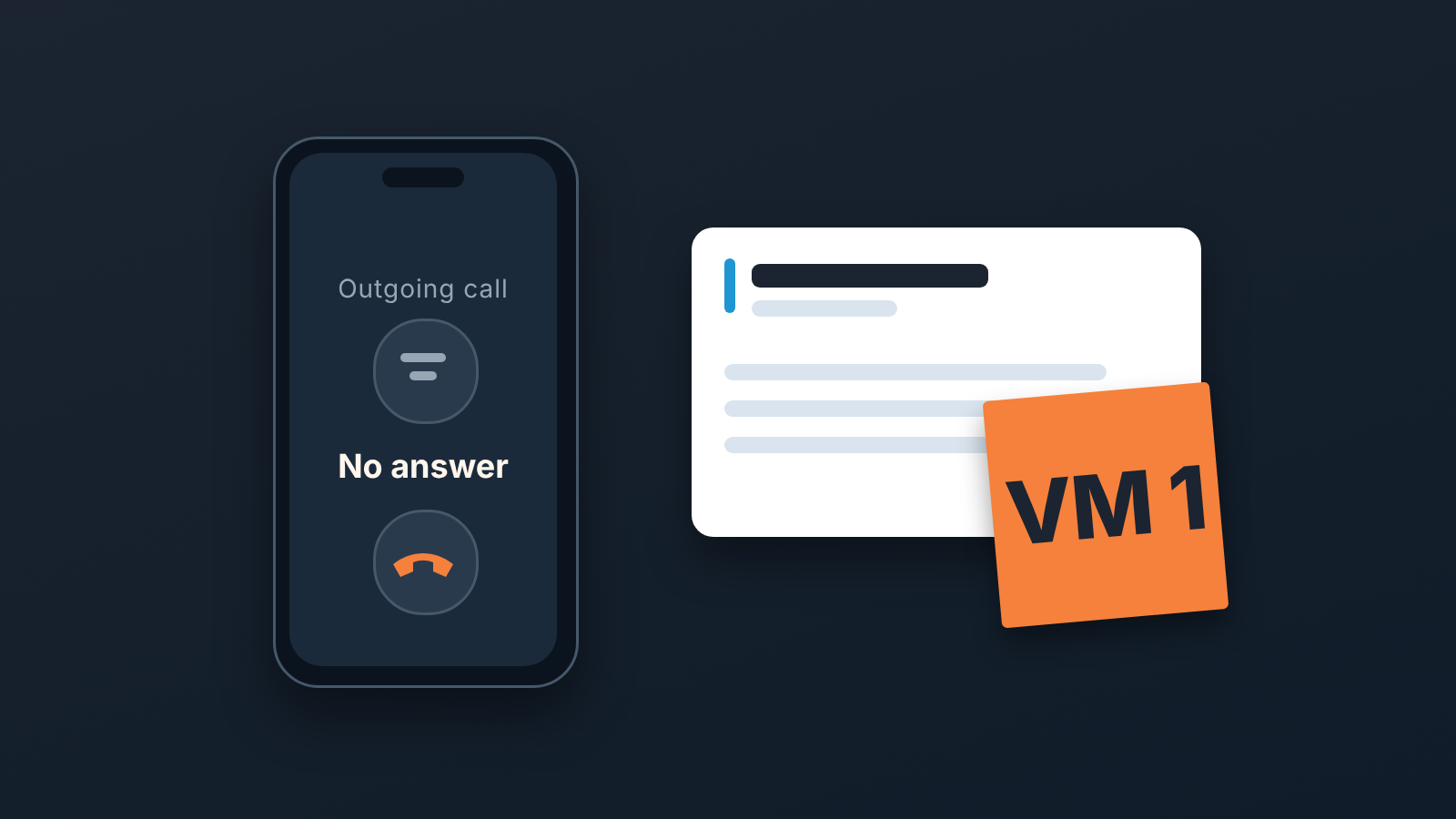
When you reach voicemail, decide three things before you hang up: whether to leave a message at all, what single reason and next step to say, and what one line to log in Pipedrive so the next person who calls knows exactly what the client already heard. Those three decisions are the whole method. They take a small team about a week to make habitual, and they replace every voicemail script library you were going to bookmark.
The second voicemail Dana never knew about
A composite example, built from several teams we have watched.
Dana sends a quote on Monday. Wednesday morning she calls the buyer, gets voicemail, and says the sensible thing: she is checking whether the quote arrived and would like ten minutes to walk through it. She marks the call done and moves on to the next deal.
At 11:40 her manager, Tom, is doing his mid-week pass through deals in the Proposal stage. The deal looks quiet. No note, no next activity, a call activity ticked off with nothing on it. He calls the buyer himself. Voicemail. He says the sensible thing: he is checking whether the quote arrived and would like ten minutes to walk through it.
The buyer gets back from a meeting to two near-identical messages from the same company, an hour apart. She replies to neither. Two days later she emails Dana: “You’ve both called me, I was in workshops all week, can we do Tuesday?” That is the first moment Dana learns a second voicemail exists.
Nothing here was lazy. What was missing was one line in the CRM: “VM left 10:35, asked for a 10-min call on the quote”. Tom would have read it and not dialed. The rest of this article is about that line and the two decisions before it.
What the data does and doesn’t say
The one voicemail study everyone cites is Gong Labs’ August 2024 analysis of cold calls, written by Armand Farrokh (Gong: should you leave voicemails when cold calling). Its headline finding is that a voicemail does not get you a callback; it gets you an email reply. In Gong’s data, leaving a voicemail raised the email reply rate from 2.73% to 5.87%. The cost is that a voicemail announces you are a salesperson: the connect rate on later dials fell to 5.17%, against 7.18% when no voicemail had been left. Gong also found that after three or more voicemails the email reply rate dropped to 2.2%, below the no-voicemail baseline. Their recommendation is two voicemails at most, each one pointing at the email rather than asking for a call back.
Read what that data is about. Its cold outreach, measured across more than 300 million dials, to people who have never spoken to the caller. Prospeo’s guide builds on the same numbers and lands on one or two messages per contact (Prospeo: how to leave a sales voicemail). Fine for a prospecting list.
It says nothing about the deal Dana is working. That buyer asked for a quote. She knows who Dana is, so the “reveals you’re a salesperson” penalty does not exist, and the number was given to you, so an unanswered dial does not burn it. The honest reading: Gong’s two-voicemail rule is a good default for cold calls, and on an open deal the question is not whether to leave a message but how to stop the second person on your team from leaving the same one.
Decision one: leave a message or hang up
The answer depends on who is on the other end, and there are only three cases a small team meets.
| Who you called | Leave a message? | What it points to | When to change channel |
|---|---|---|---|
| Cold contact, never spoken | First and second attempt only, per Gong’s data | The email you sent or are about to send | After the second voicemail: email, then stop dialing |
| Lead who filled in a form and asked to be contacted | Yes, on the first attempt, same hour | A specific time you will try again today | After one voicemail: email with two time slots the same day |
| Open deal, buyer knows you | Almost always | The one thing you need from them next | After the second voicemail in a row: email, next call in a few days |
Two notes on the table. In the lead row the voicemail matters less than how fast the first attempt happened, which is its own topic (speed to lead in Pipedrive). And the “almost” in the deal row covers a buyer who told you in writing when to call back. Calling three days early and leaving a message about it is not persistence.
Hanging up without a message is a legitimate choice and it still gets logged. A silent no-answer that nobody recorded is how Tom ends up dialing an hour after Dana.
Decision two: eighteen seconds, one reason
Gong’s data says keep it short and lead with context, and we agree, so there is one script here, not ten.
Say who you are, one reason you called that the buyer recognizes, one thing you want to happen, and where to find you. For an open deal it sounds like this:
“Hi Sarah, it’s Dana from Northfield. You’ve got the quote from Monday. I’d like ten minutes to go through the two options before your Thursday meeting. I’ll email you two time slots now, or you can reach me on this number.”
That is about eighteen seconds at a normal pace. It names the artifact the buyer already has, asks for one thing, and points her at the email, which is where Gong’s data says the reply comes from. No recap of why your product is great. She has the quote; selling to her voicemail insults the quote.
The last clause is a deliberate exception. For cold calls Gong is blunt: “Never ask them to call you back.” On an open deal we keep the number in, because the buyer expects to talk to you and calling back is a normal next step, not a favor.
What about the second message? Gong’s advice for cold calls is to make the first one about 15 seconds of context only and the second about 30 seconds, context plus a line of social proof, with both pointing at the email. On an open deal, VM 2 does a smaller job: say what changed since VM 1, if anything, and repeat the one ask in fewer words.
For a cold call, drop the artifact, use the context you have, and keep it shorter. For a lead, replace the time slots with the time you will try again. One more cut we insist on: “Sorry to bother you.” Apologizing for the call tells her it was not worth her time, and she behaves accordingly.
Decision three: the log line that saves the next call
Here is what Pipedrive gives you to work with, by its own documentation. Pipedrive has no built-in calling; calls run through Marketplace apps such as CloudTalk, Kixie, Aircall or JustCall (Pipedrive: how can I make calls). On the mobile apps, with call logging on, iOS prompts you to log an outgoing call as an activity when the call ends, and Android can log incoming and outgoing calls as activities. That same help page does not mention voicemail anywhere, so whether an unanswered dial is recorded, and what it is called, comes down to the calling app or to the rep.
What Pipedrive does give you is the activity Outcome field. Its help article on activity customization says Outcome is on by default for the Call and Meeting types, and admins can make it required before an activity is marked as done (Pipedrive: activities customization). In the API the field is outcome, and its values depend on the activity type (Pipedrive API: Activities). Pipedrive ships its own outcome values and lets admins add custom ones, so a team can add a “Voicemail” value rather than lump voicemails in with every other dial that didn’t connect. The words you said go in the Note. How to agree what each value means is in the Outcome field piece; this article assumes you have.
The log line itself has three parts, and it fits in the Note of the call activity you are marking done:
- A counter:
VM 1,VM 2. The counter is the thing Tom reads. It tells him where this buyer is in the sequence without opening the the timeline. - What you asked for, in the buyer’s words:
asked for a 10-min call on the quote. - What you promised:
emailing two slots now.
So Dana’s activity reads: outcome voicemail, note VM 1: asked for 10 min on the quote before Thu, emailing two slots now. Then she creates the next activity on the deal with a date, because a logged voicemail without a next step is a deal with no owner for three days (why the next activity date matters more than the stage).
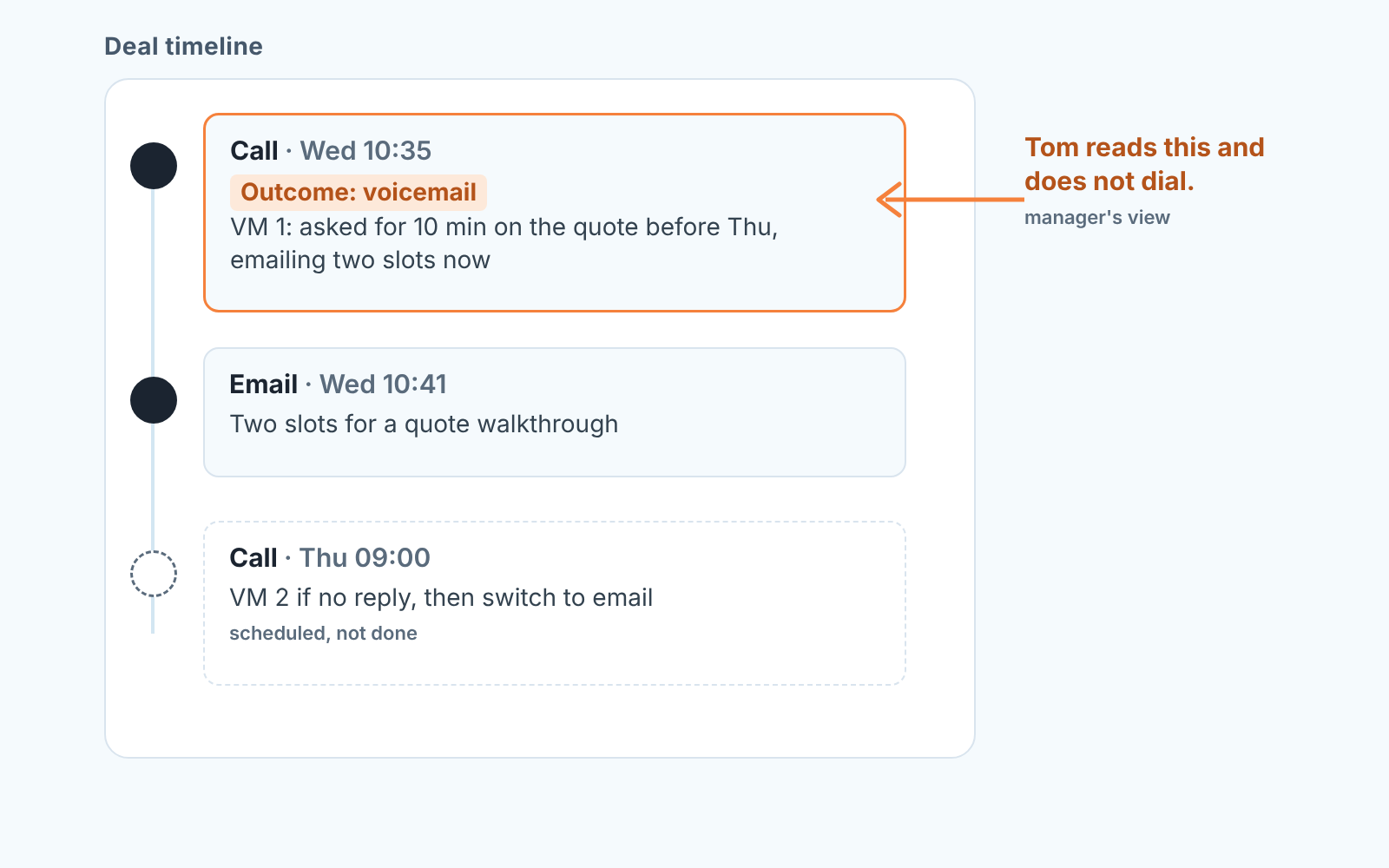
Twenty words. If your team already uses the five-line call note for connected calls, this is the one-line version for calls that did not connect, in the same place.
When to stop dialing: the voicemail follow-up rule
This is our rule, not an industry figure, and we hold it because it survives contact with real weeks.
On an open deal, voicemail on attempt one and voicemail on attempt two mean the third touch is not a call. It is an email that says what the two voicemails said, with the question written down so it can be answered from a phone in a corridor. The next call goes on the calendar two or three days later, and the deal’s next activity reflects that. On a cold contact, Gong’s data makes the case for us: two voicemails, then email, then let the sequence carry it. On a lead, one voicemail and an email in the same hour, and the second call later the same day.
Why switch channel instead of dialing a third time? Because the buyer’s silence is information. Two unanswered calls in a row on an active deal usually mean she is traveling, the decision moved to someone else, or the quote landed badly and she is avoiding the conversation. A third voicemail distinguishes between none of them. A short email with a direct question often does, including the honest “we’re going another way” that frees your week.
The rule also protects the deal from what derailed Dana’s week: once the log says VM 2, nobody adds VM 3 without a conversation. It belongs in the same five minutes where you set the team’s cadence by stage, and it takes one sentence: “Two voicemails, then it’s an email.” For a manager, checking it is just as short. Look for deals with VM 2 in the call note and no email after it; those are the ones where the rule was skipped.
The line is for the next person, not for you
Dana knew what she said on that voicemail. Writing it down was never about her memory. It was about Tom at 11:40, the colleague covering her vacation, and Dana herself in three weeks when she cannot recall whether she offered Thursday or the following Monday.
We build SalesBond, a sales management layer on top of the CRM a team already uses; we started with Pipedrive. Its Sales GPS does not listen to calls and does not know a voicemail happened, so the log line stays your team’s job. What Sales GPS does is prioritize a rep’s deals and customers, explain the reason behind every recommended step, and lay out a ready action plan. Customers that Customer Health marks as overdue, leaving or about to buy appear as cards, and accepting a card creates one task in the CRM. None of it promises that the buyer picks up. If you want to see which deals and customers need attention first, check your CRM with SalesBond.