The B2B sales process moves a deal through six stages: finding a lead, qualifying it, discovering the need, the proposal, negotiation with the buyer’s procurement, and the close with handover to whoever looks after the customer next. In a process that works, every stage has an owner, a condition for leaving it and a time limit. B2B sales itself is one company selling to another, so several people on the buyer’s side decide, the cycle runs weeks to months, and deals are larger and tend to repeat.
The B2B sales process, step by step
Salesforce lists six core elements: lead generation or prospecting, lead qualification, needs assessment, proposal and quote, negotiation, and close (Salesforce). We use nearly the same six, with one change: the last stage is close and handover, because in B2B the deal is not finished when the signature lands. The general version, with how to set up the stages in a CRM, is in sales process steps and CRM stages.
For each stage we answer four questions an owner should be able to answer about their own pipeline: what happens, who owns the deal, what has to be true to leave, and what gets written down.
A rule before the stages. An owner is a named person. If the deal is “with marketing” or “with the technical team”, it has no owner.
Lead
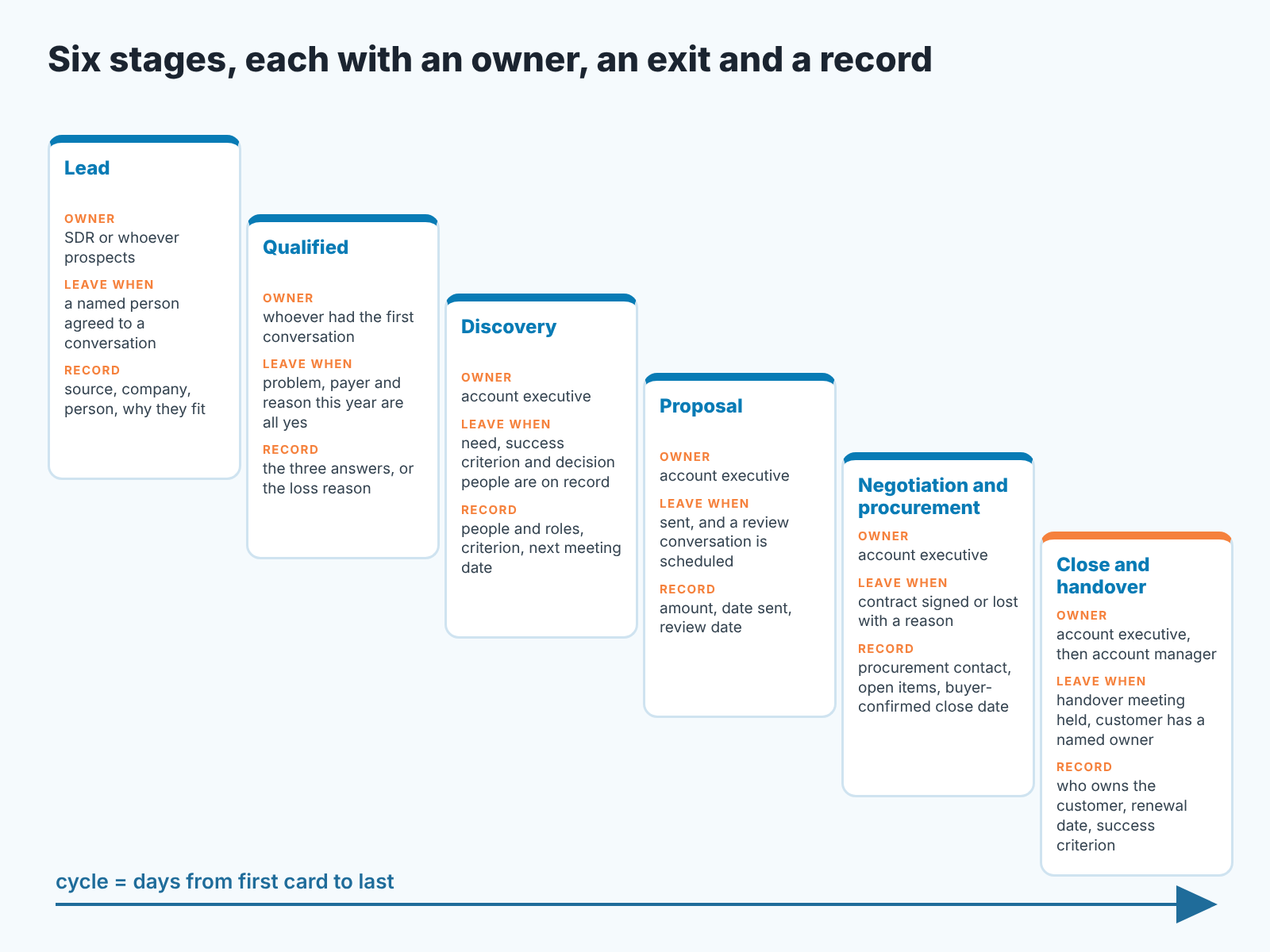
A lead is a company that fits who you sell to, plus a person inside it you can reach. The work at this stage is finding both: inbound (they filled in a form, downloaded a price list) or outbound (you researched them and reached out). The owner is whoever prospects. In a team with an SDR that is the SDR; in a three-person team it is usually the founder on Tuesday mornings.
Leave the stage when a named person at the company has agreed to talk at a set time; a reply to an email does not count. Until then the deal is not a deal and should not be in the pipeline at all; keep it in a lead list or a prospecting stage that the pipeline report excludes.
Record the source, the company, the person and one line on why they fit. That last line is the one teams skip and the one that saves the the most time three months later, when nobody can remember why this logistics firm was ever interesting.
Qualification
Is there a problem we solve, a person who can pay for solving it, and a reason to do it this year? That is the whole stage. The owner is the person who had the first conversation. If an SDR books the meeting and an account executive runs it, the deal changes hands here, and the handover should be visible in the CRM as a change of deal owner.
Leave the stage when all three answers are yes and written down, or when one is no and the deal is marked lost with the reason. Our position: a lost deal at qualification is a good outcome. It costs an hour. The same deal lost after a proposal costs a week of the best seller’s time.
The first conversation is also where many sellers lose the buyer’s attention early, by describing their own company instead of the buyer’s problem. We wrote up how to open that first meeting separately.
Discovery
Discovery is the first proper meeting, where the seller finds out what the buyer actually needs, who else will be involved in the decision and what “it worked” would mean to them. The owner is the account executive, the person who will carry the deal to the close. When the product needs a technical check (a demo on the buyer’s data, a trial, a security review) a presales person joins, but the deal stays with the account executive. Who owns what during that stretch is a separate article: presales in a B2B team: who owns the deal before the quote.
Leave when three things are on the deal record: the need in the buyer’s words, the success criterion in the buyer’s words, and the people who will take part in the decision, each with a role. If the seller cannot name the budget holder, the deal is not ready for a proposal, however warm the meeting felt.
Record the people and their roles, the success criterion and the date of the next meeting. A discovery meeting that ends without a next date is a deal that will go quiet.
Proposal
The seller sends a priced offer. The owner is still the account executive. The common mistake here is to treat “proposal sent” as the exit condition. It is not. A proposal that has been sent and not discussed is a document in someone’s inbox.
Leave when the proposal has been sent and a conversation about it has been scheduled or has happened. Record the amount, the date sent and the date of the review conversation. From this stage on, the amount on the deal should match the proposal. A pipeline where the deal value is still a guess from the lead stage reports a forecast nobody believes.
Negotiation and procurement
This is the stage that makes B2B different, and the one most pipelines we see do not have. After the buyer’s user says yes, the deal goes to the people who did not sit in teh demo: procurement, legal, finance, sometimes IT security. Salesforce’s warning that, unless you sell to a small business with a limited number of decision makers, you will deal with a committee of buyers from IT, legal, procurement and the C-suite describes exactly this stage (Salesforce). The account executive still owns the deal, and usually needs help from a founder or whoever can sign off on contract terms.
Leave when the contract is signed or the deal is lost with a stated reason. Record the procurement contact as a person on the deal, the open items (terms, security questionnaire, payment schedule) and an expected close date that the buyer has confirmed. In our experience, a deal in this stage without a buyer-confirmed date is the most common source of a wrong forecast.
Close and handover
The signature is the exit of the previous stage. This stage is the handover: the account executive passes the customer to whoever will look after them, with the success criterion from discovery and the promises made in negotiation. In a company with an account manager or customer success person, that is a meeting with the customer and a change of owner on the account. In a four-person company it is the founder writing a paragraph to themselves.
Leave when the handover meeting has happened and the account has a named owner for the next twelve months. Record who owns the customer now, the renewal or reorder date if there is one, and the success criterion, copied from the discovery notes so the next person can check it in three months.
Every stage ended with something to write down, and together that is a short set. We keep the list itself, with the field names for each CRM, in a separate piece: five facts to log on every B2B deal.
Who does what: roles in a B2B sales team
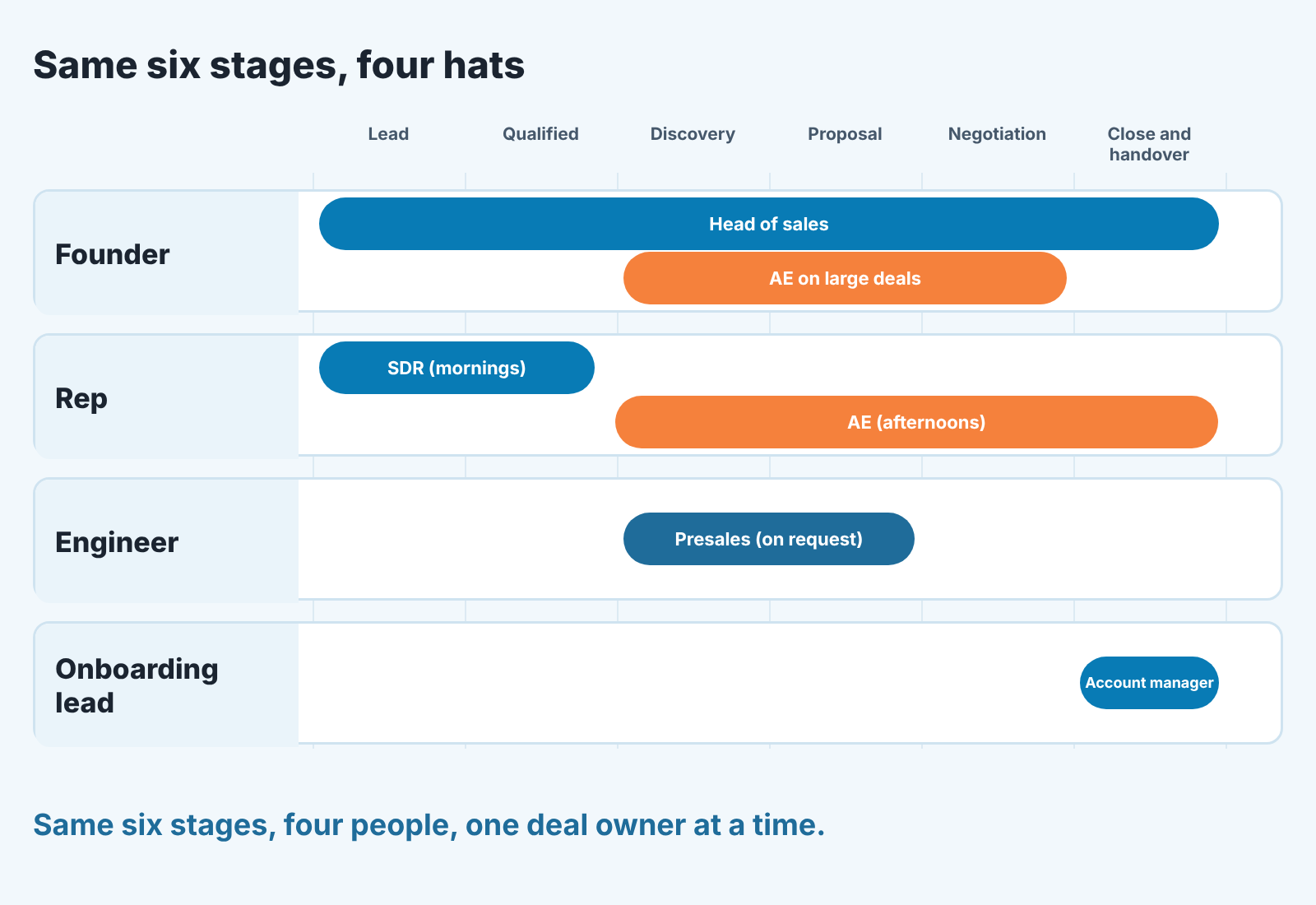
Large sales organisations have a person per role. Small ones have the same roles and fewer people, so one person wears three hats. The roles are worth naming anyway, because a hat is what gets written in the deal owner field, and a deal with no hat on it is the deal nobody works.
The sales development representative (SDR) finds leads and books the first conversation. Their output is a qualified meeting, and the stage they own is Lead, sometimes Qualification. The account executive (AE) takes the deal from qualification to close: discovery, proposal, negotiation. The presales person (sales engineer, solutions consultant, or the engineer who gets pulled in) answers the technical question during discovery and the proposal, without owning the deal. The account manager or customer success manager takes the customer after the close and owns the renewal and the second order. We compared the AE and the account manager in detail, because the titles get swapped constantly: account executive vs account manager: who owns what. The head of sales owns the process itself: the stages, the exit conditions, the weekly review, and the question of why deals sit where they sit.
In a team of three to six here is how we have seen it actually split. The founder is the account executive on the biggest deals and the head of sales for everyone. One rep does SDR work in the morning and AE work in the afternoon. The engineer is presales when asked. The person who runs onboarding is the account manager, whether or not their title says so.
That works, with one condition: the deal owner field changes when the hat changes. If the founder takes over a deal at negotiation, the CRM should say so. Otherwise the rep still sees it in their list, the founder does not see it in theirs, and the deal belongs to a conversation they had in the corridor.
The B2B sales cycle: how long, and where the time goes
Your B2B sales cycle is the number of days from the day a deal entered the pipeline to the day it was won. Every company has its own number. We are deliberately not quoting anyone else’s average, because an average across industries tells an owner nothing about their own pipeline. Their own median, by stage, tells them a lot.
Pull every deal won in the last six months. For each one, find the date it entered each stage: most CRMs keep this as stage history, and if yours does not, start recording it now. Take the median number of days per stage. That gives you a cycle like “4 days in Qualified, 12 in Discovery, 9 in Proposal, 23 in Negotiation”. Now look at the open deals. If a deal has sat in Proposal for 30 days when your won deals spent 9 there, its late by your own numbers.
Where does the time go? In most pipelines we have looked at, it goes to three things: waiting for the buyer to gather their own people, internal approvals on the buyer’s side, and proposal revisions that happen because discovery was too short. The first two are partly outside the seller’s control. The third is entirely inside it. A longer discovery often makes for a shorter cycle, which feels wrong until you have watched a proposal go through four versions.
Two pieces go deeper on this: how long a deal should sit in each stage, and what to do when it is over, and, for a Pipedrive team, how to measure sales cycle length from stage history.
Several buyers, one deal: the buying committee
The B2B buyer is a group. Pipedrive, citing Gartner, says the number of stakeholders in a B2B purchase rises on average to between six and ten (Pipedrive, updated 2026-09-24). Whatever the exact number is in your market, it is more than one, and a deal with one contact on it depends on one person’s calendar, mood and employment.
The practical rule: by the end of discovery, the deal should have at least the user, the budget holder and the person who signs linked to it, each with a role. In Pipedrive that is several people on one deal; in HubSpot it is association labels on the deal’s contacts. How to set up each is covered in multi-threading deals: several contacts per deal in Pipedrive and HubSpot association labels for the buying committee. Without them, a seller’s “I have a great relationship with their ops manager” is a single point of failure.
Where the process breaks
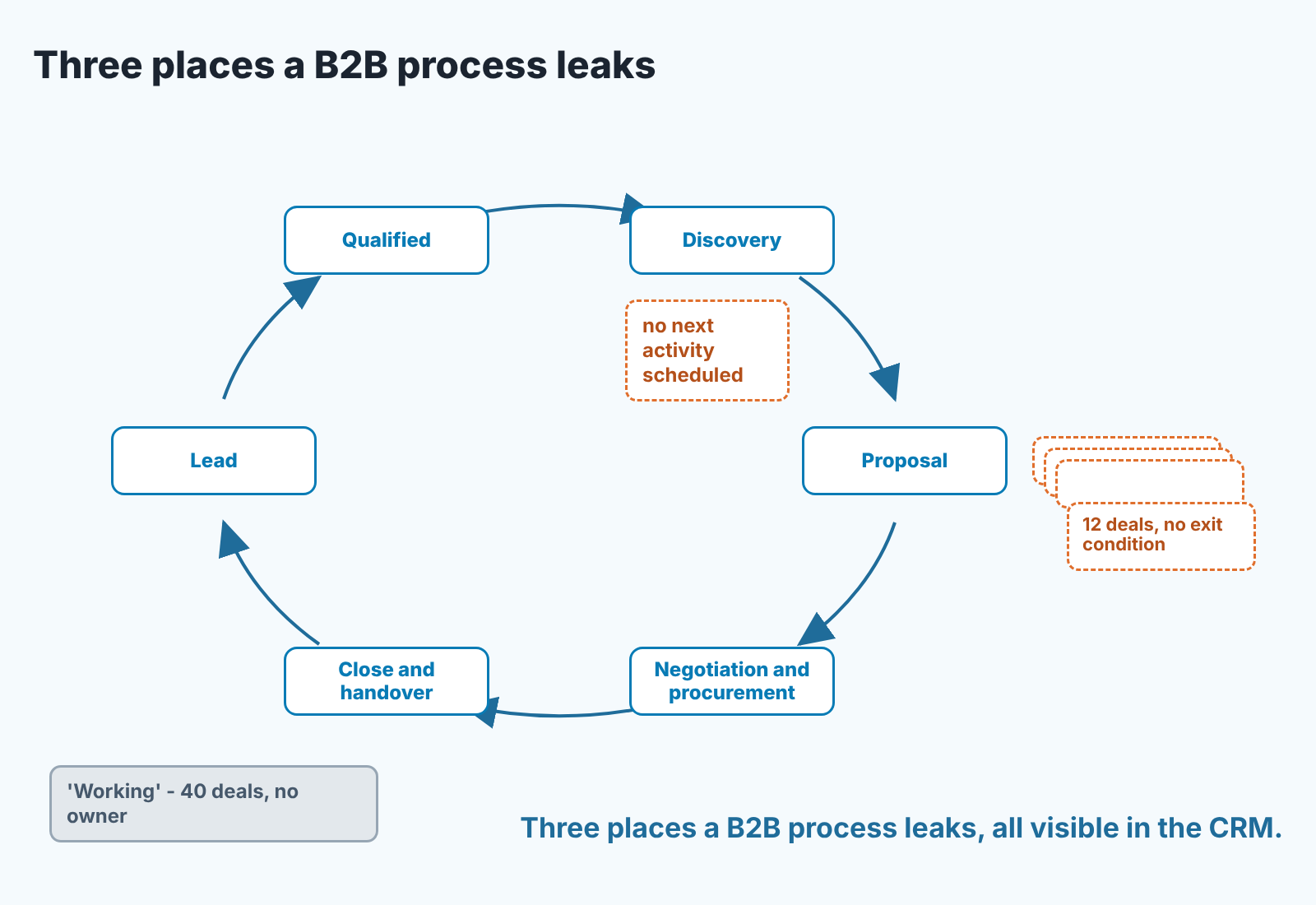
Three places, in our experience, and the CRM shows all of them if someone looks.
The first is the deal with no next step. The last activity was a demo two weeks ago. Nothing is scheduled. The seller will say the buyer is “reviewing internally”, which is sometimes true and always unverifiable. We would fix it with a rule. Every open deal has a next activity with a date, and the Monday review starts with the deals that do not.
The second is the pile-up after the proposal. The pipeline shows twelve deals in Proposal and two in Negotiation. Usually that means the proposal stage has no exit condition and deals are parked there until they rot. Give the stage an exit (“review call held”) and a time limit, and move the deals that fail both back to Discovery or to Lost. Moving a deal back corrects the report.
The third is the stage that was never defined: “Working” or “In progress”, with forty deals and no owner. A stage like that works as a drawer. The full clean-up routine for a B2B pipeline, including what to do with deals that have been open longer than your cycle, is here: B2B pipeline hygiene: the weekly routine.
Five numbers an owner checks monthly
An owner does not need competitors’ benchmarks to run a B2B process. They need five numbers from their own CRM, looked at once a month against the month before. We are not going to say what a good value is for any of them. That depends on what you sell, and a number without your own history behind it is noise.
Pipeline value by stage. The sum of open deal amounts in each stage. It only means something if the amount on the deal is the proposal amount from the Proposal stage onward. Lots of value in early stages and little in late ones is a forecast problem waiting for next quarter.
Stage-to-stage conversion. Of the deals that entered Discovery, what share reached Proposal; of those, what share reached Negotiation; and so on. The stage with the steepest drop is where the process needs the owner’s attention this month. For a Pipedrive team, how to read stage conversion rates walks through the report. The difference between a funnel and a pipeline trips people up here, and it is explained in sales funnel vs pipeline.
Cycle length, as a median of won deals, and the number of open deals already past it.
Average deal size, for won deals in the period. Watch it against the pipeline: if the average won deal is a third of the average open deal, the pipeline is inflated.
Share of revenue from repeat customers, meaning won revenue in the period that came from a customer who had bought before. In B2B this is the number that says whether your process ends at the signature or at the second order.
Pulling these by hand takes an afternoon the first time. We build SalesBond, a sales management layer on top of the CRM a team already uses; we started with Pipedrive. It starts with a free audit of the last 30 days of your CRM: a PDF with the money at risk, a CRM score, the pipeline bottleneck, managers and deal health, repeat customers and the top ten clients. Seven days later a second PDF shows what changed. The bottleneck and the repeat customers sections are the closest to the list above. If the manual pull is what stands between you and a monthly review, check your CRM with SalesBond and start from the report.
After the first deal: repeat business
The reason B2B is worth the long cycle is that the first deal is rarely the last. A customer who bought once and saw the success criterion met will often buy again, renew or expand, and in our experience the second sale takes far less work than the first. That makes the handover stage the most underrated part of the process. It also makes “when did this customer last buy, and are they late?” a question the owner should be able to answer for for every account.
We covered the second and third order as a process of its own, with what the account manager does in the months between: loyal customers in B2B: the second and third order. In SalesBond this is the job of Repeat Sales, which works from each customer’s own buying cycle and flags the ones who are overdue.
What is B2B sales?
B2B stands for business-to-business. Pipedrive’s guide sorts B2B into three broad types: wholesale and distribution (raw materials or retail stock that another business resells), supply (consumables such as office supplies and equipment) and software or services, like the cloud CRM a startup pays for every month (Pipedrive, “What is B2B sales?”, updated 2026-09-24).
The type sets the rhythm. A distributor’s customer reorders every month and rarely needs a demo. A software buyer signs once a year and wants to see the thing working first. The stages apply to all three, and our examples come from software and services, because that is where the most people get involved and the wait is longest.
B2B vs B2C: what really differs
Salesforce’s explainer puts the difference down to chains of approval: closing a B2B deal usually involves touchpoints, presentations, product demos and negotiations with decision-makers, which makes for a long sales cycle (Salesforce, “What is B2B sales?”). Pipedrive’s side-by-side view lists the same differences: long, complex cycles against short or immediate ones, several stakeholders against usually one decision-maker, high transaction value against lower, and a long-term relationship against a purchase that is often transactional (Pipedrive).
Here is the comparison the way we would draw it for an owner, without percentages nobody can verify.
| B2B | B2C | |
|---|---|---|
| Who decides | Several people: the user, the budget holder, often procurement, IT or legal (Salesforce names IT, legal, procurement and the C-suite). | Usually one person, sometimes a household. |
| How long it takes | Weeks to months; each extra participant adds a wait. | Minutes to days. |
| Deal size | Large relative to the buyer’s budget; Salesforce notes that B2B transactions can run into the millions of dollars. | Small; a single purchase rarely needs approval. |
| Repeat purchases | Expected: renewals, reorders, expansions. The first deal is the start of the account. | Possible, but each purchase is a new decision. |
| Channel | A seller, usually a named person who stays with the deal for its whole length. | Shop, website or ad; no personal seller for most purchases. |
Two rows matter more than the rest for a process. The number of people on the buyer’s side is why a B2B deal needs a map of contacts. And the expectation of repeat purchases is why the process does not end at “won”. It ends when the customer buys a second time.
FAQ
What does B2B sales mean?
Business-to-business sales: a company selling a product or service to another company. The buyer is an organisation, so the purchase goes through several people, takes weeks to months and is usually repeated. The process runs through lead, qualification, discovery, proposal, negotiation with procurement, and close with handover, each with an owner and an exit condition.
Is B2B sales difficult?
It is slower and has more moving parts than selling to a consumer, because several people on the buyer’s side have to agree and each one adds a wait. The difficulty is mostly in the process. A team that knows who owns each deal, what has to be true to move it and when it is overdue finds B2B manageable. A team that tracks deals in memory finds it very hard, and blames the market.
How long does a B2B sale take?
Weeks to months, depending on what you sell and how many people the buyer involves. The useful number is your own: the median days per stage across your last six months of won deals. Measure that before you compare yourself to anyone.
What is an example of B2B sales?
A distributor selling stock to shops that resell it, a supplier delivering office supplies and equipment to a company, or a software firm selling a monthly CRM subscription to a startup. These are the three types Pipedrive’s guide describes: wholesale, supply, and software or services. In each case the buyer is an organisation, so more than one person signs off.